








TVL breaks the 100 million USD mark, what else is worth looking forward to after StarkNet's "quantum leap" upgrade?

 Under the expectations of Cancun upgrades and airdrops, let's review the recent developments and major ecological projects of StarkNet.
Written by: flowie, ChainCatcher
Last week, StarkNet v0.12, officially named the "Quantum Leap" version, finally went live on the mainnet. With the successful upgrade of StarkNet v0.12, the community's feedback has been mixed.
On one hand, the time required for successful transactions on StarkNet has been significantly reduced from 10-30 minutes before the upgrade to just a few seconds, with community users exclaiming that StarkNet has transitioned from the "old ox pulling the cart era" to the "flying era"; on the other hand, StarkNet's gas fees are still considerably higher than most layer 2 solutions, with many users facing gas fees exceeding 1 U.
Moreover, the most commonly used wallet in the StarkNet ecosystem, "Flip-Flop" (Argent), encountered severe bugs due to the mainnet upgrade, causing many users to lose their wallets, leading to widespread criticism and doubts about its interaction security.
Despite the numerous complaints, this milestone upgrade has significantly increased StarkNet's TVL. Currently, StarkNet's TVL has surpassed 100 million USD, with an increase of over 43% in just one week, and its ecosystem projects are gradually becoming more active following the upgrade.
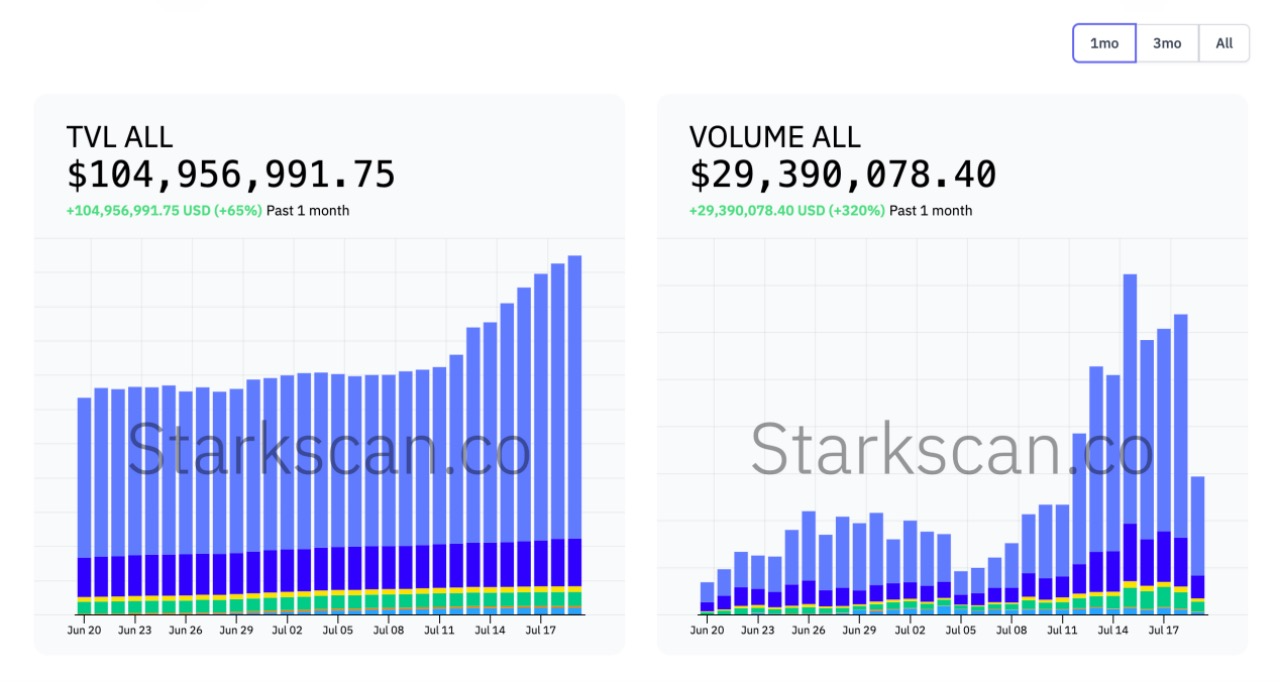
Recently, StarkNet has been quite active; in addition to the network upgrade, it has also officially announced the upcoming launch of application chains. According to the StarkNet roadmap, further upgrades addressing issues such as reducing transaction fees and fee markets will be completed by the end of the year. Coupled with community users' expectations for a token airdrop before the end of the year and the upcoming Cancun upgrade, StarkNet's ecosystem is expected to usher in a new wave of prosperity.
StarkNet's "Quantum Leap", Mixed Reviews
Compared to other star projects in Layer 2, StarkNet has often been criticized for its interaction experience due to transaction times of up to 20 minutes and a high transaction failure rate. The new version of StarkNet, Quantum Leap, aims to address these issues, focusing on significantly increasing throughput and reducing latency. Eli Ben-Sasson, President and Co-founder of StarkNet and StarkWare, stated in a public interview, "Quantum Leap significantly increases the urgently needed block capacity, helping StarkNet far surpass all other L2s."
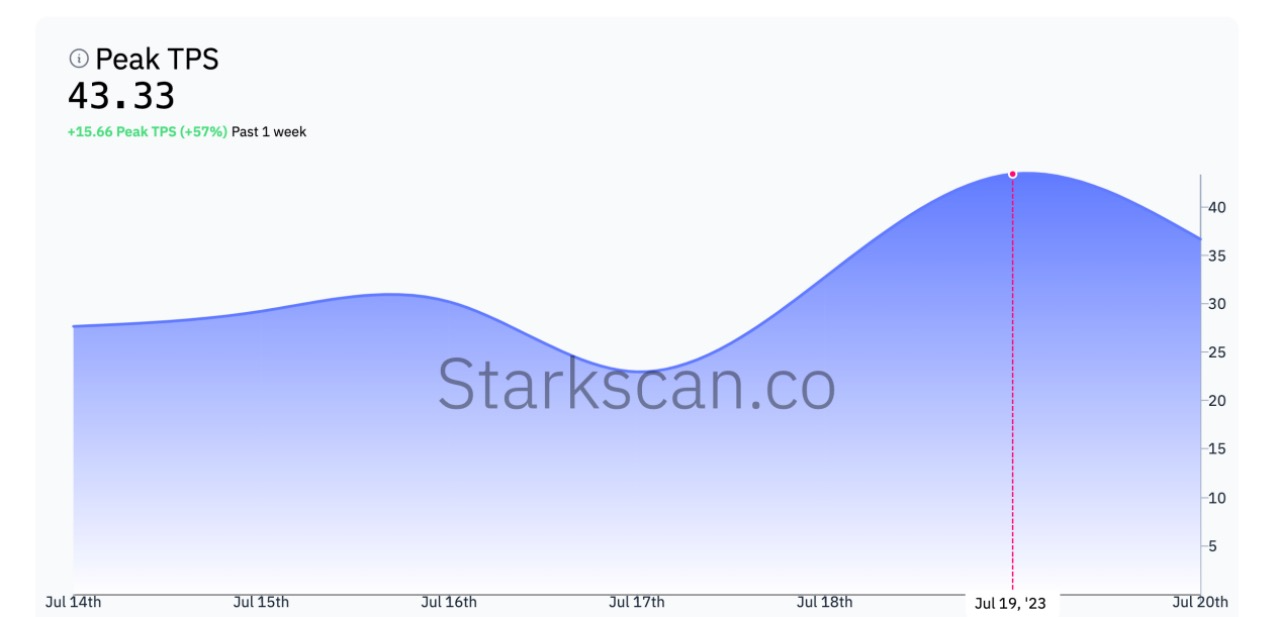
The StarkNet v0.12 upgrade was completed in two phases. The first phase, StarkNet v0.12.0, went live on July 12. After the completion of the first phase upgrade, there have indeed been significant changes in user experience. According to the StarkNet block explorer, the waiting time for a transaction has been reduced from over ten minutes before the upgrade to just seconds, and its TPS has reached an all-time high, processing over 40 transactions per second. 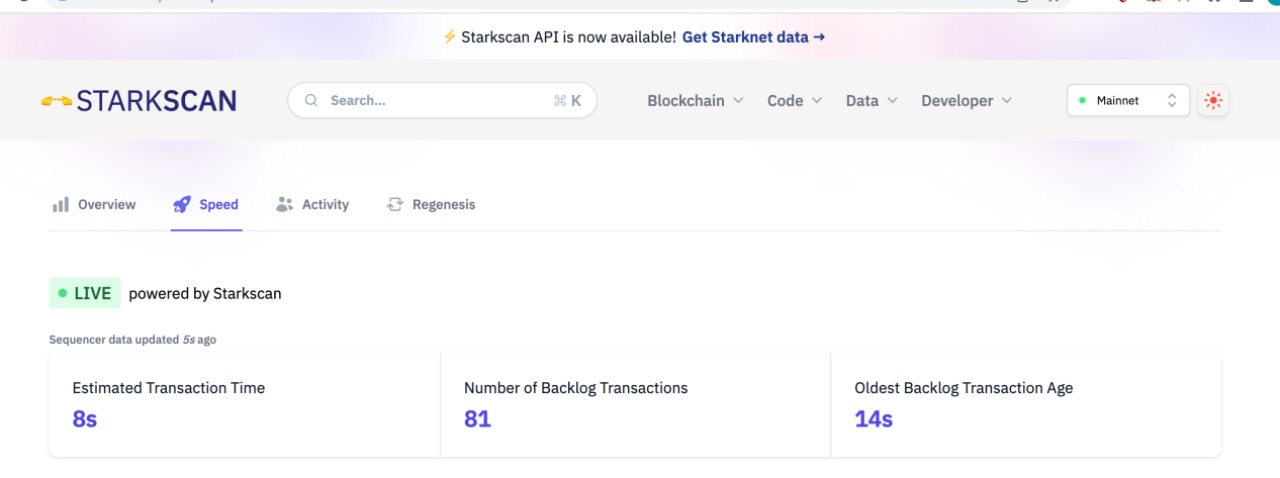
StarkNet has detailed the technical implementations behind the upgrade in its official blog, focusing on improvements to the sequencer and optimizations to the Cairo contract algorithm. According to further explanations from blockchain security practitioner Haotian (Twitter: @tmel0211), in addition to the improvements to the sequencer and optimizations to the Cairo contract algorithm, the key change is the introduction of the "Accepted on L1" timing, which greatly shortens the transaction "success" time. "In other words, users previously had to wait for txs to be successfully verified by L1 before ending the pending state, which took about 20 minutes. Now, as long as a Stark proof is generated on L2, txs are assumed to be successful, taking just a few seconds. However, the corresponding 'Accepted on L1' time has been extended to over 5 hours (as shown below), primarily to ensure the network security of the layered determinism mechanism and to avoid the probability of L1 reorganization."
Despite the significant reduction in transaction waiting times on StarkNet, its TPS and transaction fees still do not have a prominent advantage compared to other layer 2 solutions, and the high transaction failure rate remains largely unmitigated.
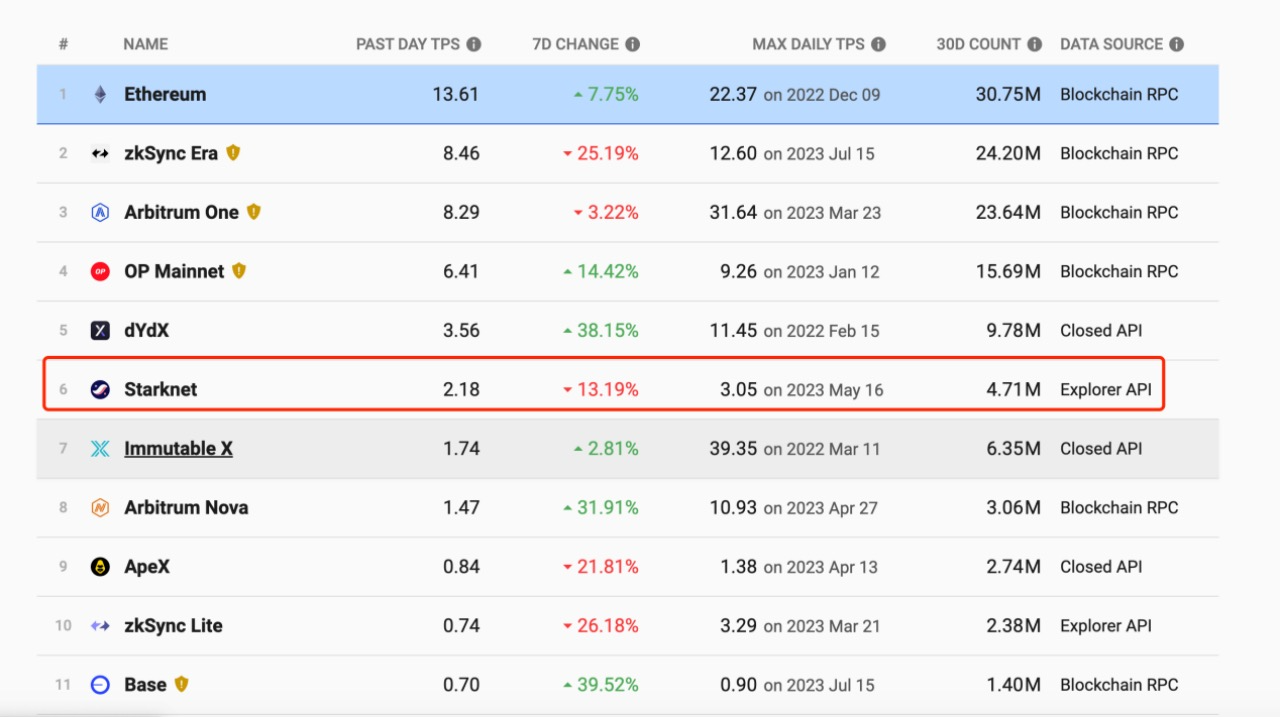
According to l2beat data, StarkNet's average daily TPS is around 2-3, which still shows a considerable gap compared to zkSync Era, Arbitrum One, and OP Mainnet's 10.32, 8.54, and 6.70, respectively.
From the perspective of transaction costs, executing a transaction on StarkNet costs over 0.4 U, making it one of the most expensive networks in Layer 2. Many users in the StarkNet community have reported that their swap gas fees exceed 1 U.
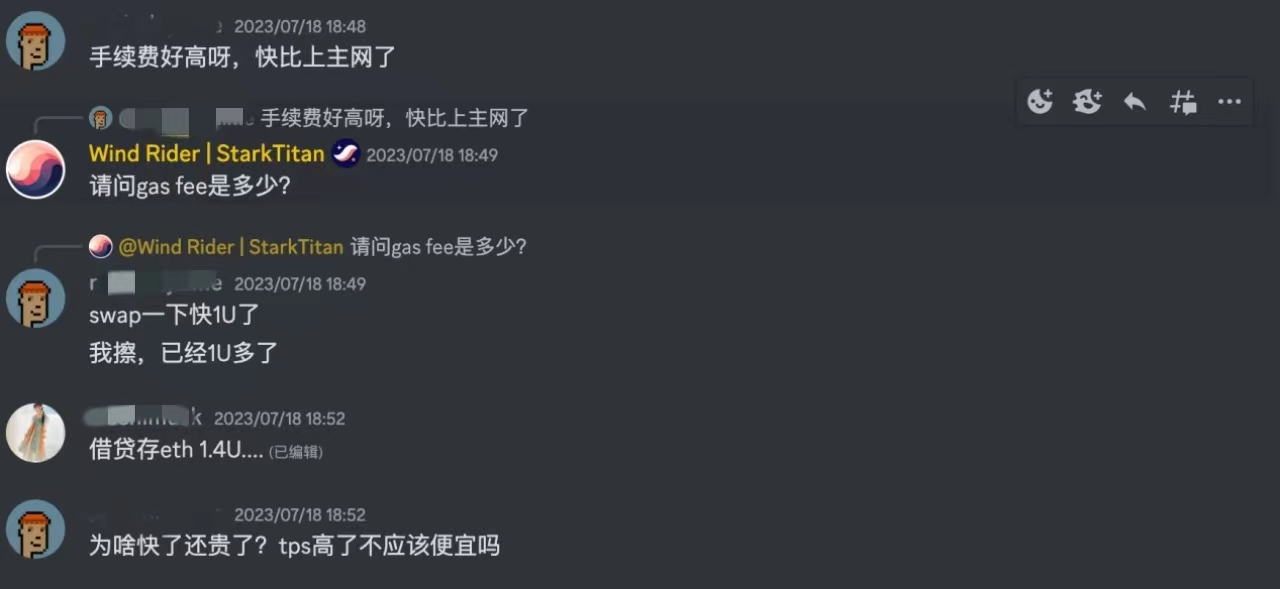 Image source: StarkNet Chinese community
However, it is worth noting that the above data is based on the fact that the StarkNet v0.12 upgrade has not yet been fully completed. Regarding the key TPS of this upgrade, StarkNet also explained on its official website that its full TPS performance is currently limited, and since demand has not yet surged, its network is not yet operating at full capacity. As demand increases, these performance metrics are expected to rise.
The second phase of the StarkNet v0.12 upgrade will occur in the coming weeks, with the next version, 0.12.1, introducing another significant improvement: incorporating failed transactions into blocks and charging fees for failed transactions.
StarkNet explained in its official blog that the reason for this is that when failed transactions are not included in blocks, the sequencer cannot collect fees and increase the nonce, forcing developers to constantly monitor transaction statuses before sending transactions, leading to a poor user experience.
Additionally, including failed transactions in blocks can protect the sequencer from users sending spam transactions to the system without payment. Previously, the sequencer's workload often exceeded 50% on processing transactions that ultimately did not enter blocks, consuming a significant amount of on-chain resources. After this upgrade is completed, it will greatly improve the current network usage situation, and StarkNet's transaction speed and TPS will further increase.
In comparison to the transaction fee issue, a severe bug in the Argent wallet, which has the largest user base in the StarkNet ecosystem, has raised community concerns about the security of using StarkNet.
Many community users have reported that during interactions, the Argent wallet experienced multiple accounts under one mnemonic phrase being reset to zero, and re-importing the mnemonic did not recover the original wallet. Additionally, the transaction failure rate was very high, with dozens of interactions failing to succeed. Before this upgrade, Shen Yu had already tweeted that he discovered a security issue with the Argent plugin wallet leaking user private keys.
Although StarkNet's official team has actively responded to the wallet issues encountered by community users, many users are dissatisfied with StarkNet's statements like "Argent is a third-party dapp, please contact the Argent community for support" and "please DYOR before using," which seem somewhat indifferent. After all, there are only two wallets in the StarkNet ecosystem, and Argent is currently the most widely used wallet.
Regarding the issues users encountered while using the upgraded version of StarkNet, the Argent team stated on July 12 that this issue arose after the Argent X wallet was updated to version 5.5.0, and the team is attempting to fix it, suggesting users try version 5.3.10 as a temporary solution. As of now, the team is still working on the fix and has not proposed any alternative solutions.

The Cancun Upgrade is Coming Soon, What Other Developments in StarkNet are Worth Noting?
The Cancun upgrade, expected to be completed by the end of this year, focuses on addressing transaction costs and speeds for Layer 2, which is a promising benefit for Layer 2 solutions. Recently, major Layer 2 projects have been actively "doing things," seemingly preparing for a potential reshaping of the Layer 2 landscape.
StarkNet has also been quite active recently. In addition to the StarkNet v0.12 upgrade mentioned above, which addresses transaction speed and TPS issues, StarkNet's 2023 roadmap indicates that further upgrades will be completed around reducing gas fees and implementing a fee market.
As mentioned earlier, StarkNet has faced criticism from community users regarding high gas fees, which StarkNet attributes to the fact that L1 (Ether) data costs account for nearly 95% of StarkNet's transaction costs. In StarkNet V0.13.0, the focus will be on significantly reducing gas fees by introducing the Volition model. It is reported that the Volition model will enable developers to build applications using a hybrid data availability (DA) approach on-chain and off-chain. According to the official response from its community, this upgrade is expected to be completed in Q4 of this year, with gas fees projected to decrease by 85% after the upgrade.
After the completion of the V0.13.0 upgrade, StarkNet plans to introduce a fee market in version 0.14.0 to improve transaction congestion issues. Currently, when congestion occurs, everyone's transaction waiting time increases. The fee market will allow users to prioritize their transactions by paying higher gas fees, rather than simply processing transactions in the order they were received.
In addition to upgrades related to network performance, Eli Ben-Sasson, Co-founder of StarkWare, announced at this week's EthCC conference in Paris that StarkNet is about to launch application chains.
According to the StarkNet official documentation on the StarkNet stack, the StarkNet stack allows applications to launch customized StarkNet application chains, which helps prevent congestion on the public StarkNet. Additionally, application chains can freely implement functionalities not supported by public chains, such as their own fee market logic.
Currently, StarkNet has officially announced some progress regarding application chains, having launched the high-performance sequencer Madara, which provides StarkNet with the ability to create customizable and efficient application chains.
It is worth mentioning that the launch of StarkNet application chains is also seen as a step closer to the L3 vision proposed in 2021. StarkWare believes that to achieve higher scalability and lower transaction costs, StarkNet application chains will migrate to L3 and operate on the public StarkNet of L2.
Moreover, StarkNet is also advancing compatibility with Ethereum. StarkNet does not directly support EVM but aims to achieve this through the Kakarot and Warp projects on StarkNet. Kakarot is a zkEVM written in Cairo, StarkNet's programming language. In June of this year, Kakarot secured pre-seed funding from StarkWare and Vitalik Buterin, and is expected to launch its testnet soon.
Under Airdrop Expectations, What Ecosystem Projects are Worth Noting?
After the StarkNet network upgrade significantly improved user experience, its TVL has also surged, leading to intense discussions among community users regarding its token issuance plan.
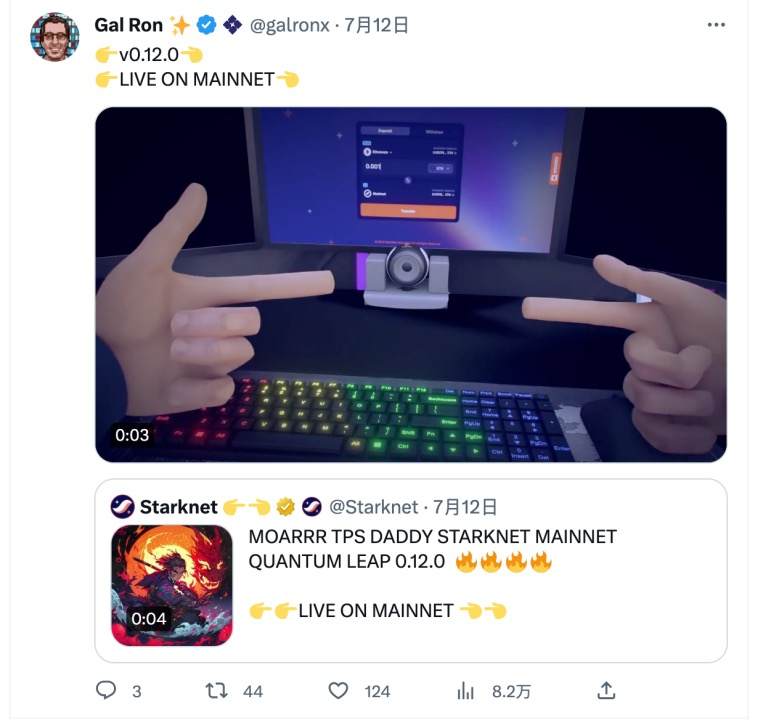
Although StarkNet has not officially announced a specific token issuance timetable, many crypto users speculate that a snapshot has already been taken, indicating that the token and airdrop are not far off. On one hand, StarkNet is expected to launch a fee market in Q4 of this year, and many speculate that the introduction of the fee market means the full launch of the StarkNet token $STRK. On the other hand, the frequent use of gold finger emojis in StarkNet's official tweets, along with a video containing a camera lens shared by the StarkNet product manager in a tweet about the StarkNet upgrade, has also been interpreted as a hint of an impending snapshot.
Last June, StarkNet announced its token economic model and stated that it would issue tokens in September, but this was ultimately delayed due to technical reasons. However, the token contract was deployed on Ethereum last November. StarkNet stated that it has minted 10 billion tokens off-chain, and according to the token distribution plan announced last year:
17% ------StarkWare investors;
32.9% --- Core contributors: StarkWare and its employees and advisors, as well as StarkNet software development partners;
StarkWare grants 50.1% to the foundation, with the following designated purposes:
9% ------Community provisions: allocated to those who work for StarkNet and support or develop its underlying technology, such as past users of the StarkEx L2 system. Importantly, all community provisions will be based on verifiable work performed in the past. For example, within the scope of providing community provisions to past users of StarkEx, allocations will be determined based on verifiable usage of StarkEx technology before June 1, 2022.
9% ------Community rebates: refunds of StarkNet tokens to partially cover the costs of joining StarkNet from Ethereum. To prevent gaming, community rebates only apply to transactions that occur after the rebate mechanism is announced.
12% ------Funding for research and work to develop, test, deploy, and maintain the StarkNet protocol.
10% --- Strategic reserve: used to fund ecosystem activities that align with the foundation's mission.
2% ------Donations to reputable institutions and organizations, such as universities and NGOs, decided by StarkNet token holders and the foundation.
8.1% Unallocated: unallocated funds from the foundation will further support the StarkNet community, with specific methods determined by the community.
With the StarkNet airdrop snapshot not yet confirmed, community users are increasingly enthusiastic about interacting with ecosystem projects following the significant improvement in user experience.
Currently, there are a total of 79 ecosystem projects according to the official statistics from ++StarkNet++ ++official statistics++, and compared to other leading Layer 2 solutions, most ecosystem projects are still in the early stages, with not many leading projects. This article filters some representative projects across various tracks in its ecosystem based on their TVL, financing, and token performance.
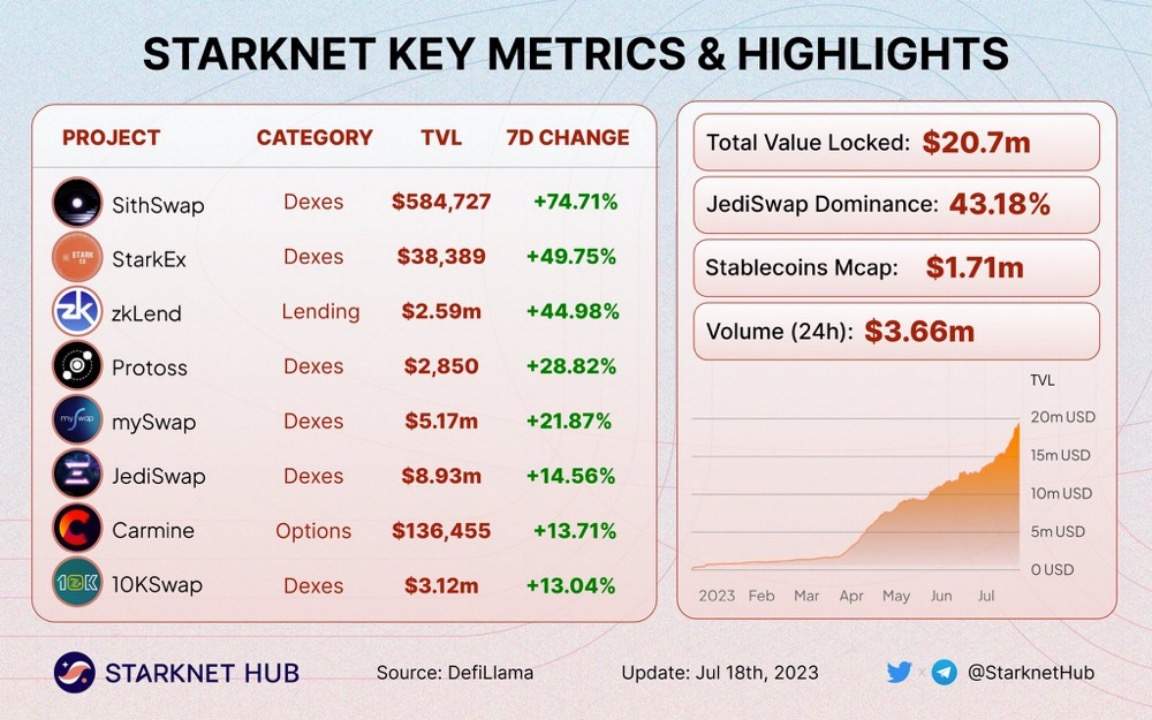
According to statistics from @StarkNet Hub on July 18, the TVL of its ecosystem projects has seen a significant increase over the past week, with SithSwap, StarkEx, and zkLend's TVL rising over 40%.
Infrastructure
Argent is the first non-custodial crypto wallet supporting StarkNet and is the most widely used wallet in the StarkNet ecosystem. It combines easy access to Dapps with security features such as recovery without a mnemonic, trusted contacts, and multi-signature. Argent has raised nearly 60 million USD in funding, with notable investors including Paradigm, StarkWare, Jump Crypto, and Animoca Brands. However, as mentioned earlier, Argent still faces significant issues regarding security, stability, and user experience.
Braavos is a smart contract-based wallet for managing funds and NFTs and connecting to dApps on StarkNet. Braavos is the second supported wallet in the StarkNet ecosystem besides Argent. In October last year, Braavos completed a 10 million USD funding round, with investors including Pantera Capital, Brevan Howard Digital, StarkWare, Crypto.com Capital, and Matrixport Ventures.
DEX
JediSwap is a fully permissionless and composable AMM protocol on StarkNet inspired by Uniswap V2. Users can trade assets instantly without losing custody of their funds, and JediSwap is led by the Mesh community. JediSwap currently has a TVL exceeding 9 million USD, making it the top project in the StarkNet ecosystem by TVL.
10KSwap is an AMM deployed on StarkNet. 10K aims to revolutionize the performance of AMM protocols by leveraging rollup capabilities, bringing lower fees, less friction, and ultimately better liquidity to the L2 world, driving the adoption of DeFi. Currently, 10KSwap's TVL exceeds 3.6 million USD, ranking second in the StarkNet ecosystem.
++SithSwap++(SITH)
SithSwap is a DEX with low fees and slippage, which went live on the StarkNet mainnet at the end of March. In terms of funding, SithSwap completed a 2.65 million USD seed round in June last year, led by Lemniscap, with participation from Big Brain Holdings, GSR, and others. SithSwap currently has a TVL exceeding 620,000 USD.
AVNU is also a decentralized exchange that optimizes trade execution and minimizes slippage by searching for the best trading routes across multiple DEXs. Additionally, its Request for Quote (RFQ) system integrates liquidity from market makers, optimizes price discovery, eliminates slippage, and provides MEV protection.
Lending
zkLend launched its testnet at the end of 2022 and officially went live on the mainnet in May this year. In terms of funding, zkLend completed a 5 million USD seed round in March 2022, led by Delphi Digital, with participation from StarkWare, Three Arrows Capital, Alameda Research, Amber Group, GBV Capital, and MetaCartel Ventures. Currently, zkLend's TVL exceeds 2.7 million USD, making it the top project in the lending sector of the StarkNet ecosystem by TVL.
Nostra allows users to lend, mint, and trade within DeFi applications. The Nostra liquidity layer consists of the Nostra money market, UNO (StarkNet's native stablecoin), and Nostra Swap (Stablecoin DEX). Nostra went live on the mainnet at the end of last year, and its TVL currently exceeds 130,000 USD. The founder of Nostra, David Garai, has also founded the lending protocol Tempus and the LSD stablecoin protocol Raft within the StarkNet ecosystem. Nostra's investors include GSR, Jump Crypto, and Wintermute.
++Hashstack++
Hashstack is a low-collateral lending protocol dedicated to providing cost-effective and capital-efficient lending solutions using zk technology. According to its official claims, Hashstack's user collateral loan rates exceed those of Aave, Compound, and MakerDAO by over 300%. Recently, Hashstack announced the launch of its Hashstack v1 public testnet, which can provide users with over-collateralized loans of 500%. In March 2022, Hashstack secured 1 million USD in seed funding from investors including Moonrock Capital and Ghaf Capital Partners.
GameFi/NFT/Metaverse
Realms is a large multiplayer on-chain game, originally a Loot derivative project. At the end of July this year, the first playable version, LootSurvivor, was opened to players on the StarkNet mainnet. Currently, the native token of LootRealms, Lords, has been bridged to StarkNet, and users can purchase this token on the decentralized trading platform JediSwap on StarkNet. In February of this year, Realms completed a 630,000 USD public funding round.
Topology is an on-chain reality project focused on implementing the underlying "rule layer" in fully autonomous worlds, inspired by "The Wandering Earth" (2000), "The Three-Body Problem," and "Factorio." The Topology team has already developed three games.
Influence is a large-scale multiplayer online game with an open economic space strategy, where players can colonize asteroids, build infrastructure, discover technologies, and engage in battles. Influence went live on StarkNet in August last year.
++Dope Wars++(PAPER)
Dope Wars is a hip-hop pixel-style strategy game. Its distribution model is similar to Loot, with each NFT randomly equipped with different items. Dope Wars has released its first playable mode and developed its visual Marketplace.
Shareverse is a 3D gallery NFT market similar to Decentraland, establishing a community-driven NFT functional component market and supporting users in building a composable, interoperable, and shareable metaverse LEGO ecosystem using easily accessible components.
Aspect is the first native NFT market on StarkNet, formerly known as PlayOasis, which went live on the mainnet last August. In May last year, it received investment from [Builder Capital](https://www.rootdata.com/zh/Investors/detail/Builder Capital?k=MTA4Njg=).
 Risk warning
 Risk warning


Popular articles





