








Gryphsis Academy: Metis Valuation Outlook

 Metis, as the first Ethereum Rollup to adopt a decentralized sequencer, occupies a unique position in the competitive Layer 2 space with its distinctive value proposition, multiple bullish catalysts, and competitive valuation.
Written by: @BC 082559
Mentor: @CryptoScott_ETH
1. TL;DR
- Metis, as the first Ethereum Rollup to adopt a decentralized sequencer, occupies a unique position in the competitive Layer 2 space with its unique value proposition, multiple bullish catalysts, and competitive valuation.
- In the medium to long term, Metis is expected to experience significant growth due to four main bullish factors: the implementation of the Cancun upgrade, the introduction of spot Ethereum ETFs, the launch of the sequencer pool, and ecosystem expansion driven by the Metis Ecosystem Development Fund.
- To explore the reasonable valuation of $METIS, we constructed a valuation model based on comparative analysis, considering factors such as total locked value, the number of stablecoins, and DEX trading volume. The results indicate a potential price range for $METIS of $188.17 to $258.29, suggesting that $METIS could grow 2 to 2.9 times from its current market price.
- Looking ahead, Metis demonstrates considerable growth potential. The upcoming launch of its sequencer pool is expected to introduce a new narrative of liquid staking and restaking within its ecosystem, potentially catalyzing new capital inflows. At the same time, the Metis EDF is expected to help narrow the gap in ecosystem robustness compared to industry leaders like Arbitrum and Optimism.
2. Introduction
Since the fourth quarter of 2023, the crypto market has experienced a significant recovery, with various narratives regaining momentum and related tokens showing strong performance. While Bitcoin-related narratives such as spot ETFs and BRC-20/Ordinals have been the main drivers of the recent market, the enthusiasm for these narratives seems to be waning as Bitcoin inscription activity slows and Bitcoin itself enters a correction phase. This shift in market sentiment provides us with an excellent opportunity to identify new narratives that may trend in the future. In this context, Metis has caught our attention with its unique value proposition, multiple bullish factors, and competitive valuation compared to other Layer 2 (L2) tokens.
In our previous report, "Metis Breaks into the Top Five Layer 2s --- Unveiling the Secrets Behind Its Disruptive Decentralized Strategy," we conducted a comprehensive analysis of Metis, exploring its technical features and recent developments from a fundamental perspective. This report shifts to examining Metis from an investment standpoint. The report first briefly reviews Metis and its main bullish factors. Next, we will explore Metis's valuation through comparative analysis and assess its potential in the current market. Finally, we will provide insights into Metis's future prospects and discuss strategies for investing in $METIS.
3. Overview of Metis
Launched in May 2021, Metis is an Ethereum Layer 2 (L2) scaling solution aimed at optimizing decentralized applications (dApps) and user experience. Metis's three core features include a decentralized sequencer, hybrid Rollup technology, and multifunctional token applications, allowing it to stand out among numerous projects. The current challenge facing major Ethereum Rollup technologies is the over-reliance on centralized sequencers, which not only contradicts the fundamental principles of blockchain and cryptocurrency but also poses a single point of failure risk. While networks like Arbitrum and Optimism are developing anti-fraud and verification systems to enhance decentralization, substantial progress in sequencer decentralization has yet to be realized. This issue relates not only to network control and revenue concentration but also poses risks to the entire network and the crypto space in the event of an attack on centralized sequencers.
In contrast, Metis is at the forefront of decentralizing its sequencer, a breakthrough that not only enhances security but also demonstrates Metis's commitment to a community-oriented model. The decentralized sequencer not only increases the network's resilience but also facilitates a fairer distribution of sequencer revenue among users. This represents a significant step for Metis in aligning network operations with the decentralization principles of the cryptocurrency ecosystem.
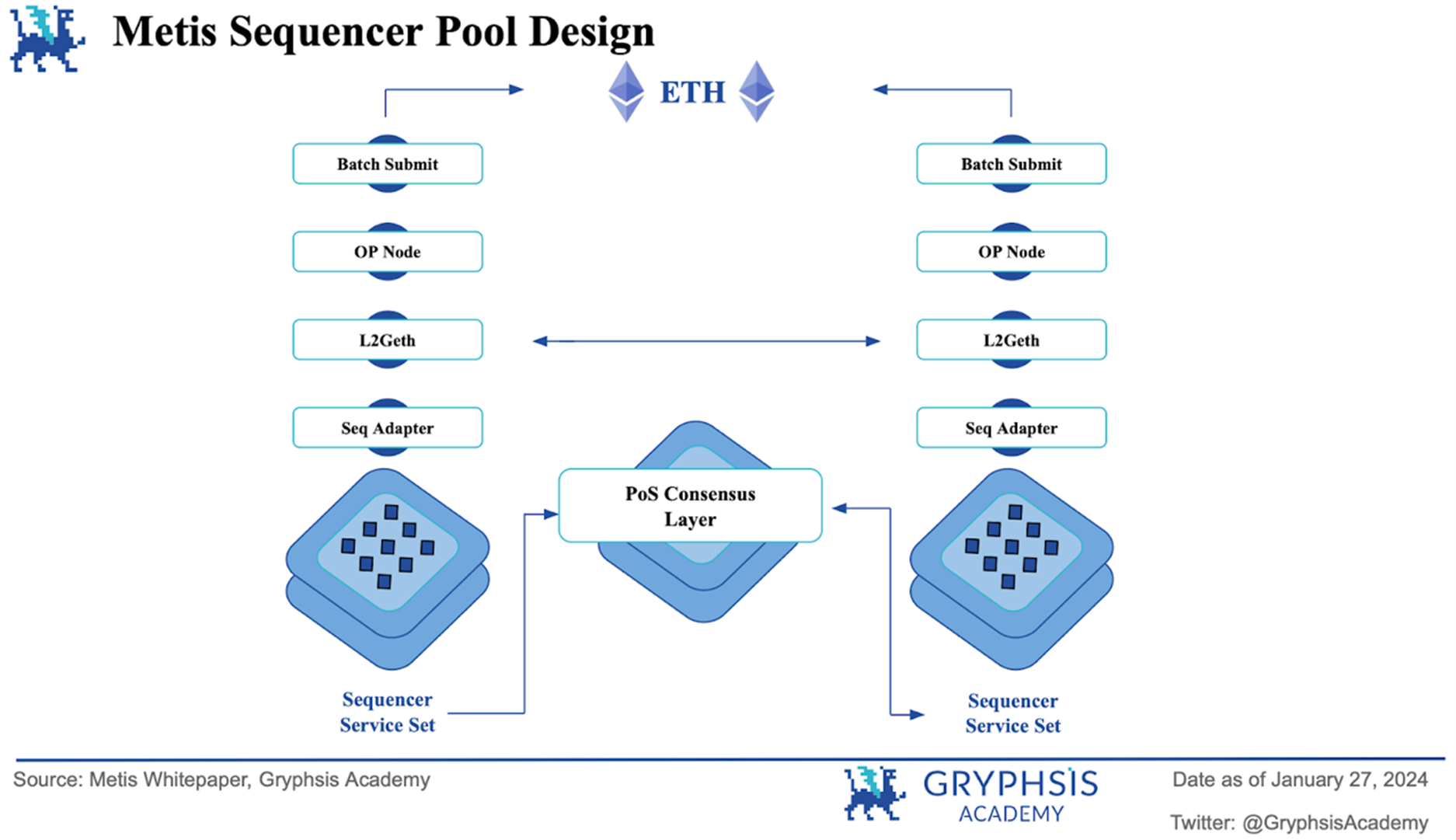
The Hybrid Rollup technology introduced by Metis in March 2023 combines the Optimistic Rollup framework with zero-knowledge proofs, making it a top priority for Metis development. This hybrid solution aims to leverage the scalability advantages of Optimistic Rollups while incorporating the inherent security and verification characteristics of ZK Rollups.
In the realm of Rollup technology, confirmation time and finality time are two key metrics. Current optimistic rollups, while fast in confirmation speed, have a long finality time due to a challenge window of up to 7 days. In contrast, zero-knowledge proofs can almost instantly verify the authenticity of transactions once the prover generates the proof and the verifier confirms it. Therefore, the combination of these two technologies is expected to significantly enhance Ethereum's scalability.
Once the hybrid Rollup technology is successfully implemented on Metis, it will bring several significant improvements. The most notable improvement is the acceleration of transaction finality, reducing the waiting time from 7 days to just 4 hours. Additionally, the introduction of zk proofs will greatly enhance transaction security. At the same time, the efficient data management capabilities of zk proofs ensure that each transaction contains only the necessary data, further improving the network's processing capacity.

The native token $METIS stands out among many second-layer tokens like $ARB and $OP due to its diverse application functions. While $ARB and $OP primarily serve as governance tokens, $METIS extends beyond this, encompassing uses in proof-of-stake (PoS) staking and network gas fees. As a dual-purpose token for staking and gas fees, $METIS endows itself with intrinsic value. With the continuous expansion of the Metis network and increased applications, the demand for $METIS is also growing, primarily due to its practical application value in network operations. In governance, while the decentralized ethos often emphasizes governance as an important function of tokens, the opportunity for profit-driven crypto investors to earn additional income through staking may be more attractive. Thus, the multifunctionality of $METIS adds significant appeal, making it stand out among numerous second-layer tokens.
For more detailed information about Metis's technical architecture, please refer to our previous report.
4. Bullish Catalysts
4.1 Cancun Upgrade
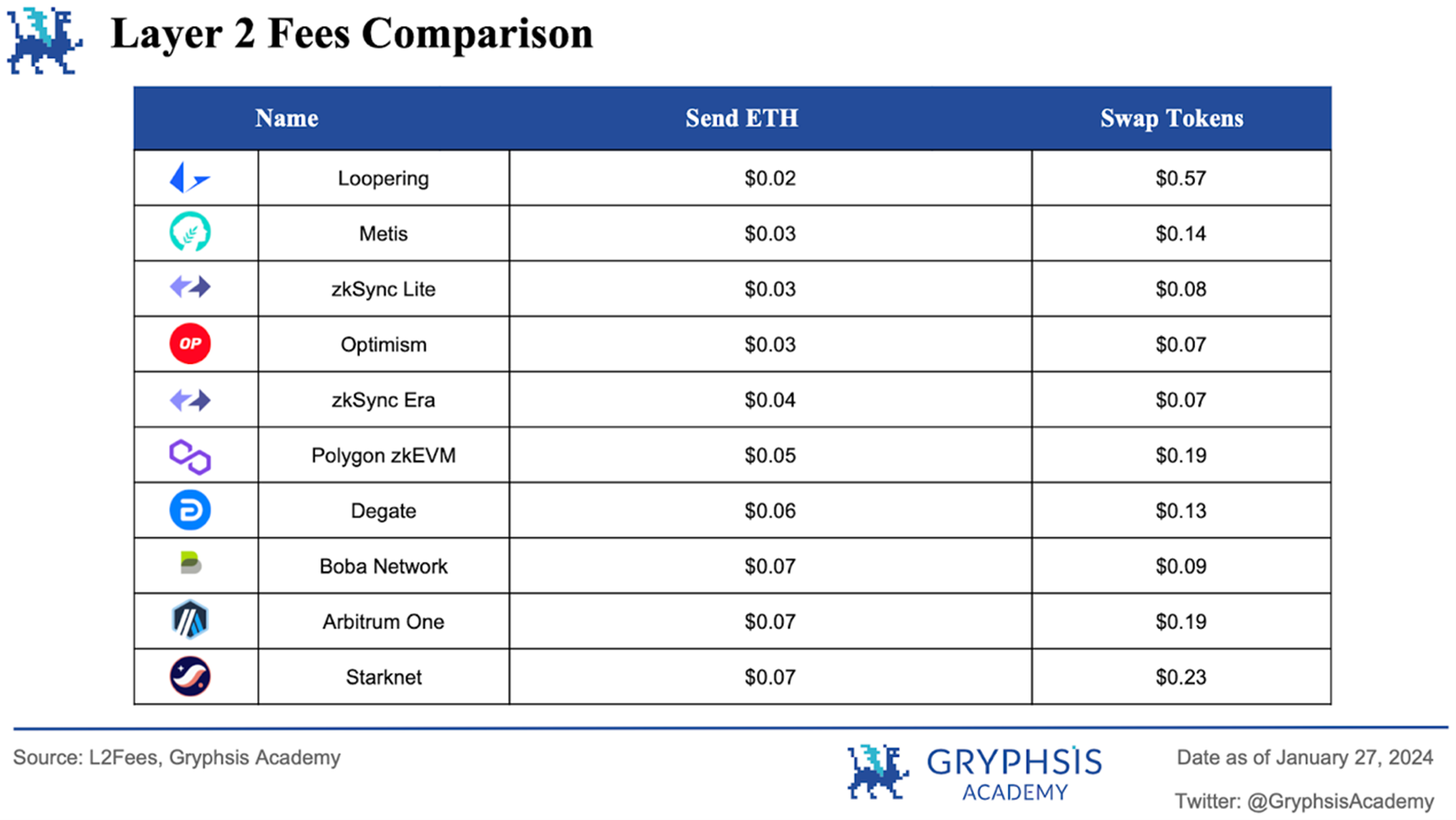
For the Ethereum network, the upcoming Cancun upgrade expected this year will be a significant advancement, with EIP-4844 being its most notable feature. The goal of this upgrade is to dramatically reduce Layer 2 (L2) solution fees by introducing a new transaction type called "Blobs." Current estimates suggest that Blobs could cut L2 fees by up to 90%. Such a significant reduction in fees is expected to boost network activity on L2 platforms, including Metis.
Data on L2 fees shows that Metis is already the second most cost-effective option for transferring $ETH and the third lowest-cost option for token swaps. Following the implementation of the Cancun upgrade, Metis's fee advantages may be further enhanced, potentially driving growth in its network activity.
 Additionally, major upgrades like Cancun often trigger speculative behavior in the market, particularly around $ETH and ETH Beta tokens. Market participants tend to engage actively in speculative activities leading up to significant updates. As a major Ethereum L2 token, $METIS may see inflows of speculative capital as the Cancun upgrade approaches, leading to increased trading activity and heightened interest in the token.
4.2 Spot Ethereum ETFs
Discussions surrounding spot Ethereum ETFs are gaining increasing attention. Following the approval of Bitcoin spot ETFs, it is reasonable to expect that Ethereum may be the next asset to receive similar regulatory recognition. The potential approval of spot Ethereum ETFs not only symbolizes government endorsement and reputation enhancement but could also attract significant capital inflows, driving up its price.
Although Ethereum differs from Bitcoin, which may complicate its approval process, market speculation during each news release and approaching deadline could lead to multiple fluctuations. This phenomenon has already occurred with Bitcoin and is likely to happen with Ethereum, especially in the context of other narratives surrounding Ethereum, such as the Cancun upgrade. While the approval of Bitcoin spot ETFs seems to be a "sell the news" event, as Bitcoin is currently in a correction phase, the launch of spot ETFs provides the public with an unprecedented convenient entry into the Bitcoin market, bringing long-term benefits.
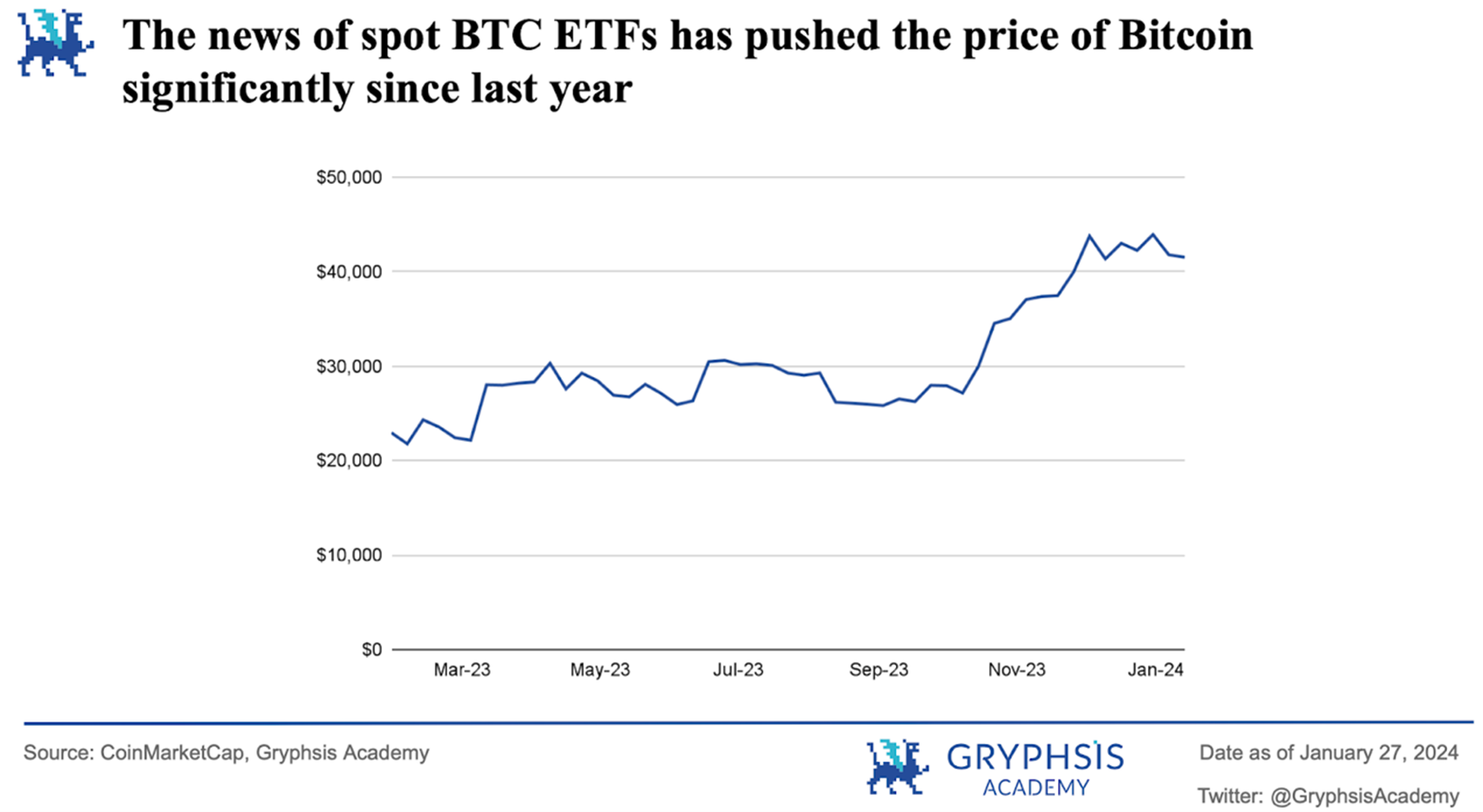
Therefore, particularly Ethereum second-layer tokens like $METIS, which have strong value propositions, will benefit significantly. As Ethereum's price rises, its related second-layer tokens, often referred to as "ETH Beta," may see larger gains due to their smaller market capitalizations. With its unique characteristics and solid value proposition, Metis has the potential to outperform its peers in this market trend.
4.3 Sequencer Pool and Liquid Staking/Restaking Narrative
Metis's decentralized sequencer, as one of its core value propositions, is a major driving force behind recent market attention. Currently, the sequencer pool is undergoing the first phase of community testing in three stages. During this phase, users are experiencing Metis's dApps through the Sepolia testnet, while developers are stress-testing and optimizing the sequencer pool in preparation for its official launch. This community testing phase is a crucial indicator of the sequencer pool's development, signaling its imminent launch. A successful deployment is expected to have a positive impact on the price of $METIS, as major protocol upgrades often act as catalysts in the crypto market. Moreover, due to market efficiency issues, prices typically continue to rise for some time after such announcements.
The launch of the sequencer pool also means that liquid staking/restaking will be introduced into the Metis ecosystem, which has already gained significant attention in the DeFi space, as evidenced by the growth of the Ethereum liquid staking ecosystem over the past year. Liquid staking offers numerous possibilities, such as lending protocols and collateral debt positions based on $stMETIS, or utilizing various forms of restaking protocols for staked $METIS tokens.

These applications could significantly increase the total locked value (TVL) of the Metis network and enhance demand for $METIS, potentially creating a virtuous cycle of growth. Even if Metis's liquid staking ecosystem does not reach the scale of Ethereum, achieving even a small portion of that growth indicates tremendous potential. Once liquid staking within the Metis ecosystem begins to attract attention, $METIS may experience supply shocks.
4.4 Upcoming Ecosystem Growth
When assessing the intrinsic value of L2 tokens, it is crucial to consider the range of economic activities supported by the network, as it reflects the usage and adoption of the network itself. Therefore, events that stimulate economic activity within the L2 network ecosystem can be viewed as bullish factors for its native tokens.
In December 2023, Metis launched the Metis Ecosystem Development Fund (Metis EDF), a significant initiative that allocates 4.6 million $METIS to promote the development, liquidity, activity, and broader adoption of the Metis ecosystem. The majority of the fund is used to incentivize sequencer staking, with about 35% allocated for ecosystem development. Similar initiatives, such as Arbitrum's STIP and Optimism's RetroPGF, have positively impacted their ecosystems. Considering that the protocols within Metis are generally smaller in scale, and smaller market cap tokens often provide higher percentage returns, the Metis EDF is expected to have a significant impact, attracting yield-seeking users to the Metis ecosystem in search of substantial gains.
Developers play a key role in the growth of the network ecosystem. Even a single popular dApp can significantly boost the chain's TVL; for example, GMX on Arbitrum. On January 8, WAGMI announced its deployment on Metis. WAGMI, developed by renowned developer Daniele Sestagalli, has attracted billions of dollars in TVL in ecosystems like Avalanche and Fantom, and its move to Metis is seen as a positive development. While it may be premature to claim that WAGMI will replicate Daniele's past successes, this deployment undoubtedly adds positive factors to Metis's growth trajectory, demonstrating developers' recognition of the network's growth potential. Additionally, the Metis community is utilizing a platform called Candidac for project approvals to initiate new projects. Currently, there are over 30 projects in Candidac's approval queue, highlighting the growing interest in the Metis ecosystem. This also proves the confidence of builders in Metis's potential and capabilities.
5. $METIS Valuation
To delve into the reasonable valuation of $METIS, we developed a valuation model based on comparative analysis. This model assesses $METIS's relative position in the Layer 2 (L2) space by selecting specific metrics. The goal of the model is to estimate the potential price range for $METIS, assuming it reaches industry average or median levels. Additionally, considering the impact of bullish and bearish factors on token prices, the model incorporates various discounts and premiums in its calculations.
Our analysis began by collecting market data from various L2 networks. This data includes price, market capitalization, fully diluted valuation, total locked value (TVL), the number of stablecoins on each network, and 30-day decentralized exchange (DEX) trading volume, among other key metrics. Based on this data, we calculated three ratios: FDV/TVL, FDV/Stables, and FDV/Volume. We selected TVL, stablecoins, and DEX trading volume as key metrics because they reflect the robustness of an L2 network and the economic health and activity of the L2 network.
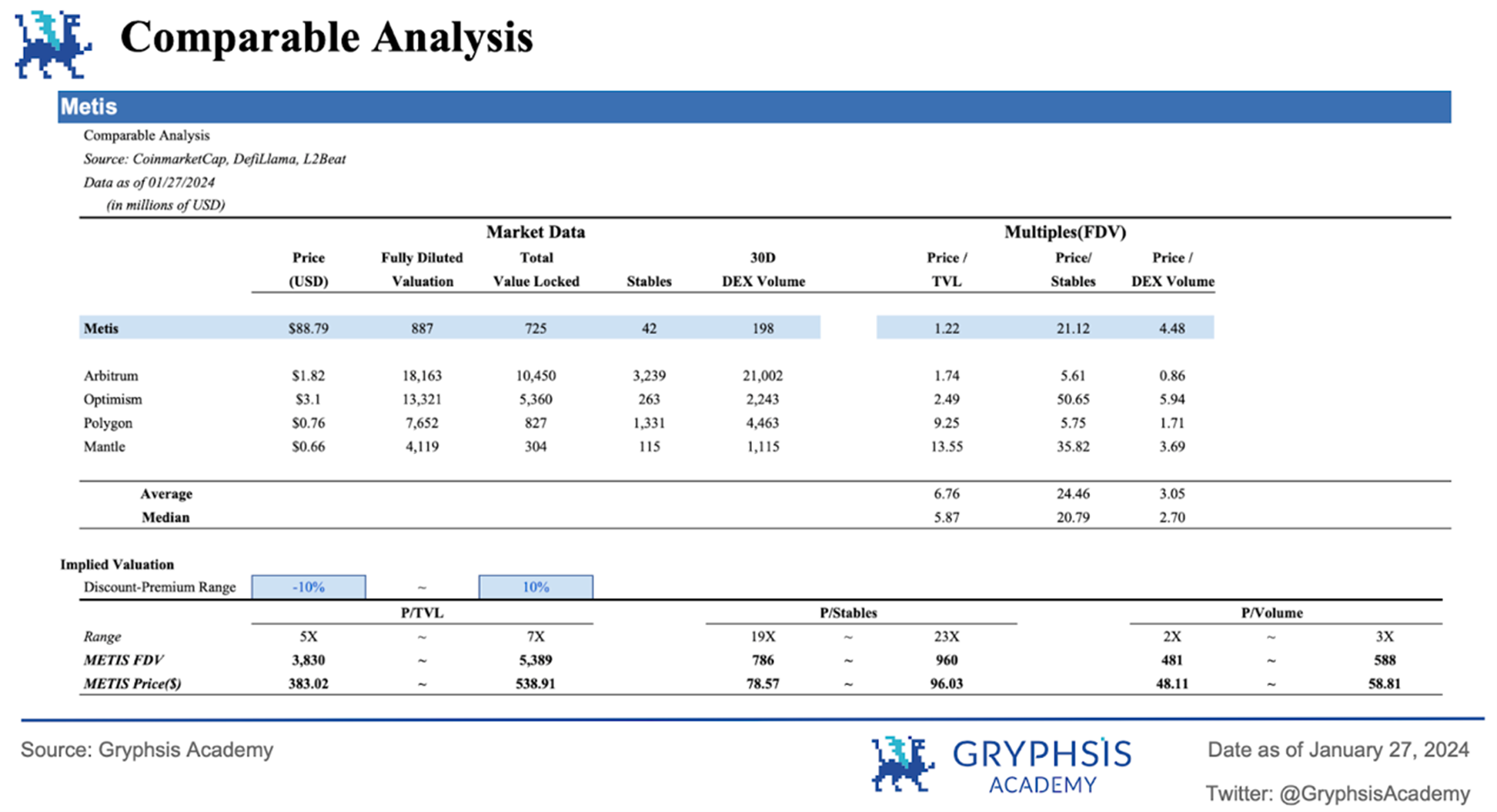
Our analysis then calculated the range for each metric (FDV/TVL, FDV/Stables, FDV/Volume) based on averages and medians. This approach aims to reduce biases that may arise from relying solely on extreme values within the dataset. By considering both averages and medians, our goal is to achieve a more balanced and representative understanding of $METIS's positioning in the Layer 2 (L2) space.
To make the analysis more precise and account for potential market fluctuations, we introduced a discount and premium range of -10% to +10%. This range is applied to the lower and upper ends of the $METIS price range. Specifically, the lower end of the price range is calculated by taking the lower of the average or median for each metric and multiplying it by 0.9 (representing a 10% discount). Conversely, the upper end of the price range is determined by taking the higher of the average or median for each metric and multiplying it by 1.1 (representing a 10% premium).
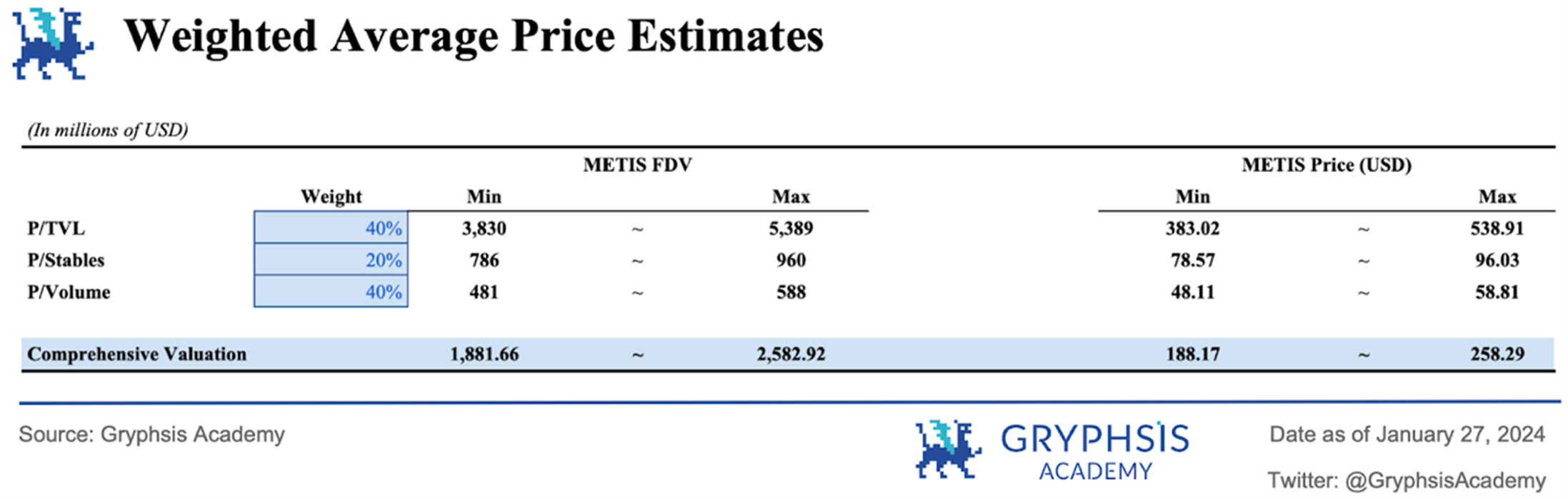
In determining the final price range for $METIS, our valuation model weighted the price estimates calculated based on the three ratios (FDV/TVL, FDV/Stables, FDV/Volume). The weight distribution is as follows: FDV/TVL accounts for 40%, FDV/Stables for 20%, and FDV/Volume for 40%. This allocation is based on the view that FDV/TVL and FDV/Volume better reflect the economic activity of the network compared to the number of stablecoins. The result of this weighted approach is that the final price range for $METIS is estimated to be between $188.17 and $258.29. This indicates that the price of $METIS has the potential to grow 2 to 2.9 times from its current market price.
It is important to note that this model and its results are based on current market conditions and assumptions about the importance of different metrics. Actual market performance may vary due to numerous factors, including but not limited to market dynamics, broader economic conditions, and specific developments within the Metis network or the broader Layer 2 (L2) ecosystem. Therefore, the proposed price range should be viewed as a rough estimate rather than an exact prediction of future prices. Readers should consider this model as one of many tools in their decision-making process and conduct their own research and analysis before making investment decisions.
6. Thoughts Sharing
From a fundamental perspective, $METIS appears quite attractive due to its unique value proposition, multiple bullish factors, and reasonable market cap growth potential. While it is possible to trade these events for profit, this requires precise market timing and expertise in selecting entry points, especially when using leverage. For many retail investors, an effective strategy may be dollar-cost averaging (DCA). This approach involves regularly investing a fixed amount, helping to gradually build an investment position while mitigating the emotional stress often associated with market timing, which is particularly common in the highly volatile crypto market.
Dollar-cost averaging allows investors to continue investing under any market conditions, reducing the emotional pressure that often accompanies market timing. This strategy also averages the purchase cost over time. When bullish factors emerge, investors may consider reducing some of their holdings to manage risk. The extent and timing of such actions should be based on individual investment goals, time horizons, and risk tolerance.
However, it is important to note that this strategy is predicated on a positive outlook for the long-term prospects of the token. Therefore, conducting thorough research and due diligence before initiating any investment is crucial. Given the unpredictability and high volatility of the cryptocurrency market, it is also essential to ensure that only funds that one can afford to lose are invested.
7. Conclusion
As the first Ethereum Rollup to adopt a decentralized sequencer, Metis holds a significant position in the competitive Layer 2 (L2) network space. This step towards a higher degree of decentralization is important, demonstrating Metis's alignment with the core values of the cryptocurrency community. It is truly exciting to see projects like Metis not only recognize the importance of decentralization but also actively innovate in this area.
Looking ahead, Metis presents considerable growth potential. The upcoming launch of its sequencer pool is expected to introduce the concepts of liquid staking and restaking within its ecosystem, potentially attracting a new wave of capital inflows. Additionally, the Metis Ecosystem Development Fund (Metis EDF) plays a key role in accelerating the growth and development of the network ecosystem, helping to bridge the gap with leading competitors like Arbitrum and Optimism. Given these developments, Metis will be a focal point of our attention, and we will continue to closely monitor its progress and future developments.
 Risk warning
 Risk warning


Popular articles





