A New Era of Perpetual Contracts: How KiloEx Redefines Perp DEX with Smooth Trading and Mechanism Innovation

 KiloEx is driving a disruptive transformation in on-chain derivatives trading, aiming to become the "Binance of the chain."
1. Perps, From Off-chain to On-chain
In the world of Web3, being fully on-chain has always been a politically correct stance. By using blockchain ledgers to confirm asset ownership and publicly record all transaction activities, this process is swept along by the historical tide of decentralization, continuously generating massive waves of money 24/7. Although the on-chain environment can also be a dark forest, it is the soil we rely on for our existence. It is an undeniable fact that blockchain is leading the advancement of human financial civilization.
Against this backdrop, the on-chain trading of perpetual contracts (Perpetual Futures, abbreviated as Perps) presents a significant market opportunity with immense incremental potential. Unlike traditional futures, Perps do not have an expiration date and can be held indefinitely, hence the term "perpetual." Their high leverage and flexibility in switching between long and short positions make them particularly popular among Web3 investors. For example, we can envision a scenario where a sudden event occurs, and an investor, based on their trading experience, assesses that the likelihood of a positive outcome for Bitcoin is high, leading them to execute a high-leverage long position. Soon, as the event's impact spreads, that investor would reap substantial rewards from this trade. Leveraging small amounts of capital for significant returns is one of the advantages of Perps. This is why, in traditional centralized exchanges (CEX), Perps have formed a highly active market with annual trading volumes exceeding trillions of dollars.
However, we also see many drawbacks in the perpetual contract trading venues provided by CEX. Compared to Perps on-chain, the on-chain Perps have several advantages:
1) Self-custody and Security
In the on-chain Perps model, user assets are always retained in personal wallets, achieving complete self-custody and ensuring fund security. All transaction data is stored on-chain, allowing users to trace it at any time, thus ensuring transparency. In contrast, CEX centralizes user assets in platform wallets, posing significant risks to user assets in the event of attacks or platform malfeasance (as seen in the frequent exchange theft incidents). Additionally, CEX often imposes withdrawal limits and other rules, further undermining users' control over their assets.
2) Simplified Trading Process
CEX typically requires users to complete multiple steps for deposits, transfers, and withdrawals, which may be prolonged due to missing tokens. Perp DEX operates directly based on user wallets, eliminating the intermediary steps of CEX, significantly enhancing trading efficiency and convenience.
3) Transparency and Risk Control
All operations on Perp DEX are executed on-chain, ensuring 100% transparency and eliminating malicious behaviors such as "price manipulation," effectively preventing fund misappropriation. Taking the FTX incident as an example, its misappropriation of user funds led to a $32 billion valuation collapse, highlighting the opacity and potential trust crisis of off-chain matching and settlement in CEX.
4) System Stability
Perp DEX executes operations directly through smart contracts, avoiding withdrawal obstacles caused by liquidity issues. Some platforms support multi-chain operations, reducing reliance on a single chain and further enhancing system stability, maximizing the safety of user funds.
5) Regulatory Restrictions
Due to long-standing and stringent regulations, users in certain countries or regions may be unable to access CEX or can only use limited functionalities. In such cases, the advantages of Perp DEX can be fully realized. As crypto assets are the money of the Internet, users can trade as long as they can connect to the Internet.
It is precisely because of these reasons that we see not only an increasing proportion of on-chain spot trading but also a rapid growth in the proportion of on-chain Perps trading. In this trillion-dollar arena, there are already products like GMX and DYDX from the previous generation, while we see the emergence of the new generation, more powerful and creative KiloEx, which is undergoing a Pareto improvement in the next generation of on-chain trading.
2. On-chain Bottleneck: Gas Fees
Although there are many advantages to being on-chain compared to CEX, there are also some drawbacks. For instance, the high gas fees on-chain are an unavoidable issue. CEX can achieve lower friction costs due to centralized data processing, while on-chain, every user operation requires contributing gas fees to nodes to maintain overall network stability. The existence of gas fees becomes a constraint for some users. So, how can we solve this problem to provide users with a better trading experience?
There are two approaches: the first is to provide users with subsidies for gas consumption. While this method achieves a 0 gas experience for users, it has trade-offs: on one hand, there may be delays in transactions; on the other hand, the platform effectively bears the cost of transactions, which can lead to significant expenses during high-frequency trading, making it difficult to maximize value for the ecosystem.
The other approach, which KiloEx has chosen, is to innovate at the smart contract level. The current gasless implementations mainly include an EOA Based Paymaster based on EIP-4337 and ERC-2771's Meta-Transaction. KiloEx has opted for the latter technical path. Specific technical details can be referenced in related documents and will not be elaborated here.

Gasless implementation process of Meta-Transaction
In simple terms, KiloEx has created a near-zero gas trading environment through smart contract innovation, providing an experience comparable to CEX. Of course, in some non-EVM public chains, this direction still needs exploration, but at least on mainstream EVM public chains like opBNB, BNB, and Base, it can be basically realized.
Additionally, in creating a user-friendly trading environment, KiloEx has other innovations, such as:
One-click Trading: KiloEx's 1CT wallet eliminates the need for user interaction with the wallet during trading, achieving more efficient one-click trading. With the introduction of a trading authorization mechanism, users no longer need to manually sign for each transaction; instead, the 1CT wallet automatically executes transaction submissions, greatly enhancing trading efficiency.
Extreme Optimization of Trading Speed: KiloEx has significantly shortened the time required for transactions through innovations at the code and contract levels, currently boasting a speed faster than over 90% of Perp DEXs.
3. Features of KiloEx's Products and Mechanisms
After understanding the inevitability of the migration from off-chain to on-chain and addressing the issues of insufficient on-chain trading experiences, we can truly begin to examine the value of KiloEx and recognize its mission as a flagship product. KiloEx is reshaping the usability standards of perpetual contract trading through its product philosophy of "CEX-level experience, DEX-level control."
As the champion project of Binance Labs' sixth season MVB, KiloEx provides up to 125x leverage trading for over 70 crypto assets (covering BTC, ETH, meme coins, DeFi tokens, AI concept assets, and forex trading pairs) through a fully decentralized perpetual contract protocol. With its unique Vault funding pool model, it achieves breakthroughs in liquidity efficiency and yield stability. Currently, it ranks first in TVL and trading volume across the entire opBNB ecosystem, while continuously leading in the derivatives sector of Manta and Taiko, rapidly growing into a benchmark protocol for multi-chain derivatives DEX.
As of now, KiloEx's cumulative trading volume has exceeded $34 billion, with an average daily trading volume of approximately $100-200 million across various chains. The total number of users is nearly 800,000, with over 1 million users in the Telegram application. Since its launch, TVL has consistently risen, peaking at $50 million and currently nearing $40 million.

KiloEX's TVL, Source: DefiLlama
In addition to the previously mentioned optimizations in gas fees and improvements in trading performance, KiloEx also has the following product features:
3.1 Dual Pool Risk Isolation Architecture
KiloEx abandons the traditional order book model and adopts a liquidity pool (LP) direct trading mechanism, completely eliminating slippage issues, allowing users to complete instant exchanges directly with the funding pool. If there were only one funding pool, liquidity issues could arise in extreme market conditions. Therefore, KiloEx has set up dual funding pools to effectively resist liquidity risks brought by one-sided market trends:
Base Pool: Composed of 70% USDT/USDC deposited by users and 30% of platform fee income, providing a stable yield base, with an annual yield rate of 22% on the opBNB chain (29% on the Taiko chain).
Buffer Pool: Absorbs trading profit and loss fluctuations and funding fee income and expenses, serving as a buffer layer for the Base Pool. Only when the Buffer is exhausted will the Base Pool bear losses, significantly enhancing the stability of staker yields.
The underlying logic of this design is crucial for a Perp DEX platform: the ability to withstand one-sided market trends. KiloEx's Vault 2.0, set to launch in Q1 2024, will utilize a dynamic rebalancing mechanism to convert surplus from the Buffer Pool into reserves for the Base Pool during bull market uptrends, reducing the impact of extreme market conditions on staking yields. Test data shows that yield fluctuations during BTC's rise above $70,000 were reduced by 63% compared to older versions.
3.2 Yield Distribution Innovation
Due to the existence of dual pools, KiloEx has innovated in yield distribution. 30% of user fees will contribute to the Vault, providing a stable growth source for KiloEx's Vault. When traders profit, funds are drawn from the Buffer Pool; when they incur losses, funds are injected into the Buffer Pool. Stakers in the Base Pool always receive a share of the fees, and the long-term positive accumulation of the Buffer Pool forms a yield "safety net," allowing yields during bear markets to outperform mainstream yield aggregators (such as Yearn and Convex).
At the same time, KiloEx has also drawn on the successful paths of CEX to create a multi-tiered rebate system, currently boasting over 1,700 first-level nodes. After deducting the 30% that goes into the Vault, 20%-40% of the remaining portion of user fees is returned to the channels. This is also one of the reasons KiloEx can achieve explosive growth. In CEX, rebate designs may lead to "killing the goose that lays the golden eggs," where some channels that bring users to CEX may no longer be needed once the brand reaches a certain level, preventing those channels from continuously enjoying profit-sharing. However, KiloEx, through smart contracts, helps channels lock in this portion of revenue, allowing for mutually beneficial growth with partners.
After the issuance of the KILO token, users can mint xKILO at a 1:1 ratio using their KILO tokens. Staking xKILO will share trading fees and grant VIP privileges. xKILO will also be used to incentivize users and partners in operational activities, as well as for treasury and other purposes. Trading fees will be allocated to the xKILO unilateral staking pool, ecosystem, and liquidity pool, with all referral rewards and profit-sharing from follow-up trades paid directly in USDT. 40% of trading fees will go to the ecosystem, 30% to $xKILO holders, and the remaining 30% to the liquidity pool.
3.3 Hybrid Vault
KiloEx's Hybrid Vault allows users to provide underlying liquidity in a variety of tokens, further optimizing the capital structure while providing real and substantial yields for LST and other mainstream assets. The Hybrid Vault consists of two parts, with USDT accounting for half of the total Vault amount and other tokens (non-USDT) making up the other half. This high-yield source comes from the fees provided by users in the Vault model.
For mainstream assets like BTC, BNB, and MANTA, it is challenging to find products that offer stable and high yields in the market, while KiloEx's Hybrid Vault achieves a real yield rate of up to 12.87% for WBNB settled in USDT on opBNB, and a real yield rate of 16.21% for FDUSD. This gives it a significant leading advantage among all staking yield products.
For many non-mainstream tokens, KiloEx also provides relatively high real yields. For example, in the LST field, compared to re-staking protocols that can only offer point rewards, KiloEx directly provides USDT yields, ensuring yield stability. For instance, holders of STONE on the Manta network can earn approximately 8% real yield in USDT by staking it in KiloEx's Hybrid Vault.
Additionally, KiloEx has developed token-based trading contracts, allowing the fees and margins in contract trading to be any project's own tokens, further lowering the threshold for contract issuance. After a successful TGE, KiloEx will also open Staking functionality, allowing users to participate in Staking to earn a share of the fees, further reducing the circulating KILO, which is beneficial for price appreciation. The price increase will attract more users to participate in Staking, further reducing liquidity and creating a virtuous cycle of deflationary effects.
3.4 Multi-chain Deployment
To break down inter-chain barriers, KiloEx has been deployed on multiple mainstream blockchains, including BNB Chain, opBNB, Manta, Taiko, and Base, and has built-in cross-chain bridging functionality, allowing users to seamlessly switch network environments while reducing gas costs and enjoying a smooth cross-chain trading experience. Currently, KiloEx is the largest application on opBNB. Additionally, KiloEx will gradually integrate with other chains like Solana and move-based public chains, ultimately achieving multi-chain interoperability and unlocking underlying liquidity.
3.5 Extremely User-Friendly Product
For novice users, the platform has designed an extremely simplified trading interface, hiding complex parameters such as funding rates and position sizes, condensing the opening and closing operations to within three steps; even when facing liquidation risks, its partial liquidation mechanism will only proportionally reduce positions, preventing users from losing their principal due to a single market fluctuation.

KiloEx Trading Interface
4. KiloEx's Team and Financing
The KiloEx team exhibits a dual characteristic of CEX veterans and DeFi innovators, with its "pragmatic and fast-paced, long-term deep cultivation" strategy standing out in the derivatives DEX field. With the key endorsement from Binance Labs and an efficient execution culture, the project has built a triangular moat of products, resources, and experience. If it can maintain technological iteration while moderately enhancing transparency in the future, it may further attract institutional funds and mainstream users.
The KiloEx team consists of core members from top exchanges like Binance and OKX, possessing rich experience in CEX operations, DeFi protocol development, and traditional financial derivatives design. As early as 2022, the team participated in Binance Labs' sixth MVB incubation program with a scale of 5-6 people and was awarded the title of "Most Valuable Project (MVB)" for its outstanding product prototype implementation capabilities, subsequently securing investment from Binance.
KiloEx has always adhered to a culture of pragmatism and efficiency, advocating for a "minimal execution" work style. For example, during the incubation period, after Binance Labs mentors suggested developing a product landing page, the team completed the design and deployment that same night and delivered the complete page the next day, demonstrating execution efficiency far exceeding the industry average. Furthermore, KiloEx insists on a low-profile, deep cultivation development strategy, understanding that the core of the DEX track lies in long-term accumulation of user trust rather than relying on short-term traffic hype. The team firmly believes in the long-term potential of perpetual contract DEX and asserts that only by continuously refining products and building a solid channel ecosystem can true mass adoption be achieved.
KiloEx initially secured strategic investment through the Binance Labs MVB incubator, with investors including Yzi Labs (formerly Binance Labs), Foresight Ventures, Crescendo Ventures, and Manta Foundation. Unlike competitors that rely on capital accumulation, KiloEx impressed Binance with its clear understanding of the track and team execution capabilities, with the rapid validation of products during the incubation period being a key advantage.
5. Competitive Analysis
5.1 Overview
In the current Perp DEX field, TVL is an important indicator of platform scale and user trust. As a rising star, KiloEx quickly reached a TVL of around $40 million, which is a notable achievement in the Perp DEX space. Additionally, trading volume is also a crucial metric reflecting user engagement with the platform. In Defilama's Perp DEX rankings, KiloEx ranks 8th in 24-hour trading volume and 9th in 7-day trading volume. This is sufficient to demonstrate that KiloEx has entered the top tier in the competitive Perp DEX arena.
 Perp Dex 24-hour trading volume ranking, 25/3/18, Source: DefiLlama
5.2 DYDX
dYdX is one of the earliest decentralized cryptocurrency derivatives trading platforms, serving as a decentralized exchange for perpetual contracts and margin trading. dYdX reached its peak in 2022 with a TVL close to $1.2 billion, but subsequently saw a significant decline during the bear market. In 2024, after the launch of dYdX V4, on-chain trading volume has rebounded somewhat, but it has not yet returned to its early peak levels. Compared to its early dominance in the decentralized derivatives market, the current market competition is much fiercer, with other Perp DEX gradually capturing some of the trading flow.
The biggest feature of dYdX is that it provides off-chain order books with on-chain settlement for traders, matching orders off-chain while settling on-chain. However, this mechanism design has two major issues:
Centralization Risk: Users cannot verify order matching in real-time, leading to a lack of transparency; at the same time, centralized storage increases the possibility of the platform manipulating market prices, making it more susceptible to interference compared to AMM.
Liquidity Issues: When the order book lacks depth, prices can be significantly affected by large trades, impacting user returns. The off-chain matching mechanism may cause transaction delays due to insufficient liquidity or network congestion, resulting in a poor user experience.
In contrast to dYdX, KiloEx adopts an AMM mechanism, which is a more optimized solution. The on-chain AMM mechanism can avoid manipulation by market makers, relying on price curves to allocate liquidity, making it more friendly to retail investors. By aggregating price data through oracles and utilizing the most reasonable AMM curves, KiloEx achieves 0 slippage trading, with no instances of "price manipulation" or downtime, ensuring price stability. Additionally, KiloEx's dual Vault mechanism also guarantees sufficient liquidity.
5.3 GMX
As a leading platform in the Perp DEX space, GMX's V2 version introduced several innovative features. The most notable change is that trading is supported by a unique multi-asset pool. In the V2 version, each trading pair has a corresponding LP. While this allows GMX to reduce risk and increase trading capacity, it inevitably leads to liquidity fragmentation due to multiple LPs. In contrast, KiloEx adopts a unique Hybrid Vault model.
Compared to GMX V2, KiloEx aggregates liquidity more effectively. Currently, CEX still occupies a large market share, capturing DEX liquidity. Therefore, whether liquidity is concentrated is crucial for Perp DEX, as it determines trading depth, capital efficiency, and market competitiveness. At the same time, the high yields of the Hybrid Vault can create a siphoning effect for many non-mainstream tokens, further attracting market liquidity.
5.4 Hyperliquid
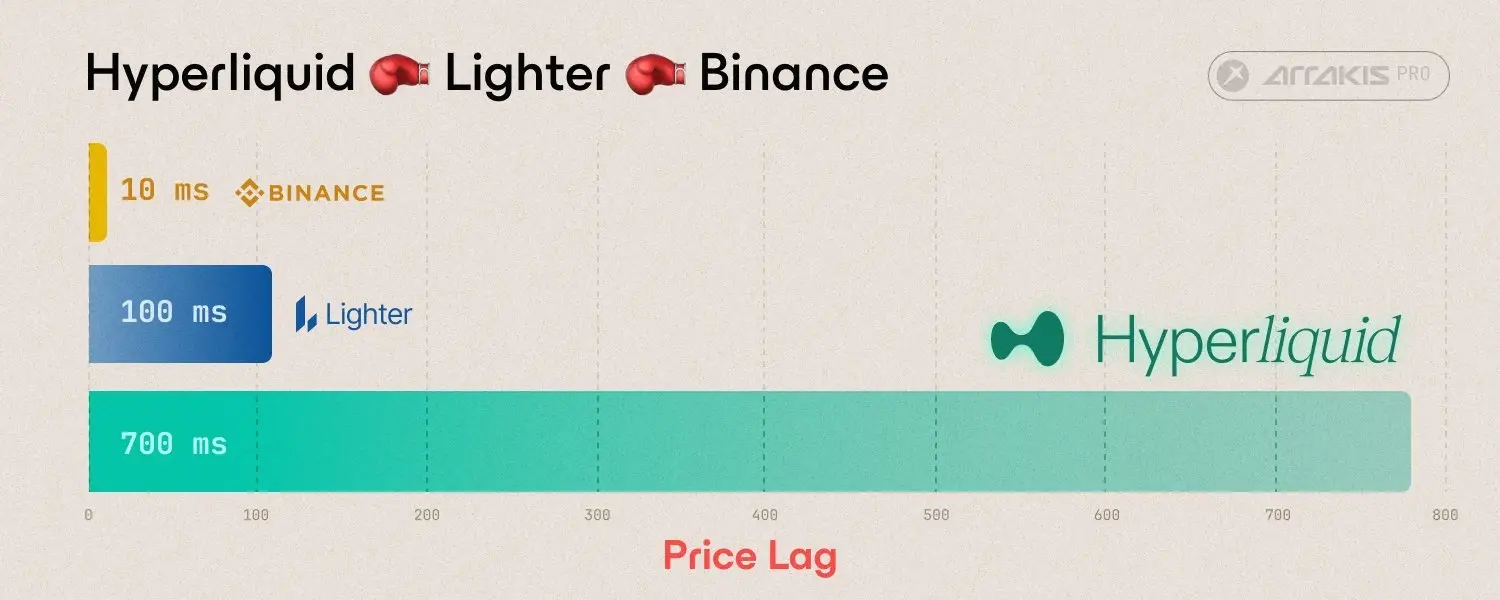
Hyperliquid is a decentralized trading platform designed for efficient trading, with its core advantages being trading efficiency and no gas fees. Although it has achieved high TVL and market share, Hyperliquid still has significant limitations in on-chain support and ecosystem openness. Hyperliquid only supports its own native L1, lacking support for other chains, which limits its adaptability in a multi-chain ecosystem. The platform is overly reliant on its mainnet,
and the current construction of Hyperliquid's mainnet still needs further improvement, restricting its interactivity with other on-chain ecosystems, user expansion, and diversity of application scenarios.
In contrast, KiloEx currently supports six networks, including BSC, OpBNB, Base, and Manta, while maintaining excellent trading experience and important market position. In the BSC + OpBNB ecosystem, KiloEx occupies a very important market position, especially in the OpBNB ecosystem, where it is in a leading position. From the perspective of TVL, KiloEx is the largest DEX in the OpBNB ecosystem, and on the Base network, KiloEx allows users to trade directly through USDT without paying any fees or needing to hold native tokens, further enhancing trading convenience. Additionally, KiloEx plans to launch in the Solana ecosystem in the next phase and introduce a spot DEX to expand more trading categories.
Moreover, Hyperliquid's strategy design carries high risks, especially when high-leverage traders utilize margin strategies, which can lead to significant losses for LPs. Although the platform attempts to reduce risks by adjusting the maximum leverage for BTC and ETH and increasing the maintenance margin requirements for large positions, this is merely a remedial measure and does not fundamentally address the potential high-risk issues in the mechanism. This strategy may still harm LP users' interests during extreme market fluctuations. Recently, there was an incident where its mechanism was exploited, resulting in a $4 million loss for HLP (a market-making fund composed of user funds), with the core issue being high-leverage traders exploiting margin strategies and flaws in the mechanism design, leading to abnormal market liquidations, ultimately causing HLP to take the hit and incur massive losses.
In contrast to Hyperliquid, KiloEx reduces the risk of LPs directly bearing losses from extreme market fluctuations through its dual Vault mechanism. When extreme market conditions arise, the Buffer will first absorb some of the losses, rather than directly imposing them on liquidity providers. This minimizes the impact of high-leverage position liquidations on LPs, maximizing user interests.
5.5 Jupiter
Jupiter excels in the trading aggregation segment on Solana, aggregating over half of the trading volume. The corresponding Perp DEX launched by Jupiter also performs well, although it has seen a slight decline, with a significant drop, yet it still occupies 7% of the market share.
However, compared to KiloEx, Jupiter has certain drawbacks. For example, Jupiter supports a limited number of tokens: including SOL, ETH, WBTC, USDT, etc., which means it can currently only facilitate leveraged trading for a limited number of tokens. In contrast, KiloEx can support a variety of tokens across multiple chains.
Additionally, Jupiter has not established a user marketing mechanism. Compared to other mainstream public chains, the liquidity depth and user base on the Solana chain still have certain limitations. For a Perp DEX to achieve long-term stable development, it must establish a comprehensive user marketing mechanism to enhance user stickiness and market competitiveness. KiloEx has already established a robust rebate mechanism and trading competition incentive mechanism, currently attracting over 1,800 channel users and a considerable number of direct customers, providing substantial trading volume.
Compared to KiloEx, Jupiter also has the issue of high fees. As trading frequency increases, the gas fees users need to pay can multiply. Since aggregators inherently involve high-frequency on-chain trading behaviors, optimizing user trading prices by sourcing liquidity from multiple sources, frequent trading activities inevitably drive up gas fees. Additionally, Jupiter's JLP pool has cost issues; due to the target ratio set for each token in the pool, any deviation from the target ratio leads to higher fees. KiloEx's low fees are primarily achieved through wallet authorization mechanisms and gas fee reimbursement.
5.6 Competitive Product Summary
We have compared and analyzed several outstanding and distinctive Perp DEXs:

In summary, KiloEx has the following advantages:
- 0 Gas Trading
- Creation of a user-friendly trading environment, matching CEX order placement experience
- Oracles ensure 0 slippage for BTC, ETH, and other tokens, with stable prices and no instances of "price manipulation" or downtime, ensuring user fund safety
- Well-structured mechanisms that allow for win-win scenarios for both traders and stakers during one-sided market trends
- Hybrid Vault with a rich variety of assets, yielding higher returns than typical DeFi protocols
- Multi-chain support, occupying an important position in the ecosystem
6. The Future, Ruler of On-chain Trading Platforms
The market is moving forward in twists and turns; TGE is the endpoint for many projects, but we believe that the upcoming TGE next month may be the starting point for KiloEx. The vast prospects of the on-chain trading market lie ahead. In the off-chain era, many CEX giants were born, while in the on-chain era, the competition for trading has just begun. Only in a vast market space can great projects emerge.
KiloEx's rise is not accidental. It anchors itself with "CEX efficiency, DEX trust," tearing open a structural gap in the derivatives track. While the market still debates whether DEX can disrupt CEX, KiloEx has already written the most straightforward answer with its 29% risk-free yield on-chain, cross-chain transactions completed in seconds, and daily contract liquidation volumes in the tens of millions of dollars.
This may be the essence of Web3 finance: no need to compromise between efficiency and security, as all value will ultimately find the most wild and rational outlet.
 Risk warning Risk warning