








When Singapore starts to drive away people from the cryptocurrency circle

 The wandering Jews continue to roam.
Author: Deep Tide TechFlow
The once Web3 paradise of Singapore is starting to push people away.
On May 30, the Monetary Authority of Singapore (MAS) officially released the final policy guidelines for "Digital Token Service Providers (DTSP)," with a very firm stance:
All crypto service providers registered or operating in Singapore, if they do not obtain a DTSP license, must cease providing services to overseas clients by June 30, 2025.
There is no transition period for this regulation, and violators will be punished according to the law, with companies found in violation facing fines of up to 250,000 Singapore dollars (200,000 USD) and up to three years in prison.
This policy hit like a bolt from the blue, causing many cryptocurrency practitioners in Singapore to feel a jolt of anxiety.
As Asia's Web3 hub, Singapore has always played the perfect place for "regulatory arbitrage."
In the past, Singapore implemented a "differentiated" regulatory strategy, allowing registered companies to freely provide services to overseas clients, with stricter regulatory requirements only for businesses targeting the local market.
Especially as major markets tighten regulations, such as China's comprehensive ban and the U.S. SEC's increased enforcement, Singapore timely played the role of a safe haven, providing a secure landing point for many crypto exchanges, funds, and projects, leading to waves of crypto companies relocating. Even Singapore's sovereign wealth fund Temasek has invested in crypto companies like FTX and Immutable, solidifying Singapore's position as a crypto center in Asia.
However, the clarity of this regulatory policy has gradually plugged the loopholes of "regulatory arbitrage."
According to the final regulatory response document released by Singapore's MAS, the most stringent key points are:
Comprehensive regulation of cross-border business: Regardless of whether the clients are local or overseas, any digital token-related business conducted within Singapore must obtain a DTSP license, directly cutting off the previous regulatory arbitrage path of "registered in Singapore but only serving overseas clients."
Extremely broad definition of business premises: MAS defines "business premises" as "any location in Singapore used by the licensee to conduct business," even including movable stalls. This definition almost covers all possible business locations, regardless of size.
Dual coverage of individuals and institutions: The regulatory targets include both individuals or partnerships operating at business premises in Singapore and Singapore companies conducting digital token service businesses overseas, achieving full coverage of entities.
Additionally, although MAS stated that overseas company employees working from home would be acceptable, the definition of "employees" is vague, leaving it to MAS's discretion to determine whether project founders and shareholders qualify as employees.
Why did Singapore's MAS suddenly strike hard?
This is not a sudden policy attack on cryptocurrency companies by Singapore's financial authorities. As early as 2022, Singapore's MAS introduced the "Financial Services and Markets Act," with the ninth part specifically addressing cryptocurrency regulation, followed by multiple public consultations and drafts for feedback. The document released on May 30 is a response to the consultations, detailing specific regulatory methods, regulations, notices, and DTSP licensing guidelines.
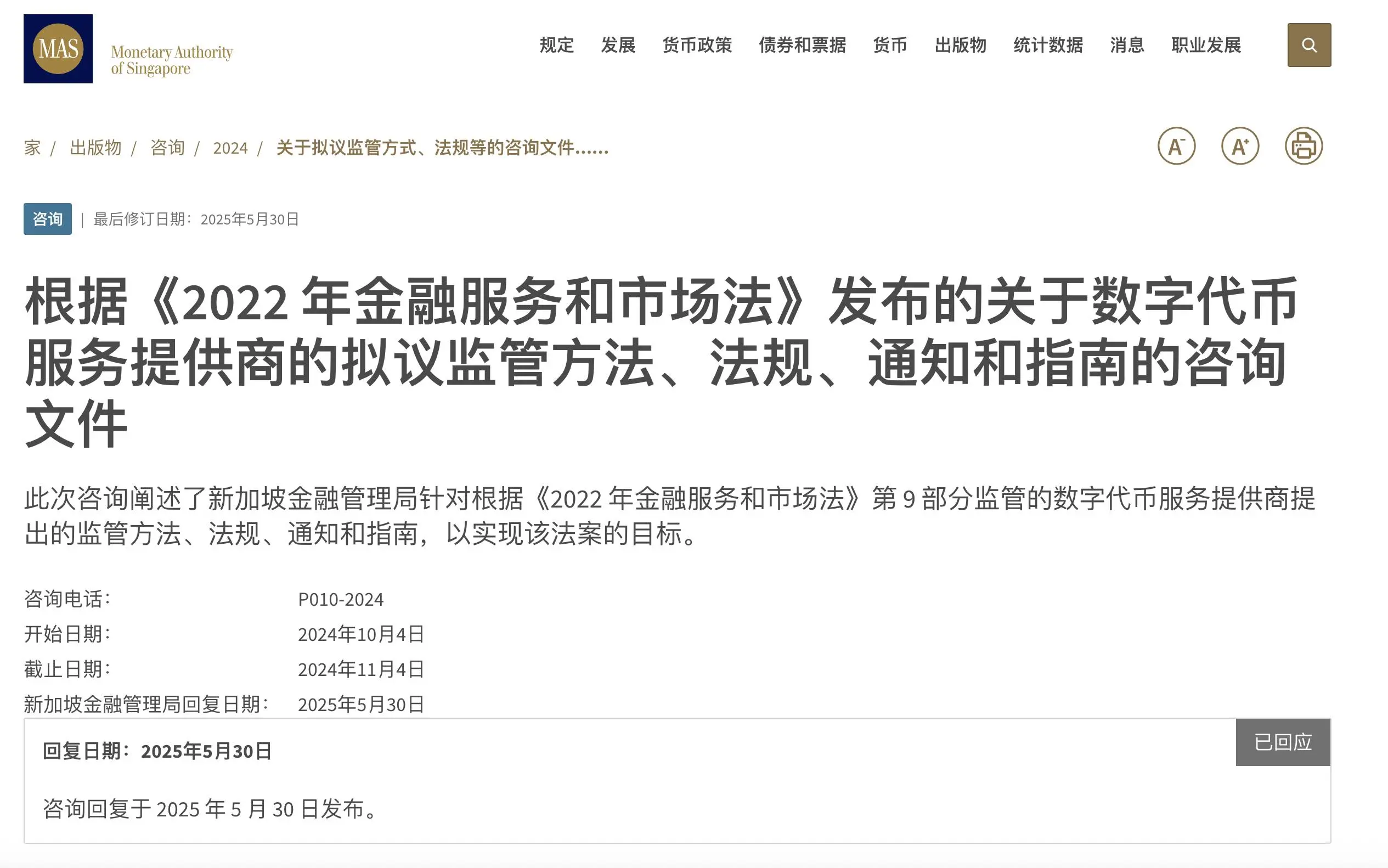
According to the consultation document, MAS's core consideration is "some cryptocurrency companies may harm Singapore's reputation."
The original text states, "Due to the internet-based and cross-border nature of digital token services, Digital Token Service Providers (DTSPs) are more susceptible to money laundering/terrorist financing (ML/TF) risks… The main risk posed by DTSPs to Singapore will be reputational risk, meaning that if they engage in or are misused for illegal purposes, it could damage Singapore's reputation."
The root of it all may trace back to 2022 when Temasek's investment in the cryptocurrency exchange FTX and the local crypto fund Three Arrows Capital collapsed, severely damaging Singapore's financial reputation. The then Minister of Finance, Lawrence Wong (now Prime Minister), publicly stated that this investment caused reputational damage, and Temasek subsequently imposed salary cuts on the investment team and senior management.
Under the latest regulations, which cryptocurrency companies will be affected?
According to the consultation document, all entities related to cryptocurrency asset trading must be licensed, including cryptocurrency trading platforms, cryptocurrency custody, cryptocurrency transfers, and cryptocurrency issuance…
With the deadline of June 30, 2025 approaching, panic from social media like WeChat Moments looms over Singapore's crypto practitioners, but more emotions are confusion.
"I didn't know about the relevant policies before; it just exploded in my WeChat Moments. Currently, opinions vary, and I can only wait and see. If it gets worse, I might leave Singapore and go to neighboring Malaysia," said Adam (a pseudonym), a project practitioner.
Kevin, a practitioner from a cryptocurrency exchange, expressed deep concern, stating that their company has already made plans to move the office to Hong Kong, but he doesn't know the specific timeline. Having lived in Singapore for two years, he was preparing to apply for Singapore permanent residency (PR) and feels regret and reluctance due to this sudden change.
Previously, Hong Kong Legislative Council member Wu Jiezhuang posted on social media to attract Singapore's crypto practitioners to settle in Hong Kong, stating: "Singapore recently released the 'Digital Token Service Provider Licensing Guidelines,' proposing new policies for companies, institutions, and individuals engaged in virtual assets. Since Hong Kong released the virtual asset declaration in 2022, it has actively welcomed the industry to develop here. According to unofficial statistics, over a thousand Web3 companies have settled in Hong Kong. If you are currently engaged in this industry in Singapore and wish to relocate your headquarters and personnel to Hong Kong, I am willing to provide assistance and welcome you to develop in Hong Kong!"
Lily, COO of the crypto custody platform Cobo and former legal counsel of PAG, believes that the policy has exaggerated panic. She stated that the policy maintains MAS's consistent regulatory style, mainly affecting the non-licensed exchanges' front and substantive operating teams in Singapore, and will not impact companies like Cobo that have already obtained exemptions and licenses, nor will it affect institutions whose business scope is outside the licensing regulatory scope.
According to information from the MAS official website, 24 companies, including COBO, ANTALPHA, CEFFU, and MATRIXPORT, are on the exemption list, while 33 companies, including BITGO, CIRCLE, COINBASE, GSR, Hashkey, and OKX SG, have already obtained DTSP licenses.
For these licensed and exempt companies, the new policy actually creates a fairer competitive environment, enhances the reputational value of licensed institutions, and lays the foundation for global expansion.
Correspondingly, as the era of regulatory arbitrage comes to an end, some offshore crypto companies based in Singapore have begun to relocate to Hong Kong, Dubai, Malaysia, and other places.
Adam believes that the departure of crypto practitioners from Singapore is a major trend, and this policy is more about accelerating that process.
"The cost of living in Singapore is high and boring. More importantly, there are too few opportunities to make money now. If I want to live, I would go to Japan; if I want to make money, I would go to Dubai."
Once, Singapore was referred to as the "Jerusalem of crypto Jews," but now its doors are tightening, forcing crypto Jews to follow the water and grass, continuing to wander.
 Risk warning
 Risk warning



Popular articles





