








$100 million bet on Web3: Unveiling the crypto investment history of "Merger King" Huaxing Capital
 Web2 was once organized into a "situation" by Huaxing, will Web3 be redefined by it?
Author: Fairy, ChainCatcher
Editor: TB, ChainCatcher
The king of mergers and acquisitions in Web2 is trying to become a player in Web3.
Huaxing Capital, which has led epoch-making mergers such as Didi Kuaidi, Meituan Dianping, and 58 Ganji, has officially turned its attention to the crypto world. Yesterday, the board of directors of Huaxing Capital Holdings formally passed a strategic resolution to invest $100 million over the next two years for the expansion of its Web3 business and direct investments in crypto assets.
Stimulated by this news, Huaxing Capital Holdings surged 33% at the market open today. This investment bank, which once influenced the landscape during the Web2 era, is now trying to reposition itself in a new round of financial paradigm shifts. Web2 was orchestrated into a "situation" by Huaxing; will Web3 be redrawn by them?

Doubling Down on Web3, Huaxing is Not a "New Player"
As one of the earliest and most knowledgeable local investment banks in China's new economy, Huaxing Capital has long been at the forefront of reshaping China's internet industry structure. Since its establishment in 2005, it has been deeply involved in almost all key mergers and strategic transactions during the rise of China's new economy, including landmark cases such as Momo's acquisition of Tantan and Tencent's strategic investment in JD.com. In the primary market, Huaxing has become the "behind-the-scenes driver" for many giants with its "investment banking + investment" dual-driven model.
Although Huaxing is making a high-profile entry into Web3 through a board resolution, in fact, its layout in the crypto world has quietly unfolded over the years, spanning multiple fields including mining companies, stablecoins, and trading platforms.
As early as 2018, Huaxing's managed new economy fund invested in Circle. In 2019, Huaxing assisted Canaan Creative in going public in the U.S., making it the first blockchain mining machine company to list on NASDAQ.
In 2021, Huaxing invested in the crypto financial service provider Amber Group through its subsidiary fund, which later completed a merger and went public in the U.S., with a valuation that once exceeded $3 billion, becoming one of Asia's most well-known crypto unicorns.
In 2022, Huaxing Capital completed its investment in Matrixport and assisted its affiliated company Bitdeer in completing the merger and SPAC listing process, paving the way for its entry into the U.S. stock market.
In 2023, Huaxing helped Bitmain complete a merger. At the same time, Huaxing Securities (Hong Kong) acted as the financial advisor for Hashkey Group, deeply participating in multiple rounds of financing for the company.
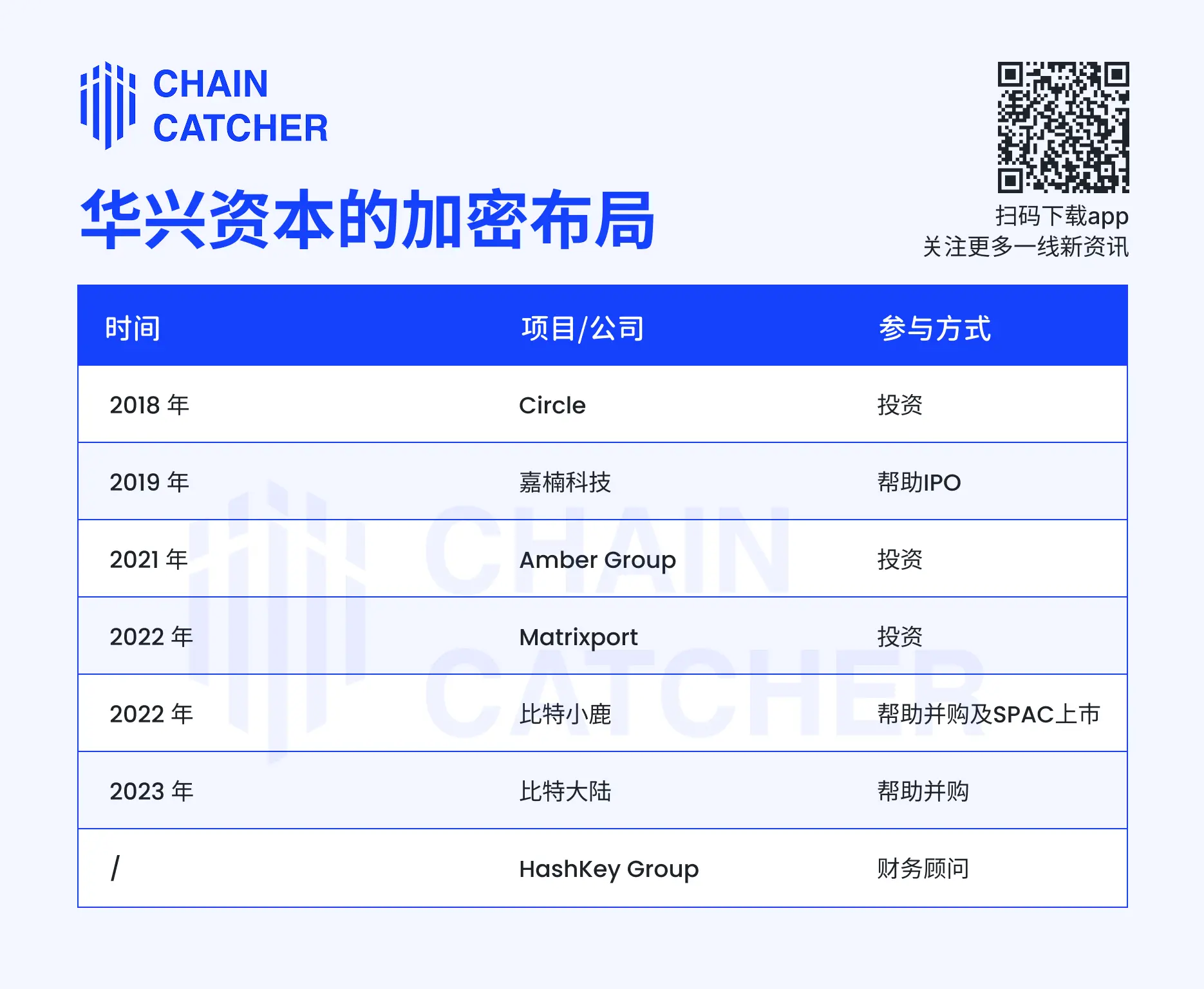
From IPO planning, equity investment, to mergers and acquisitions and financing advisory, Huaxing Capital has precisely embedded itself into the crypto ecosystem with its traditional investment banking capabilities and localized network.
Transformation After the Baofan Incident
At the beginning of 2023, the "disappearance" of Huaxing Capital's founder Baofan shocked the entire capital market and pushed the giant to the forefront of controversy. However, even before Baofan's "disappearance," Huaxing Capital's performance had already shown a significant decline. In the first half of 2022, revenue plummeted by 40% year-on-year, with a net loss of up to $23 million, while the company was still in a profitable state of $179 million in the same period the previous year.
After experiencing the dual blows of a leadership vacuum and capital volatility, Huaxing was forced to hit the brakes on expansion and began to reassess the group's core positioning. On February 2, 2024, Baofan officially resigned from all positions, including executive director, chairman of the board, and CEO. The company is now led by a new management team, attempting to "de-Baofanize" and proposing the "Huaxing 2.0" strategy, focusing on hard technology, industrial upgrading, and globalization, while downplaying the traditional consumer internet label.
Under this transformation strategy, Web3 and crypto assets began to enter Huaxing's core vision. On June 5 of this year, stablecoin issuer Circle successfully went public, with its stock price soaring, reaching nearly $300 at one point. As an investor that bet on Circle in 2018, Huaxing also reaped rewards from this "long-term bet," with its stock price soaring over 16% as a result.
Perhaps it was this long-awaited capital "linkage" that gave Huaxing more confidence to double down on Web3. Shortly thereafter, the company's board formally passed a resolution to establish a special budget of $100 million to enter the Web3 and crypto asset fields, focusing on stablecoins, RWA, and the crypto ecosystem, while simultaneously advancing the application and upgrade of related business licenses.
At this time, Hong Kong is experiencing a warming of policies and a gradual improvement of the licensing system. Hong Kong-listed companies are accelerating their crypto layouts: fintech company IDA is applying for a stablecoin license, Guotai Junan International has been approved to provide virtual asset trading services, and companies like Hong Kong BGE Limited have also obtained licenses for virtual asset trading platforms. Amid the policy tailwind and the quiet recovery of the industry cycle, Huaxing has once again found its entry point.
Huaxing has used capital operations to facilitate the rise of a generation of giants and has also reshaped the industrial landscape with strategic vision. Its mature approach and deep resources made it invincible during the Web2 era, but will all of this still work in Web3?
Regardless, it is leaving its mark in the new crypto landscape.
 Risk warning
 Risk warning


Popular articles





