








Ethereum 2030 Technical Declaration: The Path of Rollup Dual-Track Parallel World Ledger

 Where will Ethereum head in 2030? In this division of Rollup technology, how does the vision of a world ledger become a reality?
Original Author: Lemniscap
Original Compilation: Saoirse, Foresight News
More Streamlined L1 and Its Performance and Alignment Rollup Solutions
Ethereum has always been committed to maintaining trusted neutrality while allowing higher-level innovations to flourish. Early discussions outlined a "Rollup-centric roadmap," where the underlying network would gradually simplify and solidify to enable most activities to migrate to L2. However, recent developments indicate that merely serving as a minimal consensus and data availability layer is insufficient: L1 must possess the capability to handle traffic and activities, as this is the foundation upon which L2 ultimately relies. This necessitates faster block generation speeds, lower data costs, more robust proof mechanisms, and better interoperability.
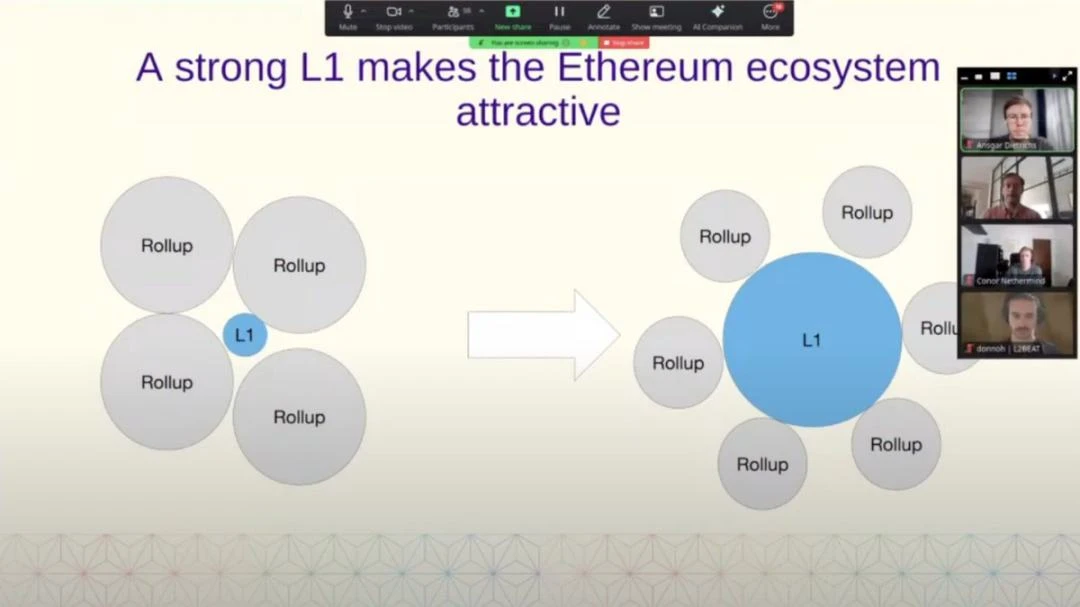
The upcoming Beam Chain consensus mechanism restructuring aims to achieve faster final confirmation speeds and lower validator thresholds, enhancing the original throughput while further strengthening Ethereum's neutrality. Meanwhile, existing proposals consider migrating activities from the increasingly outdated (and "increasingly complex") Ethereum Virtual Machine (EVM) to a RISC-V native virtual machine, which is expected to significantly improve prover efficiency while maintaining interoperability with traditional contracts.
These upgrades will reshape the landscape of L2. By 2030, I expect Ethereum's Rollup-centric roadmap to integrate in two directions within a range:
Aligned Rollups: Prioritize deep integration with Ethereum (e.g., shared ordering, native verification), fully leveraging L1's liquidity while minimizing trust assumptions. This relationship is mutually beneficial, as aligned Rollups can directly obtain composability and security from L1.
Performance Rollups: Prioritize throughput and real-time user experience, sometimes achieving this through alternative data availability layers (DA layers) or authorized participants (such as centralized orderers, small security committees/multi-signatures), while still using Ethereum as the final settlement layer for credibility (or for market promotion).
When designing these Rollup solutions, each team must weigh the following three aspects:
Liquidity Acquisition: How to acquire and utilize liquidity on Ethereum and possibly other Rollup solutions? How important is synchronous or atomic-level composability?
Source of Security: To what extent should liquidity migrating from Ethereum to Rollup directly inherit Ethereum's security, or rely on Rollup providers?
Execution Expressiveness: How important is EVM compatibility? Given the rise of alternatives like SVM and popular Rust smart contracts, will EVM compatibility still be important in the next five years?
Polarization on the Rollup Spectrum
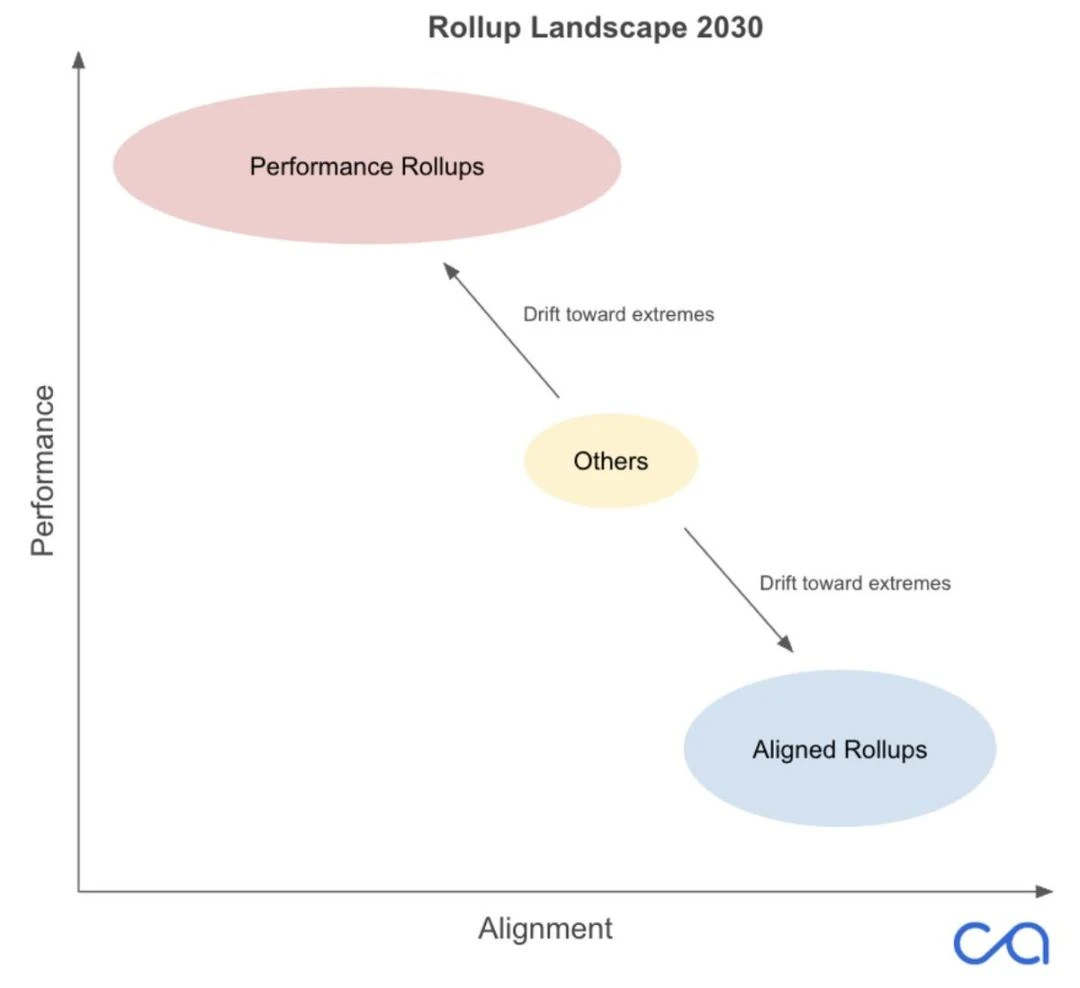
The Rollups in the upper left corner focus on performance: they may employ centralized orderers, alternative data availability networks (DA networks), or specific application optimizations to achieve throughput far exceeding conventional L2s (like MegaETH). Some performance Rollups may lean more towards alignment (for example, targeting the upper right "ideal goal" by adopting fast pre-confirmation technologies like Puffer UniFi and Rise), but their ultimate determinism still depends on L1's specifications. In contrast, the Rollups in the lower right corner maximize alignment with Ethereum: deeply integrating ETH into fees, transactions, and DeFi; solidifying transaction ordering and/or proof verification on L1; and prioritizing composability over raw speed (for instance, while Taiko is developing in this direction, it is also exploring permissioned pre-confirmation to optimize user experience). By 2030, I expect many "moderate" L2s to either shift towards one of the aforementioned models or face the risk of obsolescence. Users and developers will tend to choose high-security, Ethereum-aligned environments (for high-risk and composable DeFi scenarios) or highly scalable, application-customized networks (for mass user applications). Ethereum's 2030 roadmap lays the foundation for both paths.
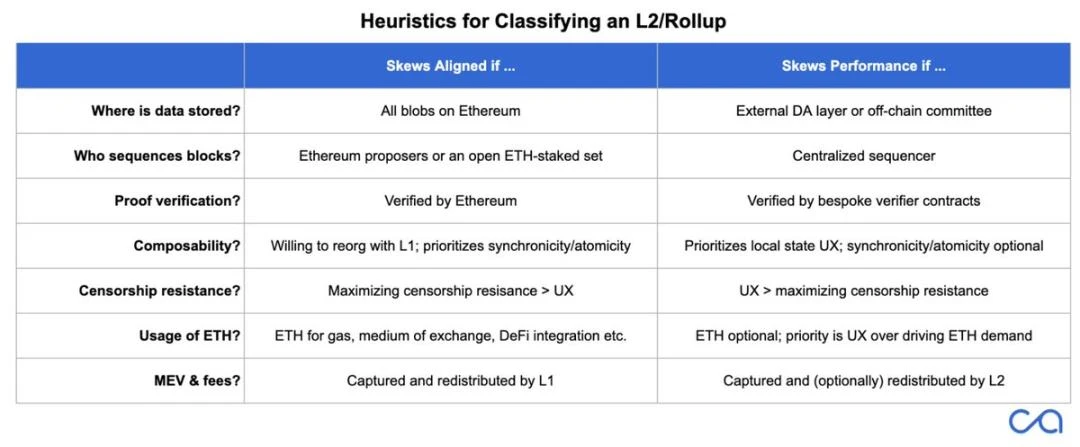
Why Will the Middle Ground Disappear?
Network effects will drive the market towards fewer, larger hubs. In markets like cryptocurrency, where network effects play a dominant role, a few winners may ultimately dominate the landscape (as we see in the CEX space). As network effects coalesce around the core advantages of a chain, ecosystems often consolidate around a few "performance-maximizing" and "security-maximizing" platforms. A Rollup that only achieves mediocre alignment with Ethereum may ultimately lack the security of the former and the usability of the latter.
As Rollup technology matures, economic activities will form layers based on the trade-off between "required security" and "cost of obtaining security." Scenarios that cannot bear settlement or governance risks, such as institutional DeFi, large on-chain treasuries, and high-value collateral markets, may concentrate on chains that inherit Ethereum's complete security guarantees and neutrality (or on Ethereum L1 itself). On the other end, applications aimed at the general public (such as memes, trading, social, gaming, retail payments, etc.) will cluster on chains that offer the best user experience and lowest costs, which may require customized throughput enhancement solutions or centralized ordering mechanisms. Therefore, those "adequate speed but not the fastest, decent security but not optimal" general-purpose chains will gradually lose their appeal. Especially by 2030, if cross-chain interoperability allows assets to flow freely between these two types of scenarios, the survival space for this middle ground will be even more limited.
Evolution of the Ethereum Tech Stack
Execution Layer
By 2030, Ethereum's current execution environment (using a 256-bit architecture and traditional design of the Ethereum Virtual Machine EVM) may be replaced or enhanced by a more modern and efficient virtual machine. Vitalik has proposed upgrading the Ethereum Virtual Machine to a RISC-V-based architecture. RISC-V is a streamlined modular instruction set that is expected to achieve significant breakthroughs in transaction execution and proof generation efficiency (improving by 50-100 times). Its 32/64-bit instructions can be directly adapted to modern CPUs and are more efficient in zero-knowledge proofs. To mitigate the impact of technological iterations and avoid stagnation (for example, the previous community's dilemma when considering replacing EVM with eWasm), a dual virtual machine model is planned: retaining EVM to ensure backward compatibility while introducing a new RISC-V virtual machine to handle new contracts (similar to Arbitrum Stylus's compatibility scheme for WASM + EVM contracts). This aims to significantly simplify and speed up the execution layer while aiding L1's scalability and Rollup support capabilities.
Why do this?
The design of EVM did not consider zero-knowledge proofs, so zk-EVM provers incur substantial overhead when simulating state transitions, calculating root hashes/merkle trees, and handling EVM-specific mechanisms. In contrast, the RISC-V virtual machine employs simpler register logic, allowing for direct modeling and proof generation, significantly reducing the required constraints. Its friendliness to zero-knowledge proofs can eliminate inefficiencies in gas calculations and state management, benefiting all Rollups that utilize zero-knowledge proofs: generating state transition proofs will be simpler, faster, and cheaper. Ultimately, upgrading EVM to a RISC-V virtual machine can enhance overall proof throughput, making it possible for L1 to directly verify L2 execution (as detailed below), while also raising the throughput ceiling of performance Rollups' own virtual machines.
Additionally, this will break through the niche of Solidity/Vyper, greatly expanding Ethereum's developer ecosystem and attracting more participation from mainstream development communities like Rust, C/C++, and Go.
Settlement Layer
Ethereum plans to transition from fragmented L2 settlement models to a unified, natively integrated settlement framework, fundamentally changing how Rollups settle. Currently, each Rollup must deploy independent L1 verification contracts (fraud proofs or validity proofs), which are highly customized and independent of each other. By 2030, Ethereum may integrate a native function (the proposed EXECUTE precompiled function) as a universal L2 execution validator. EXECUTE allows Ethereum validators to directly re-execute Rollup's state transitions and verify their correctness, essentially "cementing" the ability to validate any Rollup block at the protocol level.
This upgrade will give rise to "native Rollups," essentially programmable execution shards (similar to NEAR's design). Unlike ordinary L2s, standard Rollups, or L1-based Rollups, the blocks of native Rollups are validated by Ethereum's own execution engine.
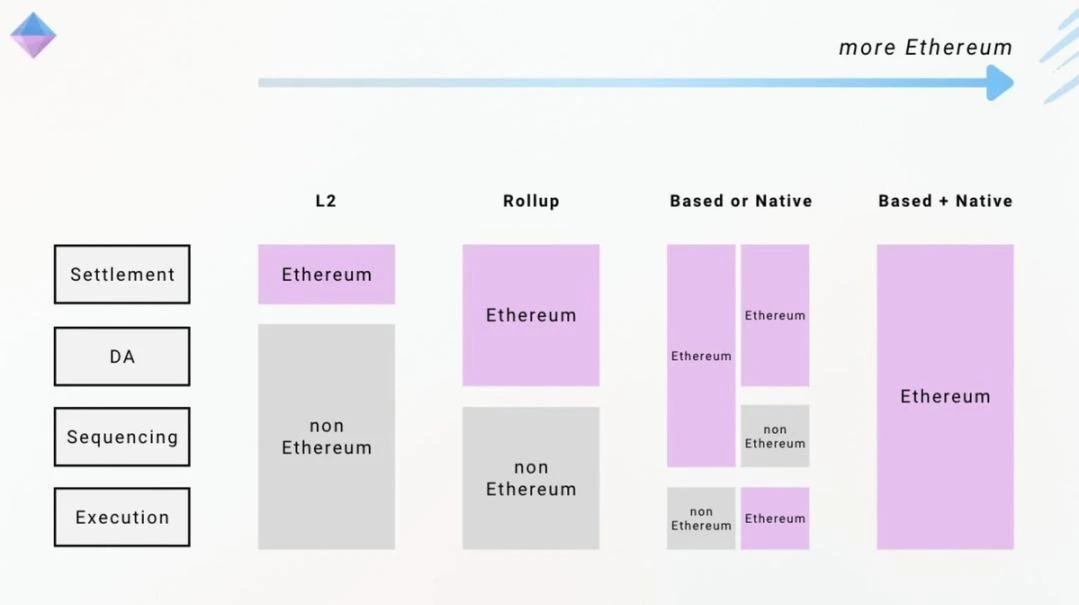
EXECUTE eliminates the complex custom infrastructure required for EVM simulation and maintenance (such as fraud proof mechanisms, zero-knowledge proof circuits, multi-signature "security committees"), greatly simplifying the development of equivalent EVM Rollups, ultimately achieving a fully trustless L2 with almost no custom code required. Combined with next-generation real-time provers (like Fermah, Succinct), real-time settlement can be achieved on L1: once Rollup transactions are included in L1, finality is reached without waiting for fraud proof windows or multi-period proof calculations. By building the settlement layer as a globally shared infrastructure, Ethereum enhances trusted neutrality (users can freely choose verification clients) and composability (without worrying about real-time proof issues in the same slot, synchronous composability is greatly simplified). All native (or native + L1-based) Rollups will use the same L1 settlement function, achieving standardized proofs and convenient interactions between Rollups (shards).
Consensus Layer
Ethereum's Beacon Chain consensus layer is being restructured into Beam Chain (planned for testing between 2027-2029), aiming to upgrade the consensus mechanism through advanced cryptographic techniques (including quantum resistance) to enhance scalability and decentralization. Among the six major research directions for upgrades, the core features relevant to this article include:
(The latest developments on Beam Chain can be followed through the YouTube series " Beam Call".)
Shorter slots, faster finality: One of Beam Chain's core goals is to enhance finality speed. The current finality of about 15 minutes (2 epochs under the Gasper mechanism, i.e., 32 + 32 12-second slots) will be shortened to 3-slot finality (3 SF, 4-second slots, about 12 seconds), ultimately achieving single-slot finality (SSF, about 4 seconds). 3 SF + 4-second slots mean that transactions can achieve final confirmation within 10 seconds of being on-chain, significantly improving the user experience for L1-based Rollups and native Rollups: the speed of L1 blocks will directly accelerate Rollup block generation. The time for a transaction to be included in a block is about 4 seconds (longer under high load), resulting in a 3-fold increase in the block speed of related Rollups (although still slower than performance Rollups, alternative L1s, or credit card payments, so pre-confirmation mechanisms remain important). Faster L1 finality can also ensure and accelerate settlements: Rollups can achieve final confirmation of state submissions on L1 within seconds, enabling quick withdrawals and reducing the risk of reorganization or forks. In short, the irreversibility of Rollup transaction batching will be shortened from 15 minutes to seconds.
Reducing consensus overhead through SNARKification: Beam plans to "SNARKify" the state transition function, attaching a concise zk SNARK proof to each L1 block. This is a prerequisite for achieving synchronous, programmable execution shards. Validators can verify blocks and aggregate BLS signatures (and future quantum-resistant signatures) without processing each transaction, significantly reducing the computational costs of consensus (while lowering hardware requirements for validators).
Lowering staking thresholds to enhance decentralization: Beam plans to reduce the minimum staking amount for validators from 32 ETH to 1 ETH. Combined with the separation of provers and proposers (APS, transferring MEV to on-chain auctions) and SNARKification, distributed anti-collusion block construction can be achieved, no longer favoring large staking pools (like Lido, which holds 25% market share), instead supporting more independent stakers using devices like Raspberry Pi. This will enhance decentralization and trusted neutrality, directly benefiting aligned Rollups. Under the APS mechanism, the number of proposers will decrease, but the inclusion list (FOCIL) will strengthen anti-censorship capabilities: once a prover includes a transaction in the list, even a small, globally distributed group of proposers cannot exclude those transactions.
All of this points to the future of Ethereum's base layer: it will possess stronger scalability and decentralization. In particular, L1-based Rollups will benefit the most from these consensus upgrades, as L1 will be better suited to their transaction ordering needs. By ordering transactions on L1, the maximum extractable value (MEV) from L1-based Rollups (and native L1-based Rollups) will naturally flow to Ethereum block proposers, and this value can be destroyed, thereby concentrating more value back into ETH rather than flowing to centralized orderers.
Data Availability Layer (DA Layer)
Data availability (DA) throughput is key to Rollup scaling, especially for performance Rollups that need to support 100,000+ TPS in the future. Ethereum's Proto-danksharding (Dencun + Pectra upgrade) has already increased the target and maximum number of blobs per block to 6 and 9, respectively, enabling blob data capacity of 8.15 GB/day (about 94 KB/s, 1.15 MB/block), but this is still insufficient. By 2030, Ethereum may achieve full danksharding, targeting 64 blobs per block (each 128 KB), which corresponds to about 8 MB/4-second slots (2 MB/s).
(Note: Proto-danksharding is a key technological upgrade in Ethereum's scaling roadmap, significantly enhancing network performance by introducing new data storage mechanisms. It is a transitional solution to Danksharding, with the core goal of reducing transaction costs for L2 solutions and enhancing data availability while laying the groundwork for future full sharding technology.)
Although this is a tenfold increase, it still cannot meet the demand of performance Rollups like MegaETH for ~20 MB/s. However, Ethereum's roadmap includes more upgrades: achieving data availability sampling (DAS) through solutions like PeerDAS (expected in the second half of 2025 - first half of 2026), allowing nodes to verify availability without downloading complete data, combined with data sharding to increase the target number of blobs per block to 48+. Under ideal Danksharding and DAS support, Ethereum could achieve a data processing capacity of 16 MB in 12-second slots, corresponding to about 7,400 simple transactions/second, which could reach 58,000 TPS after compression (such as aggregated signatures, address compression), and even higher when combined with Plasma or Validium (only on-chain state roots rather than complete data). Although off-chain scaling involves trade-offs in security and scalability (such as operator negligence risks), by 2030, Ethereum is expected to provide diversified DA options at the protocol level: offering complete on-chain data guarantees for security-focused Rollups and external DA access flexibility for scale-focused Rollups.
In summary, Ethereum's data availability (DA) upgrades are increasingly making it suitable for Rollups. However, it is important to note that Ethereum's current throughput is still far from sufficient to support high-frequency scenarios like payments, social interactions, and gaming. Even a simple ERC-20 transfer requires about 200 bytes of blob data, roughly calculating to about 20 MB/s of raw DA bandwidth; more complex transactions (like Uniswap swaps) will generate larger state differences, increasing the required bandwidth to about 60 MB/s! Relying solely on complete Danksharding technology will not meet this bandwidth requirement, so throughput improvements must rely on a clever combination of data compression and off-chain scaling.
During this period, performance Rollups will need to rely on alternative DA solutions like Eigen DA. These solutions currently provide about 15 MB/s of throughput and plan to increase to 1 GB/s; emerging solutions like Hyve even promise to achieve 1 GB/s of modular DA with sub-second availability. It is these DA solutions that will enable Web3 applications to achieve speeds and user experiences comparable to Web2.
Vision for Ethereum's World Ledger
By 2030, with core protocol upgrades and a Rollup-centric technological evolution, Ethereum will be better suited for this role. As mentioned earlier, the full tech stack upgrades will support two types of Rollup models: one leaning towards "deep Ethereum integration," focusing on security and trusted neutrality; the other leaning towards "light Ethereum integration," targeting extreme throughput and economic independence. Ethereum's roadmap does not enforce a single path but provides sufficiently flexible soil for both models to thrive:
Aligned Rollups: Ensure that high-value, highly related applications continue to receive strong security guarantees from Ethereum. Among these, L1-based Rollups can achieve Ethereum-level activity, with L1 validators responsible for both generating Rollup blocks and transaction ordering; native Rollups will have Ethereum-level execution security, with every Rollup state transition re-executed and verified on L1; while native L1-based Rollups (or super Rollups, i.e., execution shards) will possess 100% execution security and 100% activity, essentially becoming part of Ethereum L1. These Rollups will drive value accumulation for Ethereum L1: the MEV (maximum extractable value) generated by L1-based Rollups will flow directly to Ethereum validators, and through the MEV destruction mechanism, it can enhance the scarcity of ETH; invoking the EXECUTE precompiled function to verify native Rollup proofs will consume gas, creating new value inflow channels for ETH. If in the future, most DeFi and institutional finance operate on a few aligned Rollups, ETH will capture the fees of the entire economy. Ethereum's anti-censorship capabilities and MEV value capture mechanisms are the two key pillars for it to become the "world ledger."
Performance Rollups: Allow the Ethereum ecosystem to cover all categories of blockchain applications, including scenarios requiring large-scale processing capabilities. These chains are likely to become the mainstream adoption bridge, although they may introduce (semi) trust elements, they still use Ethereum as the final settlement layer and interoperability hub. The coexistence of performance and aligned Rollups enables the Ethereum ecosystem to support both top-tier security and top-tier throughput applications simultaneously. The heterogeneity and interoperability of L2 are more beneficial than harmful to Ethereum: although these Rollups have weaker economic ties to ETH, by using ETH as a gas token, transaction medium, DeFi pricing unit, and core asset for new applications in high-capacity environments, they can still generate new demand for ETH. Notably, the aforementioned Ethereum DA layer may support 100,000+ TPS, which means that even performance chains may ultimately return to the Ethereum DA layer rather than relying on modular alternatives (for reasons such as ecological synergy, trusted neutrality, and simplification of the tech stack). Of course, if they need to save costs or enhance performance, they can still choose other DA solutions, but the core point is that advancements in Ethereum's DA layer, data compression, and off-chain data management will continue to enhance L1's competitiveness.
Exceptions mainly involve Rollups deeply tied to trusted enterprises (such as Coinbase's Base, Robinhood's L2 network Robinhood Chain), where users trust these enterprises more than trustless systems (this effect is particularly evident among new users and non-technical users). In this case, the reputation and accountability mechanisms of the associated enterprises become the main guarantee, allowing these Rollups to maintain competitiveness while weakening Ethereum's alignment, as users are willing to "trust brands" as they do in Web2. However, their adoption largely depends on B2B trust; for example, JPMorgan's chain may trust Robinhood Chain more than Ethereum and the stronger guarantees provided by aligned Rollups.
Beyond this, the middle-ground Rollups are gradually integrating towards the two poles, likely a natural result of the maturity of these two paths. The reason is simple: middle-ground solutions can neither achieve high alignment nor reach top performance. Users focused on security and composability will choose Rollups that are closer to Ethereum; while users valuing low costs and high speeds will lean towards optimal performance platforms. Furthermore, as pre-confirmation technology upgrades, slot speeds increase, and L1 finality accelerates, the performance of aligned Rollups will continue to improve, further decreasing the demand for "moderate performance." Overall, the former is more suitable for institutional DeFi, while the latter is more suitable for retail-level applications.
Successfully operating Rollups require substantial resources (from attracting liquidity to maintaining infrastructure), and by 2030, integration will occur more frequently, with strong networks absorbing the communities of weaker networks. This trend is already evident. In the long run, an ecosystem composed of a few core hubs with clear value propositions will outperform hundreds of homogeneous systems.
Special thanks to mteam, Patrick, Amir, Jason, Douwe, Jünger, and Bread for their valuable discussions and feedback!
Recommended Reading:
U.S. House Passes Three Crypto Bills, How is the National Team's Bitcoin Chip War Going?
"Meme 2.0" Beginning? Pump.fun and the Future Path of On-chain Financing
From PayPal Gang to Investment Empire: Unveiling Peter Thiel's Founders Fund Origin Story (Part 1)
 Risk warning
 Risk warning


Popular articles





