Is this company the true stablecoin unicorn?

 $260 million in cash will be used to purchase ENA on the open market through a subsidiary of the Ethena Foundation.
Author: Alex Liu, Foresight News
On the evening of July 21, the native token ENA of Ethena saw a brief spike of 20% to reach 0.59 USDT due to the news of "Treasury Company planning to purchase 260 million US dollars of ENA tokens," setting a new high in nearly six months and triggering market discussions. This article will elaborate on the event and ENA's recent performance, analyze its potential impact on the Ethena project and the market, and assess the current status of the project.
StablecoinX Completes Financing and Seeks NASDAQ Listing
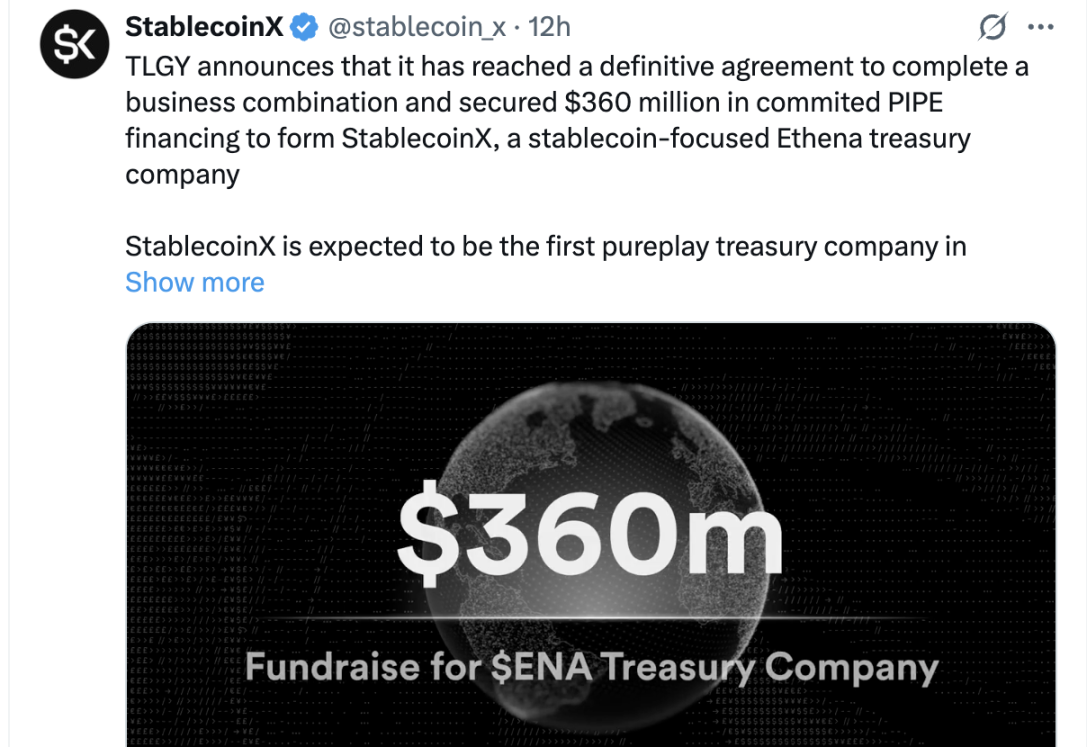
On the evening of July 21, Ethena announced that its StablecoinX company has reached a merger agreement with TLGY Acquisition Corp, planning to go public via a reverse merger and raise approximately 360 million US dollars. Among this, the Ethena Foundation will subscribe 60 million US dollars, with other institutional investors including Dragonfly, Pantera Capital, Galaxy Digital, Wintermute, Polychain, and Haun Ventures.
This round of financing is conducted in the form of PIPE (Private Investment in Public Equity), where 260 million US dollars is cash and 100 million US dollars is discounted locked ENA tokens. According to the announcement, these funds will be used to establish a long-term ENA treasury, and the new company StablecoinX plans to inject about 5 million US dollars daily to purchase ENA tokens from the open market, with a goal of accumulating approximately 260 million US dollars of ENA tokens within the next six weeks, accounting for about 8% of the current circulation.
StablecoinX will not only invest in ENA but also plans to operate technology infrastructure related to the Ethena ecosystem, such as running validator nodes and staking services. After the financing is completed, StablecoinX will list on NASDAQ with the stock code "USDE," and the Ethena Foundation will hold the majority of voting shares.
The Ethena team emphasized that these tokens will be locked in the long term and held permanently, with the Ethena Foundation retaining the right to veto any sale, aiming to support the ecosystem through continuous accumulation and increase the per-share ENA holding.
Recent Price Performance Review of ENA
Before the announcement of StablecoinX, the ENA token had already begun to rise rapidly. On July 20 (Sunday), the overall market rise led to an increase in funding rates, and mainstream assets like ETH and SOL rose, bringing funds into the previously sluggish Ethena. On that day, ENA surged 20%, breaking the 0.5 USDT level, marking its highest point since February of this year. Also, Ethena's "synthetic dollar" stablecoin USDe attracted about 750 million US dollars of net inflow, with its supply nearing the historical high of 6.1 billion. In this round of market trends, Ethena’s capital arbitrage strategy began to yield profits, causing sUSDe’s annualized interest rate to reach 10%, significantly exceeding traditional money market funds.
Potential Impact on the Ethena Project
The preparations and listing plans of StablecoinX hold significant meaning for the Ethena project itself.
First, this is another attempt for a DeFi project to actively interface with traditional capital markets, similar to the previous listings of Circle (USDC) and Ripple's tradable products, which show that the stablecoin sector is receiving significant attention from institutions. Ethena provides traditional stock market investors exposure to its "growth story" in the manner of a listed company, viewed by the industry as a signal of merging with traditional finance (TradFi). As the Ethena founder stated, this transaction offers stock market investors a pure investment object themed around "digital dollars."
Second, from the perspective of capital supply and demand, StablecoinX's plan to significantly increase its holdings of ENA and lock them in for the long term signifies that a strong buyer has entered the project's ecosystem. The daily purchase plan of 5 million US dollars over the coming weeks, along with a total procurement force of 360 million US dollars in cash and locked tokens, will significantly elevate the demand for ENA. This model, akin to a "Bitcoin treasury" (drawing from the logic of holding BTC), may provide long-term value support for ENA.
There are viewpoints suggesting that this stable capital allocation strategy could bring substantial user capital demand and raise the long-term floor value of the token to some degree. However, some analysis points out that this capital flow does not directly change the economic model of the Ethena project itself: the core mechanism of Ethena remains that users mint USDe by collateralizing crypto assets and execute hedging strategies to generate returns. The StablecoinX purchase plan will increase market demand, but it will not change the operational logic of the Ethena protocol, so whether the project's "fundamentals” have changed remains to be seen. In the long run, this essentially adds a stable "bullish ENA" capital party to the project, but if the basic arbitrage model sees variables (such as a fall in funding rates), the project’s return capabilities will still need to be tested.
Third, the macro-regulatory environment is also changing. Recently, the United States has passed several stablecoin regulatory laws, including the GENIUS Act. The GENIUS Act requires stablecoins to be fully asset-backed (cash or treasury bonds) and strengthens regulation, banning the issuance of dividend-like income-generating stablecoins, reflecting the dual interest of U.S. regulation and traditional finance in the stablecoin market.
For Ethena, its USDe belongs to “crypto-collateralized synthetic dollars” and may face compliance pressures under the new regulatory framework. If Ethena fully complies with U.S. stablecoin laws, it may need to adjust its hedging strategy. However, the Ethena team's current position is that USDe is not a stablecoin product intended for payment purposes but more of a synthetic asset tool, thus believing it is not directly governed by the new legislation. In summary, the listing and financing of StablecoinX occur against the backdrop of increasingly clarified compliance environments, which may bring more compliance considerations for Ethena, but also enhance the project's visibility and legitimacy in mature markets.
Assessment of the Current Status of the Ethena Project
Overall, Ethena is currently in a rapid development phase. First, the recovery of funding rates has indeed enhanced the attractiveness of USDe. Recently, the stablecoin strategy of Ethena hedging BTC, ETH, SOL, and other assets has been able to offer users nearly 10% annualized returns, far exceeding traditional dollar fund levels. This has attracted a flood of capital, with about 750 million dollars net minted last week, bringing the supply of USDe close to historical highs.
Second, regulatory and policy trends are noteworthy. The United States has signed the GENIUS stablecoin bill, which brings the issuance of stablecoins under Federal Reserve supervision, requiring 100% asset backing. This has had profound effects on currently mainstream stablecoins such as USDC and USDT. Ethena's USDe is considered a crypto-recollateralized stablecoin, which, under the new law's definition, may require adjustments or exemptions.
As mentioned earlier, Ethena is currently engaging with regulators to seek recognition of its synthetic dollar characteristics, thus avoiding direct constraints from the new regulations. However, if Ethena wants to offer USDe to American investors in the future, it may be required to increase reserve support with fiat or treasury bonds. In short, the uncertainty in regulation poses certain challenges for the project, especially regarding the compliance pressures that may arise from its high-yield model.
Finally, the project has made progress in integrating with traditional assets. For instance, Ethena has launched USDtb (a stablecoin backed by fiat or existing institutional assets) and invested some capital into dollar funds managed by BlackRock. These initiatives have, to some extent, enhanced the compliance and institutional recognition of its products. Additionally, Ethena's recent integration with the Telegram wallet and the launch of lending strategies have also added stickiness to its ecosystem. Nevertheless, Ethena is still a relatively young DeFi protocol and must face multiple tests, including compliance, competition, and market volatility, to achieve long-term stable growth.
In conclusion, the completion of financing and the launch of the ENA treasury plan by StablecoinX have brought positive effects to the Ethena project: in the short term, it has boosted the token price and provided appreciation expectations for holders. In the long run, this marks Ethena's attempt to connect its digital dollar theme with traditional capital markets, opening up new financing and distribution channels. However, this move does not fundamentally change Ethena's asset and revenue model, as its stablecoin operation still relies on the logic of crypto collateral hedging.
Therefore, whether the project's fundamentals have "been changed" remains difficult to conclude: the capital flow and listing support brought by StablecoinX are undoubtedly a significant benefit, but whether Ethena can continue to prove the robustness of its high-yield mechanism and whether it can cope with regulatory changes will still require time and further observation.
Recommended Reading:
"The Beginning of "Meme 2.0"? Pump.fun and Future Paths for On-chain Financing
Strong Prices, An Overview of the Four Major "Buy Orders" for ETH
 Risk warning
 Risk warning