








Popular Science: How to Evaluate the Value of Your Crypto Stocks Using NAV?

 NAV and other indicators are not a panacea, but powerful tools in the toolbox.
Author: Deep Tide TechFlow
There is no doubt that this round of the crypto bull market was first initiated in the U.S. stock market.
When the "crypto reserve strategy" becomes the trendsetter in the U.S. stock market and the correlation between cryptocurrencies and stocks emerges, how should we evaluate the quality of a stock? Should we look at who has the largest amount of crypto assets or who has the money to keep buying crypto assets?
If you have been frequently following analyses of crypto stocks recently, you might have come across a term that appears repeatedly — NAV, or Net Asset Value.

Some people use NAV to analyze whether crypto stocks are overvalued or undervalued, while others compare the stock price of a new crypto reserve company with that of MicroStrategy using NAV; but the more critical wealth code lies in:
A publicly listed company in the U.S. that adopts a crypto reserve strategy and holds $1 worth of cryptocurrency has a value greater than $1.
These companies with crypto asset reserves can continue to increase their holdings or buy back their stocks, leading to their market capitalization often exceeding their NAV.
However, for ordinary investors, most projects in the crypto space rarely use serious metrics for evaluation, let alone to assess the value of stocks in traditional capital markets.
Therefore, I also plan to do a piece on the NAV metric to help players interested in the correlation between cryptocurrencies and stocks better understand the operational logic and evaluation methods of crypto stocks.
NAV: How Much Is Your Stock Really Worth?
Before delving into crypto stocks, we need to clarify a fundamental concept.
NAV is not a metric specifically designed for the crypto market; rather, it is one of the most common methods for measuring company value in traditional financial analysis. Its essential function is to answer a simple question:
"What is the value of a company's stock per share?"
The calculation of NAV is very straightforward, which is the company's assets minus liabilities, giving the value that shareholders can receive per share.

To better understand the core logic of NAV, we can illustrate it with a traditional example. Suppose there is a real estate company with the following financial situation:
Assets: 10 buildings, total value of $1 billion; Liabilities: $200 million in loans; Total Shares: 100 million shares.
Then the company's net asset value per share would be: $80/share. This means that if the company liquidates its assets and pays off all debts, theoretically, each shareholder could receive $80.
NAV is a very versatile financial metric, particularly suitable for asset-driven companies, such as real estate companies and investment funds. The assets these companies hold are usually quite transparent, and their valuations are relatively easy, so NAV can effectively reflect their intrinsic stock value.
In traditional markets, investors typically compare NAV with the current market price of the stock to determine whether a stock is overvalued or undervalued:
If Stock Price > NAV: The stock may be trading at a premium, indicating that investors have confidence in the company's future growth potential;
If Stock Price < NAV: The stock may be undervalued, suggesting that the market lacks confidence in the company or that there is uncertainty in asset valuation.
When NAV is applied to crypto stocks, its meaning undergoes some subtle changes.
In the realm of crypto stocks, the core function of NAV can be summarized as:
Measuring the impact of a publicly listed company's crypto assets on its stock value.
This means that NAV is no longer just the traditional "assets minus liabilities" formula, but needs to specifically consider the value of the cryptocurrency assets held by the company. The price fluctuations of these crypto assets will directly affect the company's NAV and indirectly influence its stock price.
For companies like MicroStrategy, the calculation of NAV particularly emphasizes the value of their Bitcoin holdings, as this portion of assets constitutes a significant part of the company's total assets.
Thus, the above calculation can be slightly extended:

When crypto assets are included in the NAV calculation, some changes that you must consider are:
Increased Volatility of NAV: Due to the extreme price fluctuations of cryptocurrencies, NAV is no longer as stable as real estate or fund assets in traditional markets.
NAV Value "Amplified" by Crypto Assets: Crypto assets often trade at a premium in the market, meaning investors are willing to pay a price above their book value to purchase related stocks. For example, a company holds $100 million in Bitcoin assets, but its stock price may reflect the market's expectations for future appreciation of Bitcoin, leading to a market capitalization of $200 million.
When the market is bullish on the future price of Bitcoin, the company's NAV may be assigned an additional premium by investors; conversely, when market sentiment is bearish, the reference value of NAV may decline.
If you still don't understand NAV, let's use MicroStrategy as an example.

As of the time of writing (July 22), public data shows that MicroStrategy holds 607,770 Bitcoins, valued at $117,903 each, with a total Bitcoin asset value of around $72 billion, and other assets worth about $100 million, while the company's liabilities stand at $8.2 billion.
MicroStrategy's total shares are around 260 million, and according to the above calculation, its NAV is approximately $248 per share. This means that with BTC held as a crypto reserve, one share of MicroStrategy should be worth $248.
However, on the last trading day, MicroStrategy's actual stock price was $426.
This reflects market premium; if the market believes Bitcoin will rise in the future, investors will factor this expectation into the stock price, causing it to be higher than NAV.
This premium reflects that NAV cannot fully capture the market's optimistic expectations for crypto assets.
mNAV: The Crypto Stock Sentiment Thermometer
Beyond NAV, you may also frequently see some analysts and KOLs discussing another similar metric — mNAV.
If NAV is the basic metric for measuring how much a stock is worth, then mNAV is a more advanced tool that aligns better with the dynamics of the crypto market.
As mentioned earlier, NAV focuses on reflecting the company's current net asset situation (mostly crypto assets) without involving market expectations for these assets; while mNAV is a more market-oriented metric, used to measure the relationship between a company's market capitalization and its net value of crypto assets. Its calculation formula is:

Here, "net value of crypto assets" refers to the value of the cryptocurrency assets held by the company minus related liabilities.
We can use a table to clearly compare the differences between the two metrics:

Following the previous calculations, MicroStrategy's total market capitalization is around $120 billion, while the net value of its BTC (crypto assets + other company assets - liabilities) is about $63.5 billion, making its mNAV approximately 1.83.
This means that MicroStrategy's market capitalization is 1.83 times the value of its Bitcoin assets.
Therefore, when a company holds a large amount of cryptocurrency assets, mNAV can better reveal the market's expectations for these assets, reflecting investors' premiums or discounts on the company's crypto assets; for example, in the above case, MicroStrategy's stock price is at a premium of 1.83 times its net crypto asset value.
For short-term investors focused on market sentiment, mNAV is a more sensitive reference indicator:
When Bitcoin prices rise, investors may become more optimistic about the future performance of crypto asset-driven companies. This optimistic sentiment will be reflected through mNAV, causing the market price of the company's stock to exceed its book value (NAV).
If mNAV is above 1, it indicates that the market values the company's crypto assets at a premium; if mNAV is below 1, it means the market lacks confidence in the company's crypto assets.
Premiums, Reflexivity Flywheel, and Death Spiral
As mentioned earlier, MicroStrategy's mNAV is around 1.83;
As ETH increasingly becomes an asset reserve for listed companies, understanding these companies' mNAV is also of certain reference significance for identifying whether corresponding U.S. stocks are overvalued or undervalued.
Analyst @Jadennn326eth from Cycle Trading has compiled a fairly detailed table that visually displays the asset-liability situation and mNAV values of major ETH reserve companies (data as of last week).
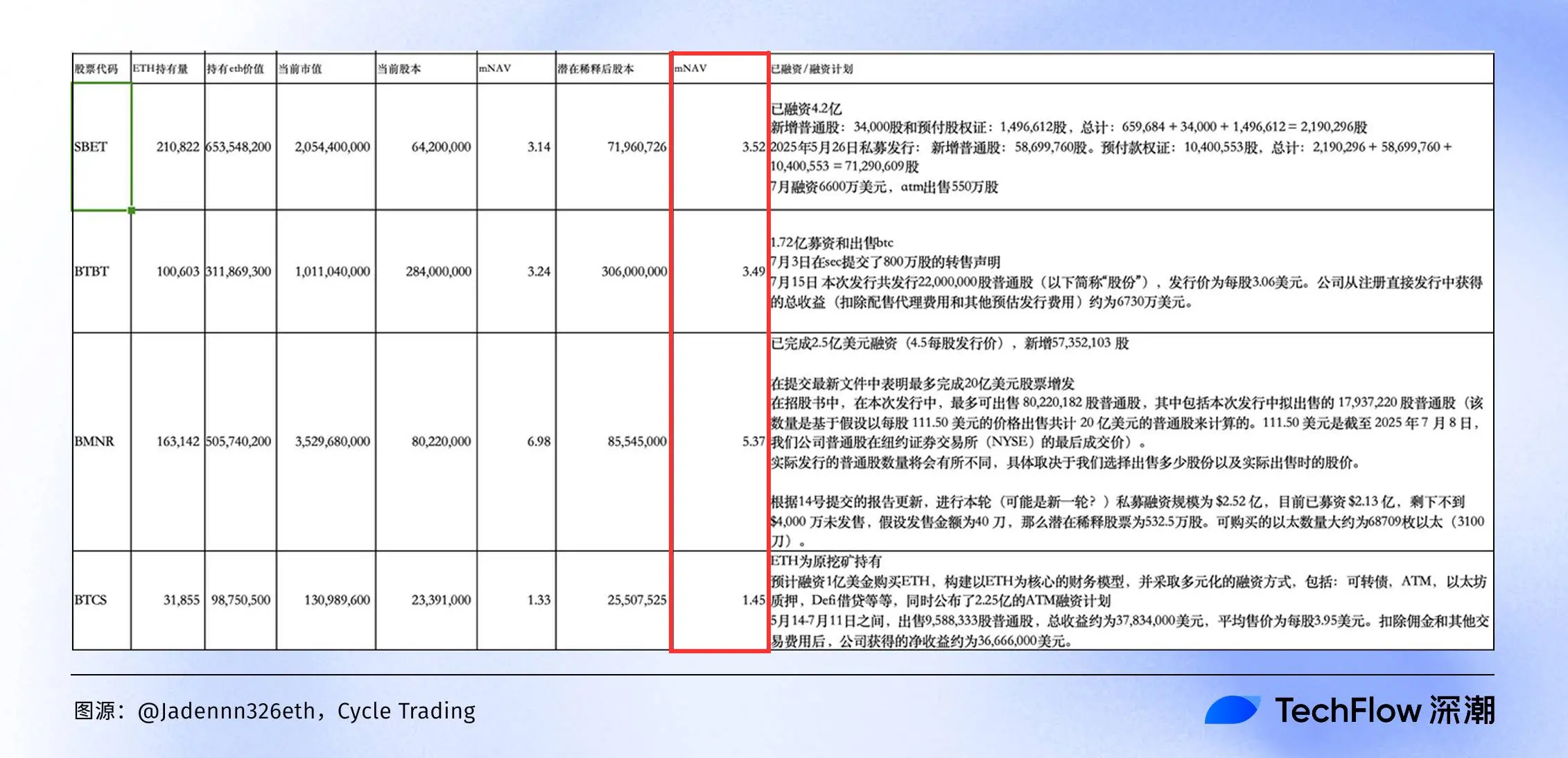
(Image source: @Jadennn326eth, Cycle Trading)
From this mNAV comparison chart of ETH reserve companies, we can quickly see the "wealth map" of crypto stocks in 2025:
BMNR tops the list with an mNAV of 6.98, with a market capitalization far exceeding the value of its ETH holdings, but this may hide an overvaluation bubble — once ETH corrects, the stock price will also be the first to suffer damage. In contrast, BTCS has only an mNAV of 1.53, indicating a relatively low premium.
Having seen the data of these companies, we must discuss the "Reflexivity Flywheel."
This concept originates from financial mogul George Soros's theory of reflexivity, which has become the "secret engine" behind the soaring stock prices of these companies in the crypto stock bull market of 2025.
In simple terms, the reflexivity flywheel is a positive feedback loop: The company first issues stocks or raises funds through ATM (At-The-Market) financing, using the cash to buy ETH in large quantities; the increase in ETH holdings boosts NAV and mNAV, attracting more investors, leading to skyrocketing stock prices; a higher market capitalization makes it easier for the company to refinance and continue increasing its ETH holdings… thus forming a self-reinforcing, snowball-like flywheel effect.

However, once ETH prices correct, regulatory tightening (such as SEC scrutiny of crypto reserve models), or financing costs soar, the ascending flywheel may reverse into a death spiral: stock prices collapse, mNAV plummets, and ultimately, it may be the retail investors in the stock market who get hurt.
Finally, by now you should understand:
Metrics like NAV are not a panacea but rather powerful tools in a toolbox.
Players chasing the correlation between cryptocurrencies and stocks should rationally assess the macro trends of Bitcoin/Ethereum, the company's debt levels, and growth rates to find their own opportunities in a new cycle that seems full of opportunities but is actually fraught with dangers.
Recommended Reading:
BitMine Stock Price Soars: Silicon Valley Venture Capitalist Peter Thiel Bets Big on Ethereum
Price Stays Strong: A Summary of the Four Major "Buy Orders" for ETH
After a 70% Plunge, Still at a 100% Premium? The Mystery of SharpLink's ETH Bet Continues
 Risk warning
 Risk warning




Popular articles





