








Paradigm incubation, Ventuals attempts to bridge the "last mile" of on-chain private equity transactions | CryptoSeed
 Siblings founders create an on-chain derivatives platform, allowing ordinary investors to short OpenAI and go long on SpaceX.
Author: Zz, ChainCatcher
In June 2025, on its first day of trading, Circle's stock performance ignited market enthusiasm, surging over 168%. However, this was a celebration for secondary market investors, while a deeper data point struck a nerve for many: according to Venture Capital Journal, early-stage venture capital firms had seen their paper returns reach about 8 times their total investment.
The primary market is large but also closed. The trillion-dollar IPO pre-market is still dominated by a few players.
Ventuals aims to change this situation, with the goal of "fragmenting" the equity of these unicorns, thereby lowering the barriers to entry, breaking the monopoly of venture capital firms, and allowing ordinary investors to share in the profits before a company goes public.
Project Advantages and Innovations
Alvin Hsia and Emily Hsia, this sibling duo, bring their wild idea: what if ordinary people could short the valuation bubble of OpenAI like hedge funds, or leverage $100 to go long on the next SpaceX?
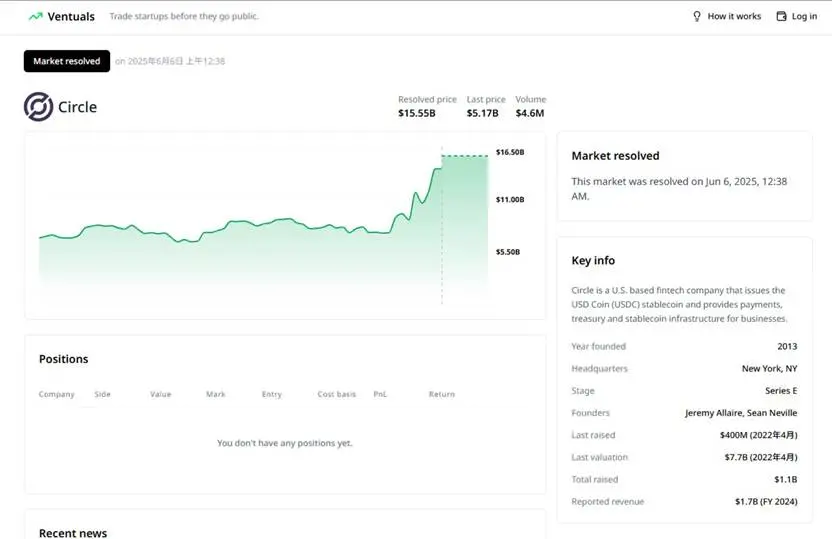
As X user @LS J1mmy commented: by investing in the unicorn company Circle using Ventuals, you can go long at a $7 billion valuation before its IPO; without using Ventuals, you can only buy the stock at a $15.5 billion opening valuation when it lists on the US stock market. Ultimately, the former yields a return of 240%, while the latter only offers 55%.
The core challenge of Ventuals, and its greatest innovation, lies in how to price private equity that does not have a public trading market. Traditional oracles rely on exchange prices; however, OpenAI has no exchange, no candlestick charts, no depth, and not even daily trading. How do we arrive at a valuation?
Ventuals' solution consists of two parts: a high-performance underlying infrastructure and an elegant pricing mechanism.
First, it chose the most difficult path: building a perpetual contract market on Hyperliquid. The reason for choosing Hyperliquid is clear: sub-second latency and 100,000 orders per second. This is not an ordinary blockchain; it is a financial infrastructure born for high-frequency trading, providing performance guarantees for complex derivatives trading.
Second, and most crucially, Ventuals designed an "optimistic oracle" to solve the valuation problem. Simply put: anyone can submit a valuation and stake collateral. If someone disagrees, they can initiate a challenge; if no one challenges, the valuation is considered the "truth" of market consensus; if there is a dispute, it is resolved through voting.
This mechanism transforms the power struggle of "who gets to decide" into an economic game of "who dares to put their money where their mouth is," reliably bringing a subjective off-chain consensus on-chain. In the crypto world, this is called "implementing justice through code."
Founding Team's Technological Evolution
For such a bold idea, the background and experience of the founding team are crucial. Alvin and Emily Hsia did not emerge from nowhere; as former resident entrepreneurs at Paradigm, their previous project Shadow has already proven itself—securing $9 million in seed funding led by Paradigm.
Looking back at the entrepreneurial trajectory of the Hsia siblings, one can find an exceptionally clear logical chain:
Shadow addresses the question of "how to efficiently extract data from the chain." It mirrors the state of public chains to create a read-only execution environment, allowing developers to access on-chain information at low cost. This is a process of "outputting" data.
Ventuals addresses the question of "how to reliably bring off-chain subjective data on-chain." The valuation of unlisted companies it deals with is essentially an off-chain consensus that needs a mechanism to transform it into on-chain facts. This is a process of "inputting" data.
The two projects may seem different, but they are fundamentally connected: both are building a more powerful data layer for blockchain. This may explain why the top fund Paradigm, known for its technological research, continues to bet on them. In their view, data infrastructure is the next frontier for DeFi. This clear technological evolution path is the most solid foundation of trust for the Ventuals project.
The Next CME or a High-Risk Playground?
Ventuals' ambition goes beyond trading. Imagine a scenario: when OpenAI's next round of financing is overvalued, the market expresses dissatisfaction through large-scale shorting; when a scandal involving a unicorn is exposed, its valuation contracts plummet instantly. Every transaction on-chain is public and transparent, financial media reports in real-time, and public pressure forces companies to reform. This is true market democratization—not just allowing everyone to buy stocks, but enabling everyone to express their judgment on a company's value.
However, revolutionaries often risk dying in the midst of revolution. Regulation hangs like a Damocles sword. Will the SEC classify these contracts as unregistered securities? Will the CFTC deem this illegal futures trading? What’s more concerning is oracle security; if valuations are manipulated, large-scale liquidations will destroy all trust. In a system that relies on "consensus" pricing, a collapse of trust means everything goes to zero.
As MicroStrategy rewrites corporate finance rules by holding Bitcoin, and as Tesla's stock price resembles cryptocurrency more than traditional stocks, the boundaries of finance are dissolving. Ventuals stands at this crossroads. To the left, it may become a niche casino for high-risk traders. To the right, it could become the Chicago Mercantile Exchange (CME) of the private market, redefining the pricing mechanism of a trillion-dollar market.
As the significant profit disparity on Circle's IPO first day reveals: the excess profits created by information asymmetry are the last bastion that DeFi aims to eliminate. In this game of David versus Goliath, the two Paradigm disciples may hold that crucial stone.
(This article is for reference only and does not constitute investment advice.)
 Risk warning
 Risk warning



Popular articles





