








Historic step: Official U.S. GDP data will be stored on nine major public blockchains including Bitcoin and Ethereum

 For the cryptocurrency industry, this marks a shift of core data from traditional centralized institutions to on-chain native availability in the world's most important economies. On one hand, this government-led data on-chain initiative brings new endorsement to the crypto world. On the other hand, it is also a symbolic move by the Trump administration in promoting the "crypto capital."
Author: Frank, PANews
On August 28, the U.S. Department of Commerce announced that starting from the GDP data of July 2025, actual Gross Domestic Product (GDP) data will be published on the blockchain. The first batch of data types includes six relevant types such as actual GDP, Personal Consumption Expenditures (PCE) price index, and actual final sales to domestic private purchasers.
This data on-chain initiative involves 9 public chains and 2 oracle networks. For the crypto industry, this marks a significant shift as core data from the world's most important economy moves from traditional centralized institutions to being natively available on-chain. On one hand, this government-led data on-chain initiative brings new endorsement to the crypto world. On the other hand, it is also a symbolic move by the Trump administration in promoting the "crypto capital."
Dual Structure of "Proof" and "Application"
First, from a technical perspective, PANews provides an overview of the data on-chain process.
According to the official statement from the U.S. Department of Commerce, the core operation is to embed the cryptographic hash value of the official GDP report PDF file—essentially the unique "digital fingerprint" of this document—into the transactions of these nine chains. The first batch of blockchain networks used includes Bitcoin, Ethereum, Solana, TRON, Stellar, Avalanche, Arbitrum One, Polygon PoS, and Optimism.
Through this operation, anyone can verify whether the report has been tampered with by comparing the on-chain hash value with the hash value of the official report.
Additionally, Chainlink and Pyth, two leading oracle platforms, were chosen for this data on-chain initiative. As middleware services between blockchain and the real world, the primary task of oracles is to securely and reliably "feed" external (off-chain) real data to the blockchain network.
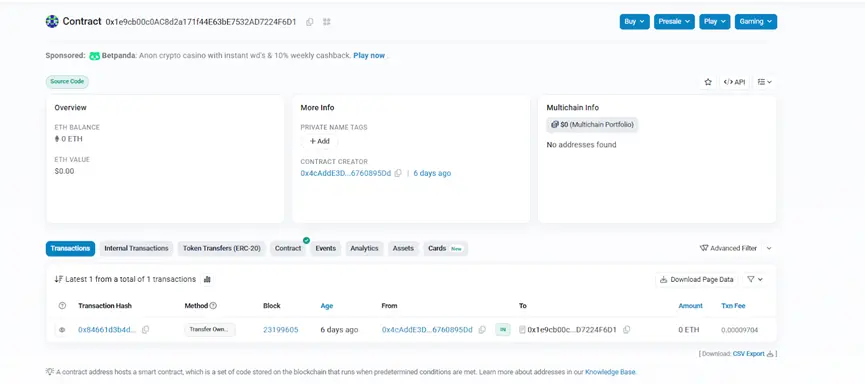
GDP data contract on Ethereum
Therefore, selecting Chainlink and Pyth can better distribute this on-chain data to applications and ecosystems that need to utilize it. Chainlink's official website currently features a dashboard function for these six data types.
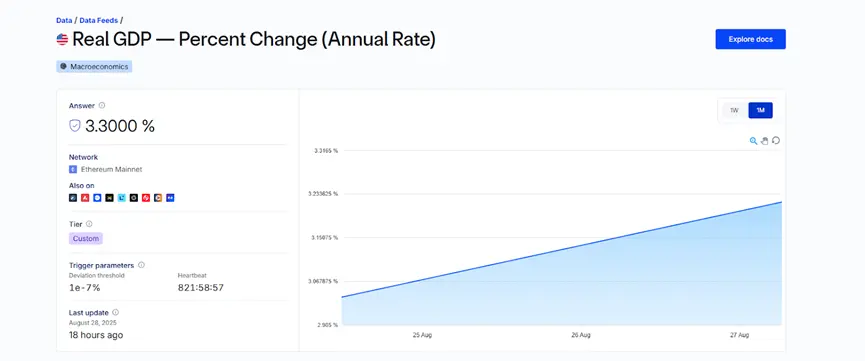
However, unlike the nine public chains announced by the U.S. Department of Commerce, Chainlink's documentation shows that it currently supports ten public chain networks, including Arbitrum, Avalanche, Base, Botanix, Ethereum, Linea, Mantle, Optimism, Sonic, and ZKsync.
This may seem like a conflict, but it is not due to an information synchronization error. Rather, the lists of blockchains mentioned by the two parties serve different roles in this process. In simple terms, the nine public chains announced by the U.S. Department of Commerce are used as original data verification networks for proof. In contrast, the ten blockchain networks listed by Chainlink are the first batch of blockchains supported by its data feed service. The common characteristic of these chains is that they are all active smart contract platforms (mainly Ethereum and its Layer 2 scaling networks).
Political "Stunt"? But Beneficial for On-Chain Products
What are the actual pain points behind this data on-chain initiative? The real reasons may stem from two aspects.
From the perspective of the crypto industry, this data on-chain initiative, especially the integration of leading oracles like Chainlink and Pyth, can provide a more direct and authoritative source of GDP and other core U.S. economic data for the crypto industry, benefiting the stability of products linked to this official data, such as stablecoins, RWA, and prediction markets.
From another angle, this data on-chain move has a profound and complex relationship with former President Trump and his administration's historical behavior of questioning the reliability of official data.
During his presidency, Trump publicly accused unfavorable economic data (such as GDP growth or employment data) of being "manipulated" or "biased" on multiple occasions. In August, he fired Labor Statistics Bureau Director Erika McEntarfer due to an unsatisfactory employment report, accusing her of releasing "false" data.
From the perspective of the U.S. Department of Commerce, writing GDP and other data onto the blockchain seems to be a proactive response to Trump's doubts about the authenticity of the data. However, many U.S. media outlets believe that such manipulation does not fundamentally resolve the issue of data fabrication. After all, the act of putting data on-chain only addresses data proof but does not guarantee the objectivity and authenticity of the core data source.
PYTH Soars, While Public Chain Tokens Remain Unmoved
Regardless of the ultimate goal and actual effect, this data on-chain initiative led by the U.S. government can ultimately be summarized as a further recognition of blockchain.
However, from the public chain list released by the U.S. Department of Commerce, it seems that the governance tokens of these public chains did not experience a price increase stimulated by this news. The collaborating Chainlink token LINK did see a quick surge on the evening of the 28th, but subsequently fell again as the market weakened.
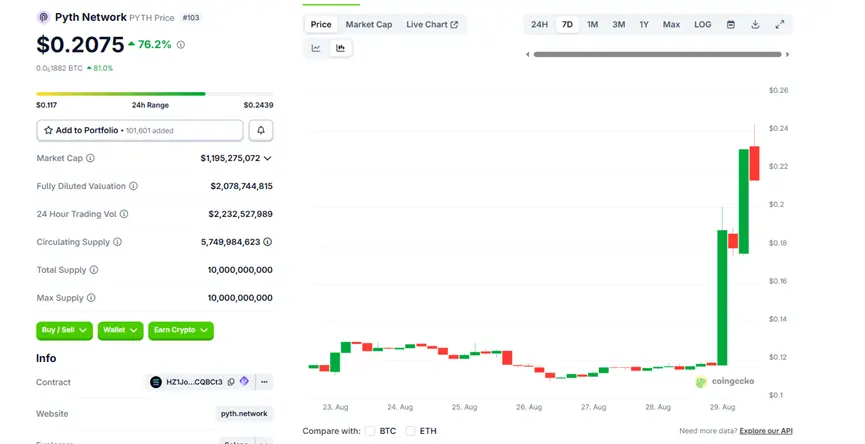
The only token that truly showed a significant response to this news was Pyth, whose token price quickly surged from around $0.11 before the announcement to a peak of $0.25, with a maximum daily increase of 110%, adding over $600 million to its market capitalization.
From this divergence, the surge in PYTH tokens may have been actively driven by capital. The actual support for this news may not be strong.
However, this may just be the beginning. Secretary of Commerce Gina Raimondo clearly stated during the announcement that after the Department of Commerce "finalizes all details," there are plans to promote this blockchain-based data infrastructure to all federal agencies. This means that in the future, various public data from the U.S. government may be published in a similar manner.
Overall, while the immediate market impact of this data on-chain action by the U.S. may not be strong, its long-term influence on the entire crypto industry could be greater. This marks the opening of a new door for mainstream public chains to serve as the core layer for data storage.
 Risk warning
 Risk warning





Popular articles





