








Is InfoFi "mouth play" or the creator economy? A gold-digging guide from six guests

 Exploring the Opportunities and Challenges for InfoFi Today
Editor: Viee, Core Contributor of Biteye
On the evening of August 20, Biteye and Xhunt jointly held an AMA themed "The Correct Guide to Mining InfoFi," inviting six guests from different roles—including representatives from projects, platform builders, and content creators deeply involved in InfoFi, as well as well-known KOLs—to discuss the opportunities and challenges of InfoFi in the current landscape.
As InfoFi is increasingly referred to as a new track for "mouth mining," is it merely a short-term traffic frenzy, or is it the embryonic form of the next generation of the creator economy? In this two-hour discussion, the guests provided answers from various dimensions.
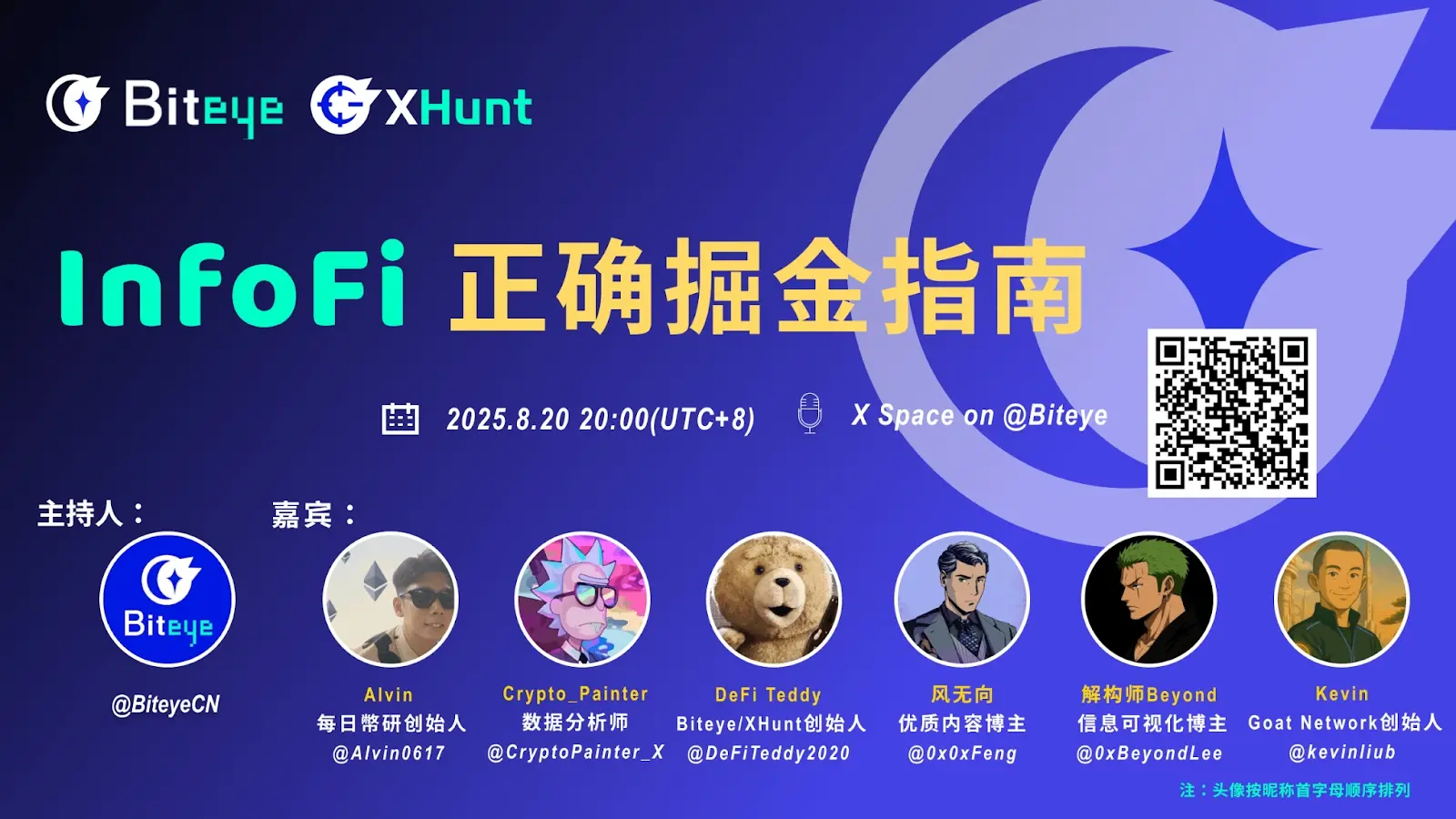
Guests and Hosts
Host / Organizer: Xhunt, Biteye
Guests:
DeFi Teddy: Founder of Biteye & Xhunt
Kevin: Co-founder of Goat Network
Crypto Painter: Data Analyst
Feng Wuxiang: Quality Content Blogger
Deconstructor Beyond: Information Visualization Blogger
Alvin: Founder of Daily Coin Research
TL;DR
- InfoFi = Creator Economy + SocialFi + AI, essentially a new evolution of attention economy in Web3.
- For project parties, the value of amplifying heat during the Pre-TGE phase is immense, but the challenge lies in avoiding interference from AI-generated content and matrix accounts.
- For creators, the real core is not the rankings and short-term airdrops, but building personal IP and continuously delivering value.
- InfoFi has already become an important link connecting project parties, creators, and communities, but it urgently needs a fairer and more precise incentive mechanism.
- In the coming months, platforms may introduce new metrics such as on-chain data and reputation systems to promote the transition from "quantity competition" to "real contribution."
- The Core Logic of InfoFi: A New Lever of Attention Economy
1.1 Many users still have doubts about InfoFi: What is it? Why is it worth paying attention to and participating in?
DeFi Teddy: Everyone has a different understanding of InfoFi. From the builder's perspective, I break it down into three parts: Creator Economy + SocialFi + AI (large language models).
- Creator Economy: Writing articles for projects, doing media/KOL work, and receiving rewards is a common monetization method.
- SocialFi: Social dissemination adds "leverage" to content. Good content amplified through sharing has a "better and better" effect.
- AI (large models): Enables the platform to assess text quality, originality, relevance, and other dimensions at a low cost and with high accuracy. Without large models, many InfoFi capabilities cannot be realized.
Why is it worth paying attention to? Because it makes it easier to earn money. Previously, writing an article might earn a few hundred or a few thousand dollars; with InfoFi, the wealth effect is completely different. It efficiently matches quality KOLs with suitable projects at a lower cost, meaning creators earn money while project parties gain amplification, forming a positive feedback loop.
Moreover, the essence of InfoFi is the attention economy. During the Pre-TGE phase, when prices have not yet become "the best advertisement," amplifying discussion heat through InfoFi is crucial. Moving forward, I am also watching whether the InfoFi platform will pivot towards Launchpad, further transforming the attention economy into a token economy, which is a natural commercialization path.
2. Platform Perspective: The Game Between Reward Mechanisms and Quality Content
2.1 What are some quality InfoFi platforms? How do they discover and incentivize quality content? Discuss the characteristics and differences of platforms like Kaito.
Alvin: I was first attracted to Kaito not because of "mouth mining," but because it started from a terminal used by institutions/researchers, providing valuable data despite its cost. It offers a dashboard for track and token heat, helping to judge market trends (such as the rise of memes, the recovery of DeFi, the strengthening of Solana, etc.).
Later, top projects like Bearshin and Movement adopted InfoFi's "new reward distribution model," enhancing the importance of InfoFi in the crypto space. I also pay special attention to the smart yappers category, which emphasizes creators with small followings but high influence, identifying "truly influential" small accounts from a data perspective.
Additionally, Ethos and Xhunt are more like on-chain reputation/account authenticity platforms: identifying whether content is AI-generated and whether accounts have "soul." Xhunt also has a "soul index." For newcomers, these tools help you quickly get started and filter information. As platform algorithms upgrade, AI-generated content is being suppressed, which is good for the ecosystem. The next focus is on fairer reward distribution and more sustainable influence mechanisms.
2.2 Please let Beyond elaborate on platform differences and value?
Deconstructor Beyond: The key for Kaito is to "price information," internalizing and quantifying the originally external "influence." Content creators can see feedback from yapper, smart followers, etc., and project parties and institutions can allocate resources and incentives accordingly. Cookie has a similar approach.
Ethos/Xhunt focuses more on the account itself (authenticity, credibility, weight), compensating for the distortion of past metrics that only looked at "follower count/likes/shares" (which can easily be manipulated). InfoFi decentralizes the discourse power, allowing small accounts to be discovered.
But I remind everyone not to overly focus on direct incentives. Treat airdrops as a byproduct; the long-term construction of IP and genuine connections with real readers is the core.
3. Project Party Perspective: How to Transition Users from "Mouth Mining" to Contribution
3.1 From the project party's perspective, what challenges and strategies are encountered in InfoFi?
Kevin: Initially, we were very excited: finally, there was a quantifiable "dashboard" to measure a project's mindshare on social media. However, after going live, we found that reality differed from our expectations: there are many projects in the Pre-TGE pool, and attention is dispersed; more critically, the mid-tier KOLs we hoped to engage are not proactive. Their input-output ratio on Kaito is not proportional, their weight diluted by AI farmers, and matrix accounts can "win by quantity over quality."
Our strategy has three points:
- One-on-one communication with mid-tier KOLs to explore individual incentives/independent pools;
- Launching an ambassador program and Content Hub to support small and medium KOLs and ordinary users, lowering the barriers to creation and helping them produce better content;
- Encouraging "use before writing": letting users first genuinely use the network/application/bridge/game, then share firsthand experiences, transitioning from "mouth mining" to network contributors. We will reward contributors, not AI farmers, and collaborate with Xhunt, Biteye, etc., to identify and demote to direct incentives to genuine participants.
4. KOL Perspective: The Essence of Influence
4.1 As a well-known KOL not participating in InfoFi, how do you view "content mining"?
Feng Wuxiang: Currently, InfoFi has some issues, with an overflow of AI-generated long articles turning it into a "garbage dump." We are in an era of fragmented reading, and long AI articles have weak influence. Many are matrix accounts mutually boosting each other's metrics, with no conversion to buying. This also "drags down" mid-tier bloggers, who mine daily, deviating from real product and community building.
Good projects do not necessarily need content mining. Take Hyper as an example; it has almost no marketing budget, but the product is good, and the community is strong; Backpack also grows together with projects, with data and transactions "voting with their feet." In contrast, many accounts below mid-tier in InfoFi are artificially inflated, with weak actual buying and conversion. Those truly generating buying are professional trading bloggers, who may not have many followers but have stronger monetization and influence.
My airdrop from Kaito was zero (demoted), which is not cost-effective for me. For newcomers wanting to become KOLs, it is a path, but they should be wary of being "bent by five pecks of rice"; focusing on projects and accompanying their growth is more important.
5. User Perspective: How to Build Influence and Correctly Participate in "Content Mining"
5.1 Please share your methodologies on "influence" from your respective perspectives, and how to correctly participate in content mining and account building?
Feng Wuxiang: The essence of influence is "internal seeking"—mastering a skill to perfection (trading, mining, memes, writing). If you can help your followers earn money or enhance their understanding, influence will naturally follow. Many people seek external validation by boosting metrics, neglecting the essence of trading/research itself.
Strengthen internal skills → Share reflections → Expand resonance, forming a "Davis double-click." You don’t have to become a top trader like "Ying Ying," but being a mini version is sufficient; that is, first earn money, then become a KOL.
Crypto Painter: First, ask yourself why you want influence. If it's just for monetization or rankings, it's easy to fall into data manipulation and self-deception. True influence is a byproduct of value; followers are willing to stick with you because they learn or earn.
My approach is long-termism; I have faith in Kaito's business model and on-chain real income (officially disclosed data). I choose to mine less, research more, and hold genuinely, focusing on 1-3 projects to deepen content. When you continuously output "content with your own ideas that resonates," the algorithm and community will naturally elevate your weight; influence is not "grabbed," but rather recognized when you do things right. Once you reach that level, you can also rank high on new project lists in a week—provided you speak plainly, speak the truth, and produce original content, avoiding "Grok one-click water articles."
Deconstructor Beyond: Treat airdrop incentives as byproducts; don’t make "mining" your main business. All rules have loopholes, and profit margins will be smoothed out by studios; it's hard for real people to outpace matrix accounts; long-termism is the only way to traverse cycles.
The core is the link between IP and real people, as data can be manipulated, but trust cannot. I recommend simultaneously managing communities/private domains to form a credible network with real creators/KOLs. Minimize data manipulation, manage expectations, and understand that when abilities do not match data, it will eventually lead to "a mud cow entering the sea." Attract readers with real value, not by "deceiving readers" with data.
6. Future Outlook for InfoFi
6.1 In the next 3-6 months, how will InfoFi evolve? Please discuss predictions and paths.
Alvin: If AI accounts continue to take rewards, the system will become unbalanced. The platform is moving towards comprehensive weighting, such as combining on-chain activity, wallet age, interaction behavior, etc. Additionally, task platforms will merge with InfoFi, allowing InfoFi project parties to build their own ecosystems/incentive programs, comprehensively measuring "early participation + content contribution." In the future, it will be more dimensional and customized.
Crypto Painter: From Kaito's Launchpad and Venture, it can be seen that the platform is filling the "discourse power/pricing power," directly converting influence into buying power, and regulating project parties' changes through rules, making distribution more predictable. AI-generated content has significantly decreased, but the comment section still needs optimization. Next, it may include holding positions/NFTs/historical assets as reward conditions, realizing a distribution logic of "not just talking, but also holding real positions/real participation."
I also believe that data infrastructure like Xhunt's "account authenticity/soul degree" will deeply couple with InfoFi applications like Kaito, jointly promoting fairer content distribution. InfoFi is a slow-burning long-distance race, and in the end, what remains will be true creators and true value platforms.
Kevin: From the project party's perspective, the difficulty of entrepreneurship in this cycle is high, and cooperation with KOLs/platforms is a necessity; the demand for InfoFi will continue to exist. The key lies in three points:
- Establishing a fairer mechanism to identify and eliminate AI/farmer interference;
- Introducing more tools and metrics (on-chain transactions, social activity, reputation systems, etc.) to measure real contributions.
- Whether the application of InfoFi will spill over into more scenarios (such as prediction markets, etc.), the collection and refinement of information will generate more new use cases.
7. Xhunt Welcomes an Upgrade, Launching Unique InfoFi Projects
7.1 Please explain the influence ranking, soul index, and other mechanisms of Xhunt.
DeFi Teddy: Measuring KOLs is not a single dimension; we look at the following four aspects.
- Influence Ranking: Not solely based on follower count (which can be inflated), but focusing on the attention of mid-tier and above KOLs, which are harder to manipulate.
- Soul Index: Measures "speaking the truth, speaking human language, non-AI generated, and not excessive commercial promotion," assessing whether fans "gain nutrition/value."
- Capability Model: Evaluates the match between vertical expertise (airdrops/DeFi/memes…) and user interests.
- Token Mention: Tracks the price trends after KOLs mention a certain token; if "every shout leads to a drop," then that is not a good KOL.
7.2 What are the two major upgrades?
Search and Recommendation: Real-time ranking and recommendation within the site based on segmented dimensions (updated every few hours).
InfoFi Projects (coming soon), which differ from common platforms, have four core points:
- AI Farming Recognition: Self-developed algorithms identify whether accounts/content are AI farming, accurately removing matrix accounts and giving rewards to those who write with care.
- Originality Algorithm: Combines a large-scale text and image database to determine "who is the original creator," with significantly lower originality scores for second "follow-up" writings.
- On-chain Behavior Integration: Requires wallet binding, combining on-chain participation + tweet content to comprehensively measure contribution.
- Dual Ranking Mechanism: Proof of Influence focuses on influence + originality; Proof of Work emphasizes content output + on-chain behavior. Small accounts can surpass large accounts as long as they write well and participate solidly on-chain.
We welcome everyone to continue experiencing Xhunt and participate in the upcoming InfoFi projects!
(This interview is for informational sharing only; Biteye does not endorse the content of the interview. Investment involves risks; please invest cautiously.)
 Risk warning Risk warning

Popular articles





