








No Turning Back Experiment: Huaxing Capital's Big Bet on Web3

 Is entering Web3 a self-redemption for Huaxing, or a collective fate of traditional investment banks in the digital age?
Author: Ada, Deep Tide TechFlow
In the summer of 2025, Huaxing Capital once again became the focus of market attention as it signed a memorandum of cooperation with YZi Labs (formerly Binance Labs), planning to invest $100 million heavily in Binance's platform token BNB.
Just two months earlier, the board had approved a similar scale of funding to enter the Web3 and cryptocurrency fields. Such intensive actions have led outsiders to speculate that Huaxing is planning a deep transformation, or even a self-revolution.
In the landscape of investment banks in China, Huaxing has always been a unique presence.
It neither has the state-owned background of CICC or CITIC, nor the century-long accumulation of Goldman Sachs or Morgan Stanley. Its growth path has almost entirely coincided with the explosive rhythm of China's internet. Since its establishment in 2005, Huaxing has witnessed and orchestrated the merger of Didi and Kuaidi, the marriage of Meituan and Dianping, the integration of 58.com and Ganji… Almost every major merger that has determined the industry landscape has Huaxing's shadow behind it. Without the wild growth of the internet over the past decade, Huaxing might find it difficult to ascend to the throne of "King of Mergers and Acquisitions."
However, as the tide recedes, and the internet economy transitions from an incremental era to a stock competition, with the anti-monopoly stick raised high, the soil on which Huaxing relies for survival is undergoing fundamental changes.
This once-glorious boutique investment bank is facing unprecedented survival challenges.
Is the foray into Web3 Huaxing's self-redemption, or is it the collective fate of traditional investment banks in the digital age?
The Dilemma of the King of Mergers and Acquisitions
In 2021, Huaxing Capital delivered an almost perfect report card: total revenue reached 2.504 billion yuan for the year. The net profit for that year also achieved a year-on-year growth of 56.5%, reaching 1.624 billion yuan. That year, it completed landmark projects such as the Hong Kong IPO of Ideal Auto and the listing of Kuaishou Technology. In the annual report, Bao Fan excitedly wrote, "We are standing at the starting point of the next decade of the new economy."
But peaks often mark the beginning of a turning point.
In 2022, Huaxing Capital's revenue and net profit both declined, with total operating income of 1.533 billion yuan, a year-on-year decrease of 8.36%; the annual loss was 564 million yuan, a year-on-year decrease of 134.71%.
Behind all this is the sharp cooling of the overall environment.
According to the "2022 Review and Outlook of China's M&A Market," the total amount of national M&A transactions fell by 23.5% that year, with the TMT sector experiencing a staggering decline of 41%. For Huaxing, which relies on TMT mergers and acquisitions, this was almost equivalent to pulling away the soil it depended on for survival.
However, the deeper crisis lies not in the data, but in the model.
Huaxing's rise coincided with the golden age of China's internet from 0 to 1 and then to 100. It was a wild era: startups needed to grow rapidly, giants were eager to acquire market share, and capital was keen on storytelling. Huaxing played the role of a "super matchmaker" in this capital frenzy. Bao Fan's personal charm, network resources, and keen intuition for industry trends formed Huaxing's moat.
As long as the market is in an incremental cycle, and mergers and acquisitions remain the preferred script in the capital market, Huaxing thrives. Almost every major deal that changes the landscape has their shadow weaving through it.
But once the environment reverses, the story takes a different turn. The market enters stock competition, and "strong alliances" gradually become a regulatory warning line, leaving the once invincible model without a stage.
This is Huaxing's real dilemma: not a decline in business, but a model that has been abandoned by the times.
Centralized networks, closed information channels, and relationship-driven value creation appear out of place in a new world that emphasizes transparency, openness, and disintermediation.
Especially in a culture centered around Bao Fan, it becomes even more difficult. A Reuters source familiar with Bao Fan commented that Huaxing is still a one-man business, a key-person-focused business model, which is hard to sustain in the new era.
The Secret Web3 Layout
Huaxing Capital's exploration of Web3 is not a spur-of-the-moment decision.
In May 2018, Circle announced the completion of a $110 million Series E financing round. The list of investors was filled with names of top-tier institutions such as IDG, Breyer Capital, and Bitmain. Almost no one noticed that Huaxing Capital was also among them.
If it weren't for Huaxing's proactive congratulatory letter in June 2025, the outside world might not even know that it had already "boarded" the stablecoin track. A closer look at Circle's prospectus reveals that Huaxing is not listed as a major shareholder, indicating that its shareholding ratio is limited or has been cleared before the IPO.
Nevertheless, Huaxing's investment in Circle still excited investors after a long absence.
After successfully entering the "Circle concept stock" category, Huaxing Capital's stock price soared from 3 HKD to over 6 HKD, an increase of over 100%. For a company that had long been in a downward trend after going public, this was undoubtedly a shot in the arm.
Huaxing's ability to invest in Circle stems from Bao Fan's foresight years ago.
In 2015, at the peak of Huaxing Capital, it was the hottest investment bank in China's new economy sector, participating in almost all significant mergers and financings of internet companies. However, at the height of its glory, Bao Fan made a surprising judgment: "In three years, we might not have any food to eat."
That statement became the starting point for Huaxing's transformation. Bao Fan understood that relying solely on advisory fees and commissions was too thin; new growth engines had to be sought. Thus, he chose to shift from "service provider" to "participant," from advisor to shareholder.
In Huaxing's investment portfolio, Circle is not particularly eye-catching. During the same period, it invested in Meituan, JD Technology, Kuaishou, Ideal, NIO, and Pop Mart… In contrast, a U.S. company engaged in crypto payments seemed somewhat "non-mainstream." Moreover, Lei Ming, who led this investment, later admitted, "There was an element of luck in being able to invest in Circle." Huaxing entered the game late and held a small share, making it hard to say it truly made a lot of money.
In addition to Circle, Huaxing has left multiple footprints in the crypto space: directly investing in Amber Group and Matrixport; serving as a financing advisor for Canaan Creative, Bitdeer, and HashKey. It even appointed Frank Fu Kan, who has years of blockchain experience, as an independent non-executive director.
However, these efforts did not immediately translate into impressive results. According to reports from 36Kr, Huaxing earned more from financing services in the crypto market than from excess returns on capital operations. The value of Circle to Huaxing exists more in the realm of imagination and market capitalization recovery.
The Gamble in the Post-Bao Fan Era
In 2024, Huaxing Capital welcomed a new helmsman.
After Bao Fan went missing, his wife Xu Yanqing gradually stepped into the spotlight, taking the wheel of this boutique investment bank. After former CEO Xie Yijing exited, Huaxing Capital formed a core leadership team consisting of Chairman Xu Yanqing, CEO Wang Lihang, and Executive Director Du Yongbo.
Xu Yanqing proposed the "Huaxing 2.0" strategy: to reduce reliance on traditional internet businesses and place bets on hard technology, Web3, and digital finance.
This shift is not a whim but is precisely timed with policy developments.
In May 2025, the Hong Kong Legislative Council just passed the "Stablecoin Bill"; a month later, the government released the "Digital Asset Development Policy Declaration 2.0." Almost simultaneously, Huaxing announced that the board approved a budget of $100 million to officially enter the Web3 and crypto asset fields.
This decision made outsiders smell a familiar scent. In the past, Huaxing was adept at hitting the timing of the era, helping Chinese internet companies outpace the wild growth of the past decade; now, it seems to want to replicate that success in a new track. Only this time, Bao Fan's presence is missing.
In August, Huaxing Capital signed a memorandum with YZi Labs, planning to invest $100 million in BNB assets, becoming the first Hong Kong-listed company to include BNB in its digital asset allocation. The market quickly provided a popular analogy: "BNB Micro Strategy" in Hong Kong stocks.
Buying coins is just the first step; Huaxing Capital also plans to continuously empower the BNB ecosystem in two areas.
First, it will develop fund products in collaboration with Huaxia Fund (Hong Kong) and other partners to promote the listing of BNB on compliant virtual asset exchanges in Hong Kong. Coincidentally, on September 3, the compliant trading platform OSL opened BNB trading services to professional investors, becoming the first exchange in Hong Kong to support BNB trading.
Second, with the assistance of YZi Labs, Huaxing Capital will establish a fund of several hundred million dollars for RWA, promoting the application of BNB public chain in stablecoins and RWA scenarios for Hong Kong-listed companies.
Behind these actions, Huaxing is attempting to leverage the momentum of the largest trading platform, Binance, to position itself among the core players in Web3.
On August 29, during the fifth anniversary celebration of BNB Chain, Xu Yanqing stated in a dialogue with YZi Labs head Ella Zhang, "Since Huaxing established strategic cooperation with YZi Labs, we have received a large number of inquiries from traditional financial institutions. They are no longer asking 'why we need to allocate digital assets,' but are focusing on 'how to correctly allocate core assets like BNB that represent the future financial ecosystem.'"
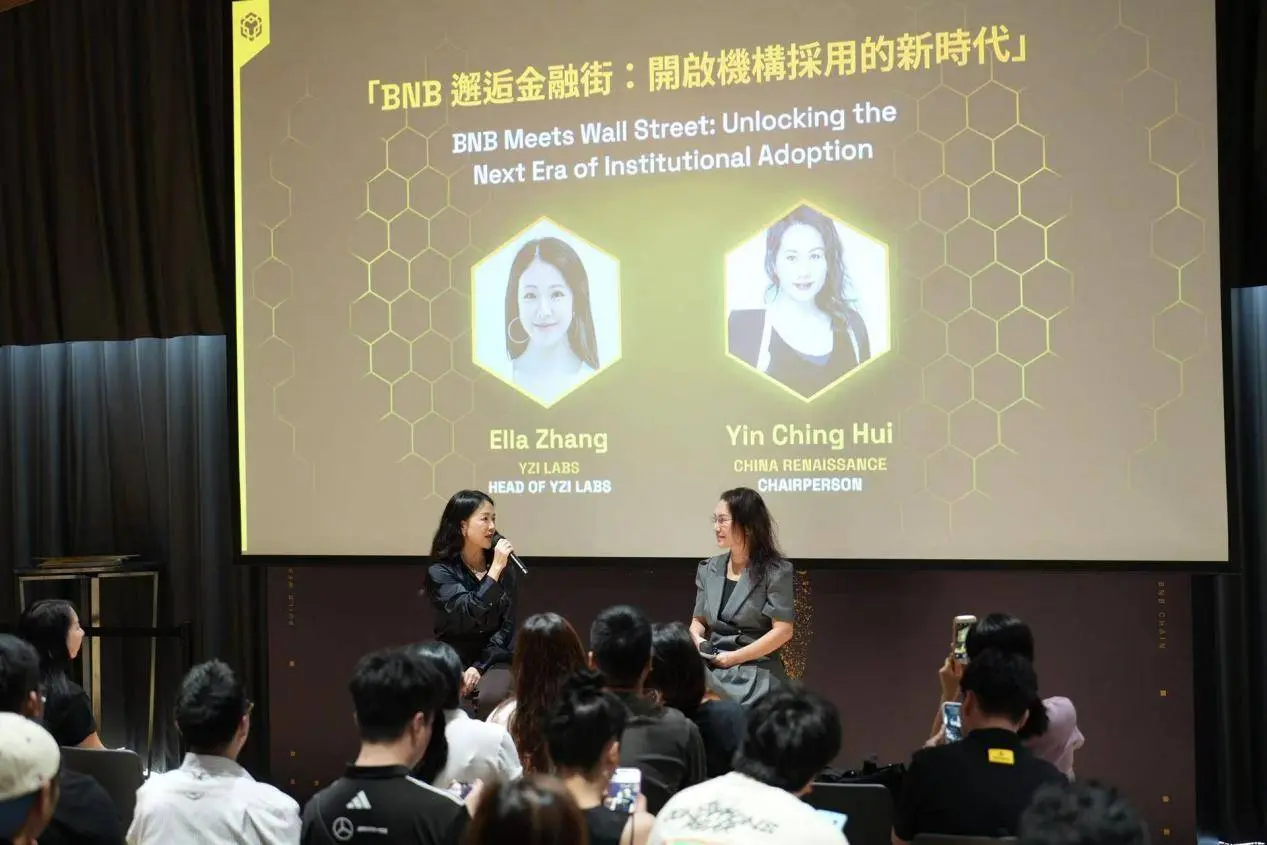
She further emphasized, "Huaxing not only wants to become a bridge connecting the Web2 and Web3 worlds but also aims to continue leading Huaxing to become the most iconic investment bank in the Web3 era through our expertise in investment banking services, asset management, and wealth management."
In summary, Huaxing's logic is clear:
External Logic: When traditional institutions want to enter the crypto market, direct investment often faces higher risks, while investing in Huaxing's stock can indirectly gain exposure to crypto assets.
Internal Logic: The integration of Web3 and Web2 will inevitably generate new financing and M&A demands, allowing for a repeat of the "decade of internet mergers and acquisitions" story.
In other words, Huaxing wants to continue playing the role of the "first investment bank" that can influence market dynamics in the crypto world.
The vision is grand, but the constraints in implementation are exceptionally real.
The Dilemma of Transformation
As a boutique investment bank that started with TMT mergers and acquisitions, Huaxing's core advantage has always been its deep understanding of the Chinese internet industry and founder resources.
In the world of traditional investment banks, the incentive mechanism is clear: commission sharing, short-term performance, and quick results. Investment bank employees are typical "professional service providers," completing transactions and extracting fees.
For Huaxing Capital, fully entering the crypto market means facing a harsh reality: many traditional top-tier capital players have failed in this emerging field.
First, the FA model's failure is almost predetermined.
During the golden age of internet mergers and acquisitions, Huaxing became a "super matchmaker" due to its network and information asymmetry: who is financing, who is selling, and how valuations are, were often known only to a few investment banks. However, in the on-chain world, the flow of funds, governance voting, and protocol data are almost completely transparent, allowing anyone to track in real-time. Except for a few large Asian exchanges or asset management institutions that genuinely need FA assistance for financing, most projects' capital actions are closer to "crowd-funding-style investments," and even derivative platforms like Hyperliquid do not require external financing at all, diminishing the investment bank's bargaining and matchmaking advantages.
Thus, to truly achieve excess returns, Huaxing Capital can only dive into investment itself.
"Doing FA is mainly about making friends and earning money through investment," once said an FA practitioner who explored the crypto world with this mindset. After successfully making friends and starting investments, he ended up losing money.
The primary market in the crypto world is extremely perilous; to excel in investment, one must have a profound understanding of the underlying logic of the crypto market and be able to connect with the best entrepreneurs for continuous empowerment.
However, the crypto space is often filled with short-term narrative traps: once a project hits a trend, its valuation may skyrocket within months; but when the narrative recedes, the market cap can halve instantly, and the team lacks a business model, relying solely on selling coins for survival, leading to a continuous decline in market value. Moreover, the current market has lost faith in altcoins, with funds primarily concentrated in top assets like BTC, ETH, and SOL. Even the currently popular coin-stock linkage model may one day be disproven.
For Huaxing, this means two layers of risk:
First, whether its investment vision can penetrate narrative traps; second, reputation risk.
The rapid turnover of crypto cycles far exceeds that of traditional markets; a protocol being hacked or a project running away can destroy market value within 48 hours. If Huaxing steps on a landmine, not only will its funds be damaged, but it may also lose the hard-earned reputation of being a "boutique investment bank."
Singapore's sovereign wealth fund Temasek not only lost about $275 million in FTX but more seriously, as a state-owned investor, Temasek faced questioning from Parliament and was forced to admit "significant lapses in due diligence," which severely impacted its reputation.
From this perspective, Huaxing Capital's best path may not be to recreate a crypto version of the "King of Mergers and Acquisitions," but rather to pivot towards being a large secondary market player. By strategically allocating core assets like BTC, ETH, and BNB, combined with quantitative strategies and risk hedging, it can pursue stable returns.
But this path is equally perilous.
Trading means competing with countless professional quantitative funds, crypto-native trading teams, and multinational market makers. Without deep technical capabilities, risk control systems, and on-chain data insights, relying solely on the brand and connections of a traditional investment bank makes it nearly impossible to establish a real advantage.
Huaxing Capital finds itself in an awkward position:
Doing FA, the information advantage is gone; doing VC, narrative traps abound; doing secondary, yet lacking native genes.
This is also the dilemma faced by many traditional FA/VCs in the crypto world. To establish a foothold in Web3, not only is capital investment needed, but a complete cognitive reconstruction is also essential.
It must answer a question: in this transparent, disintermediated world, what is Huaxing's value?
Looking back from 2025, Huaxing's Web3 transformation resembles an experiment pushed onto the table. It is not a result of proactive choice but rather a gradual cornering by the environment.
Twenty years ago, Huaxing rose by hitting the launch window of China's internet. At that time, Bao Fan, with a challenger's spirit, used "an investment bank that understands the internet" to tear open the seams of old finance.
Today's situation is different: Web3 does not merely bring offline business online but fundamentally rewrites financial logic: decentralization, permissionless access, community governance—these concepts directly shake the intermediary position that investment banks rely on for survival.
The shift in roles sharpens the questions. Huaxing of yesteryear was a pioneer, able to charge ahead lightly; today's Huaxing is a vested interest, and wanting to "all in" on a new track means severing ties and betrayal. For an institution already written into the history of Chinese mergers and acquisitions, such a choice is more brutal than twenty years ago.
Globally, traditional financial institutions have rarely achieved real breakthroughs in digital asset transformation. Goldman Sachs was one of the earliest investment banks to test the waters, but to this day, its digital asset business remains negligible in its revenue. The common challenge in this industry is: can it undergo self-revolution, or is it destined to be replaced by new species?
But for Huaxing, there is no turning back.
Click to learn about job openings at ChainCatcher
Recommended Reading:
Pantera Capital Deep Dive: The Value Creation Logic of Digital Asset Treasuries (DATs)
 Risk warning
 Risk warning





Popular articles





