








10x Research: NAV premium fades, volatility declines, is there an opportunity in crypto stocks?

Original | 10x Research
Compiled by | Odaily Planet Daily (@OdailyChina)
Translator | Dingdang (@XiaMiPP)
On the surface, Bitcoin seems calm, but the options market is releasing signals that few are paying attention to. There has been a significant shift in capital flows—traders are continuously selling volatility, and the positioning appears to be "smooth sailing." Meanwhile, key buyers who once dominated demand are constrained, and new beneficiaries are beginning to emerge.
The compression of net asset value (NAV), accelerated adoption of stablecoins, and the divergence of liquidity tailwinds are creating a market environment that has not been seen so far this year. The current consolidation is likely the calm before the storm. The question is: who will stand on the right side of the next wave of market movements?
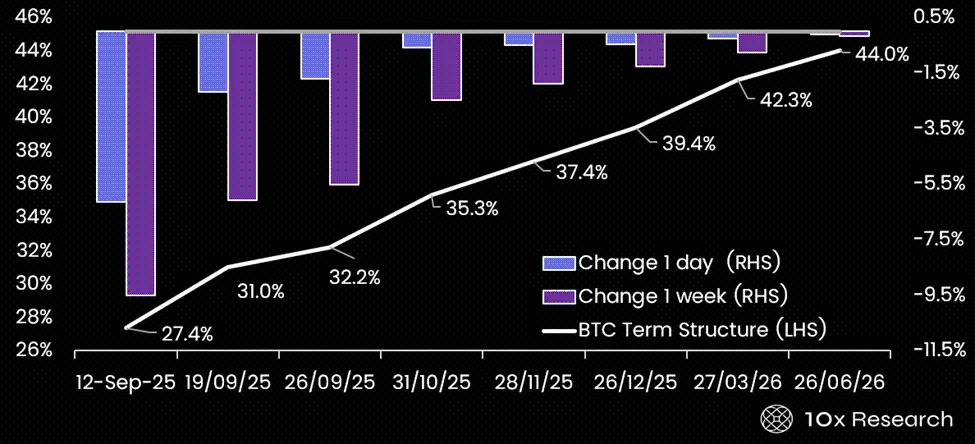
Bitcoin implied volatility (left axis) has significantly declined (right axis)
Core Insights
Bitcoin is never dull; market sentiment often changes in an instant. The rich data dimensions make the crypto market highly valuable for research, and the logic of gaining information advantages is similar to traditional markets. The difference is that most data in the crypto market is public, and the key lies in whether one has the right channels (usually professional paid versions) and can efficiently integrate the information at the right time.
After last Wednesday's PPI came in below expectations and Thursday's CPI met expectations, Bitcoin and Ethereum options experienced significant bullish repricing. The market has digested expectations for three rate cuts this year. Short-term implied volatility has significantly declined, with BTC dropping 6% on contracts expiring on September 12, and ETH down 12%, leading to an overall downward shift in the term structure.
Risk Reversal indicators have also risen; while still relatively low in late September, the magnitude is not as pronounced as before. Interestingly, the forward upward skew for Ethereum in Q2 2026 has weakened, indicating that traders' optimism about extreme long-term increases has decreased, even though short-term pessimistic expectations have largely been digested.
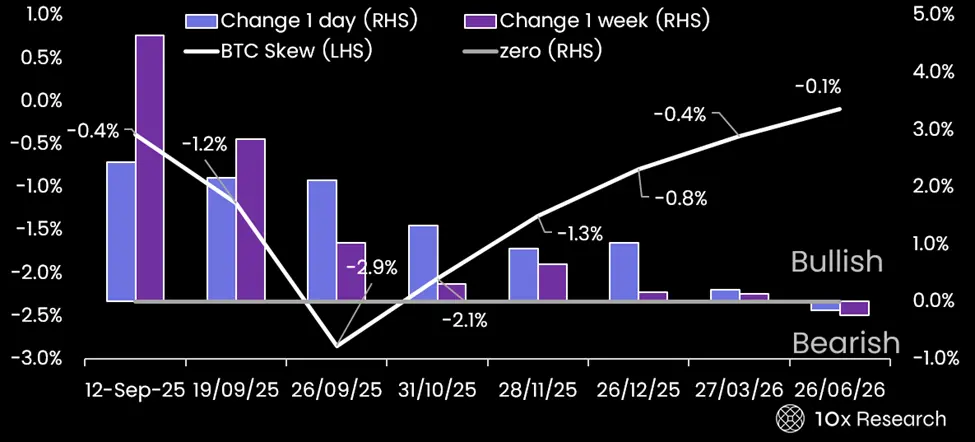
Bitcoin risk reversal (left axis) repricing upward (right axis) ------ bullish signal
Options and Capital Flows
In the past week, BTC options trading has been primarily dominated by selling call options, accounting for 27.3% of the total nominal trading volume; on the ETH side, selling put options predominated, making up 32.2%. The market is clearly dominated by volatility sellers, which has suppressed implied volatility but also highlighted a lack of effective upward leverage deployment. Despite ETH having a higher beta, traders are more willing to sell downside risk rather than upside, and in BTC, they tend to believe that the upside potential is limited.
MicroStrategy: Constraints of NAV Compression
One of Bitcoin's most active buyers—MicroStrategy—is constrained by the compression of net asset value (NAV). This was anticipated back when volatility was declining in the summer. Since June 2025, MSTR's NAV multiple has dropped from 1.75 to 1.24.
We pointed out in June that when the NAV approaches 1.5 times, the company's ability to repurchase Bitcoin would rapidly decline: financing capabilities are limited, and retail demand for premiums tends to saturate. It is important to emphasize that we focus on NAV (corresponding to market value), rather than the mNAV (which includes enterprise value and is slightly higher).
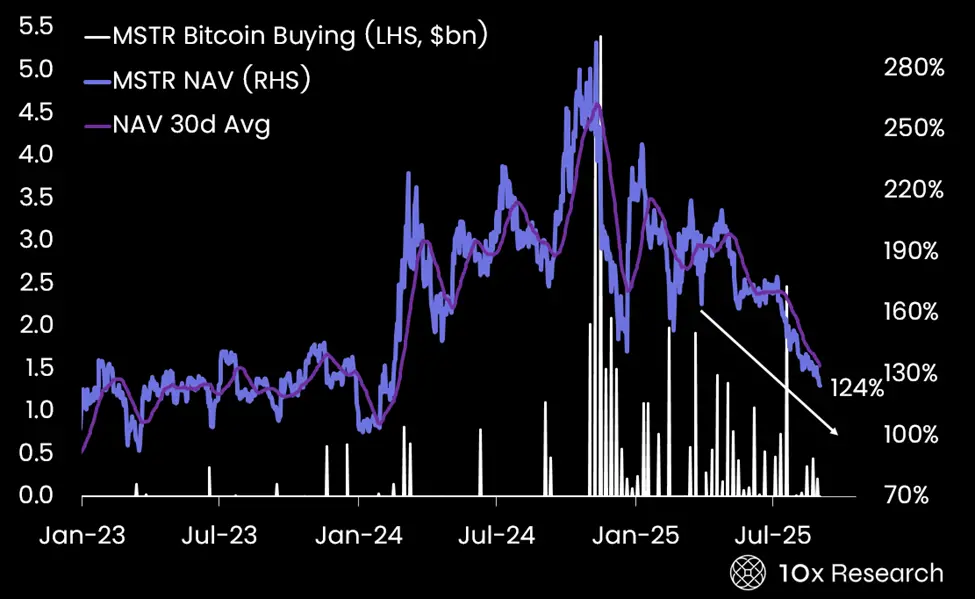
MicroStrategy's Bitcoin purchase volume (left axis, in billions) vs. net asset value (right axis)
Aside from a few preferred stock issuances, MicroStrategy has made almost no new Bitcoin purchases this summer. In the three and a half months since June 1, the company has only raised $4.2 billion, far below the $5.4 billion on November 25, 2024, and $4.6 billion on November 18. The past "golden era" of financing is gone.
Of the company's total financing of $43 billion, $19.9 billion came from premiums paid by investors—these values have almost evaporated. Many investors who bought at a 2x NAV multiple have suffered heavy losses.
During Bitcoin's roughly sideways movement, MSTR's NAV has clearly entered a bear market. In the crypto world, there always seems to be a corner in a bear market. If Bitcoin volatility cannot significantly rebound, it will be extremely difficult to rebuild NAV premiums. Meanwhile, MSTR's average daily trading volume has dropped from a peak of $14 billion in November 2024 to $3.5 billion, and recently closer to $2.4 billion.
The business model that relies on high NAV multiples and high volatility to extract value from retail investors is collapsing. In the past, high volatility attracted not only retail investors but also institutional investors, especially convertible bond buyers, due to the embedded call options being undervalued. Now, with these two advantages disappearing and investors seeking alternative crypto exposures, the era of Bitcoin "treasury" companies relying on equity financing to hoard coins is unlikely to return.
It is not surprising that MSTR's stock price has fallen from $400 to $326; we have warned of correction risks in previous reports. Now that resistance has eased, NAV has compressed to reasonable levels, and MicroStrategy's relative valuation to BTC has declined by 22%, approaching historical bottom ranges. Technical indicators are oversold, and further downside is limited, even compared to our initial target of $300.
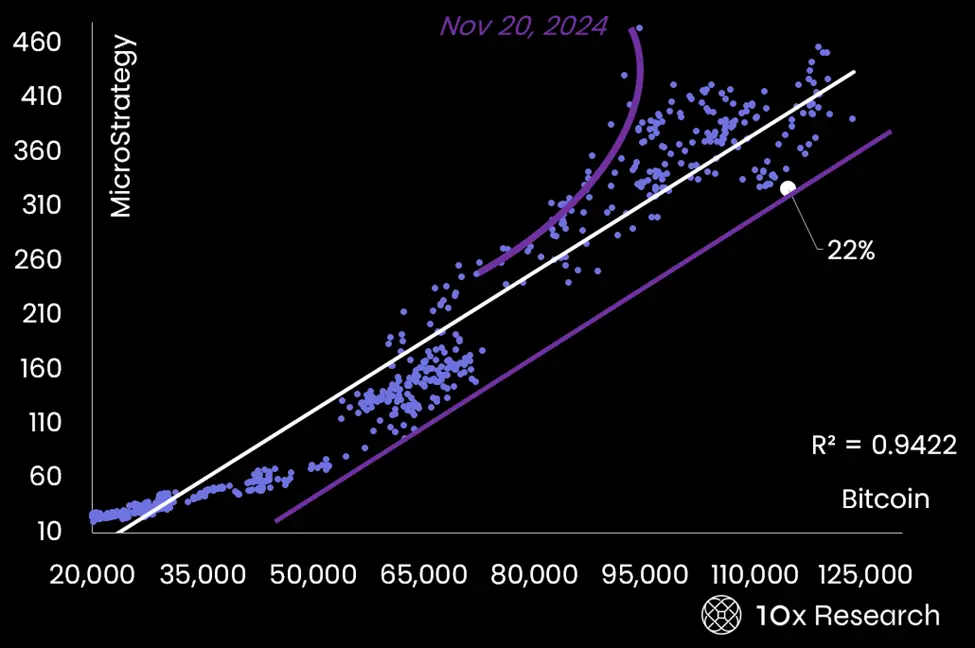
MSTR vs. BTC regression valuation: close to the bottom
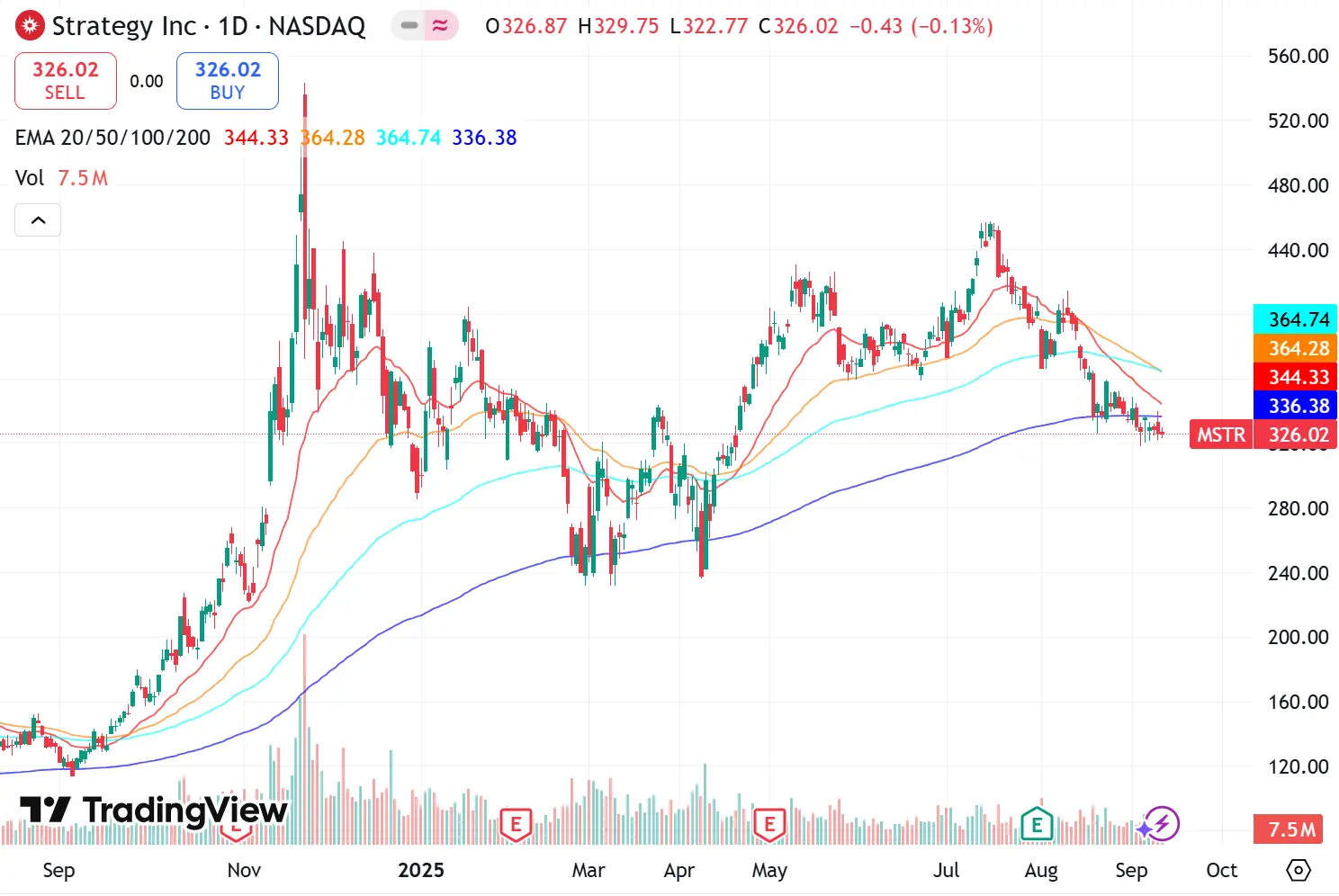
MSTR price trend
Metaplanet: Attractive Pricing
We also held a bearish stance on Metaplanet in June, and the stock subsequently plummeted 66% during the summer due to concerns over potential changes in Japan's crypto tax policy, diminishing its appeal as a Bitcoin alternative.
Nevertheless, Metaplanet's NAV multiple remains at 1.5 (down from 6), and the stock price is experiencing significant intraday volatility. Driven by retail funds, the stock remains extremely unstable. However, its market cap has dropped from $596,000 when we issued our bearish report to $173,000, gradually becoming more attractive.
Odaily Planet Daily adds: Currently, Metaplanet has seen trading volume increase for three consecutive days, but the price has not experienced further significant declines, and a bottom structure may be forming soon.
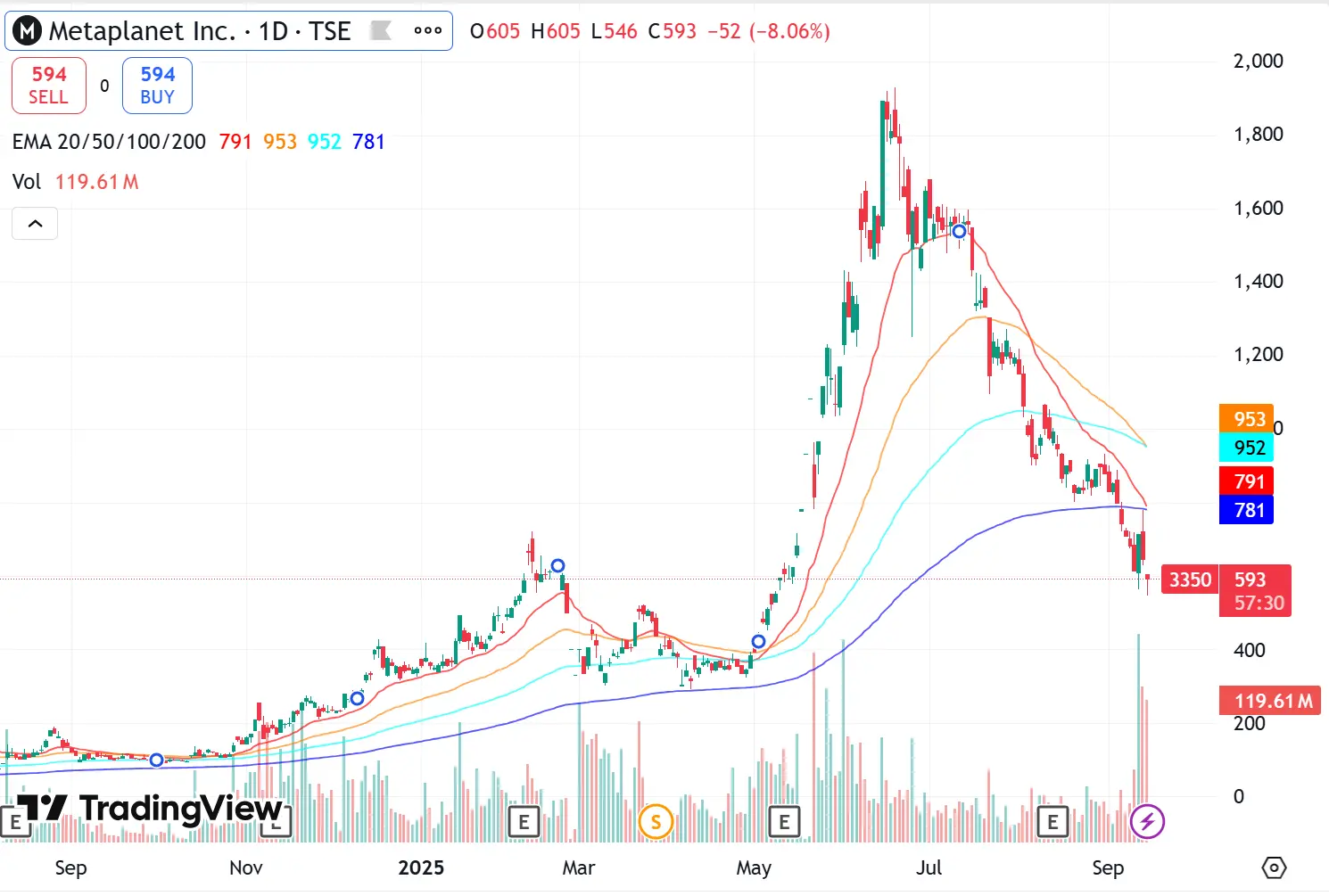
MTPLF price trend chart
Circle: Becoming the New Winner
In contrast, we have recently favored Circle, whose stock price has fallen 63% from its peak. We had been waiting for it to drop to around $100, and when the price fell to $112 on September 9, it triggered a buy signal. We also expect that this week's inflation data will bring macro tailwinds, potentially leading to a squeeze in Bitcoin.
Since the report was published on September 9, Circle has risen 19.6%. The reason is that expectations of Fed rate cuts have boosted liquidity and accelerated stablecoin adoption. We reiterate our "buy" rating with a target price of $247. Circle's collaboration with Finastra to integrate USDC into the global banking system further strengthens its adoption prospects.
We are pleased to have captured this wave early and correctly anticipated that the inflation data would shift macro sentiment from headwinds to tailwinds, thus driving Circle's rebound and Bitcoin's upward attempts. Notably, Circle has even lagged behind Coinbase in this round of corrections, while we believe Circle is more attractive and has significant room for recovery.
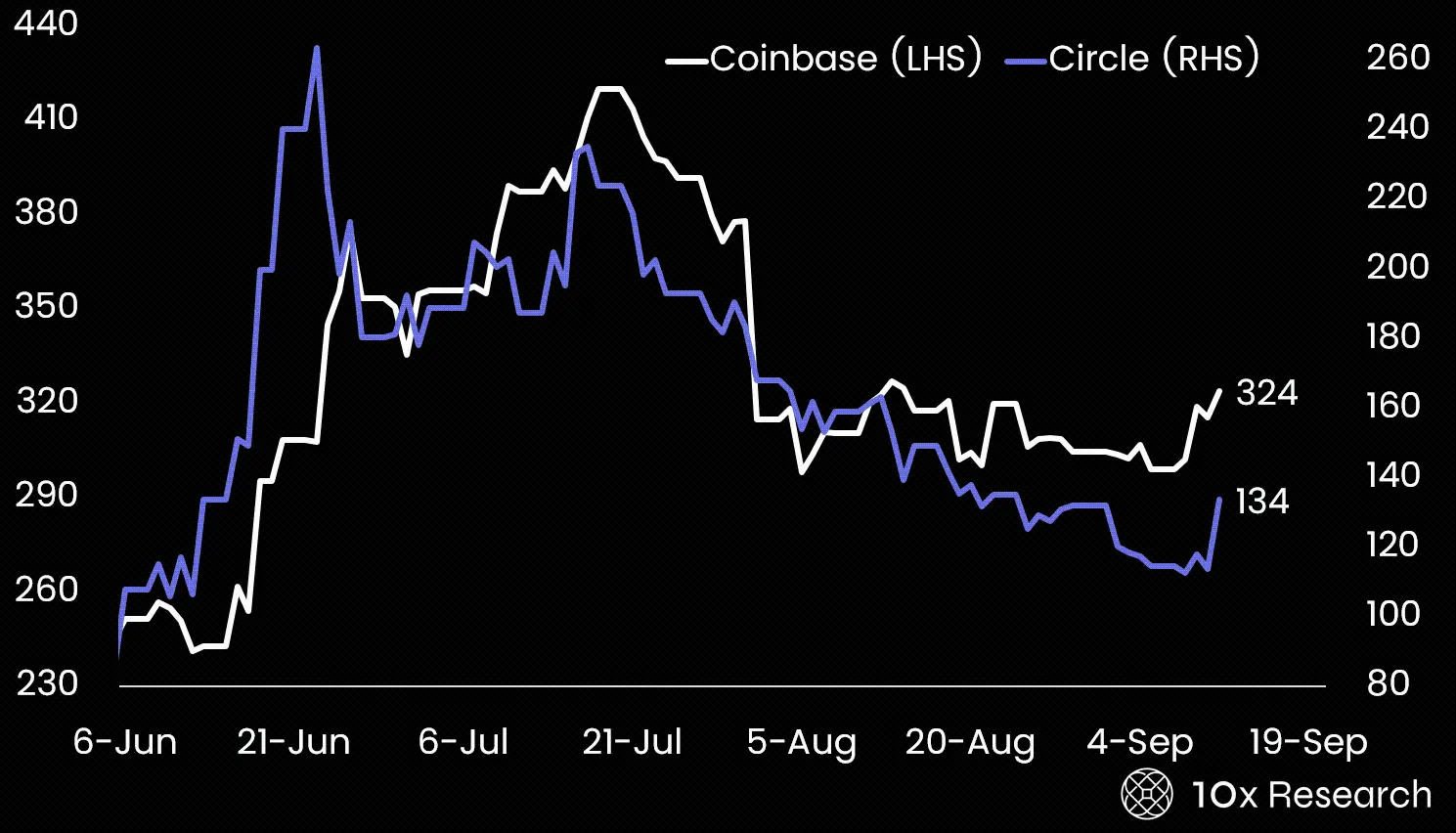
Coinbase (left axis) vs. Circle (right axis)
Odaily Planet Daily adds: Circle (CRCL) stock price has recently achieved a significant volume breakout on the daily chart, and it seems to be entering an upward channel in the short term.
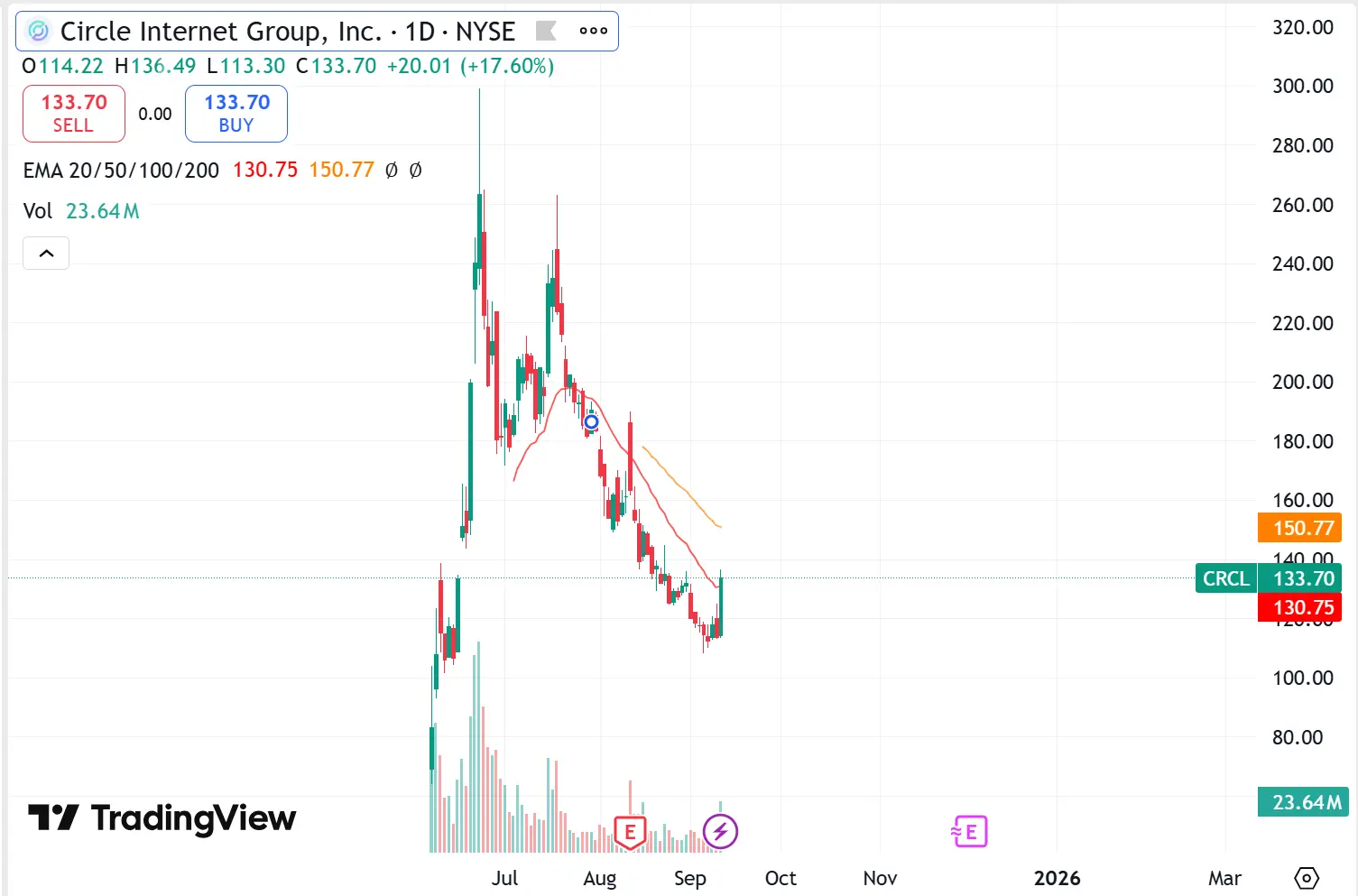
CRCL price trend chart
Conclusion
Behind Bitcoin's sideways movement, a deep transformation of capital flows and positioning is brewing, which may lay the groundwork for the next upward move. With MicroStrategy constrained and Circle gaining momentum, capital is flowing toward truly opportunistic targets. A large amount of volatility selling has suppressed implied volatility but has made the market more susceptible to short squeezes—because once a squeeze is triggered, the upward movement will be exceptionally fierce.
Circle's rebound indicates that once liquidity tailwinds return, the speed of sentiment reversal may exceed expectations. And when the tide rises, some targets are destined to run faster than others.
```
 Risk warning Risk warning




Popular articles





