








The iconic DeFi symbols MKR and DAI have officially come to an end. How will SKY重新承载市场期望?

 The extent to which the narrative can go depends not on the change of the label itself, but on whether governance can improve user experience, whether cash flow can continue to come in, and whether funds can migrate steadily along the interest rate anchor.
Author: Zhou, ChainCatcher
On September 17, Binance announced the completion of the Maker (MKR) token swap, increment, and brand upgrade to Sky (SKY), and opened the deposit and withdrawal services for the new SKY token. As of the time of writing, SKY is priced at 0.07414 USDT, with a circulating market cap of approximately 1.72 billion USD and a 24-hour trading volume of about 21.49 million USDT.
According to public information, the migration from MKR to SKY will enter a delayed upgrade penalty process, with a 1% deduction starting from September 22 after governance confirmation, and an additional 1% deduction every three months thereafter. Currently, the migration completion rate from MKR to SKY is about 78.2%, and from DAI to DSDS is about 53.6%.
At this point in the token swap, the market needs to reassess the narrative and future of the DeFi giant Sky.
Brand and Governance Reconstruction
Sky's predecessor is MakerDAO, a well-established decentralized stablecoin and credit infrastructure. It primarily operates around two mechanisms:
One is stablecoins and anchoring, which allows for nearly 1:1, low-slippage swaps through PSM and custodial stablecoins like USDC, pulling prices back to target ranges during volatility while providing low-cost entry and exit channels;
The other is interest rates and credit, which form an on-chain capital pricing system through stability fees, savings rates, and liquidation parameters, allowing capital to migrate between protocols and market making as interest rates change.
This brand and governance reconstruction involves migrating governance from MKR to SKY (1 MKR = 24,000 SKY), upgrading the stablecoin from DAI to USDS, and unifying data and entry points to sky.money. Upgraded users will benefit from core new features, such as native token rewards, where users holding the USDS stablecoin can earn SKY governance token rewards through the project's new application sky.money.
For positions held on exchanges, most replacements are completed automatically in the background; however, for those with self-custodied wallets, users need to connect their wallets at the official entry point and call the upgrade contract to complete the exchange (gas fees apply). Users holding DAI can choose whether to exchange it for USDS, and both DAI and MKR will continue to exist as legacy tokens in the renamed Sky protocol.
Financial Core: SSR, MIP65, PSM
Sky's savings annualized rate is seen as an on-chain version of a money market fund rate anchor (SSR). When users hold USDS, depositing into the savings contract will yield a "receipt" sUSDS, with earnings automatically accumulating in the receipt, redeemable at any time for USDS.
For SSR to serve as an anchor, stable cash flow is also needed as a foundation. This foundation began to be laid with MIP65, which can be understood as an investment authorization: to compliantly allocate stable assets accumulated through PSM into short-duration U.S. Treasury bonds and investment-grade debt, forming measurable coupon income.
After entering the Sky phase, the income generated from MIP65 will enter the system surplus, which will then route to savings rates and ecological incentives, linking off-chain coupons with on-chain distributions. This way, SSR does not have to rely entirely on secondary trading market conditions but instead has cross-cycle cash flow support.
Sky's USDS and DAI, along with Aave's GHO, belong to the CDP route of decentralized stablecoins. A Galaxy report indicates that GHO operates based on Aave's lending and liquidation framework, following the process of "collateralization - minting - repayment - burning"; whereas Sky focuses more on issuing its own CDP stablecoin and anchoring mechanism, leading to differences in parameters and governance paths compared to general lending protocols. The report states that in terms of scale and adjustable space in the CDP route, Sky's system still leads, with GHO, FRAX, and LUSD in a smaller second tier, which determines their operational leeway in interest rates/incentives and anchoring.
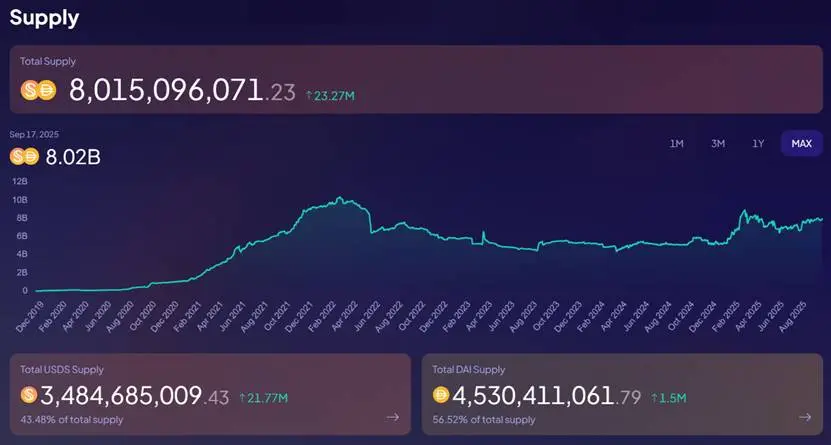
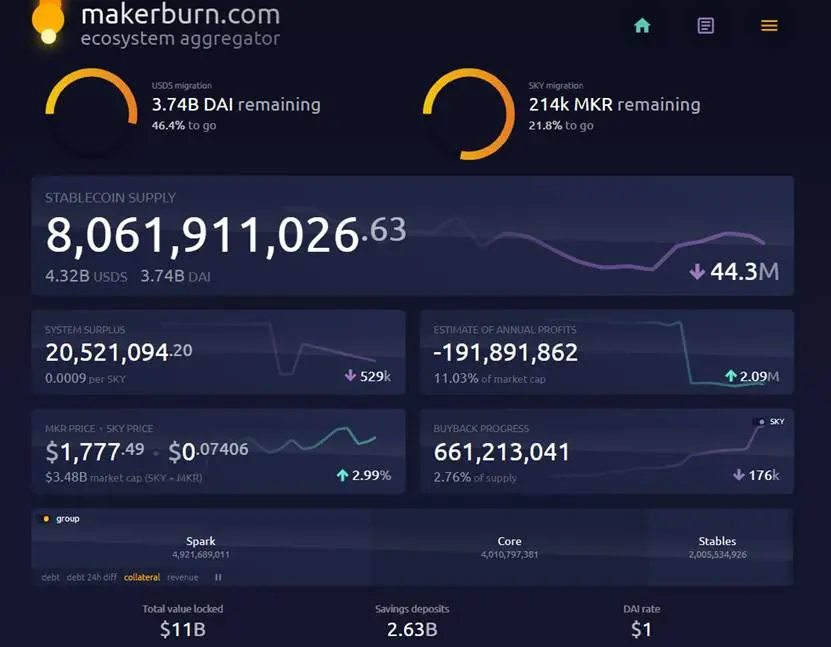
In terms of scale, Rune stated that Sky is the fourth largest stablecoin project globally. Official data shows that the total amount of Sky stablecoins is approximately 8.062 billion USD, with USDS around 4.32 billion (53.6%) and DAI about 3.74 billion (46.4%). According to makerburn data, Sky's total TVL is approximately 11 billion USD, with a system surplus of about 20.55 million USD. He also mentioned that Sky's native buyback engine generates 250 million USD in profits annually, currently using 36 million USD each year for SKY token buybacks. This figure is planned to increase to 150 million USD per year and will further grow as Sky's profits continue to rise.
Thickening Cash Flow
Sky Stars are independent protocol units relied upon by Maker for innovation at the margins outside of Maker DAO. The first Sky Star launched is the Spark protocol, positioned as a lending and capital scheduling layer. According to DeFiLlama statistics, the TVL of the Spark Liquidity Layer is approximately 3.2 billion USD, consistently maintaining above the 3 billion level.
This year, Spark initiated a tokenization competition to publicly attract up to 1 billion USD of RWA into the Spark ecosystem, and subsequent updates have confirmed the selection of winners and the actual deployment of the 1 billion USD scale of RWA.
Additionally, Sky has also joined the bidding for the USDH issuance rights from Hyperliquid. Public information shows that Hyperliquid's recent trading volume is close to 400 billion USD, with USDC deposits in the platform around 5.5 billion USD, accounting for about 7.5% of the total supply of this stablecoin. Sky promises to provide about 4.85% returns for USDH held on Hyperliquid, with earnings used for HYPE buybacks and aid funds; at the same time, it will provide about 2.2 billion USD of instant redemption liquidity through PSM, enhancing the ability for institutions to manage large inflows and outflows.
Rune also stated that Sky can commit 25 million USD of USDH to capitalize Hyperliquid Genesis Star and will exclusively custody it on the Hyperliquid blockchain.
These two lines clarify Sky's direction of thickening cash flow foundations, not only relying on MIP65's own portfolio but also amplifying through external collaborations; over the past year, Sky has also been attempting to bring broader RWA on-chain, such as institutional-level credit, with the aim of thickening the underlying cash flow. Its subsequent expansion will directly impact the growth of USDS (supply side) and the absorption of sUSDS (demand side) slope, thereby feeding back into the stability of SSR and the expected distributable cash flow.
Conclusion
This Sky migration upgrade pulls governance, stablecoins, and cash flow distribution into a clear main line. How far the narrative can go does not depend on the swap itself but on whether governance can enhance user experience, whether cash flow can continue to be credited, and whether funds can migrate steadily along the interest rate anchor. For traders, rather than betting on a one-time token swap, it is better to focus on the direction and rhythm of these data, as they determine the mid-term pricing space of SKY.
 Risk warning
 Risk warning




Popular articles





