








"Joint Margin" Comprehensive Rollout, Comparison of Mechanisms of 5 Major Exchanges
 The article provides a detailed comparison of the joint margin mechanisms of the current five major trading platforms (Binance, OKX, Bybit, Bitget, MEXC), revealing their differentiated strategies in terms of supported currencies, collateral rates, and activation thresholds. The article points out that MEXC's strategy focuses on mid-tier traders, attracting users who primarily use mainstream currencies as collateral through low thresholds and high initial collateral rates.
Author: yoyo
The Evolution of Margin: What is Cross Margin?
Early exchanges typically used a single margin account, where each contract independently utilized a single asset (such as USDT or BTC) as margin, leading to fragmented capital. The subsequently introduced multi-currency margin model allowed multiple stablecoins to be used as margin within the same account, but frequent capital allocation between different contracts remained an issue. In recent years, leading platforms have gradually launched cross margin mechanisms, incorporating multiple assets into a shared margin pool, marking the latest stage in the evolution of margin systems.
The cross margin mechanism aims to address the core pain points users face under traditional margin models: capital fragmentation, low liquidity utilization, and high liquidation risk. In a single-currency margin model, the margin for different currencies is independent, making it difficult to respond promptly to market fluctuations. When a position's losses approach the liquidation line, even if the user has surplus assets in other currencies, they cannot quickly provide support, increasing the risk of forced liquidation.
The cross margin mechanism effectively resolves the above issues by merging multiple currency assets into a unified collateral pool. This mechanism allows users to count supported tokens (such as BTC, ETH, USDT, etc.) into the same margin pool. The profits and losses between different contract positions can automatically offset each other, meaning that the profits from one contract can directly cover the losses of another.
This design significantly improves capital utilization efficiency, giving professional traders with multiple strategies and assets greater flexibility in capital allocation. Against this backdrop, major exchanges are exploring differentiated implementation paths and parameter settings to balance user risk control.
The Battle of Five Major Platforms: Who Has the Superior Cross Margin?
Currently, five mainstream trading platforms—Binance, OKX, Bybit, Bitget, and MEXC—have all launched cross margin mechanisms. However, there are differences in supported currencies, collateral rate parameters, and activation thresholds. Below is a comparison table of core dimensions:
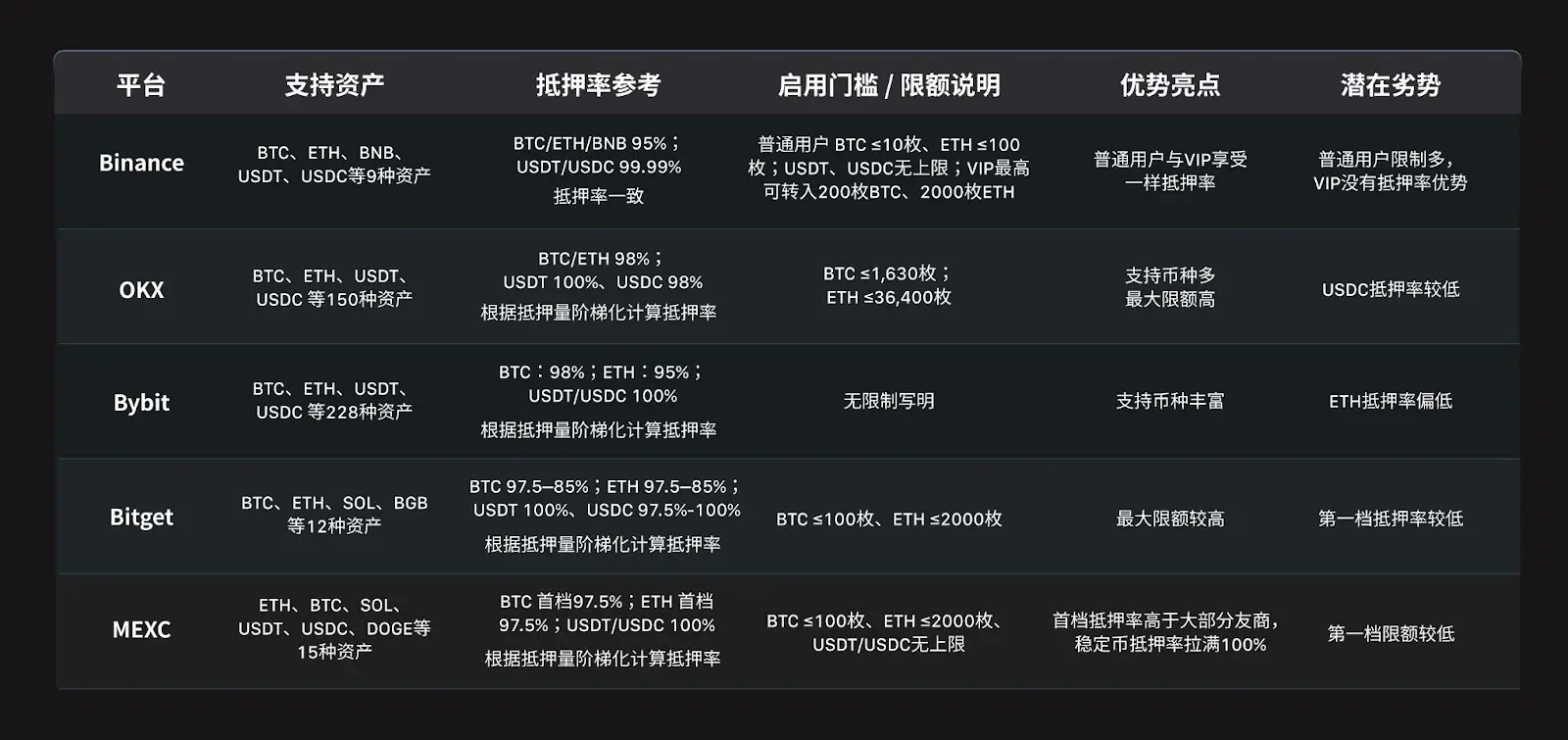
Looking across the five platforms, the design of cross margin has formed a certain "industry consensus":
Multi-asset shared margin pool, with core stablecoins generally counted at a higher collateral rate.
Mainstream coins are tiered in calculation, with BTC and ETH collateral rates typically between 85% and 98%;
Tiered limits to avoid risk exposure.
However, there are still significant differences in asset coverage, threshold design, and calculation strategies:
Binance and OKX represent the "conservative institutional faction," with high limits that are more friendly to large funds and professional institutions;
Bybit and Bitget belong to the "open coverage faction," supporting a wide range of currencies, but with discounted calculation rates and limits;
MEXC adopts a "focus on mainstream + low threshold" strategy: supporting core assets like BTC, ETH, USDT, USDC, with a first-tier collateral rate reaching 97.5% and maintaining 100% for stablecoins.
This means that MEXC does not directly compete on "coverage breadth" and "limit caps," but instead chooses to capture mid-tier traders:
Low entry threshold: MEXC is more attractive to users without high VIP levels or a million-dollar asset threshold;
High first-tier collateral rate: Continuing the tiered discount logic, the first-tier collateral rate for BTC and ETH is 97.5%, meeting most protective needs;
Coverage of mainstream assets: For high-frequency traders relying on BTC, ETH, and stablecoins as primary margins, MEXC provides sufficient capital efficiency.
This positioning makes MEXC closer to active mid-tier traders, allowing them to participate with commonly held mainstream coins without needing to meet high threshold conditions.
In the context of major platforms competing for coverage and institutional users, MEXC's positioning is clear: to be the most flexible and easily accessible option.
Why Choose Cross Margin?
In perpetual contract trading, capital efficiency, risk control, and operational convenience are key to success. MEXC's cross margin model supports the integration of 15 assets, including BTC, ETH, SOL, USDT, and DOGE, into a shared margin pool for opening USDT or USDC-denominated contracts. This "one pool for multiple uses" mechanism offers traders three core advantages: higher capital efficiency, lower liquidation risk, and a seamless trading experience.
1. Leveraging Capital Utilization
In a single margin model, traders often face the "asset island" problem, where a large amount of idle assets in wallets cannot directly participate in contract trading and must first be converted to USDT for use, which not only increases trading costs but also misses market opportunities. Cross margin allows idle assets to be converted into usable margin, maximizing capital utilization.
Assuming a user holds 1,000 SOL (200 USDT each), 1,000,000 DOGE (0.2 USDT each), and 10,000 USDT. The traditional model can only use 10,000 USDT as margin to open a position. In the cross margin model, the user can use SOL and DOGE as collateral, uniformly allocated to contract trading.
SOL Margin = 300 * 200 * 95% + 300 * 200 * 90% + 400 * 200 * 85% = 57,000 + 54,000 + 68,000 = 179,000 USDT.
DOGE Margin = 200,000 * 0.2 * 95% + 200,000 * 0.2 * 90% + 600,000 * 0.2 * 85% = 38,000 + 36,000 + 102,000 = 176,000 USDT.
USDT Margin = 10,000 USDT.
Total Margin = 179,000 + 176,000 + 10,000 = 365,000 USDT.
Compared to the traditional model, this means obtaining 36.5 times the opening capacity based on the same asset foundation.
2. Reducing Liquidation Risk
Cross margin allows for cross-settlement of multiple positions' profits and losses to offset each other, and pledged assets can hedge against positions, reducing the risk of liquidation for a single position. When a position incurs floating losses, the floating profits from other positions or the appreciation of pledged assets can automatically replenish the shared pool, enhancing the account's risk resistance.
For example, if a trader holds 1 BTC (current price 100,000 USDT) as initial margin, the discounted total margin value is 100,000 x 97.5% = 97,500 USDT; simultaneously, they open a short position of 0.975 BTC in the BTCUSDT trading pair with 10x leverage, with a total position value of 975,000 USDT. In the cross margin model, the BTC assets in the account and the positions share the margin pool, dynamically balancing profits and losses.
Assuming the BTC price rises by 9.5% to 109,500 USDT:
Floating loss on short position: (100,000 - 109,500) × 0.975 x 10 = -92,625 USDT, close to the initial margin of 97,500 USDT's liquidation line. However, the rise in BTC price also increases the margin value.
Margin asset appreciation: 109,500 x 97.5% = 106,762.50 USDT, an increase of 9,262.50 USDT from the initial 975,000 USDT, providing a buffer.
In the cross margin model, although the contract position incurs losses, the appreciation of pledged assets offsets part of the floating loss, avoiding immediate liquidation and reducing liquidation risk to some extent.
3. Simplified Accounts, Reduced Frequent Transfers
In the traditional model, managing multiple positions requires frequent transfers and conversions, which not only takes time but also incurs a 0.05% fee and additional slippage costs. In the cross margin model, multiple assets are integrated into a shared pool, allowing for immediate opening of positions without conversion. This "one pool for multiple uses" seamless experience enables traders to quickly and efficiently capture market volatility opportunities.
Who is MEXC's Cross Margin Tailored For?
- Investors Looking to Balance Long-term Holdings and Contract Trading
Holding various mainstream digital assets but unable to fully utilize idle funds, frequent conversions disrupt holding structures. Cross margin allows idle assets to be directly converted into usable margin, maintaining the original holding structure while enjoying the natural risk diversification of a multi-asset portfolio.
- Traders Profiting from Cross-Market or Cross-Asset Price Differences
Arbitrage requires quickly capturing price discrepancies, but isolated margins lead to dispersed capital, complex management, and high liquidation risks. Cross margin provides shared liquidity, ensuring automatic balancing of profits and losses between multiple positions, reducing liquidation risk, making it suitable for capturing market price difference opportunities and enhancing arbitrage efficiency.
For example, if ETHUSDT = 4,500, BTCUSDT = 100,000, and the implied ETHBTC = 0.045, which is lower than the spot price of 0.045225, the implied price deviation for ETHBTC is +0.5%. With 20x leverage:
Short 200 ETHUSDT (total value 900,000 USDT, initial margin 45,000 USDT).
Long 9 BTCUSDT (total value 900,000 USDT, initial margin 45,000 USDT).
If the deviation converges, ETH drops by 1%, yielding a profit of 9,000 USDT; BTC rises by 0.5%, yielding a profit of 4,500 USDT; ignoring rates, fees, and slippage, the total profit is 13,500 USDT.
- High-Frequency Traders Opening Positions Daily
High-frequency traders often seek faster execution speeds and extremely low costs. Frequent capital transfers and position switches slow down trading pace, and high-frequency asset conversion fees erode profit margins. In the cross margin model, positions can be opened directly with held assets, minimizing capital allocation time and costs, while also allowing traders to avoid cumbersome operational steps and focus more on strategy optimization and market analysis.
Beware of the "Double-Edged Sword" of Cross Margin
While cross margin enhances trading efficiency, it also brings the following risks that traders need to manage carefully.
When the market declines across the board, the prices of various collateral assets may plummet simultaneously, causing the value of the margin pool to shrink rapidly. The buffer from the collateral rate may not be sufficient to withstand the shock, triggering a chain liquidation.
Currently, cross margin only supports the full margin model, where all positions share the same margin pool. If the funds in the pool are insufficient, all positions will be liquidated simultaneously, and losses may involve all assets, posing a higher risk compared to isolated margin where only a single position is affected.
For novice traders, the dynamic adjustment mechanism and multi-asset management of cross margin can be complex. Misjudging the market or leverage usage may lead to significant losses. Inexperienced users may struggle to cope with rapidly changing margin demands.
Conclusion: After the Functional Rollout, Who Will Win Over Professional Users?
As part of the infrastructure for crypto trading, cross margin is becoming a "standard configuration" for derivatives.
As of today, the competition in cross margin is no longer just about "whether it is supported," but rather who can find the optimal solution among experience, strategy adaptation, security, and user structure. This question has no standard answer.
What is certain is that as traders become more professional and the demand for capital allocation grows stronger, the quality of cross margin design will directly determine whether they choose to stay.
 Risk warning
 Risk warning





Popular articles





