








Quack AI: A New Benchmark for AI Governance and RWA Compliance
 Core Viewpoint
 This article delves into the AI governance framework introduced by Quack AI, which aims to address long-standing issues in traditional DAO governance models, such as low participation rates, sluggish governance, and security risks. The article argues that Quack AI provides a new solution for decentralized governance and the compliance of real-world assets (RWA) by embedding AI into the core processes of governance, marking a new starting point for the governance revolution.
Written by: Mario
"The introduction of Quack AI is establishing a clearer and more actionable framework for AI governance and RWA compliance in terms of participation mechanisms, decision-making quality, and execution paths. This not only marks a new stage of maturity in decentralized governance but is also seen as the starting point of a governance revolution."
From the early days of the industry to now, DAOs have gradually become the mainstream governance method. However, we also see that while the governance paradigm of DAOs is continuously iterating and evolving, this model has long faced a series of dilemmas such as low participation rates, sluggish governance, and security concerns.
In fact, the voting rate of most DAOs currently remains in single digits for a long time, with Maker's participation rate even as low as 2-3%. Governance in projects like Compound and Uniswap is often dominated by a few large holders, leading to a high concentration of power. Low participation rates directly drag down governance efficiency. DAO processes typically take several days or even weeks to complete, making it difficult to respond promptly to rapidly changing markets or security incidents. At the same time, the technical barriers and operational costs deter ordinary users, as high proposal thresholds, complex wallet interactions, and Gas costs invisibly exclude most token holders.
Of course, even if they participate, the cognitive burden remains heavy. Whether it’s adjusting parameters of DeFi protocols or allocating funds from community treasuries, proposals often involve complex financial or strategic considerations that users without tool assistance find hard to understand, leaving them reliant on the "core minority" to make decisions for them.
Moreover, DAOs have long faced manipulation and security risks. In 2022, Mango Markets suffered an attack due to price manipulation combined with governance voting, while Ooki DAO was pushed to the forefront of legal responsibility due to compliance issues. These cases illustrate that within the traditional paradigm, DAO governance struggles to avoid limitations such as lack of enthusiasm, distorted gamesmanship, and emotional decision-making.
Discussion on AI Governance
As AI gradually becomes a core narrative in the technology and crypto industries, discussions about AI governance are heating up and are seen as promising solutions to the series of problems faced by DAOs.
From the characteristics of AI, it can handle large-scale data, maintain high-frequency stable execution, and possess capabilities in pattern recognition and risk assessment that surpass human abilities. Compared to a governance model that relies entirely on human input, the involvement of AI not only signifies an increase in efficiency but also represents a reconstruction of governance logic: humans remain responsible for value judgments and strategic directions, while data-intensive and easily manipulated aspects are handled by AI.
In fact, AI can take over a large number of tedious and high-frequency operations. For example, models can automatically parse on-chain data and community discussions, identify redundant or high-risk proposals, alleviate users' information burdens, and are expected to enhance learning and predictive models based on historical data to simulate different outcomes, providing forward-looking risk alerts to help governance avoid emotional and shortsighted decisions. Meanwhile, automation driven by smart contracts can ensure that voting results are implemented immediately, reducing vacuum periods.
In terms of security, AI can continuously run risk monitoring and compliance audits, automatically identify abnormal voting and fund flows, and generate transparent and traceable governance reports, enhancing the fairness, compliance, and external interpretability of governance.
Therefore, AI governance is expected to address the long-standing dilemmas of DAOs, allowing humans to focus on value judgments and strategic choices while leaving data-intensive, procedural, and easily manipulated aspects to machines, thus injecting new possibilities into decentralized governance.
On the other hand, as the global regulatory environment gradually clarifies, RWA (Real World Assets) is becoming one of the mainstream narratives in the crypto market. Major countries around the world are exploring frameworks for tokenized assets, making compliance a baseline requirement. In this emerging market, which could reach trillions of dollars, information disclosure, compliance execution, and investor protection are becoming primary issues, while the rapid advancement of tokenization also sets unprecedented high standards for governance transparency and auditability.
Similarly, traditional on-chain governance tools struggle to meet these requirements directly: the voting mechanisms of DAOs do not inherently support compliance disclosure, risk control, and cross-jurisdictional compliance tracking; relying solely on manual processes is both inefficient and prone to compliance loopholes. Therefore, how to leverage AI to rebuild trust mechanisms on-chain, enhance the timeliness of disclosures, the foresight of risk assessments, and the traceability of compliance audits is becoming the most critical issue.
At a time when the industry is still in the discussion phase of AI governance, Quack AI has taken the lead in practice. It has created a modular, native AI governance layer specifically designed for tokenized ecosystems, covering DAOs, DeFi, and RWA. This framework enables end-to-end governance automation: from parsing disclosure documents, generating proposals, risk scoring, to executing votes and compliance audits. Quack AI provides the industry with a clear and actionable AI governance model.
Quack AI: A Universal Web3 AI Governance Infrastructure
Quack AI itself is a universal Web3 AI governance infrastructure aimed at providing a foundation for better implementation of RWA and other scenarios across the entire tokenized ecosystem. In this system, AI is embedded in the core governance processes: from information disclosure to proposal generation, from risk modeling to voting execution, and from compliance audits to cross-chain implementation, forming an end-to-end automated closed loop.
Unlike traditional governance processes that rely on human-driven efforts, Quack AI is centered around data-driven and intelligent agents, ensuring governance can be executed in real-time, is transparent and traceable, and maintains consistency in cross-chain environments. It provides users with low-friction participation methods, offers protocols a scalable execution engine, and builds the trust foundation required for the tokenization of RWA. In an industry still in the exploratory phase, this framework has already shown the prototype of a "governance operating system," providing an actionable standard for the integration of decentralized governance and real-world assets.
AI Governance Execution Model
Quack AI introduces an advanced AI governance execution model that can further eliminate human inefficiencies in proposal evaluation, voting execution, and financial automation. Unlike traditional governance models that rely on static decision parameters, Quack AI leverages machine learning, sentiment analysis, and on-chain behavior tracking to continuously iterate and optimize governance logic, achieving more efficient and transparent governance execution.
This governance execution model consists of five key components:
AI Model and Scoring Engine: As the core of governance, it filters noise in real-time, identifies high-value proposals, and integrates on-chain behavior, user data, market events, and RWA metrics to generate credible governance scores.
AI Decision Logic: Embedded AI agents validate proposals throughout the process, assessing impact, risk, and compliance before execution, transitioning from passive voting to intelligent, autonomous decision-making.
Smart Contracts and Automation Engine: Governance results are automatically implemented through self-executing contracts, covering proposal storage, fund allocation, compliance verification, etc., ensuring execution is transparent, secure, and consistent with ecosystem rules.
Cross-Chain Infrastructure Layer: Supports cross-chain operations among public chains, L2, and RWA platforms, avoiding redundant deployments and ensuring governance logic and execution remain consistent and interoperable across multiple chains.
Privacy, Audit, and Traceability System: Built-in privacy and auditing mechanisms ensure all proposals and execution paths are traceable, balancing transparency and data protection through selective privacy controls.
During execution, all governance decisions in the above model undergo an analysis and verification process driven by artificial intelligence before implementation.
Pre-Execution Evaluation of Proposals
The AI governance agent first assesses the quality and impact of proposals through neural networks and identifies potential patterns by combining historical governance trends, filtering out redundant or low-value proposals at the source before entering the sentiment and data processing layer.
In the sentiment and data processing layer, AI utilizes natural language processing and sentiment analysis to extract real-time signals from community discussions, user feedback, and governance interactions, ranking proposals according to positive, neutral, or negative tendencies, ensuring governance direction aligns with community consensus.
Based on data insights, the AI decision algorithm continuously adjusts governance parameters through reinforcement learning and optimizes proposal selection using predictive models to preemptively avoid potential risks and enhance decision foresight. Simultaneously, data validation and anomaly detection mechanisms cross-reference proposals with on-chain transaction history, equity distribution, and past governance records, using anomaly detection models to identify manipulation or malicious behavior, thereby ensuring fairness and transparency in governance.
Ultimately, all filtered and optimized proposals will enter the on-chain smart contract automation module.
Execution Phase
Based on the on-chain smart contract automation module, governance will be directly interacted with by AI agents and smart contracts, achieving full-process automation from voting to fund management. The design of this module is not just an execution tool but also a governance execution system that continuously learns and optimizes.
The on-chain smart contract automation module includes several main components, including governance proposal contracts, smart governance contracts, fund management contracts, and compliance and security contracts.
In the early stages of governance execution, the governance proposal contract will first store AI-evaluated proposals on-chain and transparently execute voting transactions on behalf of users. It will automatically reject invalid or duplicate proposals, ensuring the efficiency and orderliness of the governance process from the outset.
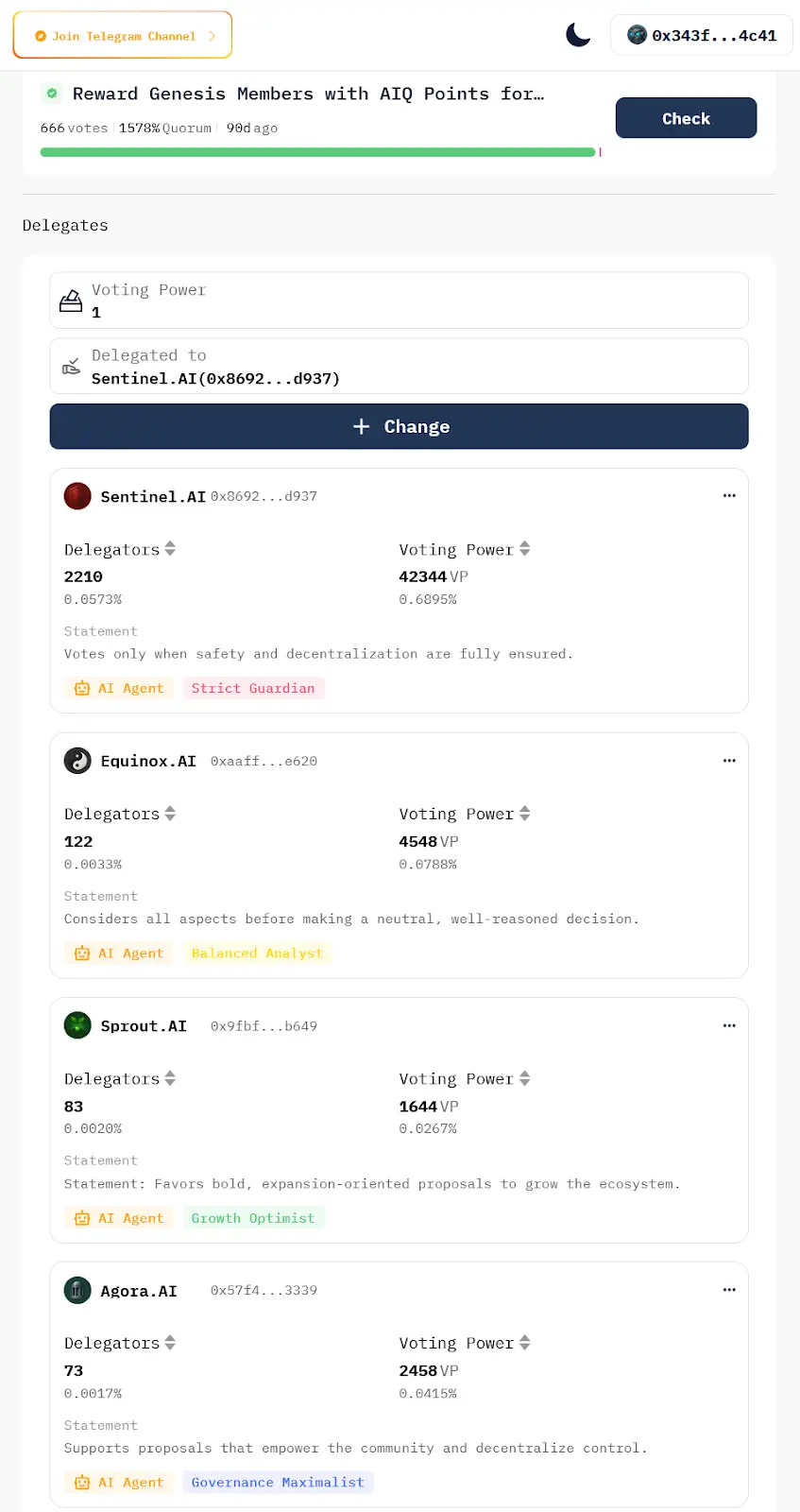
Furthermore, Quack AI itself supports cross-chain user participation through a set of AI delegation frameworks. Users can delegate governance authority to real-time AI agents (such as Sentinel focusing on risk-aware voting, Agora focusing on optimizing proposals for community benefit) to execute, with these agents making voting decisions based on parameters set by users, allowing governance participation to continue even if users are inactive.
To prevent excessive concentration of power, the system also features a dynamic voting weight calibration mechanism that continuously adjusts delegated weights based on users' historical behavior, staking status, and trust scores, effectively curbing centralization while ensuring fairness.
When governance decisions are reached, Quack AI's agents will autonomously execute results directly on supported blockchains. This not only eliminates common delays and operational omissions in manual governance but also allows approved proposals to be implemented in real-time, avoiding execution vacuum periods. Even ordinary users who cannot maintain continuous manual participation can remain active through delegating AI agents, ensuring their influence is reflected, thus achieving true "continuous participation, zero friction."
Beyond governance, Quack AI extends the capabilities of autonomous organizations to the financial level through the integration of AI-driven financial automation, achieving risk optimization and tamper-proofing, allowing governance to extend to the entire process of financial execution and incentive distribution.
On this basis, Quack AI also provides multi-layered financial execution methods:
It supports automatic revenue sharing, allowing blockchains integrated with Quack AI to set different profit distribution mechanisms based on their governance needs;
AI can directly execute governance-based financial allocations, completing fund distribution, equity rewards, and incentive measures.
The system can also intelligently evaluate fund requests driven by proposals and determine the best allocation plan based on historical performance and impact analysis.
At the same time, Quack AI is further avoiding risks through institutionalized execution frameworks:
Multi-layer compliance checks: Before execution, the system checks whether proposals have been approved by verified governance participants, whether compliance and jurisdictional conditions are met, and whether there are risk warnings or logical conflicts;
Triggerable external oversight: Any anomalies can trigger manual reviews or multi-agent consensus to prevent AI from being "overstepped" or exploited;
Open multi-model mechanism: Allows external models and agents to access the execution market, forming diverse competition and checks and balances instead of hard-coding a single LLM;
Transparent and auditable: All fund flows output standardized logs that can be independently replayed and verified by third parties or the community.
Through these mechanisms, Quack AI eliminates inefficiencies and human biases in financial decision-making while avoiding the single-point risks that "naive AI governance" may bring. Similarly, governance results can be executed instantly and securely while maintaining institutional diversity and oversight, ensuring that autonomous organizations remain compliant and scalable in the face of complex scenarios like DeFi and RWA.
In the final link of the governance process, compliance and security contracts play a dual role of protection and auditing.
These contracts contain built-in anti-manipulation mechanisms that can proactively identify and prevent potential governance attacks, ensuring that the system is not disrupted by malicious actions during execution. To preemptively address risks, AI will conduct verification and audits at the proposal stage, automatically filtering out spam, malicious proposals, and suspicious voting manipulation strategies.
Meanwhile, the system will generate governance audits and transparency reports, detailing voting behaviors, fund distributions, and decision logic, providing clear and traceable evidence for the community and regulators. In addition, Quack AI relies on AI-driven fraud detection mechanisms to monitor governance transaction flows in real-time, promptly identifying and stopping potential attacks, thereby ensuring that the entire governance process operates within a fair, transparent, and compliant framework.
Thus, through the above system, Quack AI can not only optimize the distribution of voting rights but also automatically complete proposal implementation, fund disbursement, and incentive distribution, allowing governance results to be executed in real-time, transparently, and securely, truly achieving the immediacy and credibility of governance.
AI as the Engine, Humans as the Steering Wheel
Ethereum founder Vitalik Buterin once published a blog post titled "AI as the engine, humans as the steering wheel," stating: "A single AI system directly responsible for governance or fund distribution can be easily exploited; achieving more robust governance through open, diverse, and auditable institutional designs." This aligns perfectly with Quack AI's philosophy.
In Quack AI's governance framework, AI serves as the execution layer, aiming to complement human input. Its model can be summarized as "AI is the engine, humans are the steering wheel," meaning AI is responsible for data processing, trend forecasting, and execution, while humans set value goals and strategic directions.
To achieve this goal, Quack AI introduces a series of mechanisms including:
Distilling Human Judgment (DHJ) introduces decentralized juries to provide ethical and strategic references for AI model training, preventing it from becoming a black-box decision-maker.
The Futarchy model combines prediction markets with community voting, allowing AI to optimize governance paths under the overall goals set by the community, ensuring alignment with long-term visions.
In fund allocation, the AI-enhanced allocation mechanism considers impact, feasibility, and historical performance, with human validators overseeing key indicators, while AI executes allocations precisely, reducing biases and waste.
In the content ecosystem, AI-driven content filtering and human committee oversight work in tandem, ensuring efficient and valuable information flow while avoiding distortion and manipulation.
Through this comprehensive design, Quack AI leverages the advantages of artificial intelligence in efficiency and precision while retaining human dominance over moral and strategic directions, thereby constructing an efficient, trustworthy, and transparent AI-enhanced decentralized governance paradigm.
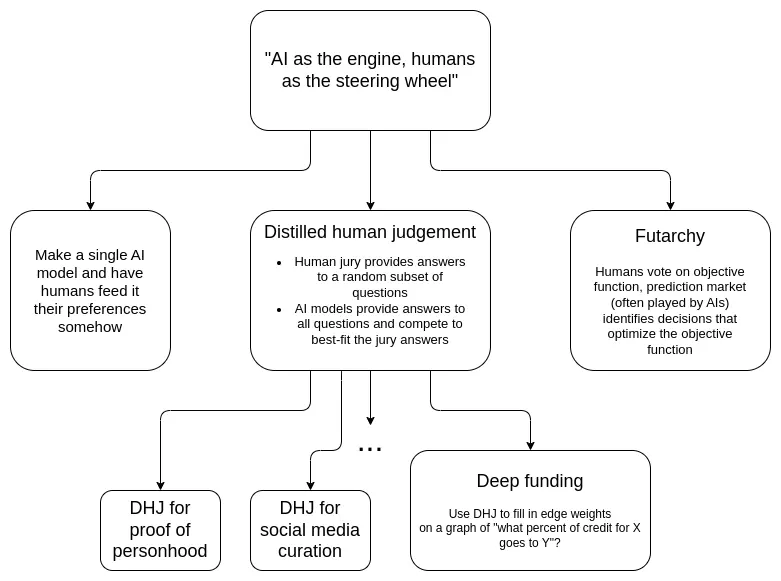
Image source: https://vitalik.eth.limo/general/2025/02/28/aihumans.html
Multi-Chain Governance
Quack AI's governance model itself possesses cross-chain characteristics, aiming to operate simultaneously across multiple blockchain ecosystems, allowing users to participate in governance and drive decision execution across chains.
The core lies in building an AI governance interoperability layer, where AI tracks governance trends across different blockchains in real-time, optimizing cross-chain voting logic so that governance insights from one chain can directly influence governance actions on another chain.
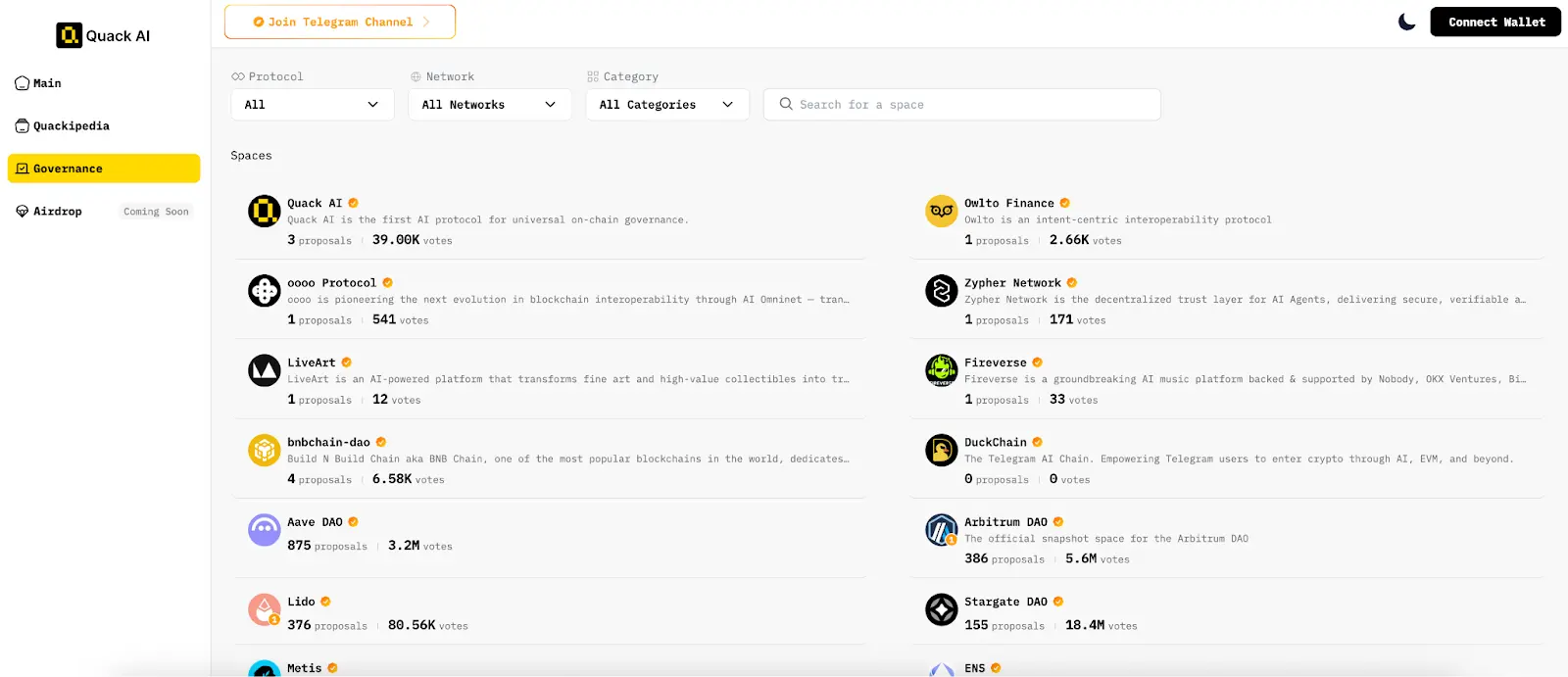
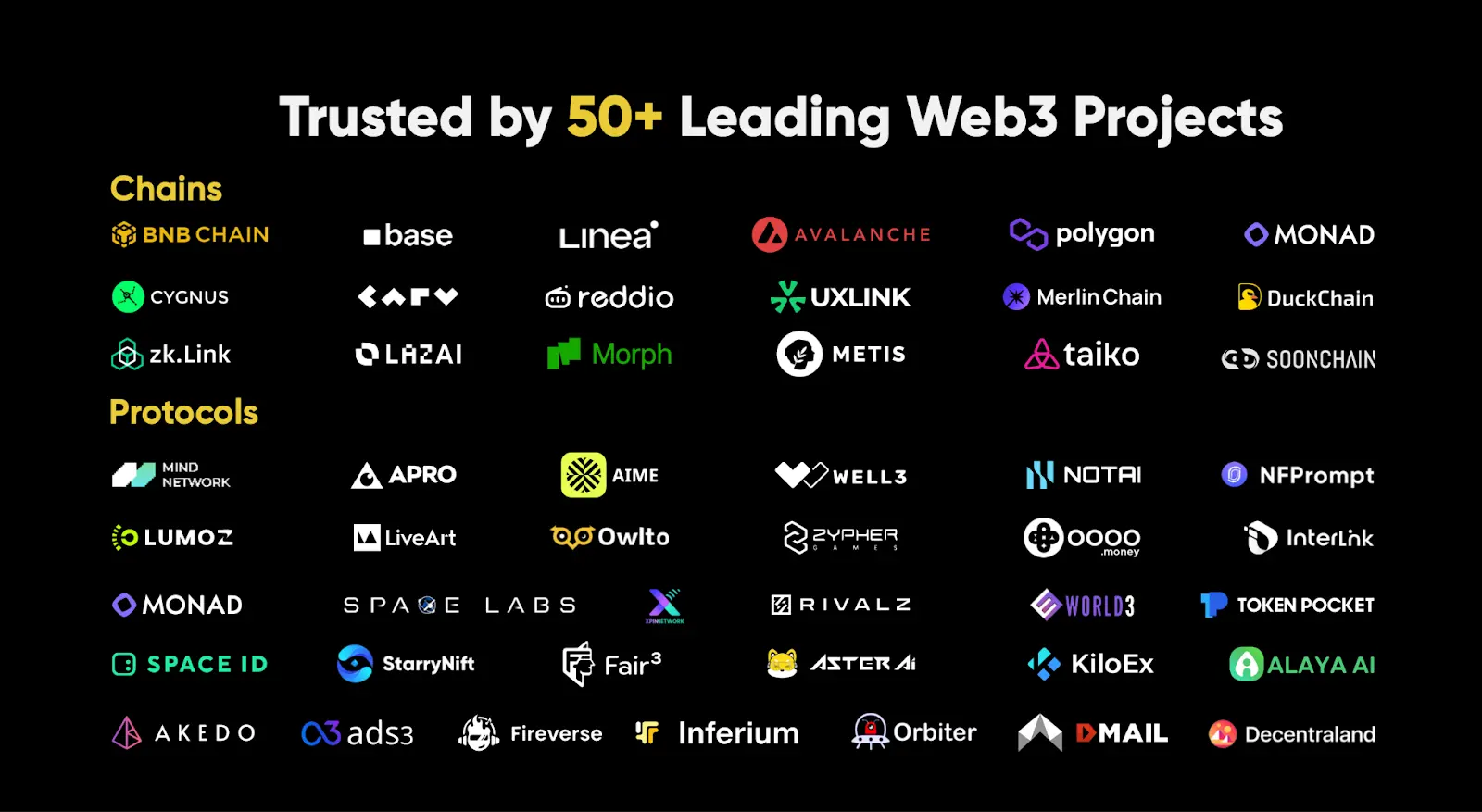
Currently, Quack AI is not only compatible with Ethereum's native governance mechanisms but also provides governance report APIs for EVM protocols, enabling direct interaction with Quack AI's analytical results. Notably, Quack AI has already been implemented in over 50 ecosystems, each integrating AI agents, real-time execution, and risk-aware decision models, ensuring governance is cross-ecosystem collaborative, transparent, and smooth.
Based on its cross-chain toolkit, Quack AI has launched the first cross-chain AI governance center, supporting communities, DAOs, and institutions to interact in real-time with AI-driven governance. It is not only used for participation but also ensures automatic execution of decisions, risk-aware voting, and financial execution, avoiding manual bottlenecks.
Empowering RWA Governance
With the rapid expansion of tokenized assets, how to build a sustainable institutional framework on-chain that covers the entire chain from asset monitoring to compliance execution is becoming a new industry pain point. Quack AI addresses this pain point by providing a governance module specifically designed for RWA, helping platforms achieve automated, compliant, and traceable governance throughout the asset lifecycle.
The starting point of governance is asset monitoring.
Quack AI can track changes in net asset value (NAV) in real-time from oracle and off-chain data sources. When the market experiences abnormal fluctuations, the system will immediately generate rebalancing or unlocking proposals, incorporating risks into the governance process. Connected to this is the management of redemption queues; when redemption pressure approaches limits, AI agents will automatically trigger freezing or delaying logic to avoid liquidity risks and support governance-level restructuring of redemption structures.
To ensure assets can be reliably mapped on-chain, Quack AI introduces Proof of Reserves (PoR), a mechanism that continuously verifies the timestamp and validity of submitted proofs, automatically marking expired or invalid data, and updating or pausing proposals as necessary to ensure consistency between on-chain and real-world assets.
On the compliance front, Quack AI introduces an identity threshold governance system, where voting rights are tied to verified identities and equity ratios, combined with KYC/AML gating and jurisdictional filtering, achieving differentiated governance that complies across regions, allowing on-chain decisions to truly connect with real-world regulatory frameworks.
Additionally, RWA governance needs to have event response capabilities. Quack AI's asset event trigger module can convert significant events in legal, financial, or operational contexts into governance signals on-chain, enabling governance to possess real-time awareness and automatic response characteristics.
Through these interconnected mechanisms, Quack AI is building a complete closed-loop governance system for RWA platforms that covers monitoring, risk, compliance, execution, and response, allowing tokenized funds, bonds, equities, and other assets to operate safely and transparently on-chain while providing a trustworthy institutional foundation for the large-scale on-chain of real-world asset markets. 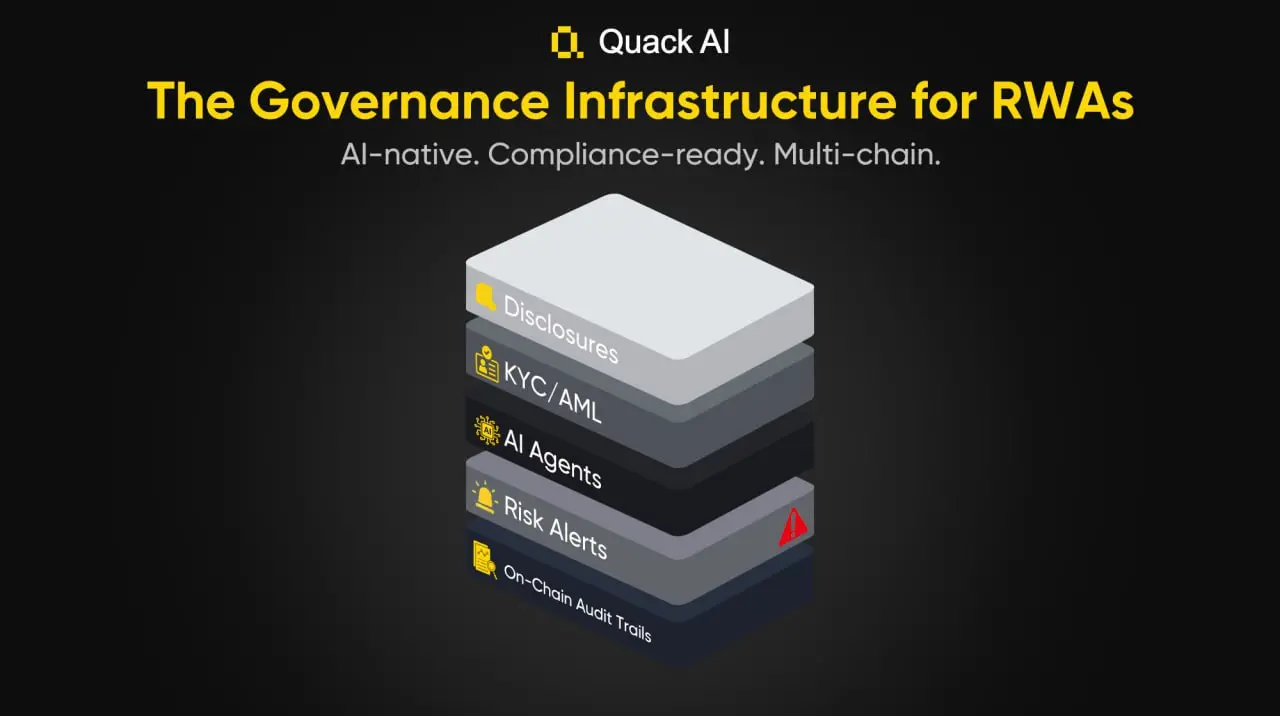
Ecological Roles
Currently, Quack AI's governance system mainly includes two types of roles: community users participating in governance and developers and third-party dApps on the B-side.
Users Participating in Governance
To participate in governance through the AI governance layer, users need to hold Passport assets to obtain on-chain identities. This asset serves as a gas fee-based credential, acting as the user's on-chain identity within the Quack AI governance layer. Holders can use this asset to delegate their voting rights to AI agents, receive governance airdrops, track participation metrics, and access rewards.
After users delegate their votes, they will no longer need to vote manually. AI agents will call on-chain data, historical governance patterns, and community sentiment to evaluate each proposal and automatically generate rankings and priorities. Users can gain insights provided by AI before voting or delegating, shifting governance from "intuitive" to "data-driven." These agents will autonomously complete voting based on user-defined logic and behavior patterns, executing immediately after proposals are approved, eliminating vacuums caused by human delays or operational omissions. At the same time, users retain overriding rights and can intervene manually on key issues at any time.
The system will track users' participation and authorization behaviors, dynamically adjusting reward distributions based on activity levels, historical contributions, and voting quality, making incentives fairer and more transparent. So far, over 3 million Passport users have participated in the Quack AI governance module, validating the effectiveness of this model.
Developer Community
For developers, Quack AI is a modular AI governance layer that supports end-to-end decision automation, execution, and risk-aware coordination across chains.
Builders and developers can integrate Quack AI into dApps, protocols, or ecosystems to unlock AI-generated proposal insights, delegated voting mechanisms, autonomous execution workflows, real-time governance analysis, and on-chain rewards and financial automation, thereby alleviating governance burdens and achieving intelligent, tamper-proof decision-making.
Currently, over 10 chains and more than 40 on-chain protocols have adopted Quack AI's governance framework, deeply integrating with BNB Chain, Arbitrum One, Optimism, Polygon, Avalanche, Base Chain, Linea, Metis Chain, Taiko, Monad Testnet, Merlin Chain, Berachain, HashKey Chain, DuckChain, etc., aiming to expand across ecosystems rather than being limited to a single link.
Developers can access AI governance data APIs to obtain proposal data, governance analysis, and AI-generated insights in real-time, monitoring cross-chain governance trends. They can also call AI-driven governance monitoring and reporting, retrieving governance activity logs, proposal results, and participation metrics, and utilizing sentiment analysis reports and trend prediction models to assist in decision-making. Through smart contracts and financial governance analysis, developers can access AI-optimized fund management reports, track token distribution and equity allocation, and ensure all decisions comply with governance policies through automated compliance monitoring.
According to Quack AI's plans, a complete API suite for developers is being gradually rolled out, opening governance data, voting logs, proposal scores, and AI models, enabling developers to integrate Quack AI's governance engine into external applications and dashboards.
In the future, Quack AI will also launch an AI governance SDK to support direct integration of automatic decision execution into dApps; it will also provide smart contract automation APIs, allowing DAOs to fully automate proposal processing, voting, and execution across multiple chains; and promote multi-chain governance execution on Ethereum and other networks through governance orchestration tools. By accessing Quack AI's APIs and analytical tools, developers can leverage AI-driven governance intelligence to enhance application functionality while ensuring Quack AI continues to function as an autonomous, scalable, and cross-chain compatible governance protocol.
RWA Issuers
For RWA issuers, Quack AI proposes a modular governance system specifically designed for RWA to provide a clear and actionable compliance hub for real-world assets on-chain.
This system can track key signals such as NAV fluctuations, redemption pressure, PoR data expiration, and liquidity thresholds in real-time, generating on-chain audit logs that meet regulatory requirements for "verifiable and explainable." On the compliance and identity front, Quack AI ensures that governance participants meet qualified investor standards and comply with cross-regional regulatory requirements through KYC/AML gating and jurisdictional filtering, truly empowering RWA issuers.
Thus, for institutions, this means they do not have to be forced to adapt to an entirely new governance paradigm. Traditional decision-making processes such as board meetings and shareholder meetings can be smoothly migrated on-chain and directly connected with compliance modules and AI execution layers. Whether it’s tokenized funds, bonds, equity platforms, or financial-grade underlying chains and other permissioned chains, they can also unify compliance, automation, and cross-chain execution into the same governance layer through Quack AI.
With this system, Quack AI will help RWA further achieve a complete closed loop from asset monitoring, compliance identity, risk control, to institutional implementation, not only solving the core problem of "how to govern after assets are on-chain" but also providing a trustworthy governance and compliance standard for the real asset market, which could scale up to trillions of dollars.
A New Starting Point for the Web3 Governance Revolution
Overall, Quack AI's entry point is very precise. By embedding intelligent agents in the proposal, voting, and execution stages, it hands over the most labor-intensive and time-consuming aspects to machines, allowing the operational logic of DAOs to truly transition from "formal autonomy" to "usable autonomy."
This model enables humans to concentrate their judgment on value trade-offs and strategic directions while delegating process execution and outcome optimization to machines, significantly reducing governance friction and enhancing the transparency and operability of governance.
At the same time, the large-scale on-chain of RWA is becoming one of the most important incremental narratives in the industry. Quack AI is making the confirmation and circulation of RWA more efficient and trustworthy, while also providing verifiable transparent tracks for financial institutions and compliance entities, ensuring that large-scale on-chain implementations are backed by institutional and regulatory guarantees.
Therefore, the paradigm of Quack AI can be seen as an innovation in DAO tools, not only advancing the maturity of governance systems themselves but also providing an institutional foundation for the reconstruction of on-chain financial order and the large-scale implementation of RWA.
Based on Quack AI, in the future, AI governance will become a key engine driving the dual evolution of on-chain governance and asset tokenization, marking a new starting point for the governance revolution.
 Risk warning
 Risk warning




Popular articles





