








The market value has evaporated by nearly $160 billion, over 400,000 people have been liquidated, why did the cryptocurrency market crash?
 Core Viewpoint

 Technical pullback or structural turning point?
Author: Zhou, ChainCatcher
At 14:00 Beijing time on September 22, BTC broke below $114,000 and quickly lost several key levels, dipping to $111,800 before fluctuating around $112,600. ETH fell from around $4,500 to $4,077, while SOL dropped to a low of $214.5, with mainstream and altcoins experiencing significant pullbacks.
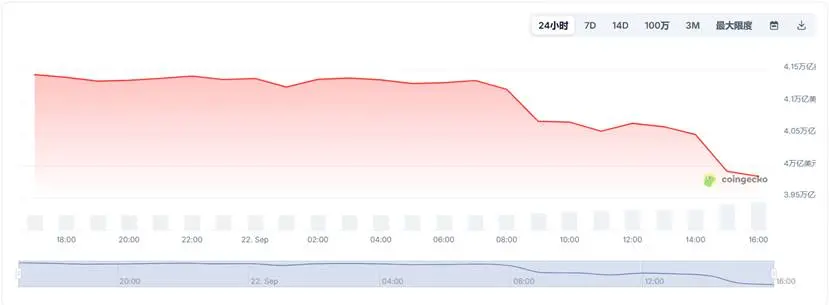
According to CoinGecko data, as of 18:00 on September 22, the global cryptocurrency market capitalization was $3.97 trillion, with a change rate of -3.98% over the past 24 hours. This means that nearly $160 billion has evaporated from the total market cap.
The latest liquidation data shows that approximately $1.7 billion was liquidated across the network in the past 24 hours, affecting over 400,000 people, with long positions amounting to about $1.616 billion, setting a new daily record for long liquidations since 2021; the largest single liquidation occurred in the BTC-USDT contract on OKX, amounting to approximately $12.74 million.
As the market experiences a sharp pullback, is this a technical correction or a structural turning point?
Market Sentiment is Clearly Divided
Under the heavy sell-off, market sentiment is being pulled in two directions. One trader stated that this is the last washout before a bull market, suggesting that BTC may still dip near $112,000, and altcoins need to drop 20-30% before stabilizing. Another trader warned that BTC is most likely to experience a secondary drop in the $115,000-$116,000 range, and if no new funds are seen before October, volatility in the fourth quarter may be even more intense.
The optimistic camp emphasizes positioning and rotation. Some view this drop as a routine pullback in September, noting that a quick rebound after breaking key levels is not uncommon and can provide a trading window for re-entry. They pointed out that Bitcoin's dominance has dropped to around 58%, with funds flowing from BTC into sectors like AI, DeSci, RWA, and DePIN, suggesting that small-cap resilience will be stronger in the later stages.
On-chain and funding sides are also in a tug-of-war. According to monitoring data, before the crash, Trend Research's associated addresses redeemed 16,800 ETH, nearing liquidation, while some institutional funds chose to withdraw liquidity first. As the market overall declined, another whale deposited 15 million USDC into HyperLiquid, opening 20x leveraged long positions in BTC and SOL, as well as 10x leveraged long positions in HYPE, with a total position size of about $26 million, indicating that some funds are choosing to bet on rebounds at low levels. Meanwhile, panic selling still shows counter-trend behavior, with a whale again dumping 1,000 ETH; this address has consistently sold high and bought low over the past two months, reflecting more emotional trading rather than systematic selling pressure.
In fact, on-chain funds had already taken action before the crash. On September 18, whales holding Ethereum cashed out a total of $2.15 billion in a single day. However, Matrixport holds a more cautious view on Ethereum, believing that the risk-reward for previous longs was better, but technical indicators can easily fail during rapid surges. A similar large cash-out occurred after ETH broke above $3,500 in July, but it did not trigger a price drop due to some U.S. treasury companies buying in. Currently, treasury companies still play a major buying role, but as net assets shrink with falling prices, their ability to add funds may be limited, leading to a decrease in the intensity of marginal buying, and risk management should take precedence in the short term.
Additionally, there are other viewpoints. Glassnode's BTC cost distribution heatmap considers the area around $117,000 as a supply-intensive zone, indicating that an effective upward breakout is necessary to open up further supply reduction channels; failure to break through could mean prolonged consolidation or repeated pullbacks. In terms of time dimension, Weiss Crypto's rhythm judgment leans towards sideways movement for 30 to 60 days, suggesting that a phase low is more likely to occur around mid-October.
Joao Wedson, founder of Alphractal, stated that Bitcoin has shown signs of cycle exhaustion, but few have noticed. Multiple on-chain signals indicate that Bitcoin's rebound may have lost momentum. Bitcoin's Spent Output Profit Ratio (SOPR), which measures the overall profitability of all spent Bitcoin transactions on the blockchain, shows declining profitability, increasing the likelihood of a deeper pullback. The Sharpe ratio is below 2024 levels, indicating reduced risk and profit potential. He also noted that this will not attract as many institutional investors as most people think. Even if Bitcoin reaches new highs, profitability will remain low, with the real focus shifting to altcoins.
Why is the Market Falling?
There are many voices regarding today's sharp decline, summarized into three points:
First, passive deleveraging on the derivatives side is the trigger point, with longs crowded in major exchanges. After key levels were breached, liquidation hot zones ignited consecutively, forming a waterfall of liquidations. Corresponding data shows approximately $1.7 billion in liquidations over the past 24 hours, with ETH liquidations exceeding BTC, explaining why high Beta and ETH are falling faster.
Second, the options structure is applying simultaneous pressure. According to market news, the nominal value of BTC options expiring this Friday is about $17.47 billion, with a maximum pain point around $110,000; the nominal value of ETH options is about $5.48 billion, with a maximum pain point around $3,700, raising the probability of price repeatedly testing these levels.
Third, macro-wise, this is a pullback after expectations were fulfilled. The Federal Reserve's 25bp rate cut has been implemented, and the gains since early September extended to $117,900 after the decision, followed by a phase of profit-taking and data observation. Additionally, this week there are PCE and officials' speeches, with traders inclined to reduce leverage first before determining direction, resembling a process of gradual reduction rather than a single black swan event.
Furthermore, comments from BitMEX co-founder Arthur Hayes conveyed some negative sentiment to the market. He stated that we are entering the mid-stage of this cycle, and those who only focus on a few months' window may be disappointed if they bought in six months ago; however, those who allocated funds years ago are mostly seeing significant returns, far exceeding the depreciation of the dollar and other fiat currencies. Therefore, there is no need to be emotional just because Bitcoin is not setting new historical highs every day. He also predicts that a major DAT incident will occur at the bottom of this cycle (FTX exploded at the bottom stage, and BlockFi also had issues at the bottom), such as Bitcoin retracting 70% from $100,000.
Next, investors may need to observe whether BTC and ETH can stabilize prices or continue to break upward with increased volume; whether the maximum pain point of options rises or at least does not fall as expiration approaches, as a downward shift in the pain point indicates continued pressure from sellers; and whether there is large-scale net inflow on-chain, especially focusing on stablecoin net issuance and exchange net outflows, as well as the actions of whales.
 Risk warning
 Risk warning




Popular articles





