








From Exchange Attributes to Sorter Centralization Debate: The L2 Predicament Behind Base's Dual Controversy
 Core Viewpoint

 This article explores the recent heated debate on whether L2 should be considered an exchange and subject to SEC regulation, and delves into the controversy surrounding the centralization of the Base sequencer that arises from this issue.
Original Author: Eric, Foresight News
Hester Peirce, a commissioner of the U.S. Securities and Exchange Commission (SEC) known as the "Crypto Mom," stated in The Gwart Show that L2s relying on centralized orderers may fit the SEC's definition of an exchange, and therefore operators must register with the SEC and comply with relevant regulations.
Hester Peirce indicated that the key to this judgment is not the technology but the actual functionality. If a single operator controls the matching engine, it is similar to an exchange. To some extent, this means that as long as there is a centralized organization with trading control over L2, that organization needs to be subject to SEC oversight.
Initially, this viewpoint did not spark widespread discussion, but as it continued to ferment, many began to worry that if the "crypto-friendly" SEC could reach such a conclusion, the development of L2s might be hindered. Base, which combines elements of both exchanges and L2s, became a primary target.
As the FUD grew louder, Coinbase's Chief Legal Officer Paul Grewal was the first to speak out, stating that the SEC defines an exchange as a market connecting buyers and sellers of securities, but L2 operates as a general blockchain infrastructure that can serve on-chain exchanges, much like AWS provides infrastructure for exchanges, but it cannot be said that AWS is an exchange. Paul Grewal believes that mislabeling the orderer could lead to overlooking L2's role in scalability.
Subsequently, Base's head Jesse Pollak also provided an explanation on X regarding the orderer, stating that the orderer collects user transactions and sorts them based on a first-in, first-out principle to calculate the resulting state changes, ultimately consolidating transactions on L1 for settlement, much like a traffic controller ensures smooth road flow. Jesse Pollak argued that the orderer does not match orders; the matching of trades occurs at the smart contract level, and the orderer merely ensures that these transactions proceed in a consistent and orderly manner.
Ethereum co-founder Vitalik Buterin joined the discussion after Jesse Pollak, asserting that Base is simply an L2 running on Ethereum, providing a stronger user experience through centralized functionality while still closely tied to Ethereum's decentralized base layer to ensure security. Vitalik emphasized that Base's funds are "non-custodial," meaning that the funds on L2 are ultimately controlled by L1 and cannot be stolen by L2 operators.
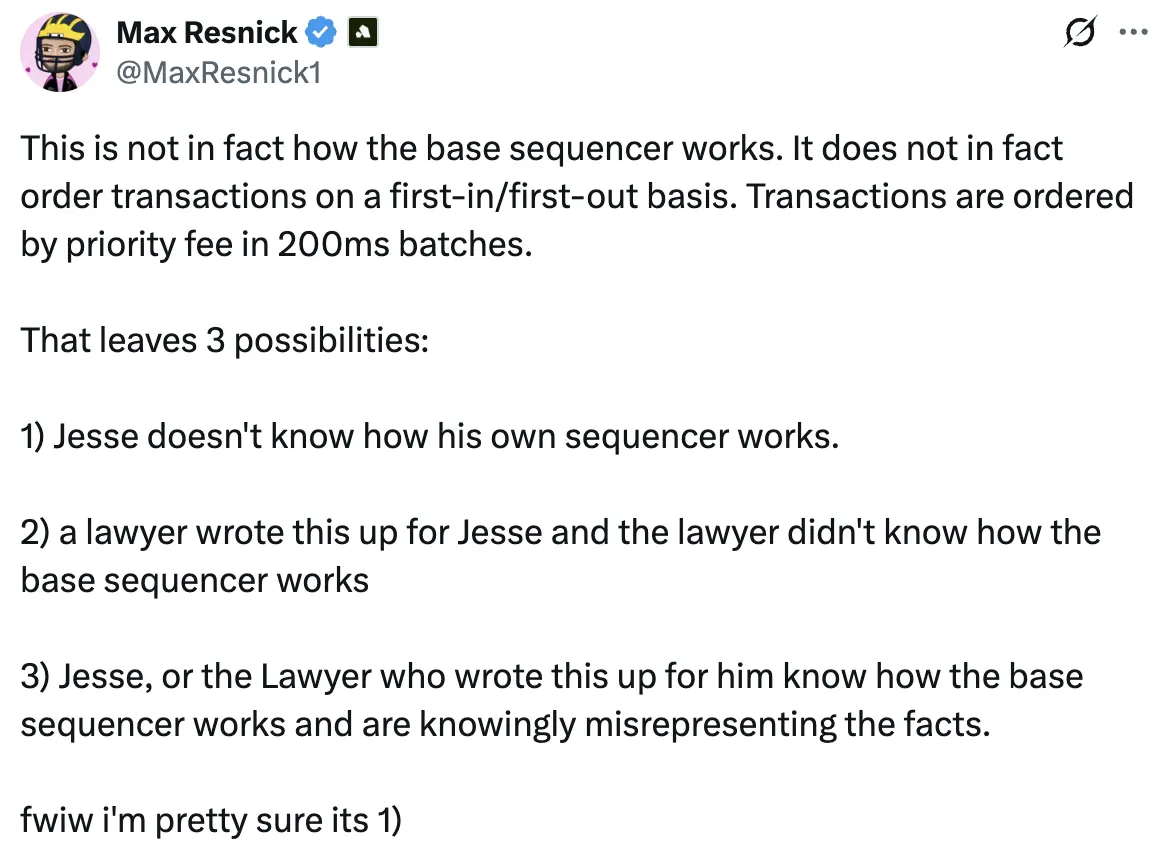
Max Resnick, chief economist at Anza, a company focused on Solana development, raised questions about Jesse Pollak's statements, indicating that Base's orderer sorts transactions based on priority fees in 200-millisecond intervals, rather than following a first-in, first-out principle. Although Jesse Pollak later clarified this, it was clear that Max Resnick wanted to express the key point that the orderer can reorder transactions according to certain rules, directly pointing to the issue of orderer centralization.
Discussions about whether L2s like Base can be considered exchanges do not yield many differing opinions; the SEC commissioner's view that "L2 is an exchange" may stem from a lack of understanding of L2 architecture. Industry discussions are more driven by regulatory concerns rather than binary issues. However, the perspectives of Base stakeholders and Vitalik sparked another layer of discussion: should the centralization of Base's orderer change?
From Regulatory Issues to the Debate on Orderer Centralization
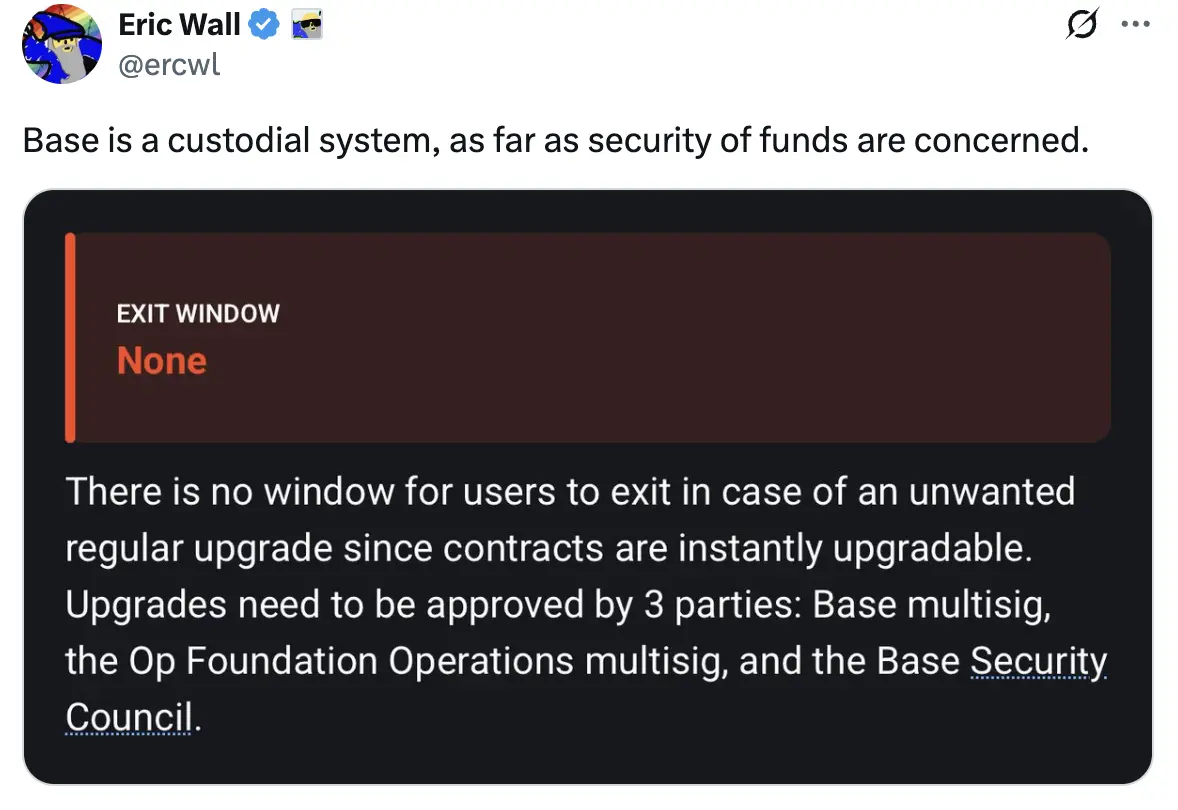
Vitalik's viewpoint that Base's centralized orderer is for scalability and user experience has also sparked significant controversy. Eric Wall, co-founder of Taproot Wizards, stated that in terms of fund security, Base is a custodial system and pointed out that Base's contracts can still be upgraded through governance, meaning that operators and their related entities (via a security council) retain considerable discretion. In his view, this makes Base functionally closer to a custodial system rather than a fully trust-minimized Ethereum scaling solution. Eric Wall also commented that Vitalik's wording could lead readers to believe that even if key leaks occur, they would not result in fund loss, which he deemed irresponsible.
Former Ethereum core developer Lane Rettig stated that while Coinbase itself would not maliciously steal user funds, that does not mean Coinbase would not act against user interests under government pressure.
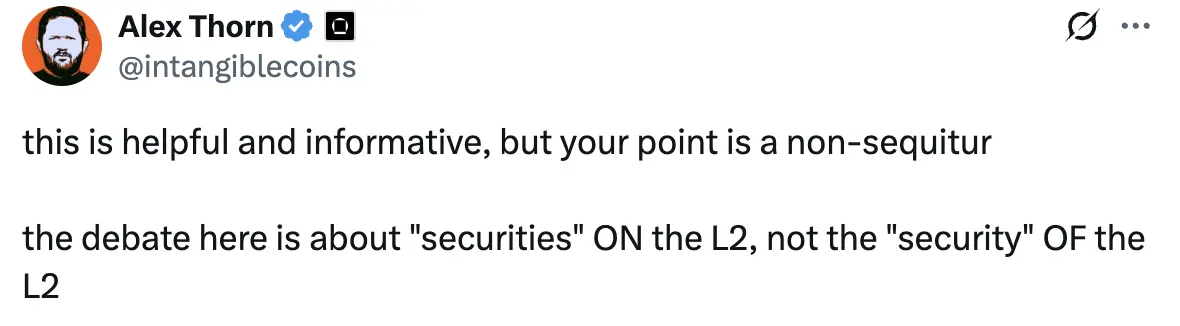
Alex Thorn, head of research at Galaxy, argued that Vitalik's viewpoint missed the point, stating that the focus of the discussion should be on securities on L2, rather than the security of L2 itself. Although Alex Thorn did not explicitly state it, his viewpoint pointed to a very critical issue: L2 itself is not an exchange, but if the trading platforms on L2 are built on a highly centralized chain, can those trading platforms still be called DEXs, and should they be regulated?
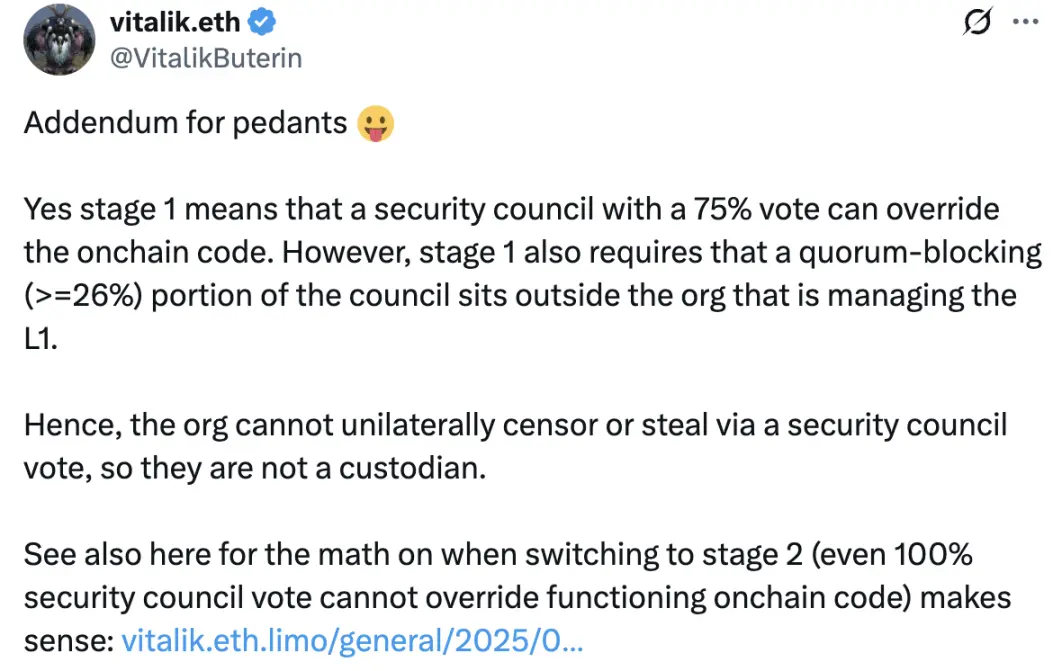
In response to the increasing criticism of Base's centralization, Vitalik reiterated that Base is indeed in a centralized phase, where the absolute majority vote of the security council can upgrade contracts, but he pointed out that quorum rules prevent Coinbase from unilaterally reviewing or stealing funds. Furthermore, even a 100% vote from the security council cannot change the running on-chain code, and a second phase is already in planning.
The founder of Anastasia Labs, which is developing Cardano L2 Midgard, sharply commented under Vitalik's supplementary remarks: interpreting "security council" as "multi-signature"; interpreting "75% vote" as "7 private keys"; interpreting "requiring individuals in the council to be independent of the organization managing L2 to veto proposals with more than 26% voting power" as "requiring that organization to use shell companies, friends' companies, obfuscated subsidiaries, or partner companies to hold the 3 private keys needed for multi-signature."
Many users in the comments supported the founder of Anastasia Labs, believing that although the rules are set this way, it is very easy to bypass the rules to achieve complete control over Base, and the opacity of governance makes these transparent rules seem very untrustworthy.
Regulatory Challenges for Web 3 Infrastructure
The excessive centralization of Base as an L2 has sparked discussions multiple times. The SEC commissioner's viewpoint seems somewhat "absurd," but it also points to the core issue: if the transaction ordering on L2 can be manipulated at will, then this L2 should be subject to regulation. Of course, regulating L2 as an exchange may superficially lack basis, but if the L2 operator controls the orderer to pocket MEV profits and influence transaction execution prices, then L2 does indeed play a role similar to that of a broker to some extent.
For regulatory agencies, determining the "decentralization" of infrastructure is a challenge. Even if the orderer achieves decentralization, it is difficult to clarify whether there are conflicts of interest among the entities maintaining the orderer network in a short time. The SEC, concerned about the potential for a repeat of the FTX tragedy due to a lack of regulation, has somewhat relaxed regulations during the new U.S. presidential term, but it still cannot hide its worries about the significant risks arising from regulatory relaxation. Recently, U.S. regulatory agencies have introduced some exemptions for DeFi, but how to define and review infrastructure remains a question that needs further study.
 Risk warning
 Risk warning


Popular articles





