








The other side of the Binance Memecoin frenzy: a 1.4% graduation rate, with giant whales losing over 3.5 million dollars
 Core Viewpoint

 Money comes quickly, and goes quickly.
Author: momo, ChainCatcher
In the past two days, the Memecoin sector on the BNB Chain has experienced a significant pullback, with most coins generally dropping 80% within 48 hours. However, the market's FOMO sentiment has not completely dissipated. It wasn't until this morning's unexpected black swan event that most community players woke up from their dreams.
In this seemingly equal opportunity speculative wave, the vast majority of participants may not have realized actual profits, as they returned all their gains or exited at a loss after briefly enjoying paper wealth. Data shows that nearly 90% of popular Memecoins have significantly retraced from their highs, with the Binance Alpha project seeing a drop of up to 87.8% in the past week. The narrative of getting rich quickly cannot hide the reality of "huge losses." Some investors have lost over $430,000 from buying BNBHolder, while some whales have accumulated unrealized losses exceeding $3.5 million on Meme coins like "Binance Life" and "Customer Service Xiao He."
As the speculative frenzy around Memecoins gradually fades, it is worth reflecting calmly: should we continue to chase risks in a rapidly rotating market, or should we focus more on underlying infrastructure that has actual value support?
Meme Season, Alpha Altcoin Season, or Just an Illusion
1. Over 87.8% of Binance Alpha tokens have dropped in the past week
The Memecoin craze initiated by the BNB Chain during the National Day holiday has gone from launch, peak, to a final crash in just about a week. The market came quickly and left even faster. The so-called "sector-wide rally" is actually extremely fragile; among the top ten popular Memecoins by market cap, after experiencing significant pullbacks, 80% are still down 40%-60% today, with 70% having dropped over 70% from their highs.
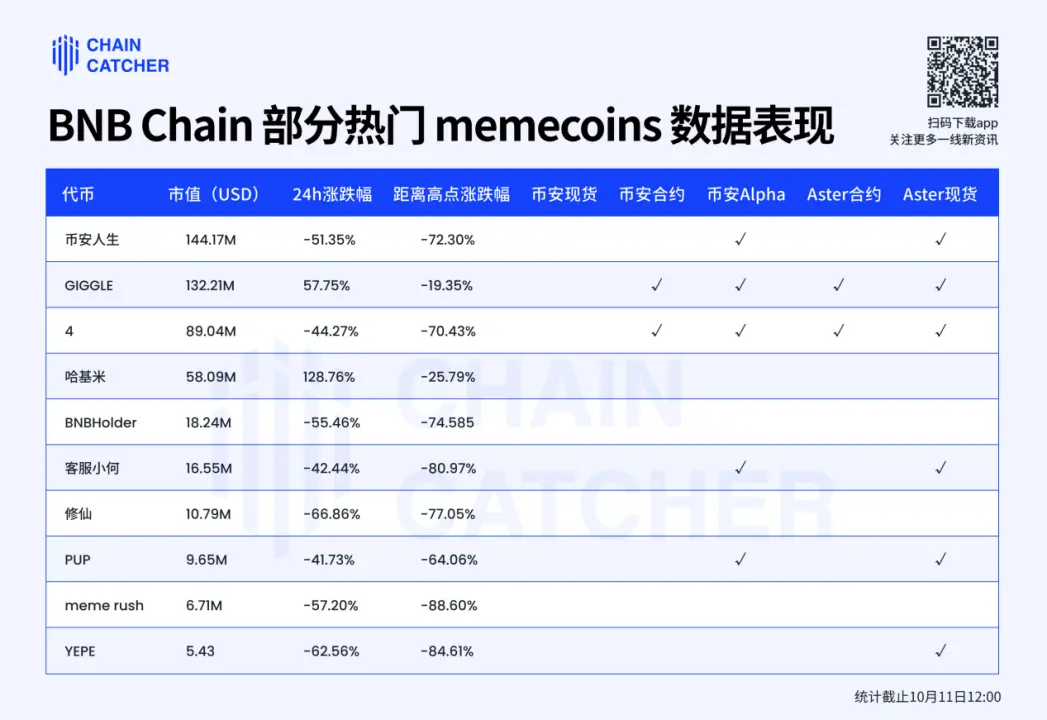
Even without the black swan event, from October 9 to 10, as the Binance wallet's internal feature "Meme Rush" went live, market funds were quickly withdrawn, causing about 80% of BNB Chain Memecoins to drop sharply due to liquidity "sucking."
More broadly, the entire Binance Alpha project ecosystem shows a similar trend. According to CoinMarketCap data, of the 320 projects with higher market caps, only 39 projects saw an increase in the past week, while the drop rate reached 87.8%. About 43% of tokens fell over 30%, and another 10% were close to being halved.
2. The Other Side of Getting Rich: Multiple Whales with Huge Losses, the Highest Unrealized Loss Exceeds $3.5 Million
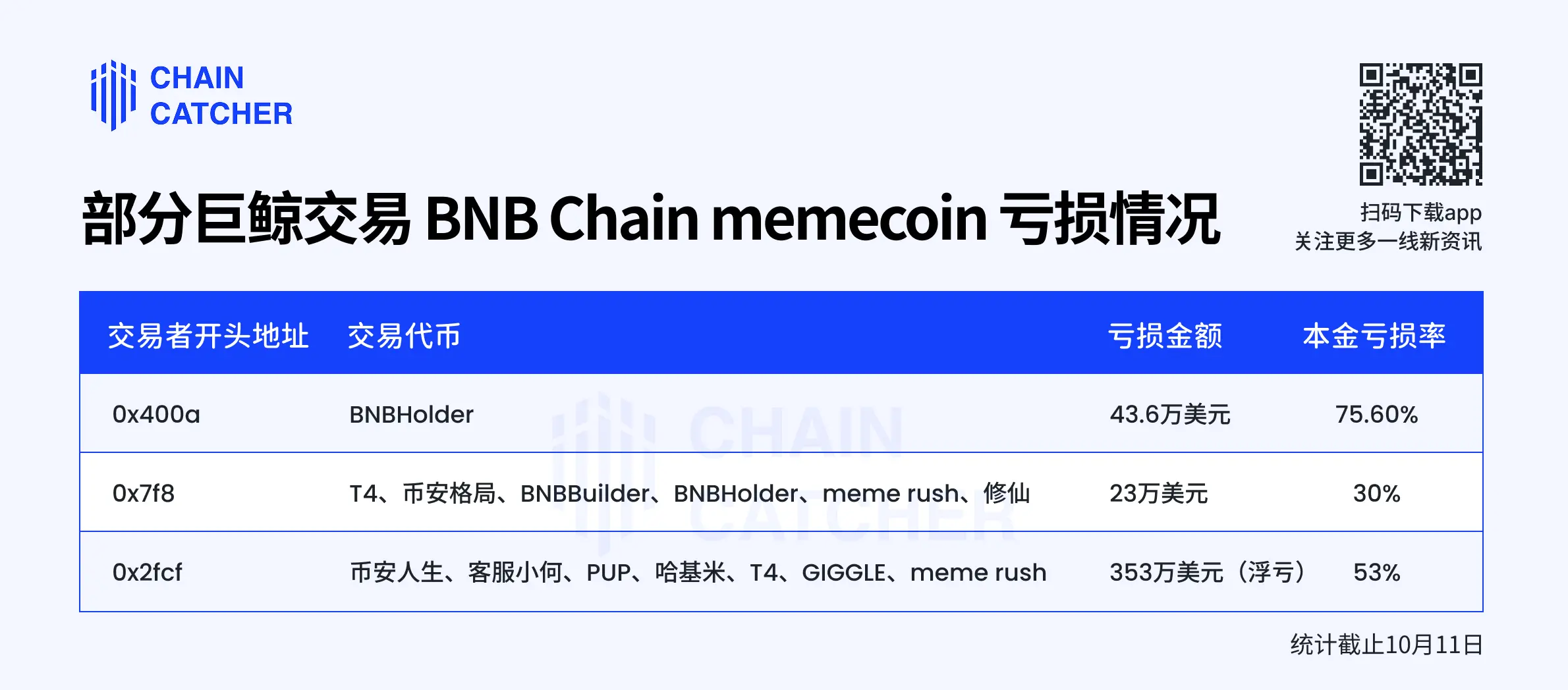
Even with large capital, in the highly concentrated and illiquid Memecoin market, whales also struggle to avoid significant losses caused by information lag, project control, or emotional drives.
Specifically, address 0x2fcf invested over $5.6 million to buy tokens like "Binance Life" and "Customer Service Xiao He," and now has an overall unrealized loss exceeding $3.5 million, with a loss rate of 53%.
Another trader, 0x400a, heavily bet on BNBHolder and was forced to sell everything after the price continued to drop, recovering only $140,000 from an initial investment of $576,000, resulting in a loss rate of 76%.
Meanwhile, address 0x7f8 traded six different Meme coins (including T4 and Xiu Xian) with a win rate of zero, accumulating a loss of $233,000 over two rounds of operations, accounting for about 30% of its total investment.
3. Four.Meme Graduation Rate is 1.4%, Less than 10% of Binance Alpha Projects Go Live
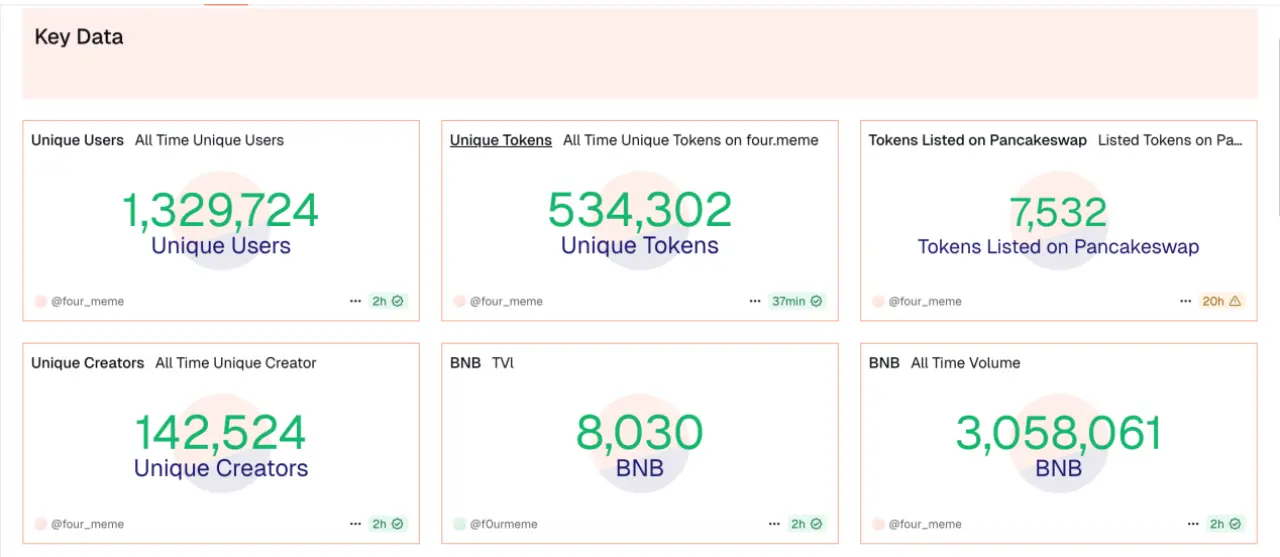
After the launch of Meme Rush by the Binance wallet, it created a seemingly clear "stairway to heaven" for BNB Chain's Memecoins: starting from the Four.Meme internal market, competing in the Meme Rush rankings, to the Binance Alpha platform, and finally landing on Binance's main site for spot trading. However, behind this layered circulation framework is an extremely brutal selection mechanism—over 99% of projects are reduced to "fuel" for platform development in the selection process.
According to Dune data panels, the Four.Meme platform has issued a total of 534,300 tokens, but only 7,532 have successfully "graduated" to trade on Pancakeswap, resulting in a graduation rate of only 1.4%. This means that over 98% of projects have failed at the budding stage.
Even if they become part of that lucky 1.4% and successfully launch on Binance Alpha, the next round of elimination is equally brutal. According to statistics from IOSG founder Jocy, of the approximately 326 projects launched on Binance Alpha, only 32 successfully went live on Binance's main site for spot trading, with a launch rate of less than 10%.
This system, while providing users with a clear path, also creates a massive funnel effect, making it difficult for the vast majority of participants to navigate through multiple levels to reach the end. What worries the community even more is that the multi-level circulation model has not brought fairness; instead, it has exacerbated manipulation issues due to opaque algorithms and concentrated internal market chips.
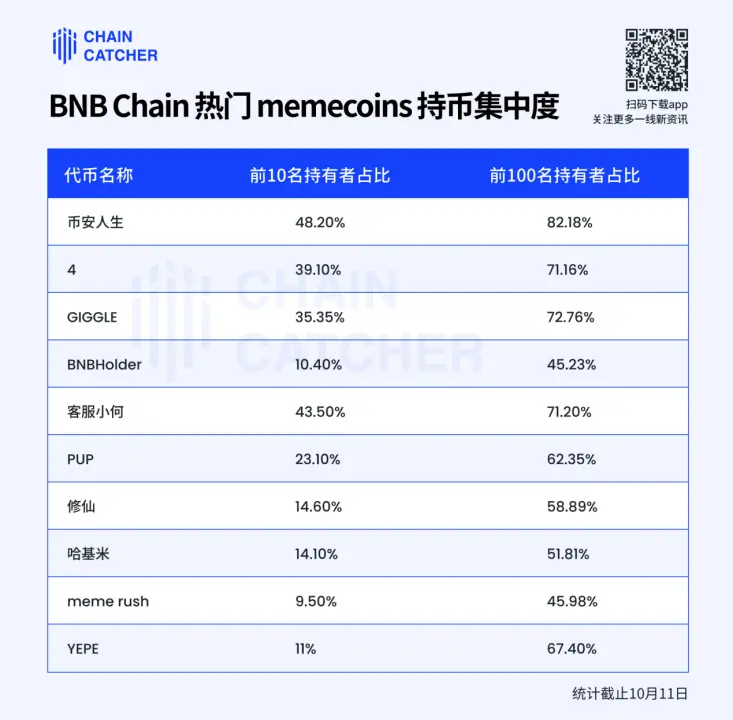
4. Concentrated Chips, the Top 100 Holders Generally Account for 50%-80%
Most popular meme tokens have over 30% of their holdings concentrated among the top 10 holders, especially "Binance Life" (48.20%) and "Customer Service Xiao He" (43.50%), with nearly half of the chips controlled by a very small number of people. The total share of the top 100 holders generally exceeds 50%, with many even surpassing 70%, leading to a high concentration of liquidity among large holders, making prices easily manipulable.
Crypto KOL StarPlatinum tracked a case where a whale address starting with 0x73d8bd held 38.62%, 14.03% of PALU, and 22.89% of Binance Life at its peak, and its selling or not directly determined the token's rise and fall. Another whale address starting with 0xe39a5 precisely bought $100,000 of PALU just minutes after CZ joked about it, making an unrealized profit of $1 million in one hour, which is hard to attribute to luck rather than insider trading.
Speculation Driven VS Infrastructure First, Two Market Tests
The explosion of Meme coins on the BNB Chain and its subsequent sharp pullback have once again triggered deep reflections on the development paths of exchanges.
Binance, leveraging the influence of its founder and a complete asset incubation chain, has demonstrated strong traffic aggregation capabilities. However, this model, which heavily relies on market sentiment, has also sparked controversy. Supporters argue that Binance has redefined asset discovery rules through the entire process from Four.Meme to main site listing, establishing a complete closed loop from "lab to listing." But critics have also been sharp, with IOSG founder Jocy pointing out that the industry has fallen into a "quick money model," and the excessive incentives for speculative trading by exchanges have affected the healthy development of the industry.
After this morning's black swan crash, crypto KOL Haotian bluntly stated that exchanges may become "vampires monopolizing traffic and liquidity," seemingly providing retail investors with many opportunities to make money through an endless stream of Alpha launchpads and high-leverage contracts, but also placing retail investors in an asymmetric risk landscape. "USDe doing cross-margin was liquidated in a chain reaction, exposing the powerlessness of retail investors under the platform's defined rules. The leverage level and opaque risk control capabilities enhanced to improve product service experience are actually traps for retail investors."
At the same time, the path chosen by OKX has also sparked polarized evaluations in the market. Compared to Binance's drive for the Memecoin craze, OKX has opted for a more neutral infrastructure-first approach. OKX founder Star stated, "Trading platforms should remain neutral. The platform's responsibility is to build a fair and transparent market environment, rather than becoming an inducer of emotions."
However, opponents argue that OKX's restraint during the Memecoin craze caused it to miss out on significant traffic dividends, resulting in relatively weak performance of its ecological tokens, having infrastructure but lacking a more attractive wealth effect.
Supporters believe that slow is fast; this steadiness precisely reflects its value. Twitter user @Web3gouhuan stated, "A truly healthy ecosystem should not rely on one or two wealth effects to sustain it, but rather on mechanisms, consensus, and user cycles for growth. A platform that can remain neutral and dare to be slow is mature." The OKX Web3 wallet has evolved from facing controversy in its early stages to becoming widely used infrastructure, including this morning's stable operation of the OKX global risk control system, successfully withstanding severe market fluctuations, which is the most intuitive reflection of this value.
The essence of this route dispute is the collision of different development visions in the crypto world. Binance has proven its ability to ignite hotspots and dare to experiment, but KOL's skepticism and market data also warn of the risks of relying on a speculation-driven model. OKX's infrastructure path lacks the wealth effect that attracts market attention but somewhat responds to the industry's expectations for sustainable development.
As the industry seeks breakthroughs in the next phase, a balanced approach that respects market sentiment while adhering to value bottom lines may be the most promising direction to look forward to.
 Risk warning Risk warning



Popular articles





