








10.11 Is the Great Crash an Organized Attack? A Detailed Analysis of Two Major Doubts
 Core Viewpoint

 Was the largest liquidation in history a deliberate attack?
Original Title: Was the Friday Crash a Coordinated Attack? The Evidence Points to Something Disturbing
Original Author: @yq_acc
Original Compilation: Jiahua, ChainCatcher
The black swan event from October 10 to 11 led to the largest liquidation in crypto history, amounting to $19.3 billion. Although initial reports attributed the cause to market panic triggered by tariff announcements, a deeper analysis of the data revealed some concerning issues. Was this a coordinated attack against Binance and USDe holders? Let’s examine the evidence.
Doubt 1: Why These Three Assets?
The most perplexing aspect of this crash centered around three specific assets—whose prices catastrophically collapsed, but only on Binance:
USDe: Plummeted to $0.6567 on Binance, while remaining above $0.90 on other exchanges.
wBETH: Crashed to $430 on Binance, 88.7% lower than ETH's normal price.
BNSOL: Dropped to $34.9 on Binance, with almost no fluctuations on other exchanges.
This "specific exchange" crash phenomenon immediately raised alarms. Market panic typically does not so precisely affect a single platform.
Doubt 2: Coincidental to Suspicious Timing
The situation became even more interesting. As early as October 6, Binance announced it would update the pricing mechanism for WBETH and BNSOL, expected to take effect on October 14 (now changed to October 11). The crash occurred precisely during the "window of vulnerability" between the announcement and the new mechanism's implementation from October 10 to 11.
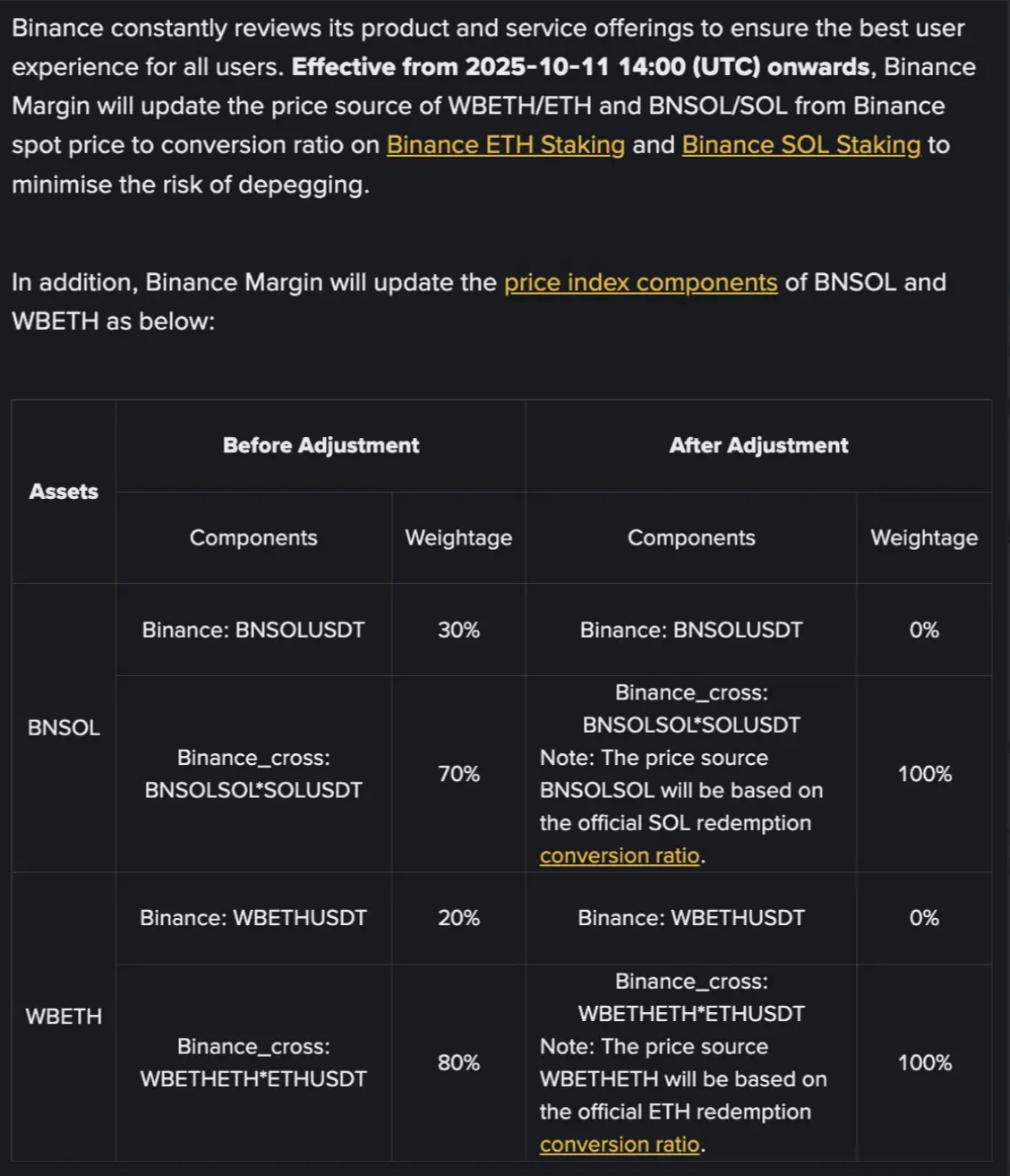
Out of thousands of trading pairs, why were only these three assets, which were announced for updates, subjected to extreme decoupling? The probability of this being mere coincidence is minimal.
Attack Hypothesis Derivation: A Carefully Planned Timeline
Assuming this was indeed an organized attack, the timeline indicates a meticulous plan:
5:00 AM (UTC+8): The market begins to decline due to tariff news, a normal reaction.
5:20 AM: The liquidation of altcoins suddenly accelerates. This step may have been aimed at specifically targeting the positions of market makers.
5:43 AM: USDe, WBETH, and BNSOL simultaneously begin to crash on Binance.
6:30 AM: The market structure completely collapses.
Specific Crash Details:
5:00 AM (UTC+8): Initial market fluctuations begin
Bitcoin starts to drop from $119,000
Trading volume is within normal range
Market makers maintain standard spreads
5:20 AM: First wave of liquidation waterfall
Altcoin liquidations accelerate sharply
Trading volume surges: 10 times normal trading activity
Market maker withdrawal patterns emerge
5:43 AM: Key decoupling event
USDe: $1.00 → $0.6567 (-34.33%)
WBETH: 3,813 USDT → begins catastrophic decline
BNSOL: ~200 USDT → accelerates collapse
5:50 AM: Maximum dislocation
WBETH reaches 430.65 USDT (down -88.7% from parity)
BNSOL bottoms at 34.9 USDT (-82.5%)
Buyer liquidity completely absent
6:30 AM: Market structure completely collapses
Total liquidation exceeds $10 billion
Market makers completely withdraw
Binance-specific price anomalies peak
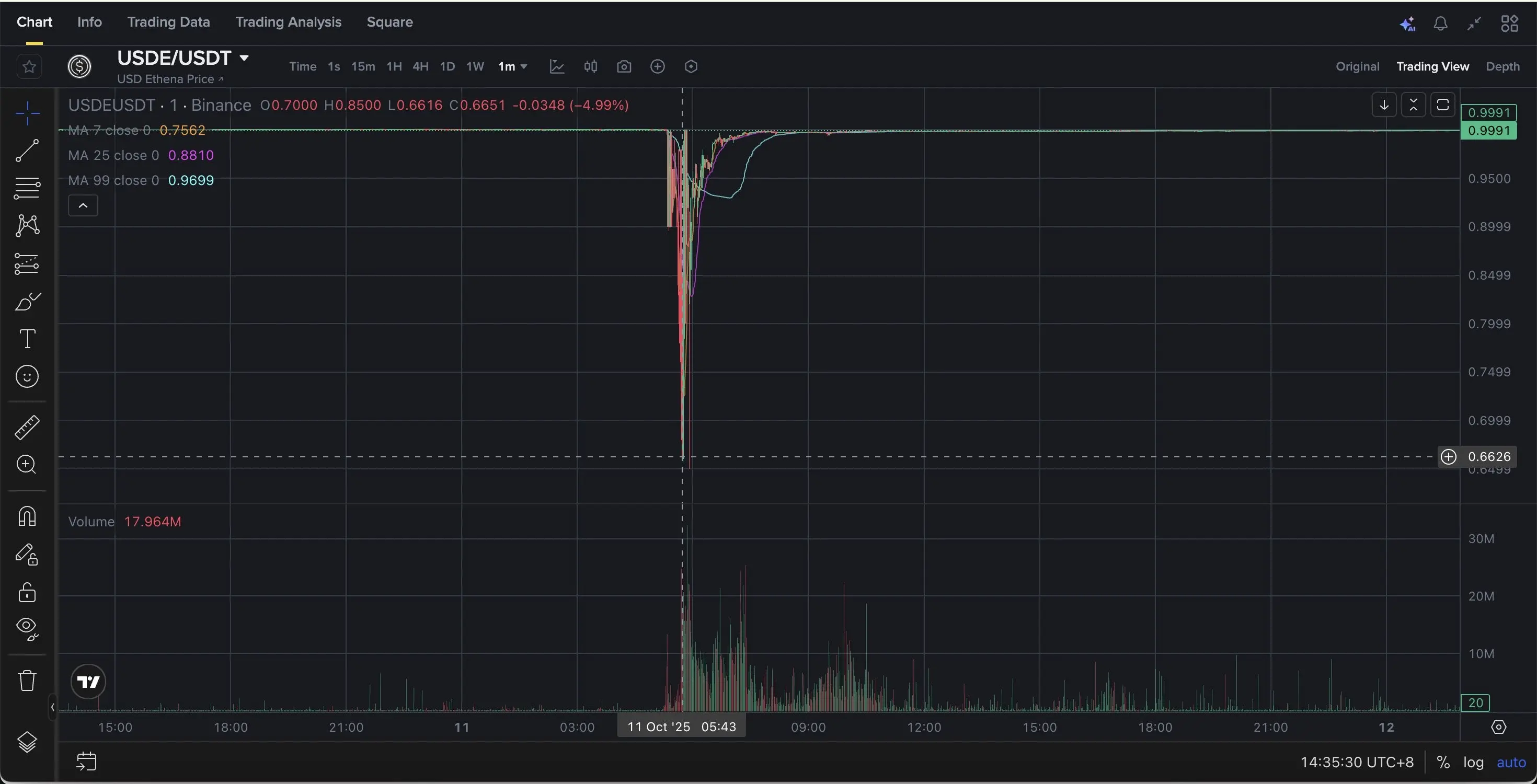
USDE/USDT dropped at 5:43 AM (Singapore time)
*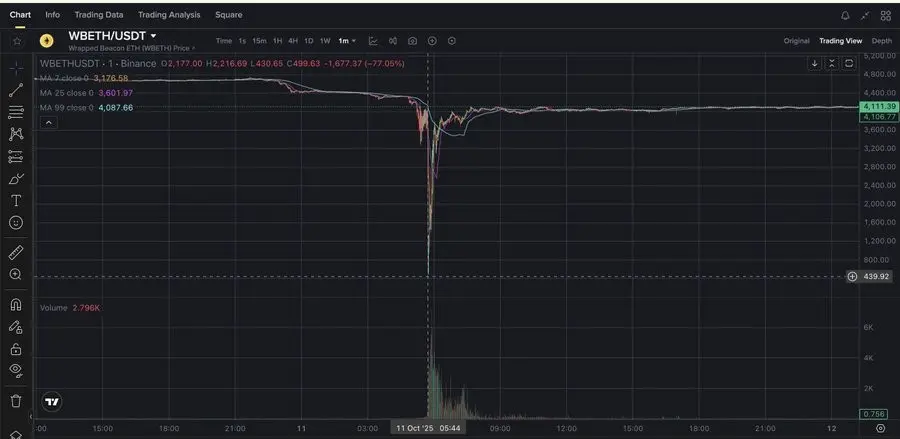 *WBETH/USDT dropped at 5:43 AM (Singapore time)**
The first wave of liquidation and the crash of USDe, WBETH, and BNSOL had a 23-minute interval, indicating a sequential execution rather than a random panic event.
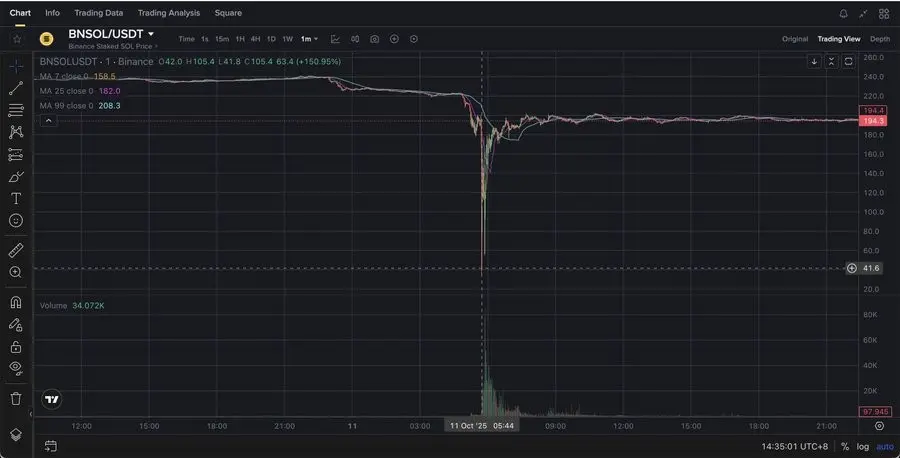
BNSOL/USDT dropped at 5:43 AM (Singapore time)
USDe Factors
USDe itself has several weaknesses that make it an ideal target for attack:
Hidden Leverage: Binance's 12% yield program encourages users to engage in recursive borrowing, creating leverage positions of up to 10 times.
Collateral Concentration: Many traders use USDe as margin collateral.
Weak Liquidity: Despite being called a "stablecoin," USDe's order book depth is surprisingly shallow.
When USDe crashed to $0.6567, it not only caused direct losses but may have triggered a chain reaction throughout the ecosystem.
Market Maker Perspective
A theory circulating among traders is that the first wave of altcoin liquidation at 5:20 was specifically aimed at targeting market makers. Once market makers were forced to exit due to losses, they would simultaneously remove all orders across trading pairs, causing the market to instantly lose liquidity and become vulnerable.
Evidence shows that many altcoin prices on Binance were far lower than on other exchanges at that time, aligning with the pattern of major market makers being liquidated.
Tracking Funds
If this was an organized attack, the attackers reaped astonishing profits:
Potential Shorting Profits: $300 million - $400 million
Opportunities to Accumulate at Low Prices: $400 million - $600 million
Cross-Exchange Arbitrage: $100 million - $200 million
Total profit potential: $800 million to $1.2 billion
This is not normal trading profit but rather a robbery-like return.
Other Explanations
That said, there are other possibilities:
Chain Liquidation Effect: A large liquidation naturally triggers a snowball effect.
Risk Concentration: Too many traders adopted similar strategies.
System Pressure: Exchanges malfunction under extreme trading volumes.
Panic Psychology: Fear itself creates a self-fulfilling prophecy.
However, these explanations struggle to account for why the crash so precisely targeted specific assets and specific exchanges.
Suspicious Aspects of the Event
Several factors distinguish this event from a typical market crash:
Venue Specificity: Price crashes were almost entirely limited to Binance
Asset Selectivity: Only assets with pre-announced vulnerabilities were severely affected
Timing Precision: Occurred within the exact window of vulnerability
Sequentiality: Market makers were cleared before the main targets were attacked
Profit Pattern: Consistent with a pre-deployed strategy
What It Means If True
If this was indeed a coordinated attack, it represents a new evolution of market manipulation in the crypto space. Attackers are no longer targeting systems or stealing keys but weaponizing the market structure itself.
This would mean:
Every exchange announcement becomes a potential vulnerability
Transparency may paradoxically reduce security
Market structures need fundamental redesign
Current risk models are inadequate
Some Disturbing Possibilities
While we cannot definitively prove the existence of an organized attack, the evidence constitutes reasonable suspicion. Its precision, timing, venue specificity, and profit pattern perfectly align with the characteristics of a coordinated attack.
Whether through excellent speculation or deliberate planning, someone has turned Binance's transparency into vulnerability, seizing nearly a billion dollars in the process.
The crypto industry must now grapple with a troubling question: In our interconnected, 24/7 operating market, has transparency itself become a weapon that cunning participants can wield?
Until we receive clear answers, traders should assume that all exchanges have similar vulnerabilities. The events of October 10 to 11 may have many explanations, but one thing is certain: it was not random.
This analysis is based on existing market data, cross-exchange price comparisons, and established market behavior patterns. The views expressed are solely my own and reference but do not represent any institutional stance.
 Risk warning
 Risk warning




Popular articles





