








Cryptocurrency and stock market double kill, how are the stocks of DAT companies?
 Core Viewpoint

 This article analyzes the dire situation of Digital Asset Treasury (DAT) following the largest liquidation in the history of the cryptocurrency market triggered by Trump's tariff news on October 10, under the dual impact of the cryptocurrency market and the stock market, and examines the relationship between its stock price decline and the multiple of its core asset value (mNAV).
Original article from: David, Deep Tide TechFlow
On the afternoon of the 10th, President Trump announced on Truth Social that a 100% tariff would be imposed on Chinese goods. This news instantly triggered panic in the global financial markets.
In the following 24 hours, the cryptocurrency market experienced the largest liquidation event in history, with over $19 billion in leveraged positions being forcibly closed. Bitcoin plummeted from $117,000, briefly dipping below $102,000, with a daily decline of over 12%.
The U.S. stock market also could not escape the doom. By the close on October 10, the S&P 500 index fell by 2.71%, the Dow Jones Industrial Average dropped by 878 points, and the Nasdaq Composite Index decreased by 3.58%, all marking the largest single-day declines since April.
However, the real disaster area was those DAT (Digital Asset Treasury) companies that held crypto assets as treasury reserves.
MicroStrategy, as the largest corporate Bitcoin holder, also saw its stock price suffer; other companies with crypto asset reserves experienced even more pronounced declines. According to after-hours trading data, investors continued to sell off.
For these companies, which are exposed to both crypto market and stock market risks, has the worst moment passed?
Why do DAT companies fall harder?
DAT companies first face the direct impact on their balance sheets. Taking MicroStrategy as an example, the company holds approximately 639,835 Bitcoins. When the price of Bitcoin drops by 12%, it means that its asset value evaporates by nearly $10 billion in an instant.
Such losses must be accounted for as "unrealized losses" under accounting standards. Although it is not a real loss as long as they do not sell, the numbers on the financial statements are very real.
As an investor, what you see is a company's core assets rapidly depreciating. There is also a multiplier effect regarding market confidence.
At the beginning of 2025, MicroStrategy's net asset value (NAV) premium was as high as 2 times, but by the end of September, it had compressed to 1.44 times; currently, it is around 1.2.
Other companies have seen their mNAV almost return to 1, with some even dropping below 1. These changes in numbers reflect a harsh reality: market confidence in the DAT model is wavering in extreme conditions.
In a bull market, investors are willing to give these companies a premium, with the narrative being that they are pioneers of crypto innovation. But when the market turns, the same story becomes an unnecessary risk exposure.
Non-Bitcoin cryptocurrencies have suffered significant technical damage in this round of leverage-induced crashes, with some even dropping to zero in an instant; even large-cap altcoins have seen their prices halved or more due to insufficient liquidity.
The stocks of companies holding these assets have become the preferred targets for short selling as market sentiment deteriorates.
When market panic strikes, investors need to quickly reduce their positions. Although the Bitcoin market trades 24/7, large sell-offs can severely impact prices. In contrast, selling stocks like MSTR or COIN on Nasdaq is much easier.
Selling gold worth hundreds of billions of dollars won't disrupt the market, but selling $70 billion worth of Bitcoin could lead to a price collapse and trigger massive liquidations; this liquidity difference makes DAT company stocks a channel for rapid capital withdrawal.
Worse still, many institutional investors have strict risk control red lines. When volatility exceeds a certain threshold, they must reduce their positions, whether they want to or not. And DAT companies happen to be among the most volatile targets.
To put it in an inappropriate analogy, if ordinary tech companies are sitting in a boat, then DAT companies are like tying two boats together, one sailing through the waves of the stock market and the other struggling in the storm of the crypto market.
When both sides encounter severe weather simultaneously, the impact they endure is not additive but multiplicative.
Who suffers the most, and who is the most resilient?
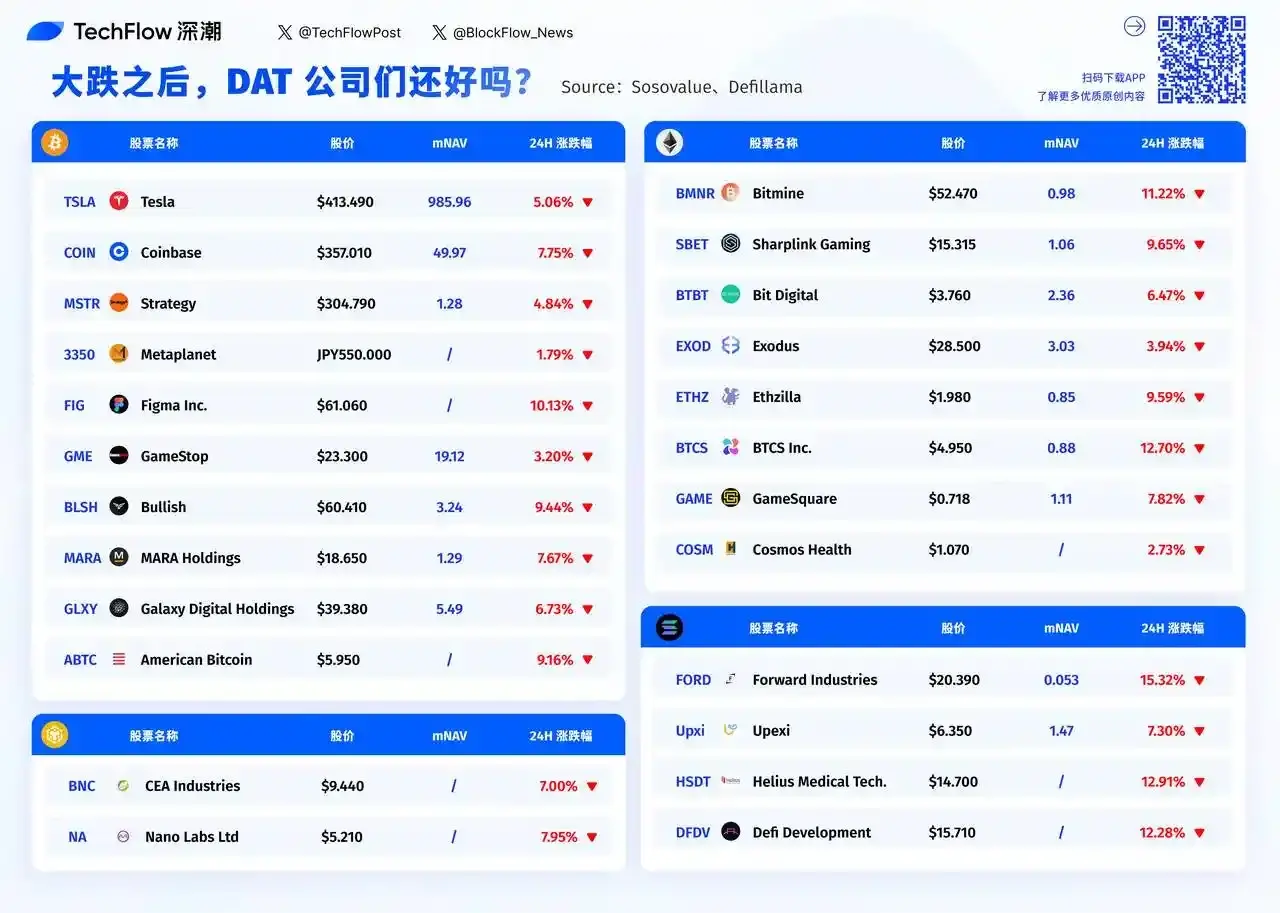
Looking back at the previous trading day's list of DAT companies' declines, a clear pattern emerges: the smaller the company, the harder it falls.
Forward Industries dropped by 15.32%, with an mNAV of only 0.053. BTCS Inc. fell by 12.70%, and Helius Medical Tech dropped by 12.91%.
These small companies, with market capitalizations of less than $100 million, can hardly find buyers in a panic. In contrast, MicroStrategy, despite being the largest Bitcoin holder, only saw a decline of 4.84%.
The logic behind this is simple: liquidity.
When panic strikes, the bid-ask spread for small-cap stocks can widen dramatically, and a slightly larger sell order can crash the stock price.
In this list, Tesla stands out as an anomaly. It fell by 5.06%, almost the smallest decline, but if we look at the data, its mNAV is as high as 985.96. This number means that the market values Tesla at nearly 1000 times its holding value.
Because Tesla is essentially not a DAT company; holding coins is just a side business. Investors buy Tesla because they are optimistic about its electric vehicle-related business, and Bitcoin's price fluctuations have minimal impact on its valuation; the same reasoning applies to Coinbase, which fell by 7.75%, but as an exchange, it has real transaction fee income.
In contrast, the situation for purely DAT companies is entirely different.
MicroStrategy's mNAV is only 1.28 times, almost trading at its holding value. Galaxy Digital's mNAV is 5.49 times, and MARA Holdings is 1.29 times. The market values these companies primarily based on their crypto asset value plus a little premium. When the crypto market crashes, they have no other business to buffer against the losses.
When a company's market value is almost equal to the value of its held crypto assets (mNAV close to 1), it means the market believes this company has no additional value beyond holding coins.
Bitmine's mNAV is 0.98, and American Bitcoin has not disclosed but is estimated to be very low. These companies have essentially become Bitcoin ETFs disguised as public companies.
The question is, since there are now real Bitcoin ETFs available for purchase, why would investors still want to hold indirectly through these companies?
This may explain why, in a panic, these low mNAV companies experience even larger declines. They bear the risks of crypto assets and the stock market without providing any additional value.
In just a few hours, the U.S. stock market will open. After a weekend of cooling off, will market sentiment improve? Will those small DAT companies that fell more than 10% continue to be sold off, or will there be bottom-fishing capital entering the market?
From the data, companies with mNAV below 1 may have opportunities for overselling, but they may also be value traps. After all, when a business model itself is called into question, being cheap is not necessarily a reason to buy.
 Risk warning Risk warning




Popular articles





