








The JST repurchase and destruction proposal has been officially initiated, driving the value upgrade of the TRON ecosystem through a deflationary model

 The proposal plans to use the net income of JustLend DAO, as well as all excess profits from the USDD ecosystem exceeding 10 million dollars, to repurchase and burn JST tokens.
In the new stage of value return in decentralized finance, a profound transformation aimed at building a sustainable economic system is unfolding within the TRON ecosystem. The JST buyback and burn proposal has officially been initiated on the JustLend DAO's DAO Governance platform and has entered the community voting phase.
The proposal plans to implement a JST buyback and burn mechanism within the JustLend DAO and USDD ecosystem, using the net income of JustLend DAO and all excess profits exceeding $10 million from USDD in the multi-chain ecosystem to buy back and burn JST. By gradually reducing the market circulation, a deflationary effect will be formed, thereby enhancing the long-term value and governance utility of JST. With transparent on-chain operations, the burned JST will permanently exit circulation, establishing a solid foundation for token value from the perspective of supply and demand.
As the "strategic wings" of the TRON ecosystem, the decentralized lending market JustLend DAO and the multi-chain stablecoin system USDD are reshaping the value logic of the governance token JST through this initiative. The innovation of the proposal lies in establishing a feedback loop that closely connects the actual revenue of the protocol with the value of the token, directly empowering every JST holder with the achievements of ecological development. The system revenue from JustLend DAO and USDD will become the driving force for the continuous buyback and burn of JST. This is not only an introduction of a deflationary mechanism but also a systematic upgrade to build a value symbiotic ecosystem.
When the leading protocols of TRON give back to the community with real profits, they not only set a benchmark for value return for other projects within the ecosystem but also hope to promote a virtuous cycle of "ecological prosperity - revenue growth - value return." This transformation driven by community consensus will reconstruct the value logic of governance tokens and open up new paths for the sustainable development of decentralized finance.
JST Buyback and Burn Proposal: JustLend DAO and USDD Protocol Revenue Driving JST Deflationary Model
In today's wave of decentralized finance continuously reshaping the global blockchain landscape, a sustainable token economic model has become the core competitiveness for the long-term development of projects. As a core pillar of the TRON ecosystem, the JUST protocol has always been committed to building a virtuous cycle of value flow. The JST buyback and burn proposal has officially entered the community voting phase, marking a strategic upgrade for the JST ecosystem driven by a deflationary model.
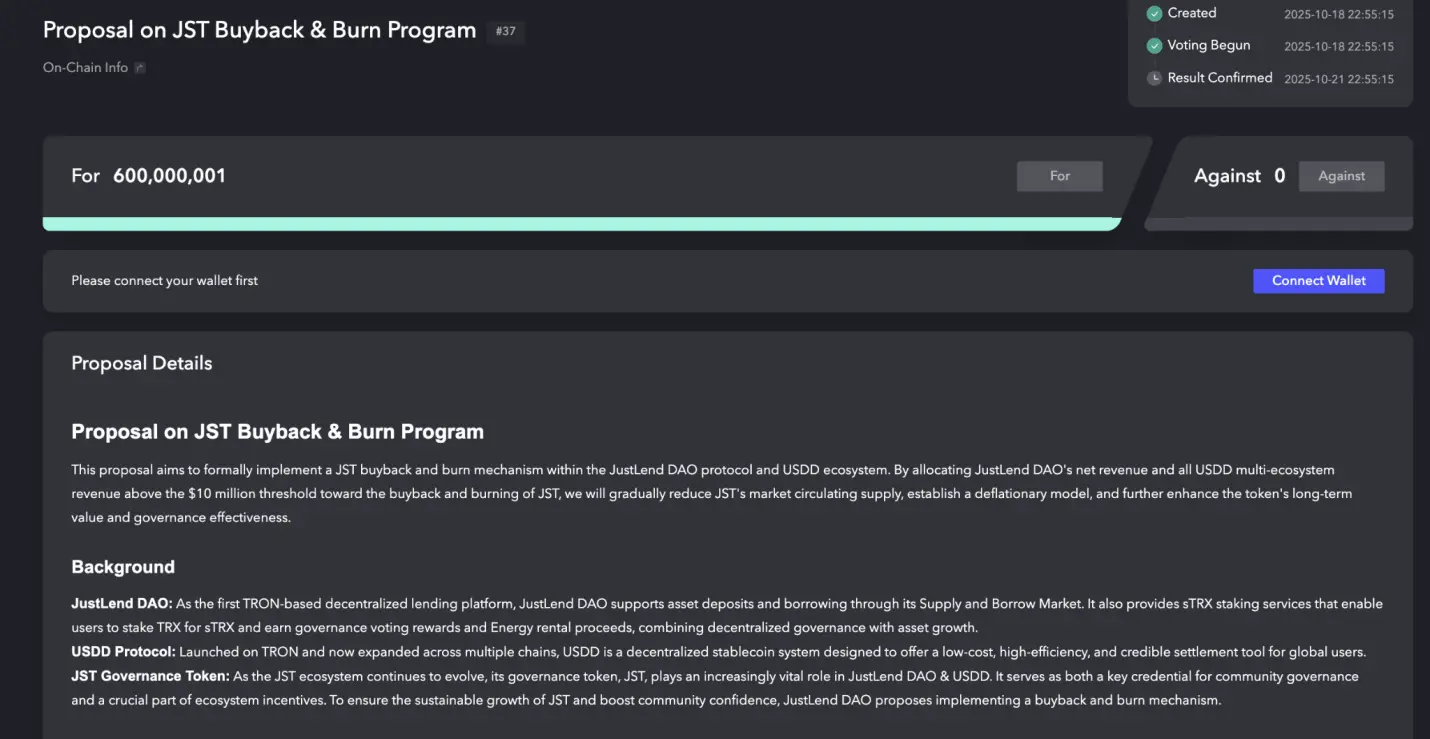
To understand the far-reaching significance of this proposal, it is essential to clarify the relationship between JST and various core protocols. JST is the governance token of the JUST ecosystem, which includes two core protocols: JustLend DAO (decentralized lending market) and USDD (decentralized stablecoin). In this structure, JST plays a crucial triple role:
First, as the governance core, JST holders have the right to participate in the governance decisions of both JustLend DAO and USDD, including parameter adjustments, function upgrades, and other key matters, ensuring that ecological development aligns with community consensus.
Second, as a utility token, JST has a rich array of application scenarios within the ecosystem, and these practical use cases form an indispensable foundation for JST's value support.
Third, as a value carrier, JST's fixed supply characteristic gives it a natural deflationary basis, and its indispensability in the two core protocols constitutes a solid foundation for its value growth.
Based on this ecological structure, the introduction of this buyback and burn proposal is particularly critical. The proposal establishes a direct value feedback mechanism by using the actual revenue generated by JustLend DAO and USDD to buy back and burn JST. The brilliance of this mechanism lies in its clever connection between the business growth of the protocol and the value growth of the token: the more mature JustLend DAO and USDD become, the more revenue they generate, and the more JST is bought back and burned, making the token's deflationary effect more pronounced. This not only provides direct value feedback to existing JST holders but also builds a self-reinforcing positive cycle for the long-term value discovery of JST.
Therefore, this buyback and burn proposal is far from a simple market operation; it is an inevitable strategic choice for the JUST ecosystem at its current stage of development. It signifies a key transformation in ecological construction from scale expansion to value deepening, injecting new momentum into the sustainable development of JST and the entire TRON ecosystem by directly empowering the governance token with the dividends of protocol development.
Strategic Upgrade: Detailed Explanation of the Value Blueprint and Execution Path for JST Buyback and Burn
The core of this proposal is to establish a clear, sustainable, and highly transparent JST buyback and burn mechanism. Its specific content reflects the principles of executability, long-term viability, and community supremacy, outlining a detailed roadmap for the enhancement of JST's value.
First, the buyback mechanism has a solid and reliable source of funds, which will mainly come from two parts: first, the net income of JustLend DAO, including sTRX business revenue and SBM business net income; second, the portion of USDD's multi-chain ecosystem profits exceeding $10 million (excluding the first $10 million), which will be fully invested in JST buyback. These two parts of funding directly reflect the operational achievements of the platform and will provide the most direct and rapid value feedback to JST holders through buyback and burn.
More importantly, the proposal deeply binds the buyback mechanism with the long-term development of the ecosystem: in the future, the net income of JustLend DAO and the excess profit portion of the USDD system will continuously inject funds into the buyback pool, ensuring that the buyback and burn is not a one-time action but a long-term value project that grows together with the ecosystem.
Second, in terms of execution mechanism, the JST buyback and burn execution mechanism is designed to be meticulous and efficient. Currently, the cumulative revenue of the JustLend DAO platform has exceeded $60 million, while USDD's current revenue has not yet reached the $10 million threshold, so this buyback will focus on the net income of JustLend DAO and will be carried out in phases: 30% will be burned in the first execution, and the remaining 70% will be gradually advanced over the next four quarters, with 17.5% burned each quarter.
Future net income will be executed quarterly, with the net income generated in the previous quarter being burned at the beginning of each quarter. This arrangement ensures a smooth and controllable burning process and establishes a continuous channel for the buyback of future new income, forming a composite deflationary model that operates in parallel with existing and new income.
Finally, in terms of the form of destruction, the repurchased JST tokens will be directly transferred from a dedicated address awaiting destruction to the TRON network black hole address, ensuring that the tokens are permanently non-circulating. This process is fully traceable on-chain and irreversible, ensuring that the tokens completely exit circulation, truly achieving a reduction in supply.
The entire process strictly follows the spirit of decentralized governance. After the formal proposal is initiated, it enters a three-day community voting period, with the final result determined by the votes of JST holders. Once the proposal is approved, the execution team will promptly and regularly disclose detailed data on each buyback and burn to the global community, ensuring that every step of the process operates transparently, thereby establishing a solid foundation of trust.
Initiating the Value Flywheel: JST Buyback and Burn Injects Perpetual Momentum into the TRON Ecosystem
When the proposal is officially launched, it will be like installing a powerful "value engine" for the JST ecosystem, significantly enhancing its attractiveness and value capture ability as a digital asset. This will not only attract more long-term investors and institutional funds to pay attention to JST but will also radiate to other quality assets within the entire TRON ecosystem, elevating the overall valuation level and resilience of the ecosystem. More excellent developers and users will join the TRON ecosystem to collectively build a more prosperous and resilient decentralized financial landscape, greatly enhancing the market's long-term confidence in TRON ecosystem assets.
More critically, this move sets an excellent value return model for projects within the TRON ecosystem. JustLend DAO and USDD, as leading protocols within the ecosystem, have a powerful demonstration effect. By using real protocol revenue to buy back governance tokens, they clearly demonstrate to all projects within the ecosystem a more advanced development idea: the success of the protocol must resonate with the interests of token holders. This is expected to lead to a wave of "value return," prompting more projects to think about and practice how to better reciprocate the community, thereby enhancing the overall healthy development level and attractiveness of the TRON ecosystem.
Ultimately, this will create a powerful flywheel effect, propelling the ecosystem into a virtuous cycle. The increase in JST's value will incentivize more users to hold and actively participate in the governance of JustLend DAO and USDD, while more active and widespread community participation will further promote the innovation and development of the protocol, thereby generating more protocol revenue. This portion of increased revenue will again empower JST's value through the buyback mechanism, forming an enhanced closed loop of "ecological development - revenue growth - value return - community expansion - driving further ecological development." Once this flywheel is set in motion, it will bring a continuous source of development momentum to the TRON ecosystem.
In summary, this JST buyback and burn proposal is far from a simple adjustment of the economic model; it is a sign of the maturity and confidence of the JustLend DAO and USDD ecosystem, a strategic declaration aimed at the future. It announces that ecological construction has entered a new era centered on value sharing, bringing tangible value expectations not only to JST holders but also injecting strong certainty into the prosperity and sustainable development of the entire TRON ecosystem. This value transformation driven by community consensus is poised to take off, about to embark on a magnificent new journey.
 Risk warning
 Risk warning
Popular articles





