








Moat or Speculative Trap? The Life and Death of the DAT Model
 Core Viewpoint

 Investors may be more concerned about whether DAT company's stock is worth investing in, how long the trend of the company financing to buy coins can last, the value of the currencies included in the treasury, and how to respond when the cryptocurrency market declines.
Author: Zhou, ChainCatcher
The Digital Asset Treasury (DAT) model was once seen as an innovative path for crypto investment, where companies hold crypto assets as reserves to drive up stock prices, creating a "buy coins - finance - buy coins again" flywheel.
However, market sentiment seems to be shifting: on one hand, DAT companies have raised over $20 billion this year, with some institutional investors believing the peak has passed. On the other hand, short-selling voices are rising, and investors are beginning to question whether a collective rush for the exit will occur, and whether the treasury model is a long-term moat or a short-term speculative tool.
This article discusses topics of high investor interest and interviews and summarizes some institutions' views on the current DAT trend.
Are DAT stocks worth investing in? Why not just buy coins or ETFs directly?
When evaluating DAT stocks, ordinary investors often struggle with whether they are superior to directly holding cryptocurrencies or gaining indirect exposure through ETFs.
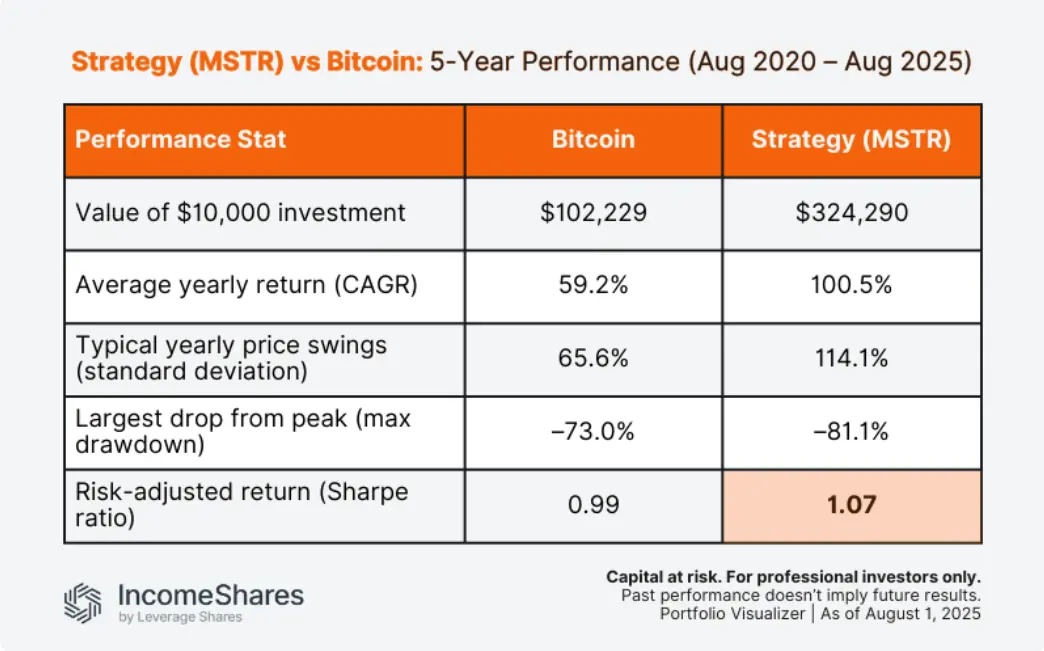
DAT company stocks provide leverage. For example, using MicroStrategy as a case study, data from Portfolio Visualizer shows that starting with an investment of $10,000 from August 2020 to August 2025, Bitcoin rises to $102,229, while MSTR skyrockets to $324,290. MSTR has higher volatility (114% vs 65.6%) and a higher annualized return (100.5% vs 59.2%), which gives it a higher Sharpe ratio than Bitcoin. This is due to the company amplifying its Bitcoin holdings through debt financing.
Sun Yuchen has publicly stated that traditional ETFs allow you to access cryptocurrency prices, but that's all. DAT goes a step further by making assets work. These DATs are not idle; they are staked, lent, and deployed in DeFi and yield protocols to earn actual returns while maintaining complete transparency on-chain. This model transforms digital assets from speculative holdings into efficient financial engines, outperforming ETFs.
However, Forbes analyst Alexander Blume states that DAT companies utilize very complex financial products that leverage retail speculation, debt instruments, marketing, and legal and judicial arbitrage, hoping to outperform Bitcoin. Some of these strategies face black swan risks, appearing to perform well until they suddenly fail.
CoinShares indicates that the risks of DAT stocks are higher than ETFs because they are not only affected by crypto prices but also involve company operations and debt burdens. This emerging model carries some risks that may be masked by the current bull market. Companies pursuing altcoins or meme coins without sustainable core businesses expose investors to higher volatility and uncertainty. If coin prices stagnate or decline, these companies may quickly become over-leveraged and susceptible to severe corrections.
In contrast, directly buying coins provides complete ownership but also requires dealing with custody and tax complexities; ETFs lower the barrier to entry for cryptocurrencies but charge an annual fee (typically 0.25%), making trading convenient but lacking leverage. The Halborn advisory team points out that DAT is suitable for investors seeking high returns, while ETFs are better for risk-averse investors, as the latter offers better diversification and avoids the risk of a single company's bankruptcy.
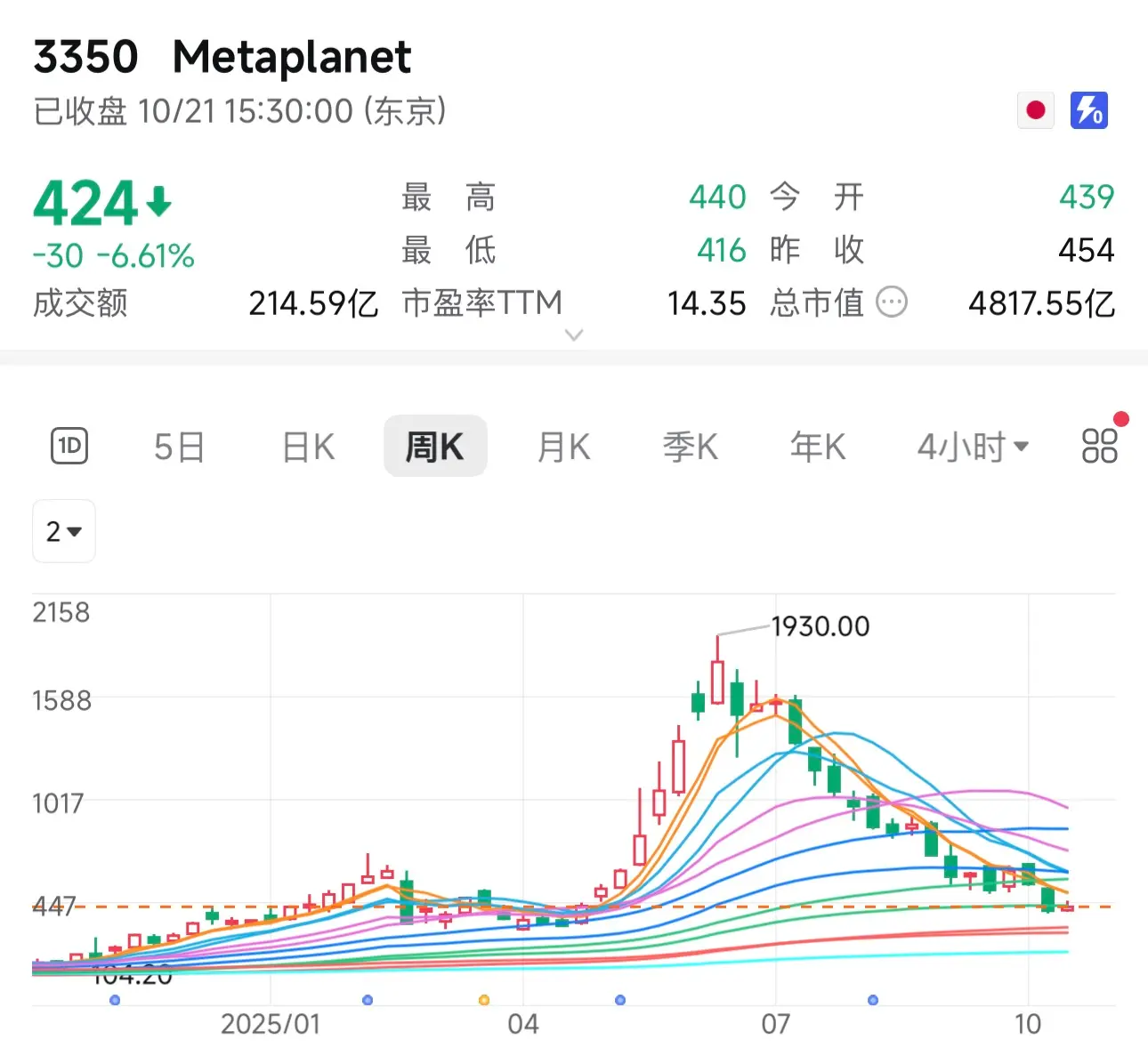
According to rough statistics, in September 2025, DAT stocks announced reserves saw an average increase of 150% within 24 hours, attracting short-term funds. However, risks coexist; since the second half of 2025, Metaplanet's stock price has dropped over 70%, with its market value falling below its Bitcoin reserve value, and the mNAV ratio dropping to 0.99, indicating a clear lack of market confidence.
How long can the treasury trend last? What is the intrinsic value of treasury coins?
Since MicroStrategy initiated the treasury trend, many companies have followed suit. By 2025, over 160 publicly listed companies globally have incorporated cryptocurrencies like Bitcoin and Ethereum into their corporate balance sheets, with a total holding value exceeding $240 billion.
As of October 6, the total amount of Bitcoin held by the listed companies (excluding mining companies) in the statistics is 864,210 coins, with a current market value of approximately $10.743 billion, accounting for 4.34% of Bitcoin's circulating market value.
Traditional funds have pushed up valuations, raising concerns about bubbles. Presto's research director Peter Chung states that while the risk of treasury companies collapsing does exist, it is more nuanced compared to the collapse scenarios seen during the last boom-bust cycle in cryptocurrencies.
As premiums narrow and mainstream targets are covered, funding focus is shifting towards execution, scaling, and mergers and acquisitions, creating a crowding-out effect on traditional crypto startup financing, leading to doubts about the sustainability of the DAT trend. Industry experts predict that large companies, including well-known tech giants, will begin establishing Bitcoin positions by the end of 2025. For small and medium-sized enterprises and large corporations, the question has shifted from "if" to "when."
Patrick PAN, head of the Web3 business unit at Huaxing Capital, told ChainCatcher that any emerging market will experience a cycle of "professional institutions leading - small and medium players flooding in - survival of the fittest and consolidation. Currently, small and medium-sized DATs are still in the "experimental stage," which is positively significant for market education. However, those that can survive long-term will be compliant, transparent, with clear capital structures and stable revenue models.
This year, the trend has seen the selection of DAT coins expand from Bitcoin to ETH, Solana, BNB, and even altcoins like XRP, AVAX, ENA, IP, and Dogecoin, showing a diversification trend. Patrick PAN notes that this is actually a natural selection process in the market. In the short term, including some small coins is to enhance returns or test mechanisms, but in the long run, quality assets will still dominate.
However, Elementus analysts have mentioned that companies investing in altcoin reserves face additional risks, as this is a poorly diversified bet. During market crashes, altcoins typically have a higher correlation with Bitcoin, but in some cases, they may not equally share Bitcoin's "quality asset migration" status.
Is the treasury a moat or a harvesting tool? How to view speculative risks?
Currently, the unrealized gains of DAT are substantial, with Strategy's Bitcoin holdings still showing unrealized gains of over $24.5 billion, yielding a return of 51.91%. Is there a possibility that these treasury companies will cash out profits early?
Short-selling firm Kerrisdale Capital announced on platform X that it has shorted the stock of Bitmine, a treasury reserve company for Ethereum, believing that the so-called DAT model has become mediocre and uninspired. The firm stated that scarcity and meme-like enthusiasm once kept premiums high despite continuous dilution, but those conditions have disappeared.
Since the 1011 crash, BitMine has continued to buy Ethereum, having increased its holdings by nearly 380,000 coins, valued at approximately $1.5 billion, bringing its total holdings to over 3 million coins.
Currently, treasury companies still play a major buyer role in the crypto market, but as net assets shrink with price declines, their ability to add funds is limited, and the strength of marginal buying decreases.
Institutions predict that new projects will still be launched by early next year, but the financing amounts will be smaller. As for the massive DAT financing of over $500 million to $1 billion, only a few high-market-cap and sufficiently volatile participants can truly raise these funds.
Sam Tabar, CEO of Bit Digital, stated during the Token 2049 summit in Singapore that Digital Asset Treasury (DAT) companies should consider adopting unsecured debt financing instead of secured debt to better cope with potential bear markets. The most efficient way to increase per-share crypto asset holdings is through debt financing; while increasing crypto asset holdings without changing equity is good, the choice of financing type is crucial—the wrong leverage can destroy a company.
Presto's data shows that only one-third of DAT company financing is through debt financing, and 87% of that debt is unsecured. Chung believes that even in the worst-case scenario, the proportion of potential collateral is far lower than the leverage levels during the 2021 cycle, so as long as this principle is adhered to, the risk of systemic liquidation due to additional margin calls is unlikely. He points out that this does not mean that cryptocurrency fund management companies will never sell their held cryptocurrencies. In unforeseen circumstances, if cash is urgently needed and there are no other funding sources, cryptocurrency fund management companies may liquidate these assets.
How do treasury companies buffer risks during crypto downturns? Amber Premium, a digital asset wealth management platform (NASDAQ: AMBR), President Vicky Wang told ChainCatcher that the key in a downturn is not to "bet on direction," but to have a systematic "defense-adjustment-保障" approach: from managing the volatility of assets and liquidity to disciplined rebalancing and managing valuation deviations to stabilize mNAV anchors, and to custody layering and transparent disclosures, minimizing operational risks and information asymmetry.
At the same time, the strategy spectrum of DAT is rapidly diversifying: single-coin exposure relies more on long-term narratives and pressure resistance, while multi-coin combinations test correlation and rebalancing mechanisms, and strategies aimed at more complex structures require a professional skill set that intersects derivatives, liquidity, accounting, and compliance.
Regarding short-term speculative risks, Vicky Wang stated that this is not a sustainable path. The success of a DAT relies on the long-term investment value of the underlying assets. The strong cyclicality of the crypto market means that most DATs will experience fluctuations together; navigating cycles relies on a dual governance of "cognition and mechanism."
Conclusion
Overall, DAT stocks are suitable for investors seeking high returns, while the trend of treasury financing to buy coins depends on each company's financing capabilities (cost and method). If they focus on long-term governance, DAT can be a moat; otherwise, it becomes a speculative trap. Excellent treasury companies are not merely chasing coin price beta but maintain long-term positive premiums on mNAV through management and governance. Crypto investors should focus more on companies with solid fundamentals and cautiously assess drawdown and cash-out strategies.
 Risk warning
 Risk warning







Popular articles





