








An old letter ignites a loyalty crisis, and the Ethereum Foundation faces renewed criticism
 Core Viewpoint

 Ethereum's biggest enemy is the Ethereum Foundation.
Written by: David, Deep Tide TechFlow
"I feel like I am a somewhat useful fool for the Ethereum Foundation."
On October 19, a public letter written a year and a half ago was published on Twitter, and this sentence quickly ignited discussions within the crypto community.

The author of the letter is not some fringe Ethereum critic, but Péter Szilágyi:
The former lead of the Geth client, which maintained over 60% of Ethereum nodes, and a core developer who has worked in this ecosystem for a full 9 years.
Does this feel familiar?
If you have been following Ethereum long enough, you will notice that this scene plays out every few months:
Criticism of the Foundation (EF) suddenly erupts, the community falls into intense discussions, Vitalik steps in to respond, and then everything calms down until the next eruption.
In 2022, it was concerns about centralization post-Merge; in 2023, it was conflicts of interest among researchers; in 2024, it will be the fragmentation issues of L2.
Now, the powder keg has been ignited by an old letter.
The description of "useful fool" is like a knife, piercing through a long-maintained illusion and hurting the hearts of many contributors to the Ethereum ecosystem.
Core contributors, who rarely criticize publicly, including Polygon founder Sandeep and the father of DeFi AC, have stepped forward one after another; the message can be summarized in one sentence:
We have been betrayed.
The specific questions they raised hit the nail on the head: Where has the money gone? Why do the most loyal get the least? Who is really controlling the direction of Ethereum?
These questions are actually old news, but when they are voiced by the core contributors of Ethereum, the situation and weight may be completely different.
Let's take a closer look at this letter and see what a technical leader who has worked in Ethereum for 9 years has experienced to describe himself as a fool.
Nine Years of Loyalty, One Paper of Disappointment
On May 22, 2024, when Péter Szilágyi wrote this letter, he was likely caught in a painful cycle.
The beginning of the letter is very sincere. Péter expresses that he has become increasingly confused and pained about Ethereum and his role in the Foundation over the years. He tried to clarify his thoughts, which led to this letter.
The content of the letter reflects the numerous issues regarding Ethereum and the Foundation that a loyal developer has witnessed throughout his career.
- Issue One: Named Leadership, but Actually a Used Fool
Péter candidly states that he feels he is being used as a "useful fool" by the Foundation.
He explains that whenever there is a controversy within Ethereum, such as a researcher receiving money from an external company creating a conflict of interest, or a new proposal clearly favoring a specific interest group, the Foundation would have him, the "troublemaker," stand up to oppose it.
Looking back at Péter's previous tweets, there is indeed a flavor of sharp criticism and frankness, as he often discusses various issues within the Ethereum ecosystem; however, the content revealed in this long letter suggests that these statements are more like a performance to cater to the collective interests of the Ethereum Foundation.
This way, the Foundation can publicly claim, "Look, we are so democratic; there are different voices within."
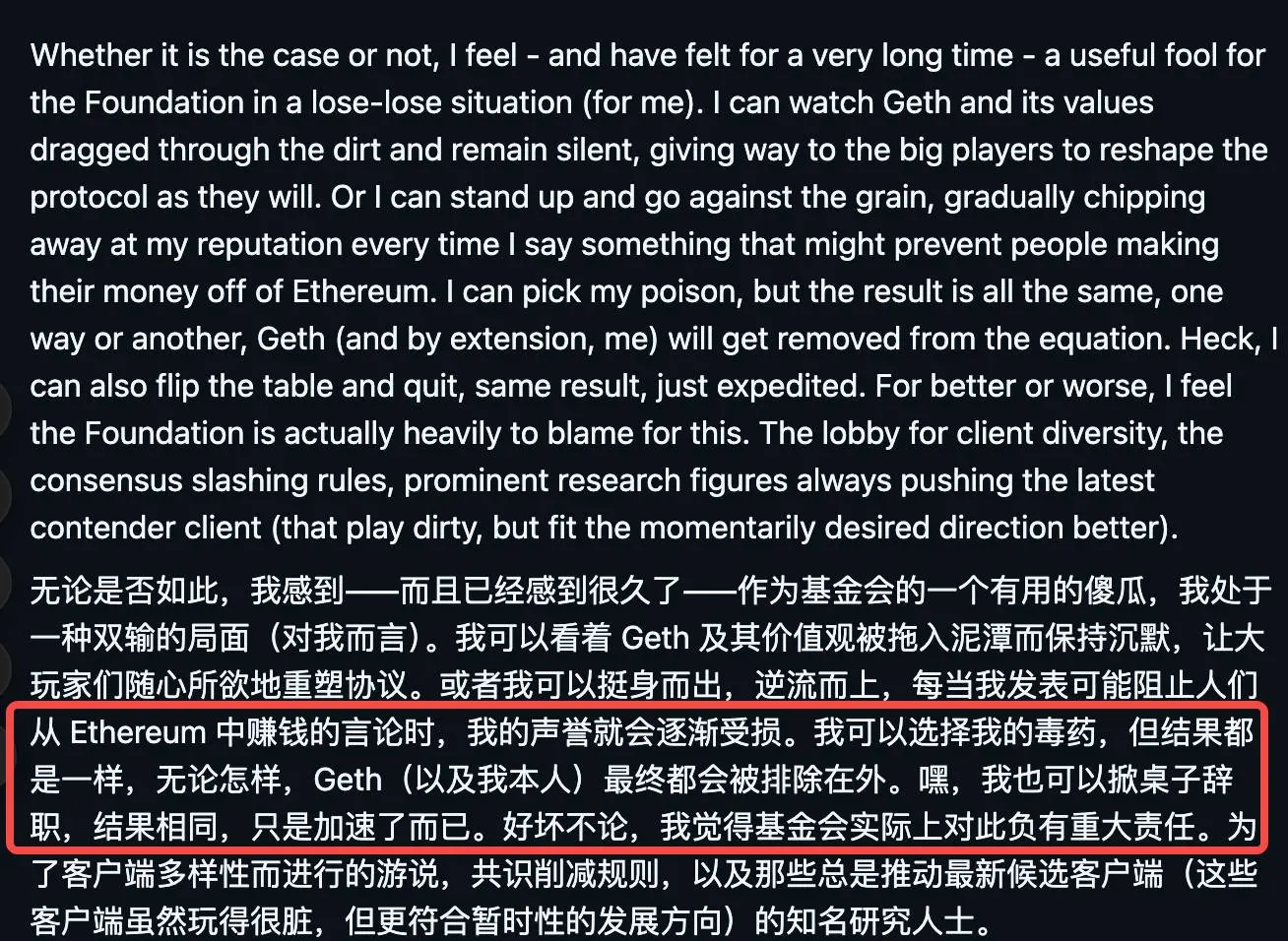
But the problem is, every time Péter stands up to challenge those in power or those with connections, his credibility takes a hit. Supporters of the other side attack him, saying he is hindering progress. Over time, he and the Geth team have become seen as troublemakers.
"I could choose to remain silent and watch Ethereum's values be trampled; or I could speak out, but gradually ruin my reputation." He wrote, "Either choice leads to the same outcome—Geth will be marginalized, and I will be excluded."
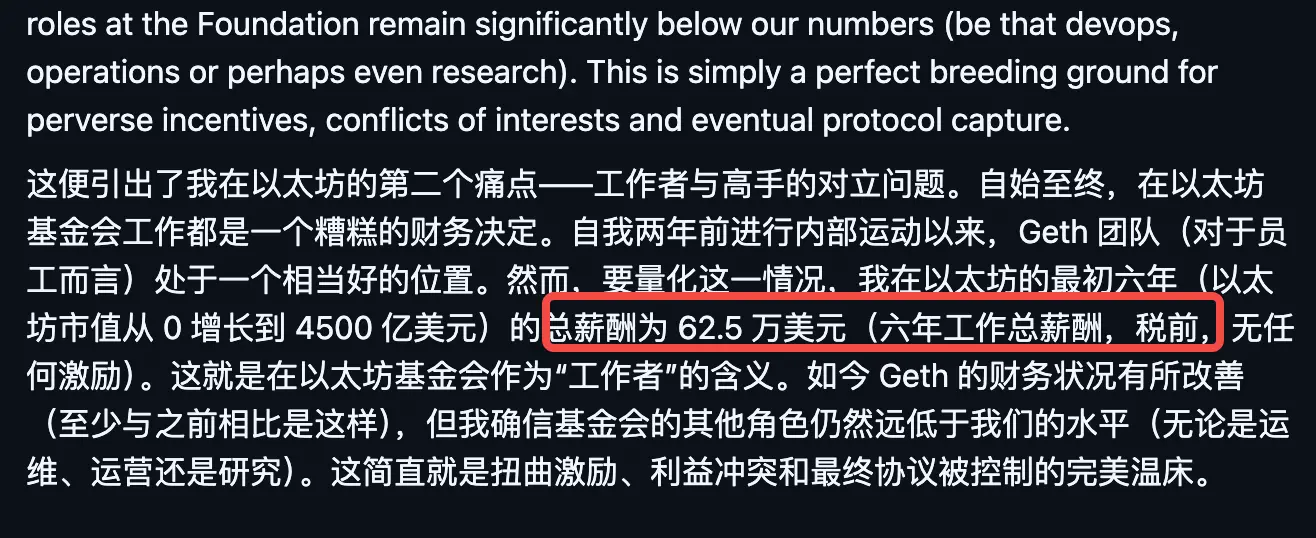
- Issue Two: 600,000 Salary Over 6 Years, High Effort Low Return
In the first 6 years (2015-2021) of working at Ethereum, Péter received a total of $625,000. Note that this is the total for 6 years, pre-tax, with no equity or incentives. That averages about $100,000 per year.
During the same period, the market cap of ETH rose from $0 to $450 billion.
As the person responsible for maintaining the most critical infrastructure of the entire network, Péter's salary might even be lower than that of a freshly graduated programmer in Silicon Valley.
He mentions that other departments in the Foundation, such as operations, DevOps, and even some researchers, have even lower salaries.
Why is this the case? Péter quoted a saying from Vitalik: "If someone is not complaining about their salary being too low, it means the salary is too high."
Diving deep into technology and not caring much about returns is indeed the ideal image of some tech geeks and cypherpunks. But the problem is that a long-term low-salary culture can have negative consequences.
Those who genuinely care about the development of the protocol are forced to seek compensation outside of Ethereum due to the lack of good salaries internally.
This leads to various conflicts of interest: researchers acting as consultants for external projects, core developers privately accepting sponsorships.
Péter bluntly states, "Almost all of the Foundation's early employees have long since left because that was the only reasonable way to obtain compensation commensurate with the value they created."
- Issue Three: Vitalik and His Circle
The sharpest part of the letter is the analysis of Ethereum's power structure.
Péter admits that he has great respect for Vitalik himself but points out a fact:
Whether Vitalik wants to or not, he unilaterally decides the direction of Ethereum. Where Vitalik's attention goes, resources follow;
The projects he invests in succeed;
The technical routes he endorses become mainstream.
Worse still, a "ruling elite" of 5-10 people has formed around Vitalik. These individuals invest in each other, act as advisors to one another, and control the distribution of resources within the ecosystem.
New projects no longer conduct public fundraising but directly seek out these 5-10 individuals. Securing their investment is equivalent to obtaining a ticket to success.
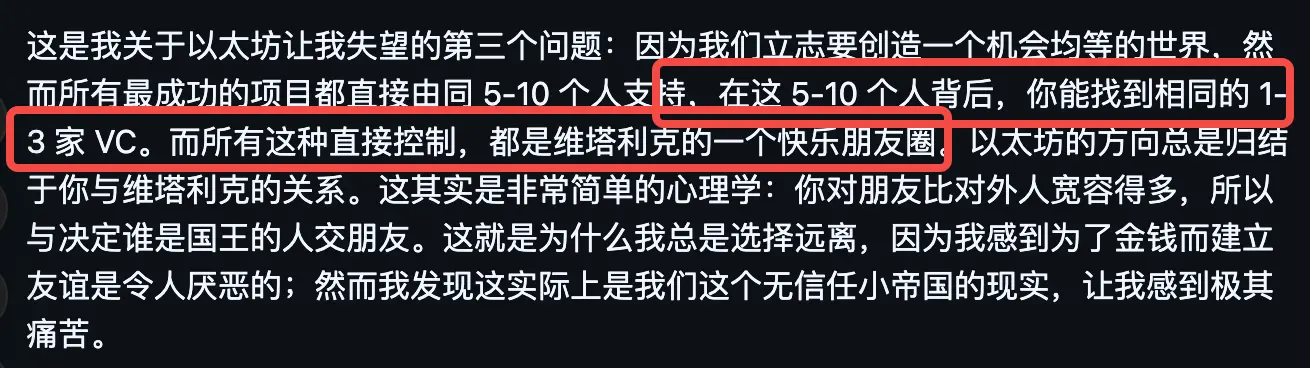
"If you can get Bankless (a well-known podcast) to invest, they will promote you on the show. If you can get a researcher from the Foundation to act as an advisor, you can reduce technical resistance."
This bears a familiar resemblance to the upward management often seen in domestic workplaces, where the key to success is not technology or innovation, but rather getting in good with those few people around Vitalik.
- Issue Four: The Saddest Idealism
At the end of the letter, Péter's tone shifts from anger to sorrow. He says he has turned down countless high-paying offers over the years because he believed in the ideals of Ethereum.
But now the entire ecosystem is saying "it's just business." He cannot accept this mentality but also sees no way out.
"I feel that in Ethereum's grand blueprint, Geth is seen as a problem, and I am at the center of that problem."
This letter was written in May 2024. A year later, in June 2025, Péter left the Ethereum Foundation. Reports indicate that he rejected a $5 million proposal from the Foundation and chose to spin off Geth into a private company.
He chose to leave entirely rather than turn ideals into business.
Chain Reaction, Big Names Speak Out
Less than 24 hours after Péter's letter was made public, Polygon founder Sandeep Nailwal could no longer sit still and echoed Péter's sentiments.
Polygon is one of the largest Layer 2 projects on Ethereum, handling a large volume of transactions and hosting numerous applications, including the prediction market Polymarket.
It can be said that Polygon has made significant contributions to Ethereum's scalability.
But Sandeep stated, the Ethereum community has never truly accepted Polygon.
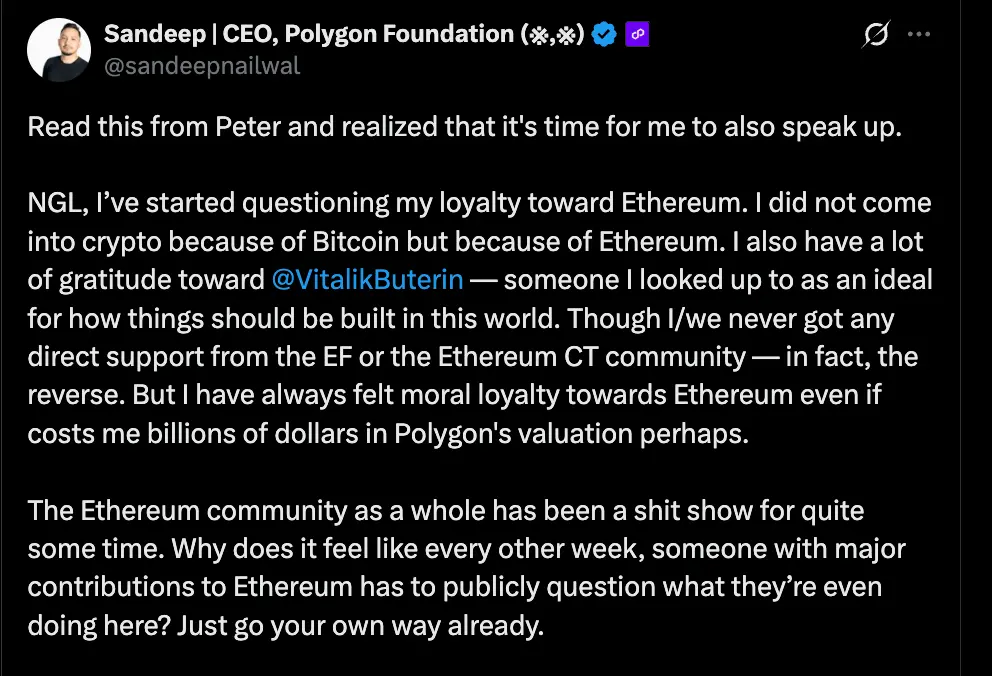
There is a strange double standard in the market, he wrote. "When Polymarket succeeds, the media calls it 'a victory for Ethereum.' But Polygon itself? Not counted as Ethereum."
This is not just a matter of reputation but a real loss of money.
Sandeep pointedly noted that if Polygon announced itself as an independent L1 rather than Ethereum's L2, its valuation could immediately double or even quintuple.
For example, the relatively niche L1 project Hedera Hashgraph has a market cap that exceeds the combined total of the four major L2s: Polygon, Arbitrum, Optimism, and Scroll.
As for why they don't pivot to L1, Sandeep said it is out of moral loyalty to Ethereum, even though this loyalty may cost them tens of billions in valuation.
But what has this loyalty brought in return?
There are always voices in the community saying Polygon is not a true L2. The growth statistics website GrowthPie refuses to include Polygon's data. Investors do not consider Polygon part of the "Ethereum ecosystem" in their portfolios.
In Sandeep's original post, there was a particularly poignant rhetorical question:
"Why do Ethereum contributors question themselves every week?"
He mentioned the story of his friend Akshay. Akshay initially leaned towards supporting Polygon but was disgusted by the Ethereum community's criticism of successful projects and its promotion of "political correctness." In the end, he took his talents to Solana, helping the latter build today's empire.
Even Polygon's shareholders are questioning his decisions, believing he has a fiduciary duty to Polygon and asking why he would sacrifice the company's value for so-called loyalty.
Also speaking out is the legendary figure in DeFi, Andre Cronje.
Andre's post is relatively brief but sharp:
"I am confused. Who is EF actually paying/supporting? When I was building on ETH, I burned over 700 ETH just deploying contracts and infrastructure. I tried to contact EF, but never received a response; no BD contacted me, no funding, zero support, not even a retweet."
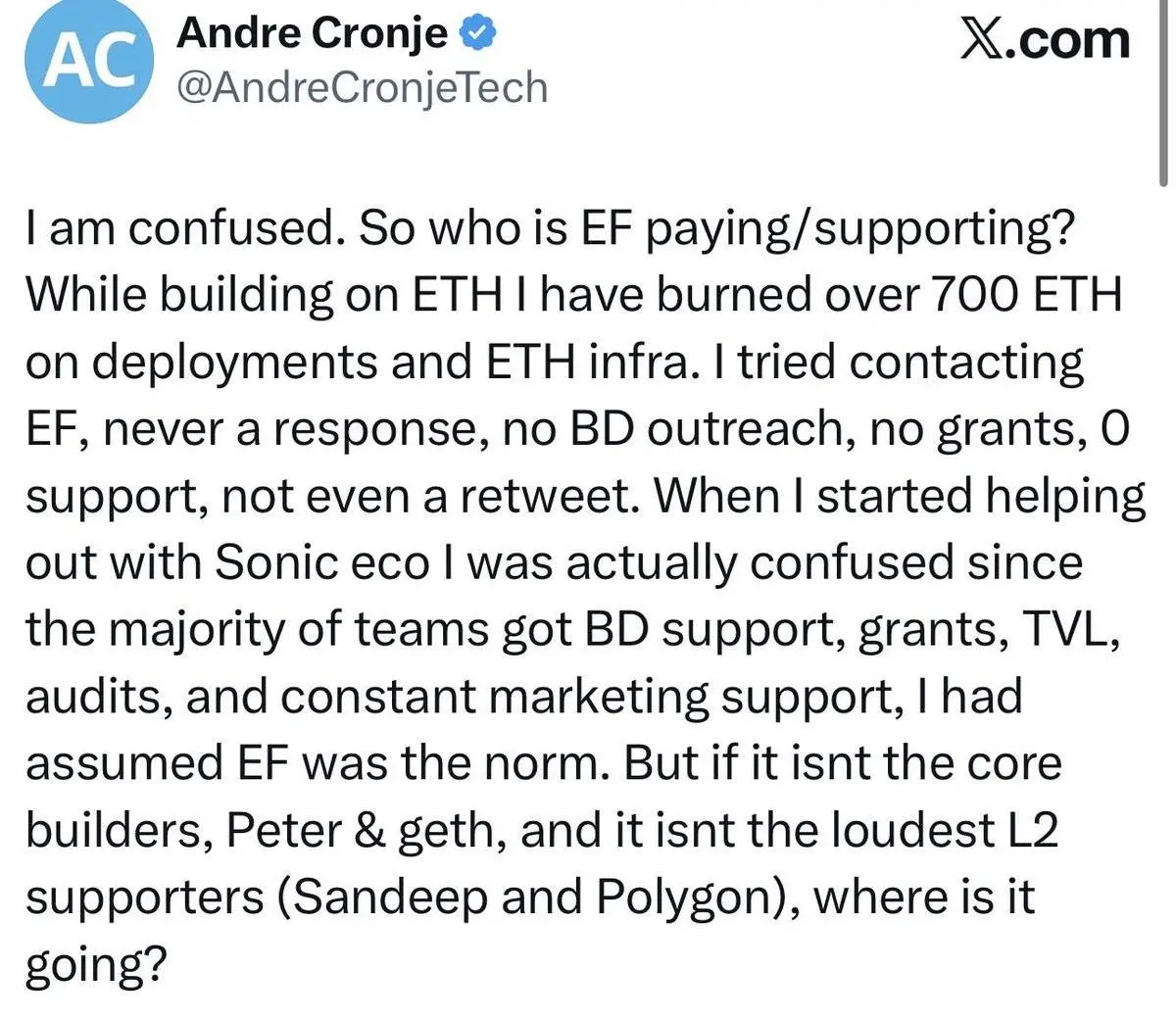
700 ETH is approximately $2.66 million at current prices. These are all costs Andre incurred out of his own pocket.
Ironically, when AC began helping the Sonic ecosystem, he was surprised to find that most teams received ongoing support in terms of BD, funding, liquidity, and audits.
Then, this soul-searching question became even more poignant:
"If the money didn't go to core builders like Peter and Geth, nor to the loudest L2 supporters like Sandeep and Polygon, then where did the money go?"
Vitalik Responds, Avoids the Issues
In response to these criticisms, Vitalik addressed Sandeep's comments on October 21 in a response. His reply was lengthy, mainly covering:
A detailed enumeration of Polygon's contributions (hosting Polymarket, advancing ZK technology, etc.)
Extensive praise for Sandeep's charitable work (donating medical resources to India)
Thanks to Sandeep for returning $190 million in SHIB token profits
Suggesting Polygon adopt the latest ZK technology upgrades
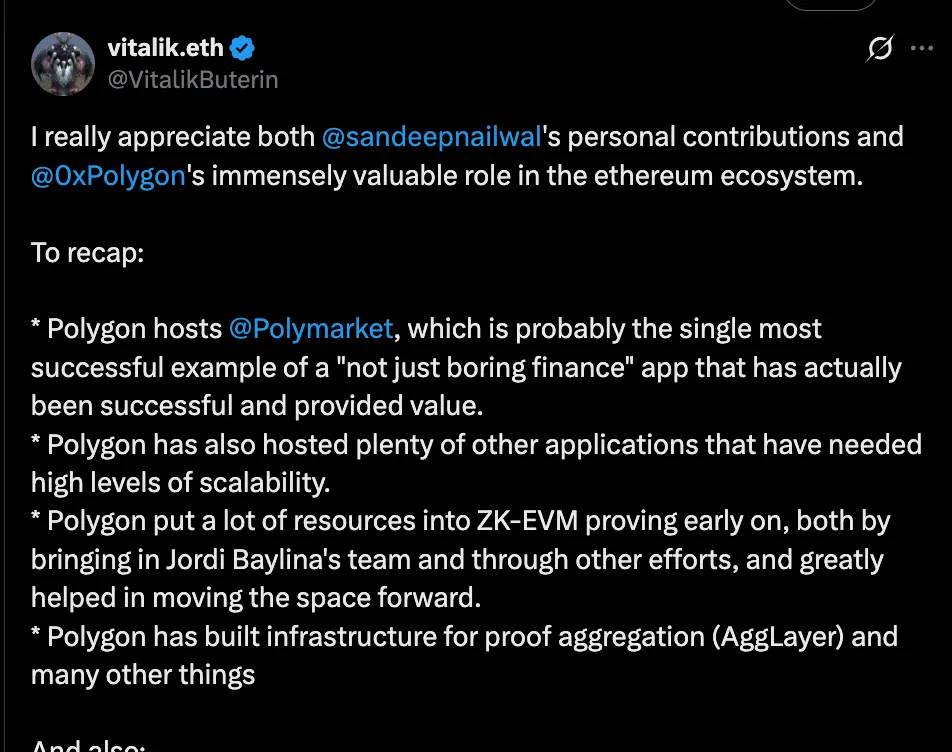
But upon careful reading, you will find that Vitalik did not mention a single word about the three core issues: low salaries, lack of transparency in funding, and the small circle of power.
This kind of evasion may itself be an answer.
These responses collectively point to a truth that everyone can see but no one is willing to speak out about: there are serious problems with the resource allocation of Ethereum.
The most loyal contributors do not receive support, while those adept at "playing the game" can obtain substantial resources. The Foundation sold over $200 million worth of ETH in 2025, but this money clearly did not flow to those who are truly building the protocol.
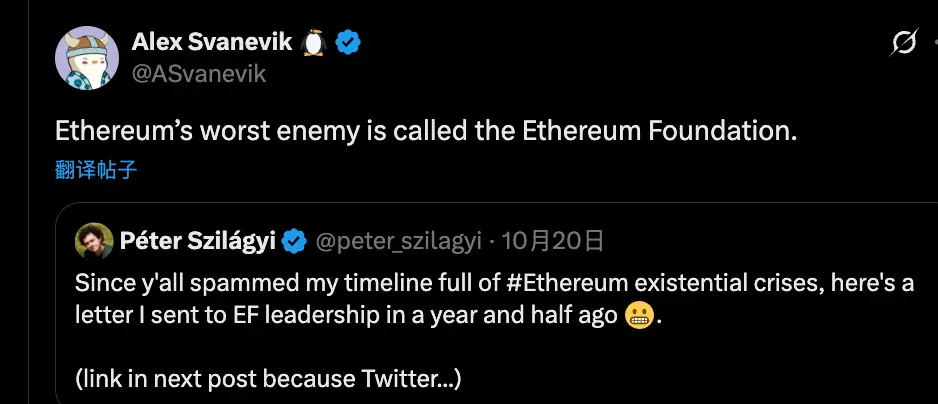
The Biggest Enemy of Ethereum is the Ethereum Foundation
The uproar triggered by Péter's letter may be overshadowed by new hot topics in two weeks, but the issues it reveals will not disappear.
In fact, this collective outcry against the Ethereum Foundation occurs every few months.
For today's Ethereum, its biggest enemy is not other chains like Solana, but the Ethereum Foundation itself.
Ethereum has grown from a geek project to an ecosystem worth hundreds of billions of dollars, but its governance structure and culture remain at an early stage.
In Péter's words, the Foundation is still managing a large system that requires "additive thinking" with a "subtractive mindset."
The deeper reason may be that Ethereum has fallen into the typical malaise of large companies.
The issues that startups face as they grow, such as bureaucratization, factional struggles, and stagnation of innovation, are all present in Ethereum.
The difference is that traditional companies can respond through equity incentives and management reforms, but Ethereum, as a decentralized project, cannot admit to being centralized nor can it truly decentralize.
Thus, the core contradiction we see is: it must maintain the appearance of decentralization, but its actual operation relies heavily on centralized decision-making.
Vitalik's existence is a concentrated embodiment of this contradiction.
On one hand, the community needs his vision and leadership; on the other hand, his very existence negates decentralization.
This creates a peculiar "decentralized theater," where everyone is performing decentralization, but everyone knows where the real power lies.
The cost of this performance is enormous.
As Sandeep pointed out, the Ethereum community superficially promotes egalitarianism, but the actual control of small circles is more hypocritical than pure capitalism.
At least on Solana or other centralized chains, the rules of the game are clear.
Now, the ball is in the hands of Vitalik and the Foundation. Their choices will not only affect Ethereum but also the direction of the entire crypto movement. Will they continue to maintain the decentralized theater, or will they bravely face reality?
Time will provide the answer. But it is certain that those "useful fools" like Peter will not remain silent forever.
The next eruption may be more than just a letter.
 Risk warning
 Risk warning




Popular articles





