








Investing $375 million to acquire the fundraising platform ECHO, Coinbase's self-rescue and gamble
 Core Viewpoint

 Coinbase is trying to transition from a "compliant exchange" to an "asset-side ecological platform." In the context of diminishing compliance dividends and intense competition in fees, it aims to reconstruct a full-stack ecological system centered around asset generation, issuance, and circulation through acquisitions, fundraising, derivatives, and token management.
Author: Zhou, ChainCatcher
According to official news, Coinbase has acquired the cryptocurrency investment platform ECHO for $375 million, marking its eighth acquisition since 2025. From integrating the privacy technology project Iron Fish at the beginning of the year, to taking over the derivatives exchange Deribit and the token management platform LiquiFi mid-year, and now ECHO, Coinbase's acquisition scope in the core areas of the crypto ecosystem is expanding.
Behind this series of operations, Coinbase is attempting to shift from a "compliant exchange" to an "asset-side ecological platform," building a full-stack ecosystem around asset generation, issuance, and circulation.
1. The Compliance Dividend is Fading, the Old Moat is Collapsing
In recent years, Coinbase built its moat with "compliance licenses + listing windows," allowing it to be the first to list mainstream tokens (such as SOL, APT, AVAX), thereby attracting both institutional and retail investors and forming a differentiated asset advantage.
However, this advantage is rapidly diminishing. As the SEC expands its licensing and more exchanges pursue compliance, compliance has shifted from a scarce label to an industry standard. This change directly weakens Coinbase's core competitiveness and brings multiple challenges: the high fee model is under pressure, retail trading profit margins are compressed, and an increasing number of users prefer low-cost platforms like Binance (average fee 0.015%-0.1%) or Robinhood.
Meanwhile, Coinbase's MTU (monthly trading users) growth has stagnated, having peaked in Q4 2021, with no significant rebound since 2022. User growth is highly dependent on market fluctuations, and the traditional trading-driven model may struggle to sustain itself.
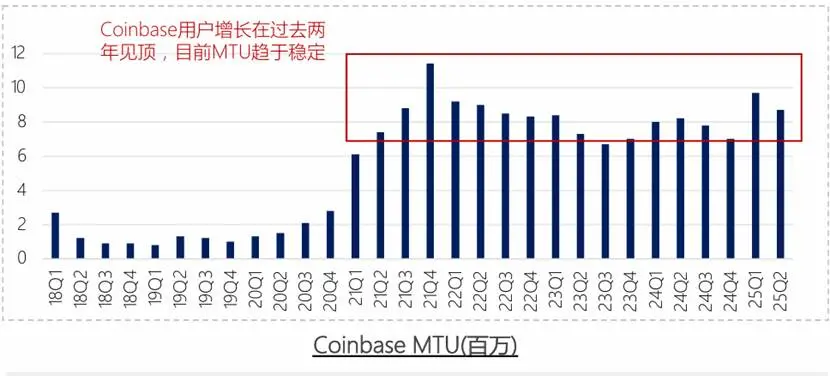
To mitigate volatility risks, Coinbase has been promoting a "AWS-like" transformation over the past two years, hedging cyclical fluctuations through non-trading businesses such as stablecoin revenue, staking rewards, interest, and subscription services. Although the proportion of non-trading revenue in total revenue has risen to 36.8% in 2024, overall expansion growth remains slow, and a clear second curve has yet to form.
When the compliance dividend is no longer a moat, Coinbase must redefine its relationship with assets and users.
2. From Exchange to Ecological Platform: Seeking a Second Growth Curve
Since the beginning of this year, Coinbase has significantly accelerated its acquisition pace on the asset side. It is no longer just a matching platform but is attempting to establish dominance in the "asset generation---issuance---circulation" process.
The list of eight acquisitions in 2025 is as follows:
- January 8, Roam.xyz (Blockchain Explorer / Social Entry): Strengthening on-chain consumer entry, laying out a browser-level Web3 interaction layer to improve user acquisition efficiency.
- January 31, Spindl (On-chain Advertising and Attribution Analysis): Used to improve on-chain traffic tracking and ad attribution, providing a data foundation for ecological growth.
- March 12, Iron Fish (Privacy Technology Protocol): Introducing privacy trading capabilities to the Base network, enhancing the infrastructure layer.
- May 8, Deribit (Cryptocurrency Derivatives Exchange): Expanding derivatives business to fill the product depth gap with competitors like Binance.
- July 2, LiquiFi (Token Management and Equity Distribution Platform): Building token creation and issuance services, connecting the primary market.
- July 11, Opyn (DeFi Options Protocol): Enhancing on-chain derivatives trading capabilities, complementing Deribit.
- September 9, Sensible (DeFi Consumer Finance Team): Strengthening on-chain consumer finance scenarios, improving C-end product experience.
- October 21, ECHO (On-chain Fundraising Platform): Seizing the on-chain financing entry, completing the asset-side closed loop.
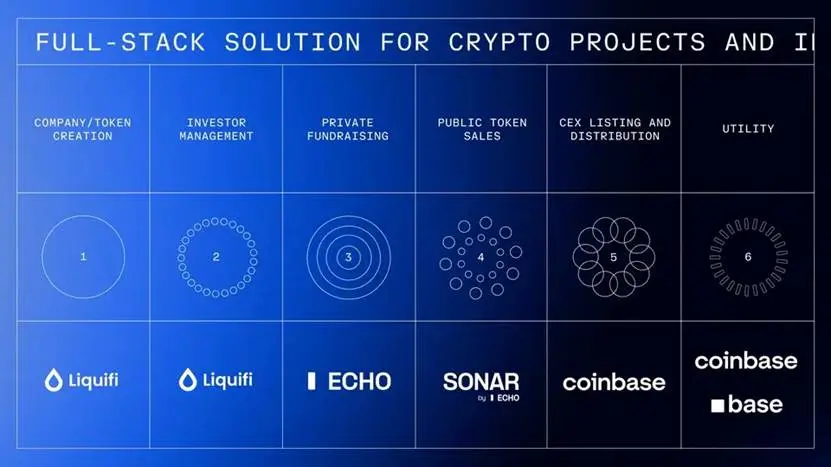
From these actions, it is clear that Coinbase is no longer betting on fee competition but is shifting towards ecological control: driving retention through asset diversification and reducing dependence on trading pairs through upstream and downstream integration.
Reports show that ETF trading volume has accounted for nearly 50% of U.S. spot trading, and it is expected that within 1-2 years, ETFs may become the largest distribution channel, forcing CEXs to lower fees and reshape their positioning. Coinbase's acquisitions are clearly a response to the "erosion of the trading distribution end": if distribution channels are taken over by ETFs, then it must control asset supply.
From the revenue structure, the company's total revenue in 2024 reached $6.2 billion, with non-trading revenue accounting for 36.8%, up from 20% in 2021. Among them, stablecoin revenue has become the core of growth (over the past three years, Coinbase has received 50% of Circle's revenue).
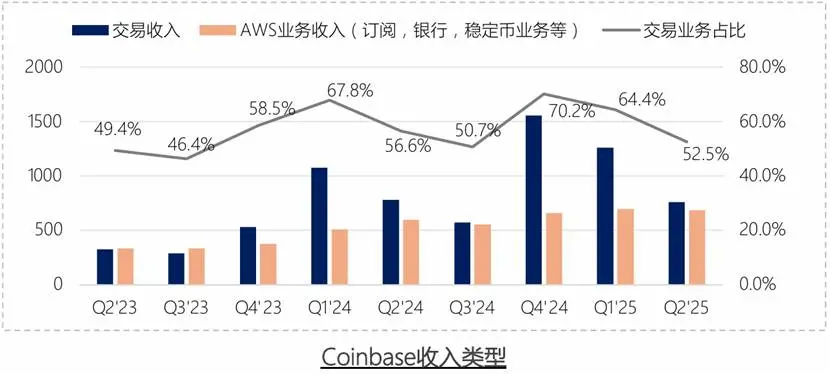
The Q2 2025 shareholder letter shows that Coinbase's revenue for the quarter was $1.5 billion, with a net income of $1.4 billion. The derivatives business saw a surge in Q2 2025, but mainly due to fee rebates and market-making incentives, raising questions about sustainability. The AWS-like business is still in its early stages and has not fully offset the volatility of trading revenue.
In other words, this round of transformation for Coinbase is more focused on ecological integration, essentially extending the growth cycle and reshaping competitive barriers.
3. ECHO : A Key Entry Point on the Asset Side, Competing with Binance Alpha?
ECHO is a key piece of Coinbase's asset-side layout. It facilitates token financing through group private placements and the Sonar public sales tool, simplifying the participation process for community investments.
Specifically, the group private placement model involves well-known investors or KOLs acting as lead investors, selecting Web3 startups and inviting the community to co-invest. It has currently supported early financing for projects like Ethena, MegaETH, and Morpho.
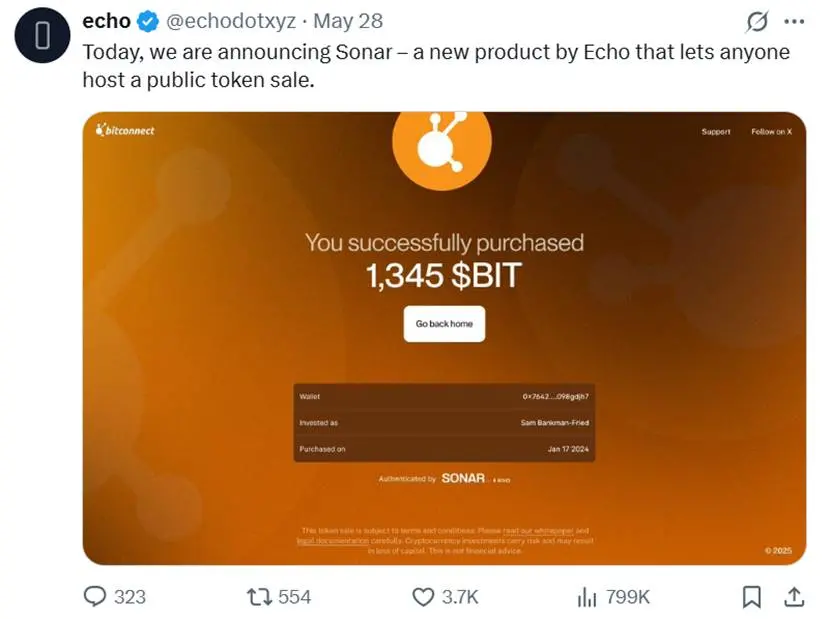
Additionally, ECHO launched Sonar in May 2025, a self-custody token sales tool that allows project parties to initiate compliant fundraising on chains like Hyperliquid, Base, and Solana, using a time-weighted deposit mechanism. Participants deposit USDT or USDC, and the longer the deposit time, the more token shares they receive, on a first-come, first-served basis. As of October 2025, Sonar has supported over 30 projects raising more than $100 million, with the first case being Plasma XPL in September.
For Coinbase, the value of ECHO lies in:
- Enhancing user stickiness: Sonar allows over a hundred million Coinbase users to directly participate in early financing, enhancing user stickiness.
- Feeding back into the Base ecosystem: ECHO has supported over 40 Base projects and has received backing from Paradigm and Hack VC, bringing new projects and traffic to the L2 network.
- Filling the gap in the primary market: Connecting early financing processes to introduce new token supply and trading scenarios for the platform.
It is worth noting that Binance Alpha (focusing on pre-listing projects) has been attracting a large number of Alpha native users by continuously launching high-profit projects with an efficient listing mechanism. However, Coinbase has long had a slow listing pace and a lack of quality project screening ability, missing out on traffic dividends. This is related to its compliance review process and reflects its shortcomings in project acquisition, while ECHO's early project investments have somewhat compensated for this shortcoming.
The two have formed differentiation in positioning, but essentially both aim to seize new narrative power as they enter the phase of competing for existing users.
Conclusion
Coinbase's transformation resembles a self-rescue effort. When the fee dividend and regulatory barriers are no longer protective charms, it chooses to rebuild its walls on the asset side. Can Coinbase still thrive? At least these actions indicate that as the crypto market enters a phase of competition for existing users, it has finally realized that the era of relying on compliance dividends and early listing windows to retain users has ended.
 Risk warning
 Risk warning






Popular articles





