








The Dilemma of AI Oracles: Why Cryptographic Proofs are the Key to the Agent Economy?
 DeAgentAI zkTLS AI Oracle: The Trust Revolution of the AI Agent Economy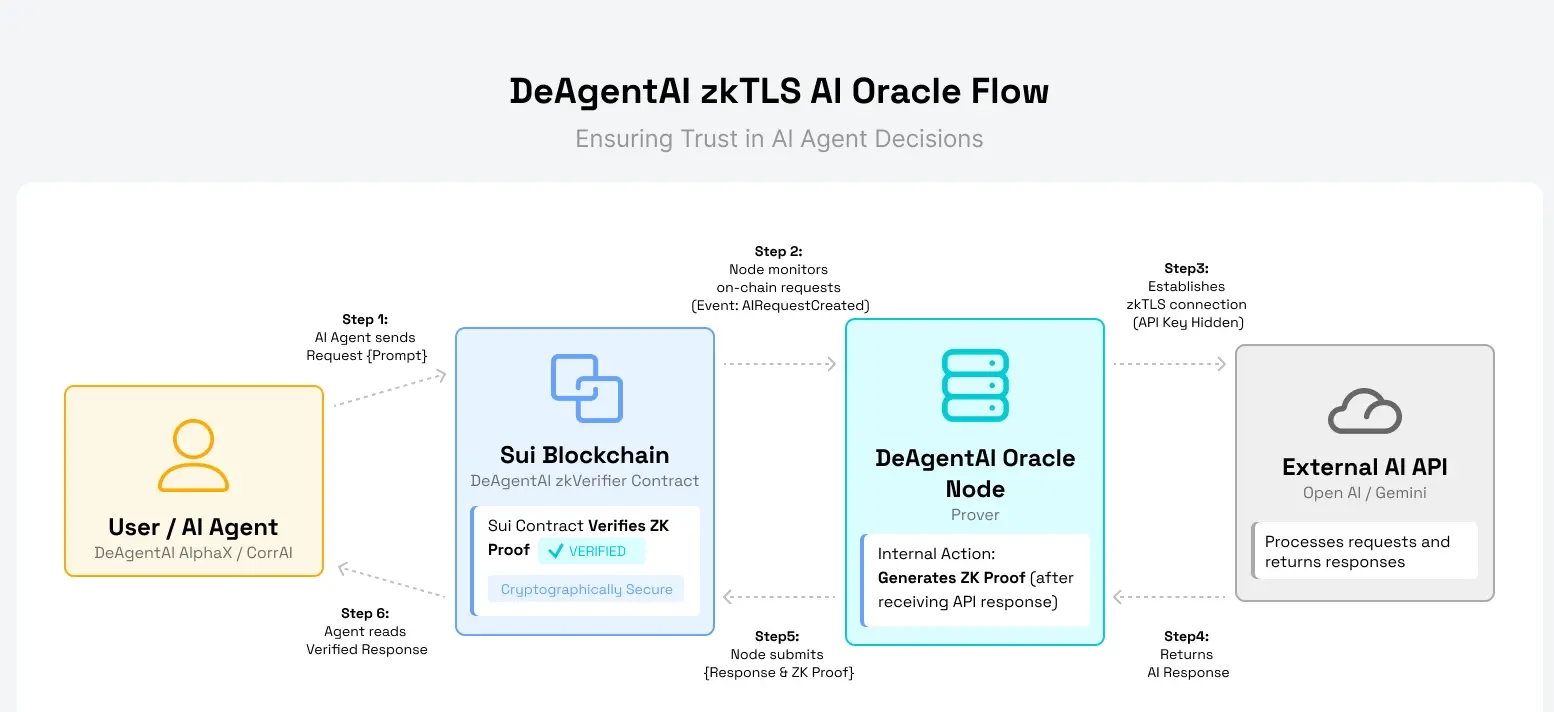
The Dual Surge of AI Waves
The current Crypto space is being activated by two explosive narratives: the rise of autonomous AI Agent economies and the parallel prosperity of on-chain prediction markets. The wave represented by the x402 protocol is standardizing how agents "pay" for API calls. Platforms like Polymarket have proven that "pricing collective intelligence" is a multi-billion dollar market.
These two trends converge at a single, crucial dependency point: data. AI Agents must consume external data to inform their decisions; a prediction market without reliable oracles to settle its outcomes is utterly useless!
The popularity of x402 has turned this theoretical issue into an urgent reality: when an AI Agent can autonomously pay to call any API, how does it trust the results returned? This has given rise to a massive, high-risk demand: the need for an oracle that can reliably input information from the external world (Web2) into the blockchain (Web3).
The "Bug" of Traditional Oracles
This is precisely where the mainstream oracle model, commonly referred to as "reputation-based consensus," falls short.
Traditional oracles (like Chainlink) are designed for simple, public, and easily verifiable data. For example, to obtain the price of SUI/USD, a decentralized oracle network (DON) only needs to have 20 independent nodes query 10 different exchanges and report the median. If one node lies, it gets voted out.
However, when data becomes complex, private, and non-deterministic, this model collapses.
Suppose an AI Agent needs to execute a high-value transaction based on a complex prompt sent to OpenAI:
Privacy Bug: The agent cannot broadcast its proprietary prompt, and more critically, cannot broadcast its API_KEY to 20 different nodes.
Consensus Bug: Even if it could, 20 different nodes querying OpenAI with the same complex question might receive 20 slightly different, non-deterministic answers. There is no "median" to vote on.
This forces the agent to do something that a trustless system absolutely cannot do: trust a single, centralized oracle node. The entire security of a multi-million dollar protocol now hinges on "hoping" that this single node has not been hacked, is not malicious, or has not returned a false result for convenience.
A Deeper Issue: Trust-Based AI Oracles
You might think: isn't the solution simply to let the AI Agent call the API directly?
But this idea is overly simplistic; smart contracts on Sui cannot issue HTTPS requests to OpenAI. It is a closed, deterministic system. It must rely on an off-chain participant to "relay" the data.
The seemingly obvious solution is to create a dedicated "AI oracle" that is solely responsible for calling APIs and relaying results. But this does not address the core issue. Smart contracts still blindly trust that node. They cannot verify:
Did this node really call api.openai.com?
Or did it call a cheaper, malicious server that looks similar?
Did it tamper with the response to manipulate a prediction market?
This is the real deadlock: the AI Agent economy cannot be built on "reputation"; it must be built on "proof."
Solution: DeAgentAI zkTLS AI Oracle
This is precisely the challenge that DeAgentAI, as a leading AI Agent infrastructure, is committed to solving. We are not building a "more trustworthy" oracle; we are building an oracle that fundamentally does not require trust.
We achieve this by shifting the entire paradigm from reputational consensus to cryptographic consensus. This solution is a dedicated AI oracle built on zkTLS (Zero-Knowledge Transport Layer Security Protocol).
The diagram below illustrates the complete interaction architecture between AI Agents, Sui smart contracts, off-chain nodes, and external AI APIs:
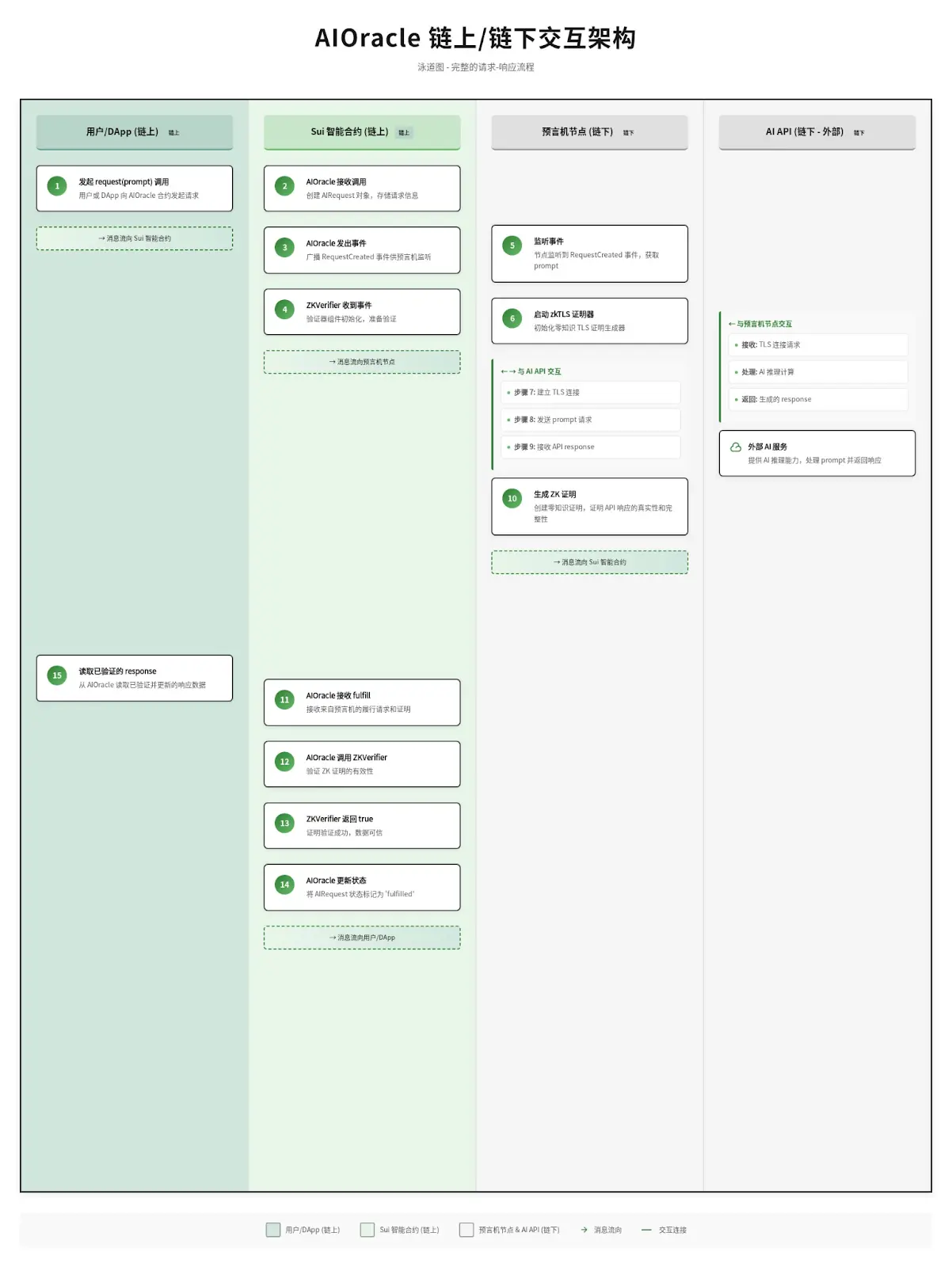
How It Works: "Cryptographic Notary"
Do not think of DeAgentAI's oracle as a messenger; rather, view it as an internationally recognized "cryptographic notary."
Its technical workflow is as follows:
Off-Chain Proving: DeAgentAI oracle nodes (an off-chain component) initiate a standard, encrypted TLS session with the target API (e.g., https://api.openai.com).
Privacy-Preserving Execution: The node securely sends the prompt using its private API key (Authorization: Bearer sk-…). The zkTLS proof system records the entire encrypted session.
Proof Generation: After the session ends, the node generates a ZK proof. This proof serves as the "notary's seal." It cryptographically proves the following facts simultaneously:
"I connected to a server with the official certificate of api.openai.com."
"I sent a data stream containing a public prompt."
"I received a data stream containing a public response."
"All of this was done while provably hiding (editing) the Authorization header, which remains private."
- On-Chain Verification: The node then calls the on-chain AIOracle smart contract, submitting only the response and proof.
This is where the magic happens, as shown in the DeAgentAI architecture based on Move:
Code snippet
// A simplified snippet from DeAgentAI's AIOracle contract
public entry fun fulfillrequestwith_proof(
oracle: \&AIOracle,
request: \&mut AIRequest,
response: String,
server_name: String, // e.g., "api.openai.com"
proof: vector\<u8>, // The ZK-proof from the off-chain node
ctx: \&mut TxContext
) {
// --- 1. VALIDATION ---
assert!(!request.fulfilled, EREQUESTALREADY_FULFILLED);
// --- 2. VERIFICATION (The Core) ---
// The contract calls the ZKVerifier module.
// It doesn't trust the sender; it trusts the math.
let isvalid = zkverifier::verify_proof(
\&proof,
\&server_name,
\&request.prompt,
\&response
);
// Abort the transaction if the proof is invalid.
assert!(isvalid, EINVALID_PROOF);
// --- 3. STATE CHANGE (Only if proof is valid) ---
request.response = response;
request.fulfilled = true;
event::emit(AIRequestFulfilled {
request_id: object::id(request),
});
}
The fulfillrequestwith_proof function is permissionless. The contract does not care who the caller is; it only cares whether the proof is mathematically valid.
The actual cryptographic heavy lifting is handled by the zk_verifier module, which performs mathematical operations on-chain to verify the "notary's seal."
Code snippet
// file: sources/zk_verifier.move
// STUB: A real implementation is extremely complex.
module myverifier::zkverifier {
use std::string::String;
// This function performs the complex, gas-intensive
// cryptographic operations (e.g., elliptic curve pairings)
// to verify the proof against the public inputs.
public fun verify_proof(
proof: \&vector\<u8>,
server_name: \&String,
prompt: \&String,
response: \&String
): bool {
// --- REAL ZK VERIFICATION LOGIC GOES HERE ---
// In this example, it's stubbed to return `true`,
// but in production, this is the "unforgeable seal."
true
}
}
This architecture separates the AIOracle business logic from the ZKVerifier cryptographic logic, representing a clear modular design that allows for seamless upgrades to the underlying proof system in the future without halting or migrating the entire oracle network.
Economic Impact: From "Data Cost" to "Trust Value"
Existing oracle giants (like Chainlink) excel in the "public data" market, where their core business is providing price data like SUI/USD for DeFi. This is a market based on "redundancy" and "reputational consensus" (N nodes voting), where the economic model is to pay for data.
DeAgentAI, on the other hand, is targeting a new blue ocean: the incremental market (private/AI oracles). This is a market where AI Agents, quantitative funds, and institutions need to call private APIs, non-deterministic AI models, and confidential data. This market is currently almost non-existent, not because there is no demand, but because it is completely locked down by the "trust dilemma."
DeAgentAI's zkTLS oracle is not designed to compete in a red ocean with traditional oracles over "price data," but rather to unlock the trillion-dollar "autonomous agent economy" market that has been stalled due to a lack of trust!
Redefining Costs: "Gas Cost" vs. "Risk Cost"
Our zkTLS oracle verifies ZK proofs on-chain, which incurs a significant amount of gas at this stage. This may seem like a "high cost," but it is actually a misinterpretation. We must distinguish between these two costs:
Gas Cost: The on-chain fee paid for a verifiable, secure API call.
Risk Cost: The cost incurred when an AI agent makes erroneous decisions due to trusting an opaque, centralized oracle node, resulting in millions of dollars in losses.
For any high-value AI Agent, paying a controllable "Gas Cost" in exchange for 100% "cryptographic certainty" is a far cheaper economic choice than bearing unlimited "Risk Costs."
We are not "saving costs"; we are "eliminating risks" for users. This is an economic "insurance" that transforms unpredictable catastrophic losses into a predictable, high-level security expense.
Why DeAgentAI: Why We Are Essential?
We address the most challenging yet often overlooked issue in the AI Agent economy: trust.
The x402 protocol resolves the friction of "payment," but that only completes half the task. An AI agent pays for data but cannot verify its authenticity, which is unacceptable in any high-value scenario. DeAgentAI provides the missing other half: a verifiable "trust layer."
We can achieve this not only because we have the right technology but also because we have proven its market viability.
First: We serve a mature infrastructure, not a laboratory
DeAgentAI is already the largest AI agent infrastructure across the Sui, BSC, and BTC ecosystems. Our zkTLS oracle is not a theoretical white paper; it is built for the real, massive demand in our ecosystem.
18.5 million+ users (USERS)
Peak of 440,000+ daily active users (DAU)
195 million+ on-chain transactions
Our zkTLS oracle is designed for this already validated high-concurrency environment, providing the foundational trust services urgently needed by our vast user and agent ecosystem.
Second: We chose the right and only architecture from day one, and our market leadership stems from our strategic choices in the technology roadmap:
Cryptographic Consensus vs. Reputation Consensus: We firmly believe that the "consensus" issue for AI agents cannot be solved through "social voting" (node reputation) but must be solved through "mathematics" (cryptographic proof). This is our fundamental distinction from traditional oracle models.
Native Privacy and Permissionless: DeAgentAI's zkTLS implementation addresses the privacy issue of API keys at the protocol level, which is a rigid requirement for any professional-grade AI agent. Meanwhile, the permissionless nature of fulfillrequestwith_proof means we have created an open market that certifies proofs without recognizing individuals.
Modularity and Future Compatibility: As mentioned earlier, DeAgentAI's engineers have intentionally separated AIOracle (business logic) from ZKVerifier (cryptographic verifier). This is a crucial design. With the rapid development of ZK cryptography (such as STARKs, PLONKs), we can seamlessly upgrade the underlying ZKVerifier module to achieve lower gas costs and faster verification speeds without interrupting or migrating the smart contracts of the entire ecosystem. We are built for the AI development of the next decade.
Conclusion: From "Trust Messenger" to "Verification of Information"
DeAgentAI's architecture realizes a fundamental shift: from "trust messenger" to "verification of information." This is the necessary paradigm revolution for building a truly autonomous, trustworthy, and high-value AI agent economy. The x402 provides the payment track, while DeAgentAI provides the indispensable "security and trust" guardrails on that track.
We are building the trustless "central nervous system" for this upcoming new economy. For developers looking to build the next generation of trustless AI agents, DeAgentAI offers the most solid foundation of trust.
Official Links:
Website: https://deagent.ai/
Twitter: https://x.com/DeAgentAI
Telegram: https://t.me/deagentai
CoinMarketCap: https://coinmarketcap.com/currencies/deagentai/
Dune Analytics: https://dune.com/blockwork/degent-ai-statistics
 Risk warning Risk warning



Popular articles





