








The Return of Price Discovery Mechanism in the Era of High Throughput
 Core Viewpoint

 In order to achieve a market without licensing, we replaced the natural price discovery mechanism with a formula. This made trading continuous and accessible, but also removed the elements that maintain price fairness.
Article Author: Prince
Article Compiler: Block unicorn
One of the biggest issues in the cryptocurrency space is rarely discussed. To achieve a permissionless market, we replaced the natural price discovery mechanism with formulas. This made trading continuous and accessible, but also removed the elements that maintain price fairness.
Price discovery has always been a natural part of market operations. Buyers and sellers trade openly, and prices form during the transaction process. It does not require any formulas or fixed curves; it is simply a way for the market to reach a consensus.
With the development of decentralized finance (DeFi), this process began to change. Automated market makers opened trading to everyone, replacing buy and sell quotes with curves. Liquidity became stable, and the market could operate without counterparties. This undoubtedly improved the convenience and speed of trading, but in the process, some important factors also changed. Prices no longer formed through interaction but began to be derived from formulas.
Virtual AMMs further advanced this concept. They price perpetual contracts using formulas and oracles instead of actual trades. The market became predictable, but it became increasingly disconnected from the demand and risk flows that once defined it. The factors that used to drive market dynamics now exist only in code.
Uniswap v3 added new tools to enhance precision. Liquidity providers can concentrate their funds within smaller ranges, thereby increasing efficiency. This has a significant effect on increasing trading volume, but it also fragmented the price discovery process. Each range reflects only a part of the market, rather than the whole. Liquidity became specialized, and the collective pricing mechanism disappeared.
The Hidden Side of Credit
The development path of the lending market is different. Although trading has undergone several design iterations, the lending market has remained largely unchanged. Each protocol creates its own liquidity pool, which has a fixed yield curve and parameters controlled by governance mechanisms. Interest rates automatically adjust with changes in capital utilization, but these adjustments rarely reflect changes in other markets.
Borrowers compare data across different protocols, but the results never seem to reflect the full picture. Each market operates independently, with its own rules and liquidity. Capital stagnates because it lacks competitive pathways. What appears efficient from the outside often feels stagnant to users.
Anyone who has borrowed or provided funds in these markets knows this well. You open several applications, compare interest rates, yet still cannot determine which rate reflects real market demand. Sometimes, you find that different markets under the same protocol yield completely different results. The system functions normally, but it feels incoherent.
Lessons from Hyperliquid
Hyperliquid demonstrates that markets can regain autonomy without sacrificing efficiency. Its on-chain order book directly links trading activity to prices. Every buy, sell, and cancel contributes to a real-time view of demand. Prices begin to reflect trading participation once again.
This outcome reminds builders that minor inefficiencies are not problems to be eliminated but signals. The gap between bids and asks, changes in bid depth, and the time required for price adjustments all reveal information. These differences indicate how the market reaches agreements.
The Avon Structure
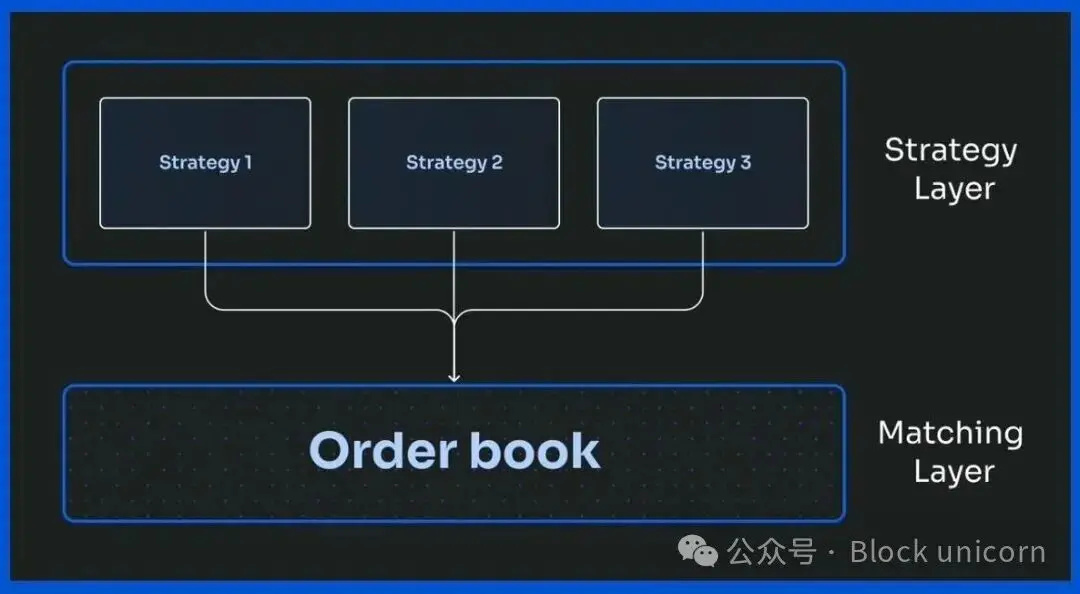
Avon applies the same concept to the credit space. Each strategy functions like an HLP vault: an independent lending market with its own logic and liquidity. Above these strategies is a coordination layer, an on-chain order book that connects all strategies through shared information rather than liquidity pools.
When someone deposits, borrows, or repays, the shared layer updates immediately. All strategies can observe these changes. Liquidity self-adjusts to more favorable conditions. Interest rates are not set by regulators or external entities but are continuously formed by internal network activities.
It is this mechanism that allows Avon to operate without external market makers. The coordination layer itself becomes the balancing mechanism. Every transaction updates the market in real-time, enabling liquidity to respond to changes across all strategies.
Over time, lending began to operate like trading. The market reflects participants' valuations of risk and return as the market environment changes. Credit becomes a part of the real-time system that constitutes the modern trading framework.
Consistency Revisited
MegaETH timely restored coordination by centralizing all activities on a shared sequencer. Its high throughput and Giga Gas limits make it possible to coordinate complex systems entirely on-chain. For the first time, the lending market can operate a continuous order book without sacrificing transparency or performance.
Avon developed on this foundation. The shared environment of the network allows the credit market to quote in real-time and respond to one another. Prices form openly, occurring within the same block space that records every transaction. The discovery process becomes visible again.
When the discovery process is transparent, pricing becomes fairer. Fair pricing can attract deeper liquidity and higher-quality capital. Institutional funds that rely on transparency can participate smoothly. Various forces that once led to market fragmentation now begin to reinforce each other. Liquidity flows faster, terms become better, and the market becomes more favorable for all participants.
This is the possibility brought by the high-throughput era: a system where discovery, coordination, and fairness operate within the same block space.
 Risk warning
 Risk warning



Popular articles





