








Tron Industry Weekly Report: Strong QE Expectations Reverse Market Downtrend, VC Bets on Transforming Predictive Products into DeFi Product Limitless Exchange

 Macroeconomic Weakness, Structural Rebound in Cryptocurrency, and Analysis of Three Major Potential Projects
# I. Outlook
1. Macroeconomic Summary and Future Predictions
Last week, U.S. stocks weakened overall. The three major indices fell for the third consecutive week, with the Dow Jones Index dropping about 1.4%, the S&P 500 down 1.8%, and the tech sector leading the decline, with the Nasdaq falling over 2%. Corporate earnings reports were generally cautious, consumer stocks faced pressure, and safe-haven demand drove bonds and gold to strengthen again.
Looking ahead, as negotiations between the Treasury and Congress on the budget show signs of progress, the market expects the government may reopen in mid-November, which could boost confidence in the short term. However, if inflation rebounds again or corporate earnings expectations continue to be revised downwards, volatility in U.S. stocks will likely increase. Overall, the U.S. economy is at a critical point of low growth and policy wait-and-see, with market risk appetite remaining weak.
2. Market Movements and Warnings in the Crypto Industry
Last week, the cryptocurrency market continued to show a weak oscillating pattern, but volatility increased significantly. Bitcoin briefly fell below the critical support level of $100,000, and the total market capitalization briefly dropped below $3.9 trillion, with tight liquidity and fluctuating macro interest rate expectations continuing to suppress risk appetite. However, after a week of deleveraging and liquidations, the market saw a noticeable rebound on Sunday, with Bitcoin bouncing back, and mainstream assets like Ethereum and Solana also recovering. On-chain data shows funds returning to exchanges, and some short-term bottom-fishing capital has begun to enter.
It is worth noting that although overall funds remain cautious, some sub-sectors have shown structural activity, especially tokens related to decentralized storage, AI computing, and on-chain infrastructure, which have seen significant short-term gains due to concentrated speculation. Looking ahead, if Bitcoin can stabilize in the $100,000 range and maintain the momentum from the weekend rebound, the market may see a technical recovery; conversely, if fund enthusiasm cools again and macro liquidity does not improve, there remains a risk of a second downward probe. Overall, the crypto market is currently in a weak rebound phase, with frequent rotation of hotspots but lacking a sustained mainline.
3. Industry and Track Hotspots
Led by Dragonfly, with participation from A16z------Lighter, a decentralized trading platform rebuilt with zero-knowledge proofs for ultimate security and scalability; total financing of $3.2 million------Novastro is building a modular ledger layer for the global RWA market, anchoring asset issuance on Ethereum's secure ledger.
# II. Market Hotspot Tracks and Potential Projects of the Week
1. Overview of Potential Projects
1.1. Analysis of Lighter, a decentralized trading core platform rebuilt with zero-knowledge proofs, led by Dragonfly and participated by A16z
Introduction
Lighter is a decentralized trading platform built for ultimate security and scalability.
It is the first exchange to achieve verifiable order matching and liquidation mechanisms, while also matching the performance of traditional centralized exchanges (CEX), providing an industry-leading trading experience.
Overview of Lighter Core Mechanism
The design of Lighter Core is based on four core principles:
Users always control their own asset custody (Self-Custody).
All operations must be verifiable and strictly adhere to a public, predefined set of rules.
The system must seamlessly scale in terms of latency and throughput.
Users must be able to exit the system safely and independently at any time.
To achieve these goals, Lighter Core requires a publicly verifiable computing engine to prevent malicious behavior by operators and ensure that all execution processes fully comply with public rules. Currently, there are several technical solutions for verifiable computing, each with trade-offs:
Blockchain decentralized consensus: Achieves verifiability through node redundancy execution, secure but limited by high latency and low throughput caused by network consensus; additionally, data must be public, which is not conducive to privacy protection. For example, Ethereum is such a structure.
Trusted Execution Environment (TEE): Relies on hardware-level verification but must trust device manufacturers and may be subject to side-channel attacks; users cannot fully independently verify the execution process.
Zero-Knowledge Proofs (ZK-Proofs): Although historically computationally expensive, they offer strong security, can scale horizontally and vertically, and have the advantage of privacy modularization, making them an ideal verification method.
Additionally, to ensure safe exits, assets must be stored in a non-custodial environment; however, if an independent chain connected by a cross-chain bridge is compromised, this security will be lost.
Therefore, Ethereum, as the most mature verifiable execution platform, becomes the neutral and secure settlement layer for Lighter Core, providing a reliable user exit channel.
Architecture and Mechanism of Lighter Core
Lighter Core combines succinct execution proofs with Ethereum's mainnet anchoring layer to ensure:
All state updates take effect only after verification on Ethereum;
Users can securely enter and exit the system directly through Ethereum;
All transactions and state changes can be publicly verified.
Its scalability comes from a self-developed high-performance proof engine optimized for the specific workload of exchanges.
The system executes batches of transactions signed by users, generating new system states and corresponding cryptographic proofs.
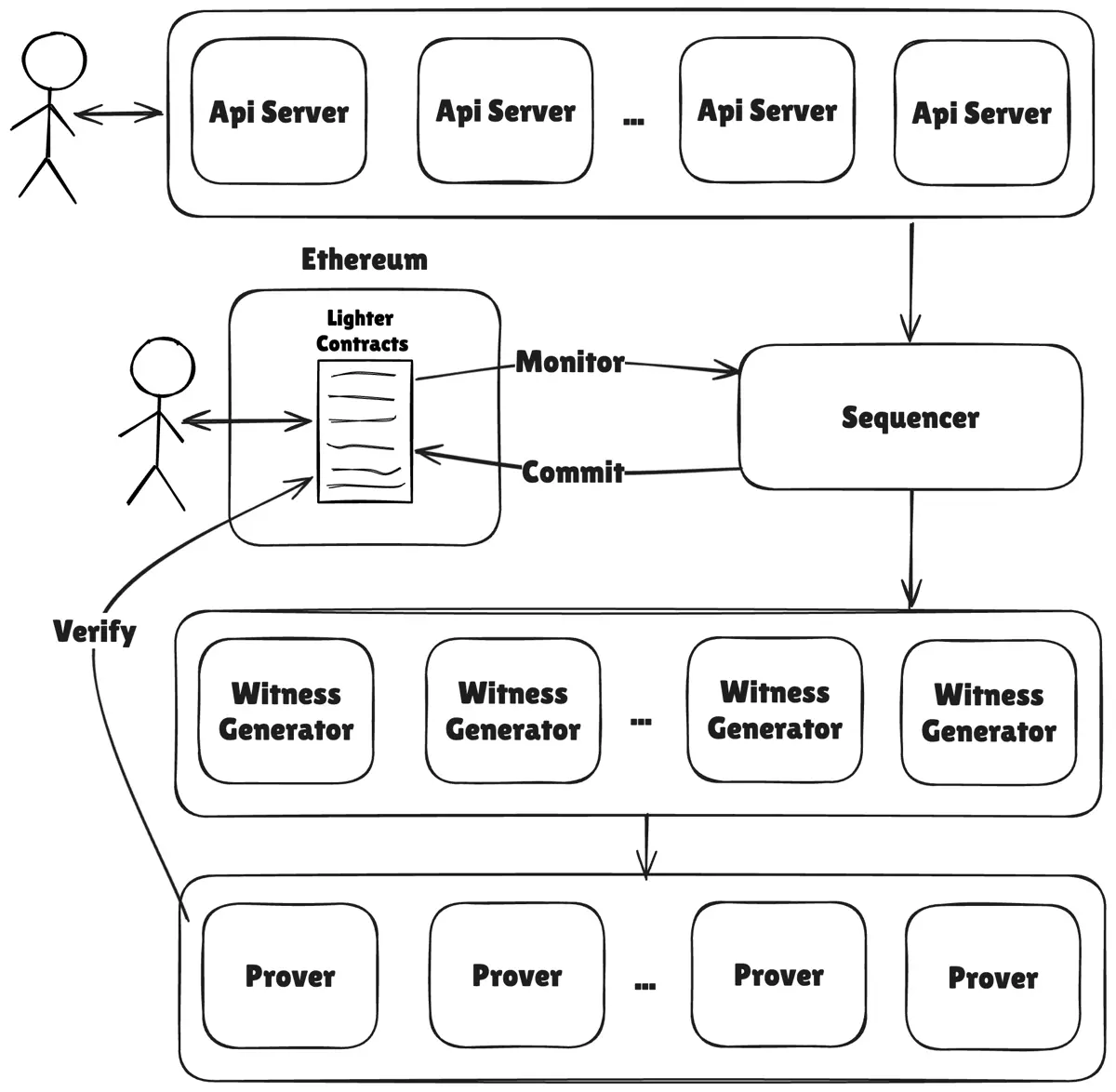
On Ethereum, smart contracts are responsible for:
Custody of all user assets;
Maintaining Lighter's global state root, including core data such as user assets, positions, public pools, and order books.
Lighter Core regularly submits state update proposals to Ethereum, accompanied by compressed data blobs.
These data blobs record account change information, allowing any user to independently reconstruct their account state, achieving complete transparency and self-verification.
In the system, the Sequencer is responsible for:
Organizing transactions in FIFO order;
Generating data for low-latency APIs and proof generators;
Providing data inputs suitable for ZK circuits to the Witness Generator;
The Prover generates thousands of execution proofs in parallel and compresses them into a single batch proof through a multi-layer aggregation mechanism for efficient verification on Ethereum.
Once the batch proof is verified on Ethereum, the smart contract updates the exchange's state.
The proof also guarantees the integrity and correctness of on-chain data blobs, ensuring that anyone can independently restore all account states based solely on on-chain data.
Escape Hatch Mechanism
To ensure system liveness and censorship resistance,
Lighter Core has a Priority Request Queue on Ethereum.
Users can directly submit key operation requests (such as withdrawals, exiting liquidity pools, or IOC orders that only reduce positions) on-chain.
The Sequencer must process these requests within a specified time frame.
If the Sequencer fails to execute on time, the system will automatically enter Escape Hatch Mode:
Smart contracts immediately freeze all operations;
Users can use the data blobs already published on Ethereum to reconstruct their account states;
And generate zero-knowledge proofs of ownership (such as balance, position, pool shares);
With this proof, users can directly withdraw all assets on Ethereum without any off-chain collaboration.
This ensures that in any extreme situation, users can completely independently and safely retrieve their assets.
Tron’s Commentary
Lighter's core advantage lies in its combination of centralized exchange-level performance with blockchain-level security and verifiability, achieving the industry's first decentralized trading architecture with verifiable matching and liquidation mechanisms. Through ZK proofs + Ethereum anchoring layer, Lighter ensures that every transaction and every state update can be publicly verified, while introducing the Escape Hatch mechanism to guarantee that users can safely and independently extract assets under any circumstances. Its self-developed high-performance proof engine and multi-layer aggregation structure achieve a balance between low latency (0.2s) and high throughput (200,000+ transactions per second), rivaling top CEXs.
However, its potential disadvantages include the high computational cost of generating zero-knowledge proofs, higher system complexity and development threshold, and a certain dependency on
 Risk warning Risk warning



Popular articles





