








The economic rift deepens, and Bitcoin may become the next liquidity "pressure relief valve."
 Core Viewpoint
Summary:
Cryptocurrency is one of the few areas that does not rely on banks or governments to hold and transfer value.

2025-11-14 18:25:33
 Cryptocurrency is one of the few areas that does not rely on banks or governments to hold and transfer value.
Original Title: The Two-Tier K-Shaped Economy
Original Author: arndxt, Crypto Analyst
Original Compiler: AididiaoJP, Foresight News
The U.S. economy has split into two worlds: one side is a booming financial market, while the other side sees the real economy trapped in a slow decline.
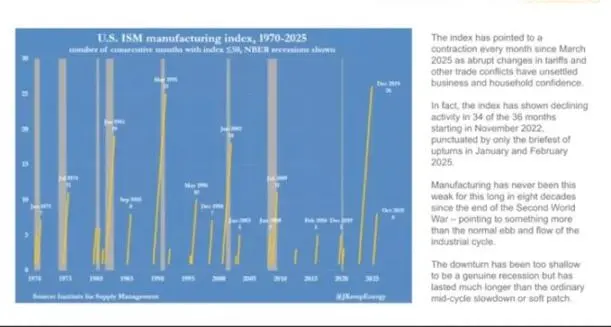
The manufacturing PMI index has shrunk for over 18 consecutive months, the longest record since World War II, yet the stock market continues to rise as profits increasingly concentrate in tech giants and financial companies. (Note: The full name of the "manufacturing PMI index" is the "Purchasing Managers' Index for Manufacturing," which is a "barometer" for measuring the health of the manufacturing sector.)
This is essentially "balance sheet inflation."
Liquidity continuously drives up the prices of similar assets, while wage growth, credit creation, and small business vitality remain stagnant.
As a result, an economic split has formed, with different sectors moving in completely opposite directions during recovery or economic cycles:
On one side: capital markets, asset holders, tech industry, and large corporations are rapidly rising (profits, stock prices, wealth).
On the other side: wage earners, small businesses, blue-collar industries → declining or stagnating.
Growth and hardship coexist.
### Policy Failure
Monetary policy can no longer truly benefit the real economy.
The Federal Reserve's interest rate cuts have driven up stock and bond prices but have not brought new jobs or wage growth. Quantitative easing has made it easier for large companies to borrow money but has not helped small businesses develop.
Fiscal policy is also nearing its end.
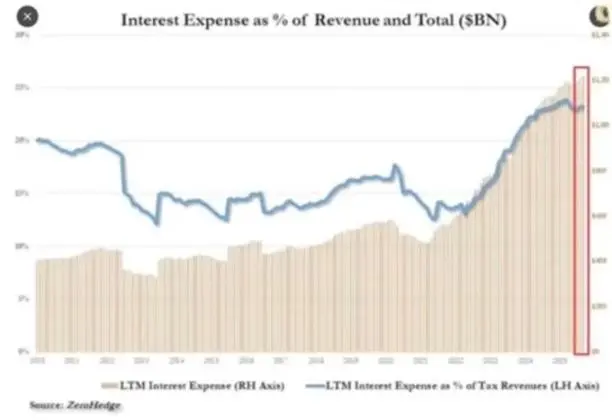
Now nearly a quarter of government revenue is used just to pay interest on national debt.
Policymakers are thus caught in a dilemma:
Tightening policies to combat inflation leads to market stagnation; loosening policies to promote growth causes prices to rise again. This system has become self-reinforcing: once attempts are made to deleverage or reduce the balance sheet, it will impact the asset values on which it relies for stability.
### Market Structure: Efficient Harvesting
Passive fund flows and high-frequency data arbitrage have turned the open market into a closed-loop liquidity machine.
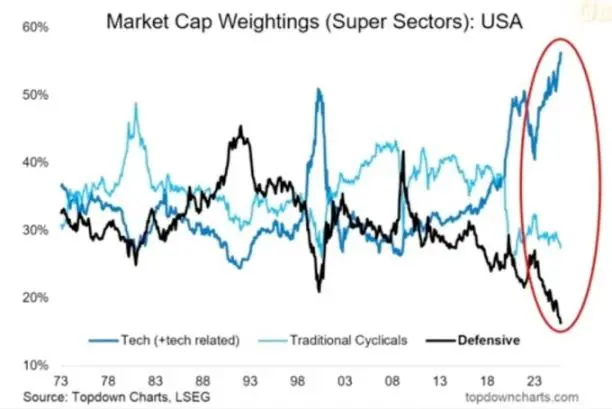
Positioning and volatility supply are more important than fundamentals. Retail investors have effectively become counterparties to institutions. This explains why defensive sectors are abandoned while tech stock valuations soar; the market structure rewards chasing gains, not value.
We have created a market that is highly price-efficient but has very low capital efficiency.
The open market has become a self-reinforcing liquidity machine.
Funds flow automatically → through index funds, ETFs, and algorithmic trading → creating continuous buying pressure, regardless of fundamentals.
Price movements are driven by fund flows, not value.
High-frequency trading and systematic funds dominate daily transactions, with retail investors actually standing on the opposite side of trades. Stock price fluctuations depend on positioning and volatility mechanisms.
Thus, tech stocks continue to inflate while defensive sectors lag behind.
### Social Backlash: The Political Cost of Liquidity
Wealth creation in this cycle is concentrated at the top.
The richest 10% hold over 90% of financial assets; as the stock market rises, the wealth gap widens. Policies that drive up asset prices simultaneously erode the purchasing power of the majority.
Without substantial wage growth and the ability to afford housing, voters will eventually seek change, either through wealth redistribution or political turmoil. Both exacerbate fiscal pressure and elevate inflation.
For policymakers, the strategy is clear: maintain rampant liquidity, boost the market, and claim economic recovery. Substitute superficial prosperity for substantive reform. The economy remains fragile, but at least the data can hold up until the next election.
### Cryptocurrency as a Pressure Release Valve
Cryptocurrency is one of the few areas that does not rely on banks or governments to hold and transfer value.
Traditional markets have become closed systems, with large capital siphoning off most profits through private placements before going public. For the younger generation, Bitcoin is no longer just speculation; it represents an opportunity to participate. When the entire system seems manipulated, at least there is still a chance here.
Although many retail investors have been hurt by overvalued tokens and VC sell-offs, the core demand remains strong: people crave an open, fair, and self-controlled financial system.
### Outlook
The U.S. economy cycles through "reflexes": tightening → recession → policy panic → easing → inflation → repeat.
The next round of easing may come in 2026 due to slowing growth and expanding deficits. The stock market may have a brief celebration, but the real economy will not truly improve unless capital shifts from supporting assets to productive investments.
Right now, we are witnessing the late-stage form of a financialized economy:
* · Liquidity acts as GDP
* · The market has become a policy tool
* · Bitcoin serves as a social pressure valve
As long as the system continues to cycle debt into asset bubbles, we will not achieve true recovery, only a slow stagnation masked by rising nominal figures.
[Original Link](https://x.com/arndxt_xo/status/1988936582011765181)
 Risk warning Risk warning
Related reading
Wall Street institutions warn: The Federal Reserve has committed the "original sin," and the yield on the 10-year U.S. Treasury bond may approach 8%
2026-10-01

Strategy restarts coin accumulation while increasing support for STRC
2026-09-29

Morning Report | QCP: Bitcoin faces dual challenges from geopolitical issues and macro data, key support levels under scrutiny; Grayscale Research Director: Computing power is becoming a new scarce digital asset
2026-09-29

Popular articles
In response to Meta Muse, OpenAI urgently launched a personal assistant, expected to be released on Tuesday
09-28

The "Meme Factory" has emerged; how does the harvesting assembly line of Robinhood Chain operate?
09-28

Circle is responsible for issuance, Coinbase controls the users: who actually profits from stablecoins?
09-28



