








Chen Yizhou, who caused the collapse of Renren, has turned around and launched the first cryptocurrency bank in the United States
 Core Viewpoint

 "We must first become a bank, and then, with the identity of a bank, do what others cannot do."
Original Author: Sleepy.txt
In November, American fintech giant SoFi announced the full opening of cryptocurrency trading to all retail customers. This comes just three years after it obtained a national banking license in the United States, making it the first true "crypto bank" in the country, and it is even preparing to launch a dollar stablecoin in 2026.
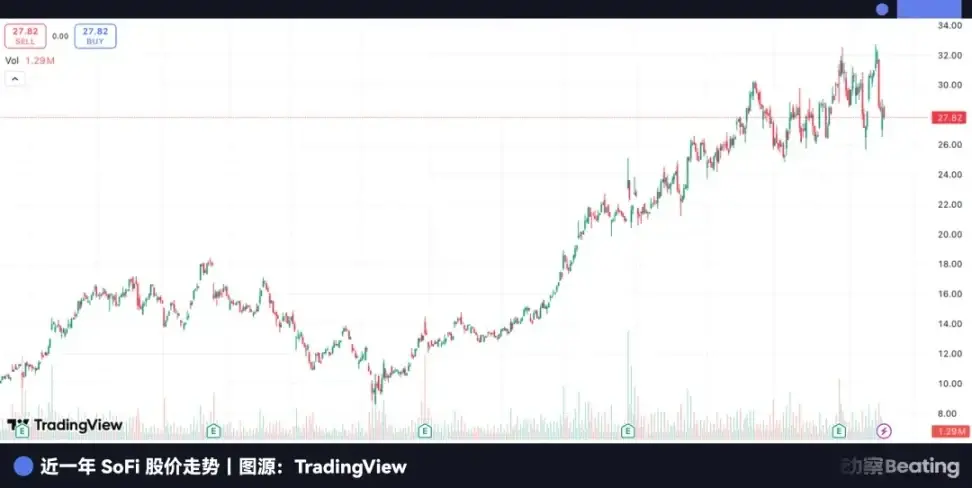
On the day the news was announced, SoFi's stock price surged to an all-time high, with a market capitalization reaching $38.9 billion, marking a 116% increase since the beginning of the year.
Chen Yizhou, the CEO of the now-rebranded Renren (formerly known as 校内网), was one of SoFi's earliest investors. In 2011, he was introduced to SoFi's founders at Stanford and, after a conversation of less than five minutes, decided to invest $4 million.
Later, he recalled this investment in a speech, saying, "At that time, I didn't even know about P2P lending; I just thought this was a great idea."

A traditional financial license and a sensitive crypto business have been woven into the same story by SoFi. Before it, traditional banks on Wall Street dared not touch cryptocurrencies, while crypto giants like Coinbase could not obtain banking licenses. SoFi became the only outlier standing at the intersection.
However, if you rewind the timeline, you'll find that its starting point was not glamorous; it was not a tech company or a crypto company, but rather, like the Chinese generation of P2P platforms, it started with the most traditional "matching loans." Just over a decade later, they have taken completely different paths.
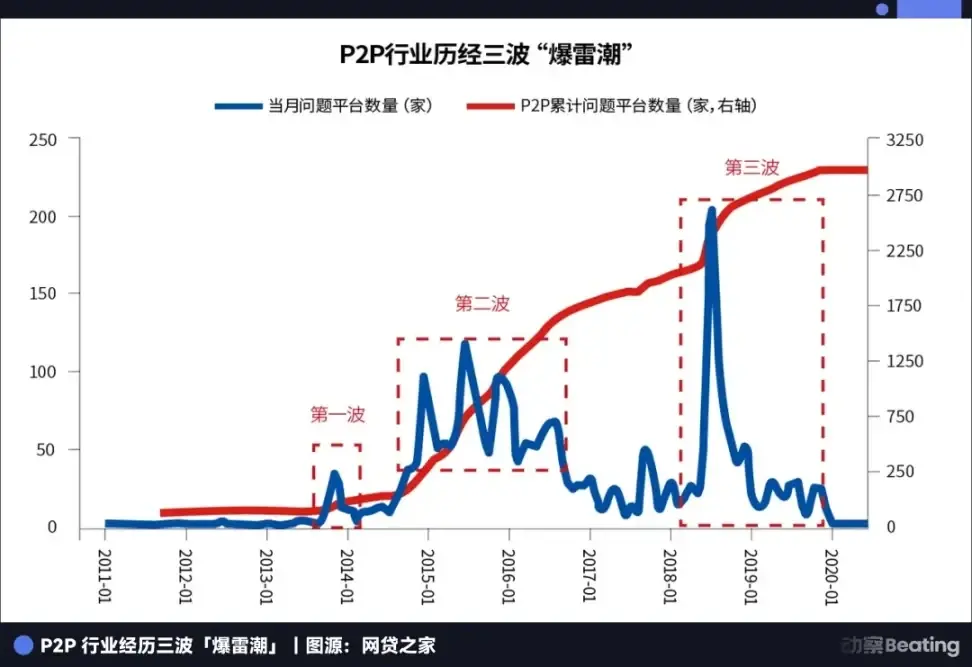
Across the ocean, China's P2P has become a thing of the past, with over 5,000 platforms at its peak, none of which survived. The bubble of an era eventually burst, leaving behind hundreds of billions in bad debts and countless shattered families.
Both are P2P, but why did one head towards death while the other evolved into a new species called "crypto bank"?
Two Genes of P2P
Because their underlying genes are completely different.
The model of Chinese P2P is essentially a business of "traffic + high-interest loans," acquiring customers through offline street visits and online channels, with high interest rates and short cycles. Platforms do not look at long-term credit and do not need to manage customer relationships.
SoFi, on the other hand, is an entirely different species. In 2011, as Chinese P2P platforms sprang up like mushrooms after rain, SoFi was born in a classroom at Stanford Business School. Four MBA students raised $2 million from alumni, and their first business was lending $50,000 in tuition to 40 classmates.

The story SoFi told from the beginning was as simple as it could be: solving real borrowing needs on campus, with their first customers being their own classmates. This allowed SoFi to bypass the most challenging hurdle from the start: risk control.
It targeted a group of the highest-quality credit individuals in the United States: students from prestigious universities. These individuals have promising future incomes and extremely low default rates. More importantly, SoFi stands for "Social Finance," and its earliest lending relationships came from alumni networks. Borrowing money from fellow alumni is essentially a form of familiar credit, with alumni status serving as the most natural guarantee.
Unlike Chinese P2P, which often has annualized interest rates of over twenty percent, SoFi kept its rates lower than those of government and private institutions from day one. It did not seek high-interest spreads; instead, it aimed to attract the best young people into its system, creating a long-term business that could last ten or twenty years. Tuition loans were just the starting point, followed by mortgages, investments, and insurance, representing a complete financial lifecycle.
The essence of Chinese P2P is transaction-based, a one-off deal; while SoFi's essence is service, a steady stream.
It was also during this phase that a group of investors willing to bet on "atypical finance" began to emerge.
Chen Yizhou, who was involved with 校内网, invested in this "campus loan."
This well-placed step helped him avoid the high-interest rates and funding pool quagmire that Chinese P2P later faced, instead hitting the jackpot with a financial service company that had the aura of an elite club.
This investment also inspired another Chinese investor. Zhou Yahui, founder of Kunlun Wanwei, was deeply inspired after seeing Chen Yizhou invest in SoFi and decided to invest in the domestic platform Qufenqi. Zhou later referred to Chen as his "mentor." However, Qufenqi took a different path, entering the campus loan market with high-interest rates, ultimately falling into significant controversy and regulatory storms.
Just three years after Chen Yizhou invested in SoFi, in the fourth quarter of 2014, Renren launched its own campus loan product, "Renren Installment." This time, Chen was no longer the "investor who didn't understand P2P," but a savvy operator. Renren Installment offered installment loans to students, charging installment repayment fees and interest, while also launching "Renren Wealth Management" as a P2P investment platform.
From then on, the Chinese P2P industry hit the gas pedal. Campus loans were just the entry point, quickly extending to cash loans, consumer loans, and asset-backed investment products, with high interest rates, funding pools, and guaranteed returns becoming mainstream practices. In May 2016, Renren Installment chose to exit the student consumer loan market, shifting to installment loans for used car dealers, in a sense quietly leaving before the industry truly spiraled out of control.
2018 was a watershed year for the life and death of this industry.
Chinese P2P soared amid regulatory absence and exorbitant interest rates, but in that year, it collectively collapsed, with platforms shutting down and assets evaporating, quickly leading to a comprehensive exit. By November 2020, Chinese P2P platforms had completed their exit, and all industry entities were liquidated.
As the industry was liquidated, the person who had first bet on SoFi was also putting a period on this investment. Chen Yizhou, through a series of internal transactions, stripped Renren's holdings in SoFi to a company he controlled and then sold them at a low price to buyers including SoftBank. Minority shareholders were outraged, and a New York court intervened, with litigation lasting for years.
In the eyes of many, this meant SoFi was merely a chip that could be easily disposed of, a footnote to the end of the P2P era. But at the same time, SoFi's management was solving another problem: it needed to transform from "a subject of regulation" to "a part of the regulatory system."
At that time, everyone believed that the fate of FinTech was to disrupt banks, but SoFi, as a FinTech company, chose the opposite path: it decided to become a bank.
Life-and-Death Decision: From P2P to Bank
In July 2020, when the entire FinTech circle was discussing decentralization, cryptocurrencies, and disrupting banks, SoFi made a surprising decision: it formally submitted an application to the Office of the Comptroller of the Currency (OCC) for a national banking license.
This was a historical reversal. A star company labeled with technological innovation turned around to embrace the most traditional, heavily regulated, and least glamorous identity.
But there are always moments in business history when, as everyone rushes in one direction, the one who turns back either misjudges or sees further.
Why did SoFi do this? In fact, from the first loan, this company resembled a bank more than a matching platform. It valued long-term relationships, risk control, and the entire lifecycle value of customers, rather than one-off interest income.
More critically, the significance of a banking license for a financial company goes far beyond mere "compliance." On the surface, it means being able to accept public deposits, issue more types of loans, and enjoy the protection of federal deposit insurance (FDIC); however, the true power of the license lies in its ability to lower the entire cost of funds.
The cost of funds is a perpetual pain for FinTech companies.
Before obtaining a banking license, SoFi had to rely on external financing and bond issuance, which were costly and unstable. Once it had the license, it could absorb large-scale savings deposits like all traditional banks. The cost of these funds typically ranges from 1% to 3%, while the financing costs in the capital markets often exceed 5% to 8%, or even higher.
In the scale effect of finance, this seemingly small cost difference can be magnified infinitely, directly determining a company's profitability and expansion speed.
SoFi's decision was essentially a strategic exchange; it chose to embrace regulation in exchange for a true source of capital belonging to the banking industry, a pool of funds with infinitely reduced costs.
The essence of finance is a game of money: whoever can obtain more money at a lower cost holds the ultimate pricing power.
After a year and a half of long waiting and scrutiny, on January 18, 2022, the OCC and the Federal Reserve finally approved. SoFi became the first large fintech company in U.S. history to obtain a full banking license.
SoFi's ability to secure this precious license was due to its ten years of effort to prove to regulators that it was not a "barbarian." Its business model was robust, and its risk control record was good; from the regulatory perspective, it was a "trustworthy innovator." In contrast, its competitors, whether aggressive crypto companies or slow-moving traditional banks, could not follow SoFi's path.
However, this victory did not come without a cost.
A regulatory document in September of the same year clearly stated that after obtaining the license, SoFi could not engage in any cryptocurrency-related services without further approval. In other words, SoFi had to abandon its crypto business, which was at the peak of its popularity at the time. In the eyes of regulators, a true bank must prioritize stability and cannot seek both a license and a trendy business.
The moment SoFi complied and halted its operations actually sent a signal to regulators: it was willing to constrain itself by banking standards.
It is worth noting that prior to this, SoFi had already launched cryptocurrency trading in early 2020, allowing users to buy and sell mainstream cryptocurrencies like Bitcoin and Ethereum on its platform. Although this business was not large, it represented SoFi's initial foray into the emerging financial sector.
In 2021, the cryptocurrency boom coincided with Bitcoin's rise from $29,000 to a new high of $69,000 that year. Competitors like Coinbase and Robinhood made a fortune from crypto trading. Yet, SoFi proactively withdrew during this critical period to secure its banking license.
What was Chen Yizhou doing while SoFi was making this drastic decision for its banking license?
In October 2021, due to allegations of "asset stripping," a New York court froze $560 million in assets under his private company OPI. Under immense pressure, he ultimately chose to settle with minority shareholders, paying at least $300 million in compensation.
On one side was a company betting on the future, exchanging the most stable yet least sexy approach for long-term space; on the other side was the earliest investor in the company settling old accounts and being forced to withdraw.
The Birth of the Crypto Bank
SoFi chose a more difficult yet steadier path: first becoming a regulatory-approved bank, then innovating in ways others could not. This strategic patience is the biggest distinction between it and most FinTech companies.
So, where is the direction it truly wants to go?
After obtaining the banking license, SoFi's business model underwent a fundamental transformation. The most direct change was the explosive growth in deposit scale.
With savings rates far exceeding the market average, SoFi attracted a large number of users. These continuous and low-cost deposits provided ample ammunition for its lending business.
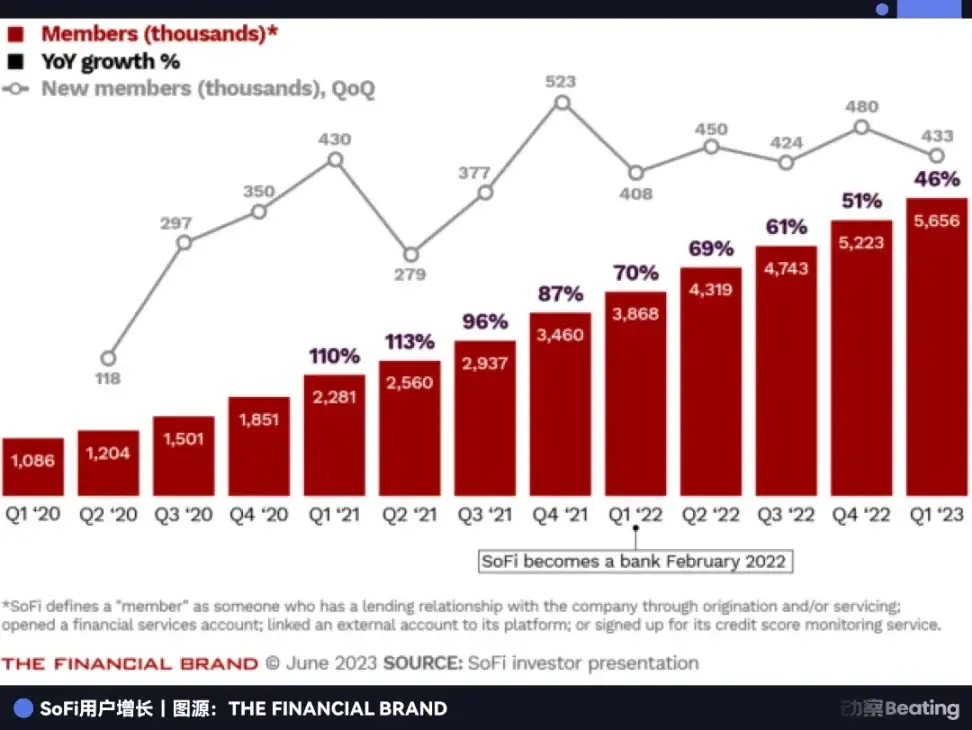
Financial report data clearly shows this change, with deposits soaring from $1.2 billion in Q1 2022 to $21.6 billion by the end of 2024, an 18-fold increase in two years. It transformed from a large-scale wealth management platform into a medium-sized national bank. By Q3 2025, the company's net income reached $962 million, a nearly 38% year-on-year increase.
The lowest cost is the highest barrier. While other FinTech companies are still struggling with expensive financing costs, SoFi has already acquired a "money printer" on par with traditional banks. In just two years, it completed the leap from platform to bank, completely outpacing all competitors.
What truly changed the industry landscape was the authority brought by the license. Without a license, crypto business is merely an incremental business for FinTech; with a license, the same business is incorporated into the banking system and becomes a formal service within a compliance framework. These are two completely different forms of discourse power.
On November 11, 2025, SoFi dropped a bombshell in the market, announcing that it would reopen cryptocurrency trading services to its retail customers after a nearly three-year pause.
This means that SoFi became the first and only financial institution in U.S. history to hold a national banking license while also offering mainstream cryptocurrency trading.
SoFi is actually creating a brand new financial species. It combines the stability and low-cost funds of traditional banks with the flexibility and imagination brought by FinTech and crypto business. For users, it resembles a "one-stop financial supermarket," where savings, loans, stock trading, and cryptocurrency investments can all be completed within a single app.
Its innovation does not lie in inventing something new, but in merging two seemingly opposing systems—banking and crypto—into a coherent whole. Wall Street analysts have been generous with their praise, believing that what SoFi is now showcasing is the closest combination to the ultimate form of FinTech.
From this perspective, the proactive abandonment of the crypto business in 2022 was, in fact, a well-thought-out retreat to advance. At that time, it relinquished short-term growth in exchange for the industry's most scarce trump card. And when it returned to the table in 2025, no one was its opponent.
Counter Consensus
Traditional bank stocks on Wall Street are generally sluggish, with price-to-earnings ratios hovering between 10 and 15 times. In contrast, SoFi's price-to-earnings ratio is as high as 56.69 times, with the market valuing it not as a bank but as a tech company.
This is SoFi's greatest achievement: it is both a bank and does not operate like one.
Over the past fifteen years, the grand narrative of the entire FinTech industry has been about using technology to disrupt traditional banks. Coinbase talks about enabling everyone to trade cryptocurrencies; Robinhood discusses a commission-free trading revolution; Stripe focuses on making payments extremely smooth.
But SoFi's story is entirely different; it says, we want to become a bank first, and then, using the identity of a bank, do what others cannot do.
The "compromise" and "surrender" of 2022, when looked back upon three years later, was precisely the most radical innovation.
Now, SoFi's story has reached its climax, but it is far from its conclusion. After SoFi has become the only "crypto bank," where will its next battlefield be? Will it continue to expand its loan scale, delve deeper into crypto business, or leverage this unique identity to explore possibilities we cannot yet foresee?
This company started from P2P, pushing forward in the cracks of regulation, and now stands in a position that the entire industry has never imagined.
In the beginning, no one would associate SoFi with the term "crypto bank"; by 2025, no one could predict its next fifteen years.
 Risk warning Risk warning


Popular articles





