








Morning News | Total market value of stablecoins exceeds $306.7 billion; HumidiFi announces token economic model; Grayscale indicates Bitcoin may reach a new high in 2026

 Overview of Important Market Events on December 2nd
整理:ChainCatcher
Important News:
- Tom Lee's Fund Analyst: Crypto Has Entered a Two-Month "Risk-Reward Rich" Window
- Musk: $38.3 Trillion "Crisis" Could Trigger Bitcoin Price Surge
- Dark Pool HumidiFi Announces Token Economic Model, 10% Allocated for Jupiter Presale
- Grayscale: Bitcoin May Reach New Highs in 2026, Four-Year Cycle Theory Questioned
- Zhao Changpeng: Predicts More Historical Highs Will Appear Soon, Exact Timing Unknown
- OECD Expects Fed to Cut Rates to 3.25% to 3.5% by End of 2026
- Data: Total Market Cap of Stablecoins Surpasses $30.67 Billion, USDT Market Share Exceeds 60%
What Important Events Happened in the Last 24 Hours?
Tom Lee's Fund Analyst: Crypto Has Entered a Two-Month "Risk-Reward Rich" Window
According to ChainCatcher, Tom Lee's fund analyst Mark Newton stated on November 25, "We are buying cryptocurrencies here and taking advantage of the weak prices to buy low." He believes that from now until mid-January, even into early February, cryptocurrency prices should be higher, and despite short-term market volatility, the next two months present a good opportunity for risk-reward.
Tom Lee retweeted this related content.
It is worth noting that although Mark Newton has made accurate predictions about Ethereum's trends multiple times in the past, since September, his optimistic views on Ethereum have often diverged from actual market trends.
OECD Expects Fed to Cut Rates to 3.25% to 3.5% by End of 2026
ChainCatcher reports that according to Jinshi, the OECD expects the Fed to "gradually" lower the key interest rate to 3.25% to 3.5% by the end of 2026.
Data: Total Market Cap of Stablecoins Surpasses $30.67 Billion, USDT Market Share Exceeds 60%
ChainCatcher reports that data from the DefiLlama website shows that the total market cap of stablecoins has surpassed $30.67 billion, currently at $30.6775 billion, with a 7-day increase of 0.87% (an increase of about $2.639 billion). Among them, USDT's market share reached 60.17%, with a market cap of about $18.4572 billion; USDC ranks second with a market cap of $7.6982 billion, with a 7-day increase of 3.62%. Additionally, USDe, USDS (Sky Dollar), and DAI rank third to fifth in market cap.
"Big Short" Michael Burry: Bitcoin Reaching $100,000 is "Absurd," It's Worthless
ChainCatcher reports that according to Business Insider, "Big Short" Michael Burry criticized Bitcoin again in a podcast aired on Tuesday.
Burry stated in the program, "I think Bitcoin at $100,000 is the most absurd thing," describing the cryptocurrency as "worthless." He also pointed out that Bitcoin is "worse than tulip bulbs because it enables so much criminal activity."
This is not the first time Burry has criticized cryptocurrencies. In 2021, he warned that Bitcoin was a "speculative bubble," with risks outweighing opportunities.
Zhao Changpeng: Predicts More Historical Highs Will Appear Soon, Exact Timing Unknown
ChainCatcher reports that Binance founder Zhao Changpeng posted on social media, stating: "I predict: more historical highs will appear soon. I just don't know the exact timing."
Musk: $38.3 Trillion "Crisis" Could Trigger Bitcoin Price Surge
ChainCatcher reports that according to Forbes, Elon Musk warned again that the U.S. is heading towards a debt crisis, which could significantly drive up Bitcoin prices. Musk stated in an interview, "Bitcoin is based on energy; you cannot legislate energy," and predicted that in the future, "money as a concept will disappear," with energy becoming the only "real currency."
Currently, U.S. debt has exceeded $38.3 trillion, and Musk pointed out that the U.S. money supply has increased significantly, with an annual deficit of about $2 trillion. He predicts that the development of artificial intelligence will drive the output of goods and services beyond the inflation rate within three years, potentially leading to deflation and interest rates approaching zero.
Musk: AI Stocks Favor Nvidia and Google
ChainCatcher reports that Musk said in a Sunday episode of the "People by WTF" podcast, "AI and robotics will become very important. The output of goods and services brought by AI and robotics will far exceed everything else." When asked which stocks he would invest in at the current price level, he named two: Google's parent company Alphabet (GOOGL.O) and Nvidia (NVDA.O).
Musk stated that Alphabet "has already laid the groundwork for creating tremendous value from an AI perspective." Last month, the company launched the highly praised Gemini 3 AI model, and Google's chips have also received increasing acclaim. Nvidia is an "obvious" choice, as it remains the dominant player in the AI space, collaborating with almost all major players in the industry.
Beyond AI and robotics, Musk also mentioned that companies engaged in "spaceflight" are also worth watching as potential investment targets. His private company SpaceX leads the launch industry, although some listed companies, including Rocket Lab, are seeking to challenge its dominance.
Dark Pool HumidiFi Announces Token Economic Model, 10% Allocated for Jupiter Presale
ChainCatcher reports that the Solana ecosystem dark pool project HumidiFi announced today the economic model for its token WET. The total supply of WET is 1 billion tokens, with the following specific allocations:
10% allocated to the presale activity on the Jupiter DFT platform, with 6% allocated to the whitelist for the HumidiFi ecosystem, 2% to JUP stakers, and 2% for public sale. All presale shares have no lock-up restrictions.
40% allocated to the foundation, with 8% unlocking at TGE.
25% allocated to the ecosystem, with 5% unlocking at TGE.
25% allocated to the team, with no token unlocking at TGE.
Grayscale: Bitcoin May Reach New Highs in 2026, Four-Year Cycle Theory Questioned
ChainCatcher reports that according to Grayscale's latest report, the 32% pullback of Bitcoin since early October is in line with historical averages, marking the ninth significant pullback in the current bull market. Grayscale believes that Bitcoin may not enter a deep cyclical downturn and expects its price to reach new highs next year, questioning the applicability of the four-year cycle theory.
The report notes that this bull market has not seen the parabolic rises seen in past cycles, and the market structure has changed, with funds primarily flowing in through exchange-traded products (ETPs) and digital asset trusts (DATs), rather than retail trading. Additionally, privacy-focused cryptocurrencies have performed well, with Zcash rising 8%, Monero increasing by 30%, and Decred soaring by 40%. Meanwhile, the first ETPs for XRP and Dogecoin have begun trading.
Grayscale also mentioned that the Fed may cut rates again at its meeting on December 10, and progress in bipartisan crypto legislation in the U.S. is expected to provide more positive news for the market. Although short-term market volatility remains, Grayscale holds an optimistic view on the crypto market outlook for 2026 and emphasizes the importance of long-term holding.
Chinese Shanxi Court Uncovers USDT Fraud Case, Two Accomplices Heavily Sentenced
ChainCatcher reports that the Taiyuan Wanbailin District Prosecutor's Office in Shanxi Province, China, recently announced the first-instance verdict for Chen and Li, who were prosecuted for concealing and hiding criminal proceeds. The court accepted the sentencing recommendation from the prosecution, sentencing the two to two years and six months and one year and six months in prison, respectively, along with fines.
In May of this year, Ms. Zhang met "Lin Hao" (who has not been apprehended) on a short video platform, who falsely claimed to have information on the stock price fluctuations of a well-known company and could profit by registering an account on the company's internal website to "buy long," but needed to trade in U.S. dollars and exchange cash for U.S. dollars with designated merchants, then transfer it to his comrade's U.S. dollar account, which would then be transferred to the company's account. On May 21, Ms. Zhang followed "Lin Hao's" instructions and brought 1.47 million yuan in cash to a hotel in Wanbailin District to prepare for the dollar exchange. Under the direction of their superior, Chen and Li went to connect with Ms. Zhang. Ms. Zhang forwarded the U.S. dollar account provided by "Lin Hao" (which was actually the scammer's Tether account) to the superior through Chen, who then transferred 202,328 Tether (equivalent to about 1.47 million yuan) to that account in three installments. Chen and Li then handed over the 1.47 million yuan in cash received from Ms. Zhang to their superior. However, "Lin Hao" did not transfer the funds to Ms. Zhang's account at the company as agreed, and Ms. Zhang reported the fraud after realizing she had been scammed.
The prosecuting attorney reviewed the case immediately and consulted with investigators, proposing a core investigation direction based on the actions of suspects Chen and Li: to retrieve chat records to secure evidence that the two "knew the funds were abnormal"; to clarify the flow of funds through data from virtual currency trading platforms, tracing the final destination of the Tether to confirm their role in assisting the transfer of criminal proceeds. After investigation, the police transferred the case to the Wanbailin District Prosecutor's Office for review and prosecution on August 17. The office found that both Chen and Li confessed to "knowing that the fund operations were too concealed and involved large cash transactions, which definitely had problems," and that the two received a 30,000 yuan kickback afterward, which was sufficient to determine that they knew it was criminal proceeds; their actions of assisting in the "cash → U.S. dollars → Tether" cross-border conversion constituted "concealing and hiding criminal proceeds."
After the verdict, the office issued a risk warning letter to relevant units, outlining the typical characteristics of "investment scams + virtual currency money laundering," and collaborated with anti-fraud centers and other relevant units to carry out anti-fraud publicity activities. Wanbailin District Prosecutor Sun Yinping stated that in response to new types of telecom network fraud-related crimes, the office will continue to deepen the "investigation-prosecution collaboration + precise prosecution + social governance" mechanism, aiming to combat fraud while severely punishing "accomplices" to protect the property safety of the public.
U.S. Military Sees Investment Boom, Tech Stocks and Cryptocurrencies as Main Investment Directions
ChainCatcher reports that according to The Wall Street Journal, a strong investment culture is sweeping through the U.S. military. From tech stocks to cryptocurrencies, military bases are becoming a unique "investment club."
The report states that this trend is significantly changing the wealth status of military personnel. More and more Porsches and Hummers are appearing in military base parking lots, and social media influencers in uniform are teaching their followers how to get rich. However, this phenomenon is also accompanied by significant market risks, as some military personnel's high leverage and concentrated positions have raised concerns about their financial situations in the event of a market reversal.
The article presents several cases to illustrate the high risks of military investments. The story of Coast Guard petty officer Bryson Saunders is particularly representative. He entered the market after hearing comrades brag about making money on Dogecoin, subsequently investing in Bitcoin and meme stocks like GameStop, candidly stating, "I was trying to punch my ticket."
Navy Major Zach Rodriguez, influenced by peers while cruising the Pacific on an aircraft carrier, invested half of his family's savings (over $100,000) in cryptocurrencies like Chainlink. He has experienced asset surges and suffered a painful loss of $250,000 in cryptocurrency scams. Now, he describes himself as a "bitcoin and chill" investor, holding about $1 million in Bitcoin and related company assets.
The article analyzes IRS data, revealing that the U.S. military played a significant role in the cryptocurrency market cycle from 2020 to 2021. Data shows that in 2021, 11 of the top 25 U.S. ZIP codes with the highest percentage of individuals reporting cryptocurrency receipts or disposals were located near military bases. Some military bases had taxpayer participation rates more than four times the national average.
ChainCatcher reports that the Japanese government has launched its version of the "Government Efficiency Department" (DOGE), which, in its first meeting, established a plan aimed at identifying and eliminating inefficient tax measures and subsidies.
After the first DOGE meeting, Finance Minister Katsuyuki Kitagawa stated to reporters: "By eliminating waste through the efforts of everyone, including the public, and directing funds to areas that truly need them, we will contrast sharply with previous governments. This is crucial for maintaining trust in the nation, our currency, and the market."
Katsuyuki Kitagawa also stated that after Bank of Japan Governor Kazuo Ueda expressed confidence in the economic outlook and hinted at a possible rate hike, she believes there is no discrepancy between the government and the Bank of Japan in their economic assessments. Japan's Economic Growth Strategy Minister Minoru Kiuchi echoed these comments verbatim, indicating that this response was coordinated within the cabinet to convey a consistent support signal. (Jinshi)
U.S. SEC Chair: Cryptocurrency Company Innovation Exemption Will Take Effect in January
ChainCatcher reports that according to market news, U.S. Securities and Exchange Commission (SEC) Chair Gary Gensler stated that the innovation exemption for cryptocurrency companies will take effect in January.
Kraken to Acquire Backed Finance to Promote Tokenization Development
ChainCatcher reports that according to Bloomberg, cryptocurrency exchange Kraken is acquiring a tokenized asset platform, demonstrating its confidence in blockchain stock trading.
In a statement on Tuesday, Kraken announced it would acquire Backed Finance—a platform that issues digital tokens representing real assets, including stocks and exchange-traded fund (ETF) shares. Kraken Co-CEO Arjun Sethi stated in an interview that Kraken has already offered stocks and ETFs issued by Backed and plans to integrate these products more closely into its platform after the acquisition is completed.
Asset Management Giant Tidal Investments Acquires Approximately $60 Million in Strategy Stock
ChainCatcher reports that according to BitcoinTreasuries.NET, asset management giant Tidal Investments has disclosed the acquisition of 351,619 shares of Strategy (MSTR) stock, valued at approximately $60 million.
Meme Popularity Rankings
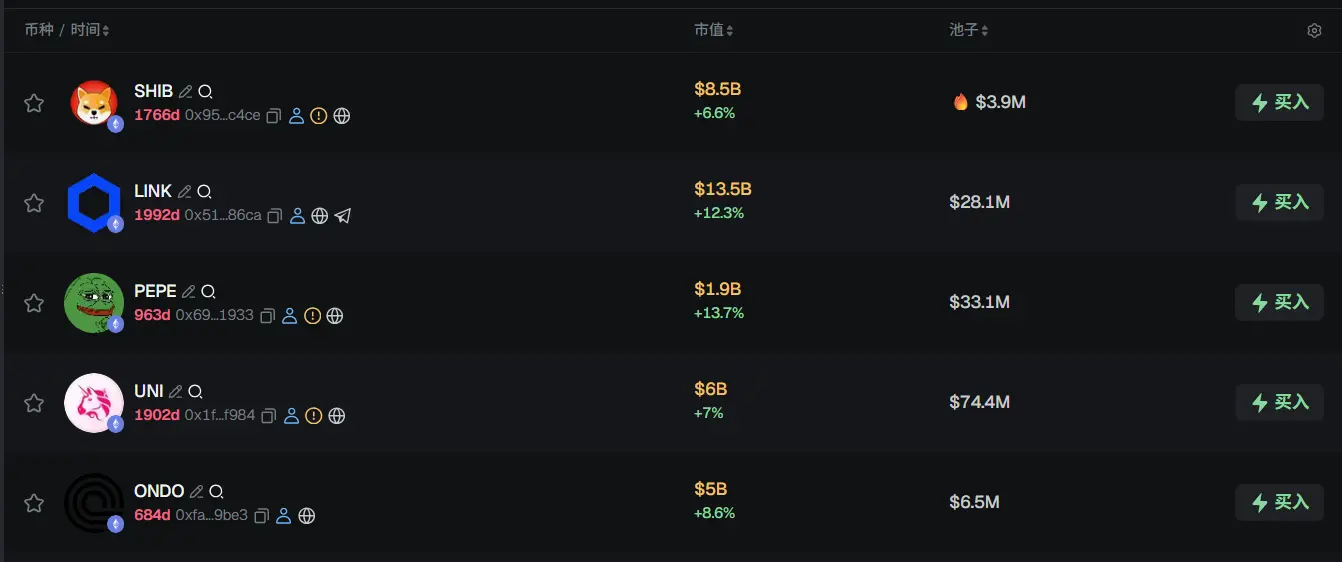
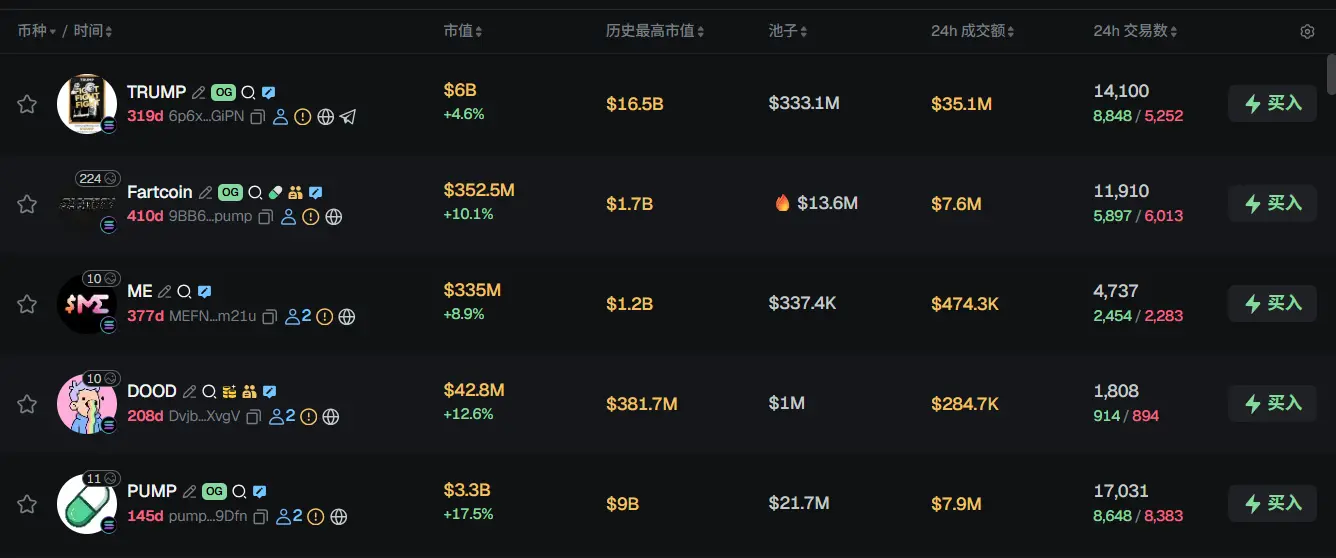
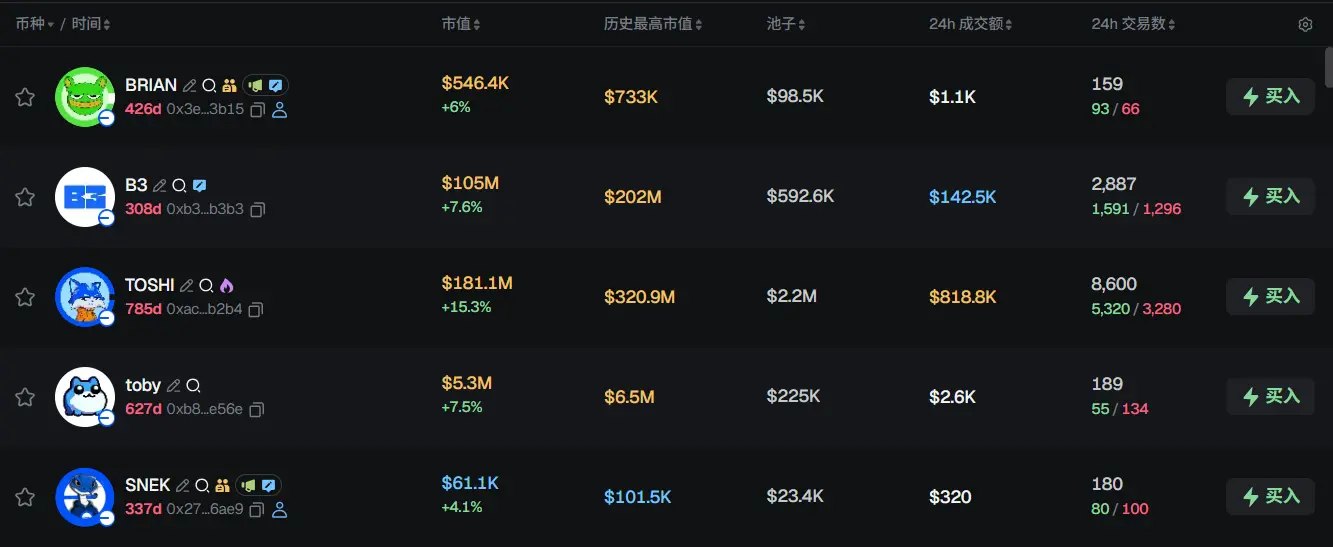
According to meme token tracking and analysis platform GMGN, as of December 3, 09:00,
The top five popular ETH tokens in the past 24 hours are: SHIB, LINK, PEPE, UNI, ONDO
The top five popular Solana tokens in the past 24 hours are: TRUMP, Fartcoin, ME, DOOD, PUMP
The top five popular Base tokens in the past 24 hours are: BRIAN, B3, TOSHI, toby, SENK
What Are the Must-Read Articles in the Last 24 Hours?
MicroStrategy's Plunge Analysis: Facing Four "Death Outcomes"
Recently, MSTR (MicroStrategy) holders are likely losing sleep.
This stock, once hailed as the "Bitcoin central bank," has experienced a bloodbath. As Bitcoin rapidly pulled back from its historical high of $120,000, MSTR's stock price and market cap have significantly shrunk, plummeting over 60%, with the possibility of being removed from the MSCI stock index.
The price pullback and stock price halving are just the surface. What truly makes Wall Street nervous is the increasing signs that MSTR is caught up in a battle for monetary power.
On December 1, Hong Kong licensed digital asset trading platform HashKey passed the Hong Kong Stock Exchange's listing hearing, just a step away from going public. The joint sponsors for this IPO are JPMorgan and Guotai Junan.
Although HashKey has achieved significant revenue growth in the past two years, with rapid expansion in trading volume and customer base, high growth cannot hide the fundamental pressures: continuous losses, long-term negative operating cash flow, and high net debt, leaving its financial resilience before listing uncertain.
Successfully Simulated Theft of $4.6 Million, AI Has Learned to Autonomously Attack Smart Contracts
Leading AI company Anthropic, developer of the Claude LLM model, announced today a test utilizing AI to autonomously attack smart contracts (Note: Anthropic was previously funded by FTX, and theoretically, the equity value could compensate for FTX's asset shortfall, but was sold at a low price by the bankruptcy management team).
The final test result shows that profitable, practically reusable AI autonomous attacks are technically feasible. It is important to note that Anthropic's experiment was conducted only in a simulated blockchain environment and was not tested on a real chain, so it did not affect any real assets.
Buying Opportunity? In-Depth Analysis of "Real Yield" DeFi Tokens
We examined DeFi star projects with "real yield"—Ethena (ENA), Pendle (PENDLE), and Hyperliquid (HYPE)—and posed a core question: while token prices are falling, are their fundamentals still strong, or are the yields themselves under pressure?
The answer is mixed:
- ENA generated huge fees, but almost all fees were recycled to subsidize maintaining TVL, so the protocol's actual "surplus" is minimal.
- PENDLE's fundamentals have deteriorated along with its price. As TVL plummeted to about $3.6 billion, the current sell-off is not a divergence between price and value but a rational market response to business shrinkage.
- HYPE is a massive money-printing machine, with annual revenue exceeding $1.2 billion, almost all of which is used for token buybacks—but its price has already reflected winner expectations and is currently maintaining growth through fee reductions.
 Risk warning
 Risk warning



Popular articles





