








TRON Industry Weekly Report: High inflation sets the tone for long-term easing, the crypto market stabilizes and builds a bottom, detailed explanation of Kakarot enabling seamless transition of EVM chains to ZK
 Core Viewpoint

 The shift in macro policy has been confirmed by the Federal Reserve, and the sentiment and liquidity in the cryptocurrency market remain weak and fragile.
# I. Outlook
1. Summary of Macroeconomic Developments and Future Predictions
Last week, the core changes in the U.S. macro environment were the formal establishment of the Federal Reserve's policy stance and the confirmation of economic slowdown signals. On December 11, the Federal Reserve maintained interest rates as expected, but in its statement and economic forecasts, it clearly acknowledged the trends of falling inflation and cooling employment. The dot plot indicated an overall downward adjustment in future interest rate paths, signaling that "policy is nearing a turning point." Meanwhile, recent inflation and employment data did not show any rebound; although service inflation remains relatively high, it is marginally slowing down, and the labor market continues to cool, making the judgment of "soft landing but slowing growth" more solid.
Looking ahead, the macro focus will shift from "whether to turn" to "when and at what speed to cut rates." After confirming the policy ceiling in the December meeting, as long as subsequent inflation does not show significant reversals and employment continues to weaken, the probability of the Federal Reserve starting to cut rates in early 2026 will continue to rise. For the market, interest rates are no longer the biggest uncertainty; the real variable is the speed of economic decline: if the slowdown is moderate, risk assets are expected to gradually recover; if data weakens rapidly, it may trigger a repricing of recession risks. Overall, the U.S. macro environment has entered an "observation period after confirming the policy shift."
2. Market Movements and Warnings in the Crypto Industry
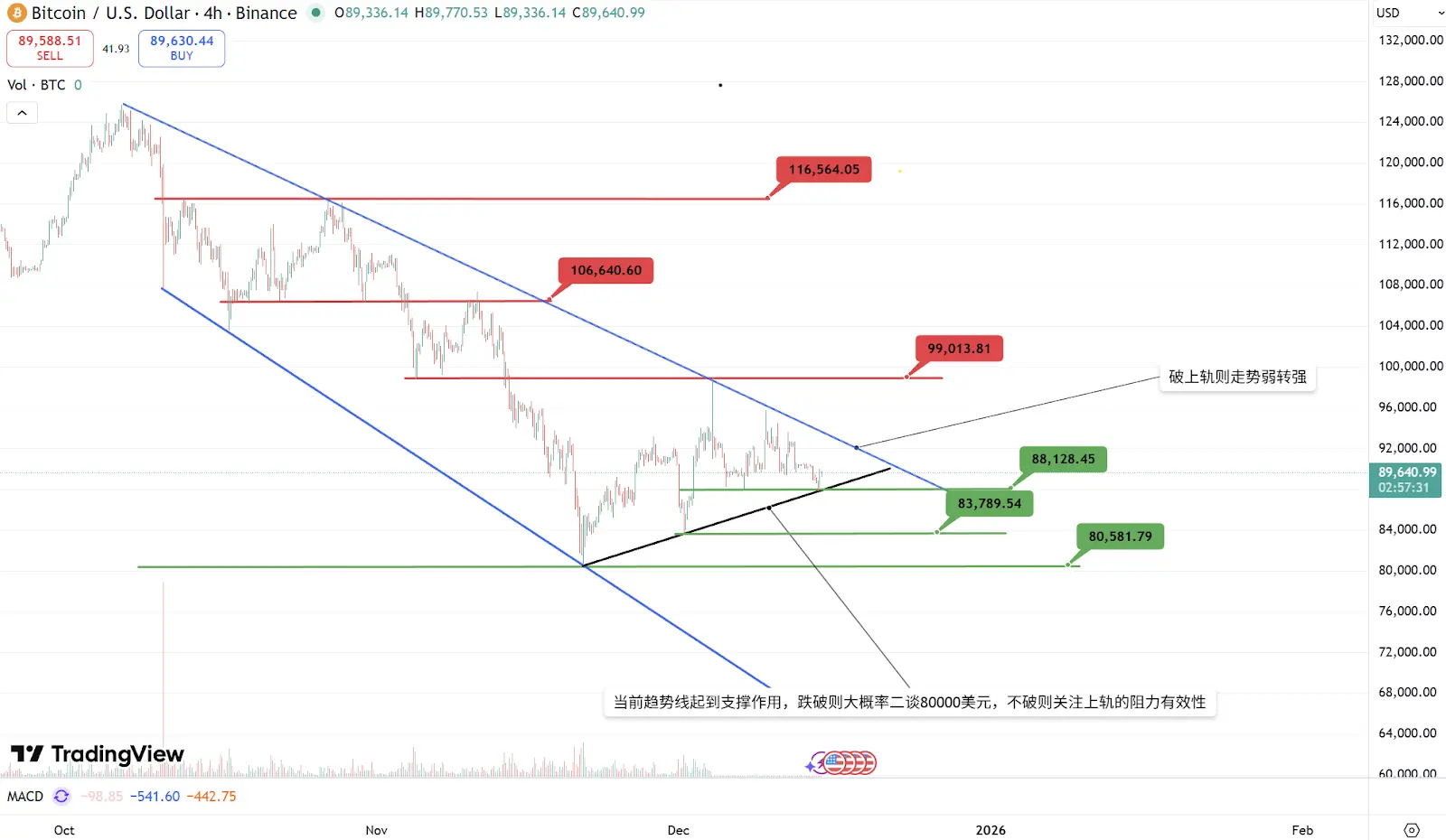
Last week, the cryptocurrency market experienced brief fluctuations after the Federal Reserve's December interest rate decision, but overall it remained weak. Bitcoin showed a spike and subsequent retreat around the announcement of the interest rate decision, failing to effectively stabilize in the $95,000 to $100,000 range, and retreated to low-level fluctuations during the week, indicating that the market did not give positive pricing to the "confirmation of the policy turning point." Despite the Federal Reserve releasing dovish signals, in the context of macro data confirming economic slowdown and risk appetite not yet recovering, incremental funds remain cautious, with limited ETF inflows and persistently low trading volumes. Altcoins overall performed worse than BTC, with most sectors continuing to decline, and the market structure remains defensive.
In terms of warnings, the current crypto market is still in a phase of fragile liquidity and sensitive sentiment. If Bitcoin continues to fail to recover and stabilize above $100,000, the medium-term downward trend will still be difficult to reverse, and the sentiment of "bear market expectations" may further solidify; at the same time, with the year-end approaching and increased institutional settlement and risk convergence demands, short-term volatility may also be amplified. Only when a clearer rate-cutting timetable is seen at the macro level, or when risk assets overall warm up, can the crypto market potentially break out of the current weak range. Until then, caution is still needed regarding the risk of further declines after a weak rebound.
3. Industry and Sector Hotspots
A total financing of $17 million, led by YZiLabs and participated by star VCs such as OKX, zkPass is a zero-knowledge verification network that combines 3P-TLS (three-party TLS) + MPC (multi-party computation) + IZK (interactive zero-knowledge proof); a total financing of $33.55 million, with well-known institutions such as Sui, Beam, and Polychain participating, Bluefin is a decentralized order book-based exchange aimed at professional and first-time traders.
# II. Market Hotspot Sectors and Potential Projects of the Week
1. Overview of Potential Projects
1.1. Brief Analysis of zkPass, which raised a total of $17 million, led by YZiLabs and participated by star VCs such as OKX------A zero-knowledge verification network that securely and verifiably brings Web2 private data into Web3
Introduction
zkPass is an innovative protocol that combines 3P-TLS (three-party TLS) + MPC (multi-party computation) + IZK (interactive zero-knowledge proof). Its goal is to solve the problem of Web2 private data not being reliably brought into Web3:
Users can obtain private data from websites using HTTPS and prove to third parties that "this data indeed comes from a specific website and meets certain conditions" without disclosing the data itself.
In other words:
zkPass = Web2 private data → verifiable → can privately enter Web3 infrastructure
Core Mechanism Overview
In the traditional model:
User → Verifier → Website
This leads to:
User privacy exposure
Websites unable to provide customized verification
Verifiers can see all user data → high privacy risk
zkPass reverses the structure:
Users directly access HTTPS data sources (websites) locally, then generate zero-knowledge proofs locally for verifiers, proving only the conclusion without exposing data.
To achieve this process, zkPass introduces:
3P-TLS: Extending TLS to a three-party protocol (User + zkPass Node + Data Source). The node verifies the authenticity of the data but cannot decrypt the private content.
MPC: Users share a MAC key with the node to prevent data tampering. The node cannot see the content but can ensure that the data has not been forged.
IZK: Users execute assertions on the data (e.g., "balance > 1000") and generate large-scale interactive zero-knowledge proofs.
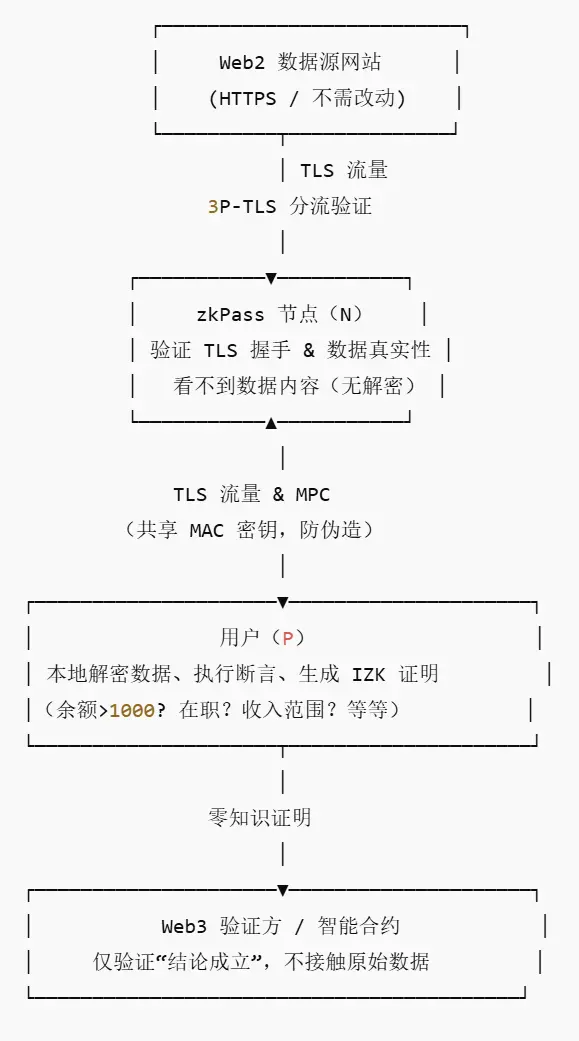
Complete flowchart of zkPass (ASCII clear flow)
2. 3P-TLS (Three-Party TLS)
The white paper describes the complete handshake process of real TLS and transforms it into a three-party version:
Three-party structure:
P (Prover/User)
N (Node)
S (DataSource/Website)
Features:
Users and nodes share a MAC key → Users cannot forge website responses
Nodes do not have decryption keys → cannot read content
Websites still only need ordinary HTTPS, no changes required
This mechanism allows zkPass to be plug-and-play compatible with all internet websites.
3. MPC (Multi-Party Computation)
Used to ensure:
Users cannot forge data
Nodes cannot see data
Session MAC keys are jointly generated by users and nodes
Security is achieved through Oblivious Transfer (OT) and Garbled Circuits (GC)
GC is used to compute the TLS session key (Pre-Master Secret), ensuring that both parties only see their own fields.
4. IZK (Interactive ZKP) Interactive Zero-Knowledge Proof
Due to limited browser memory, large SNARK/STARK is not applicable. Therefore, zkPass adopts:
VOLE-based IZK:
No trusted setup required
Can submit circuits in chunks
Can be generated in the browser
Can handle millions to billions of gate circuits
The phased process of IZK includes:
Preprocessing (random VOLE)
Online proof (circuit step-by-step computation)
Multi-gate verification
Output verification
This solution can run on ordinary user devices.
5. Circuit Factory
zkPass has built a modular circuit system to avoid memory explosion caused by giant circuits.
Includes:
Bristol circuits (basic circuits)
Modular circuits (reusable repeating modules)
Hash verification circuits
JSON parsing optimization circuits (parsing off-chain, verification on-chain)
Assert circuit set (equal/greater than/contains/range assertions)
For example: only need to prove "salary > 5000" without disclosing the specific salary value.
6. Benchmark Performance Comparison
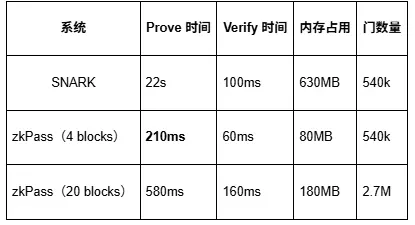
zkPass is over 100 times faster than traditional SNARK, with memory reduced by 80%.
Tron Comments
The core advantage of zkPass lies in its construction of a zero-knowledge proof network that verifies the authenticity of Web2 data without requiring website cooperation, while not exposing any user privacy. Through the combination of 3P-TLS, MPC, and ZK technologies, it balances security, scalability, and a strong coverage of Web2 data, enabling Web3 applications to reliably call real-world data and achieve non-disclosure verification in scenarios such as identity, credit, assets, and behavior. At the same time, the network design is decentralized, auditable, and tamper-proof, greatly enhancing the trust foundation across Web2/Web3.
However, its disadvantages lie in the overall complexity of the architecture and high dependence on cryptographic infrastructure, which may pose challenges in user understanding costs, verification costs, ecological maturity, and adaptability to changes in website TLS in the early stages; additionally, large-scale adoption requires continuous developer education and support from ecological partners.
1.2. Interpretation of Bluefin, which raised a total of $33.55 million, with well-known institutions such as Sui, Beam, and Polychain participating------A professional decentralized order book exchange that reshapes the on-chain trading experience
Introduction
Bluefin is a decentralized order book-based exchange aimed at professional and first-time traders. It focuses on security and transparency and is committed to reshaping the user experience of on-chain trading platforms.
The project has received support and investment from top institutions such as Polychain, SIG, Brevan Howard Digital, and Tower Research.
Architecture Overview
1. Bluefin's Centralized Liquidity Market Maker (CLMM)
This is a cutting-edge protocol aimed at optimizing capital efficiency, deepening market liquidity, and providing a seamless trading experience.
Whether you are a beginner or a professional trader, Bluefin's CLMM can provide you with powerful tools to help you formulate more efficient strategies in decentralized trading.
Main Features
Minimal Slippage:
CLMM is designed to optimize price depth, maintaining stable prices even for large transactions.Real-Time Pricing:
The system provides accurate exchange rates and expected minimum output values before execution.Multiple Token Pairs:
Users can freely choose from multiple token combinations for exchange.
Working Mechanism
In Bluefin, exchanges are not matched through traditional order books but interact directly with liquidity pools:
Users exchange one token for another;
Liquidity providers (LPs) earn fees by injecting funds into the pool;
Transactions are completed instantly within the pool without waiting for order matching.
Unlike traditional models, Bluefin's Concentrated Liquidity Pool allows LPs to concentrate liquidity within specified price ranges and withdraw accumulated fees and rewards at any time without needing to withdraw liquidity.
Fee Mechanism (Swap Fees)
All trading fees are allocated to LPs within active price ranges.
When prices exceed this range, liquidity temporarily becomes "inactive," stopping billing until prices return.
LPs can withdraw fees at any time without exiting funds. This ensures fairness and efficiency in fee distribution.
Price Impact
Refers to the impact of a single transaction on the price of tokens within the pool.
The larger the transaction amount and the shallower the liquidity, the more pronounced the price impact.
CLMM significantly reduces price fluctuations through deeper price liquidity distribution.
Slippage Protection
Slippage is the difference between the expected price and the actual transaction price.
Users can customize slippage tolerance;
if the price deviation exceeds the set range, the transaction is automatically canceled,
to prevent losses due to market fluctuations.
Liquidity Pools
Concentrated Liquidity:
LPs can concentrate liquidity within specified price ranges rather than covering the entire price range (0, ∞), significantly improving capital efficiency. This mechanism is particularly effective for stablecoin trading pairs due to smaller price fluctuations.
Active Liquidity:
Only liquidity within the current market price range is considered "active" and can generate fees. Once prices exceed the set range, that portion of liquidity will pause earnings until prices return to that range.
Fee Tiers:
Bluefin allows multiple pools with different fee rates for the same token pair (e.g., 0.01%, 0.1%, 0.2%) to match assets with different volatility and risk levels.
Stablecoin pools tend to have lower fees.
High-volatility assets adopt higher fees to compensate LP risks.
Price Ticks:
CLMM divides prices into tiny intervals (approximately 0.01% per step). Each Tick is a liquidity range boundary; when prices enter that range, corresponding liquidity is activated. Denser Ticks help achieve high-precision trading and low slippage for stablecoin pairs.
Position NFT:
Each concentrated liquidity position is represented by an NFT, recording the position's
Pool address
Price range
Amount of liquidity. This NFT serves as proof for receiving fees and rewards and is destroyed after closing the position.
Active Liquidity Reward Model:
Bluefin's incentive mechanism distributes rewards based on LP contributions within active price ranges, encouraging LPs to concentrate funds in the most frequently traded price ranges, making the pool's TVL more efficient.
Protocol Fees:
To support Bluefin's long-term sustainability, 20% of the fees from each transaction will go to the protocol treasury to fund platform development, maintenance, and optimization.
2. BluefinX ------ A decentralized RFQ execution network that creates a zero-slippage, low-cost on-chain trading experience
BluefinX is a new product launched by Bluefin, connecting Bluefin's spot CLMM with a group of decentralized execution agents (Execution Agents) through a permissionless RFQ (Request for Quote) system, optimizing trade execution through protocol-controlled auction mechanisms.
Working Principle
In BluefinX, multiple execution agents simultaneously quote users' trade requests, and the system automatically selects the best bid, completing a "mini-auction" off-chain before executing the trade on-chain.
This mechanism ensures that users receive the most efficient and fair exchange results on the Bluefin platform.
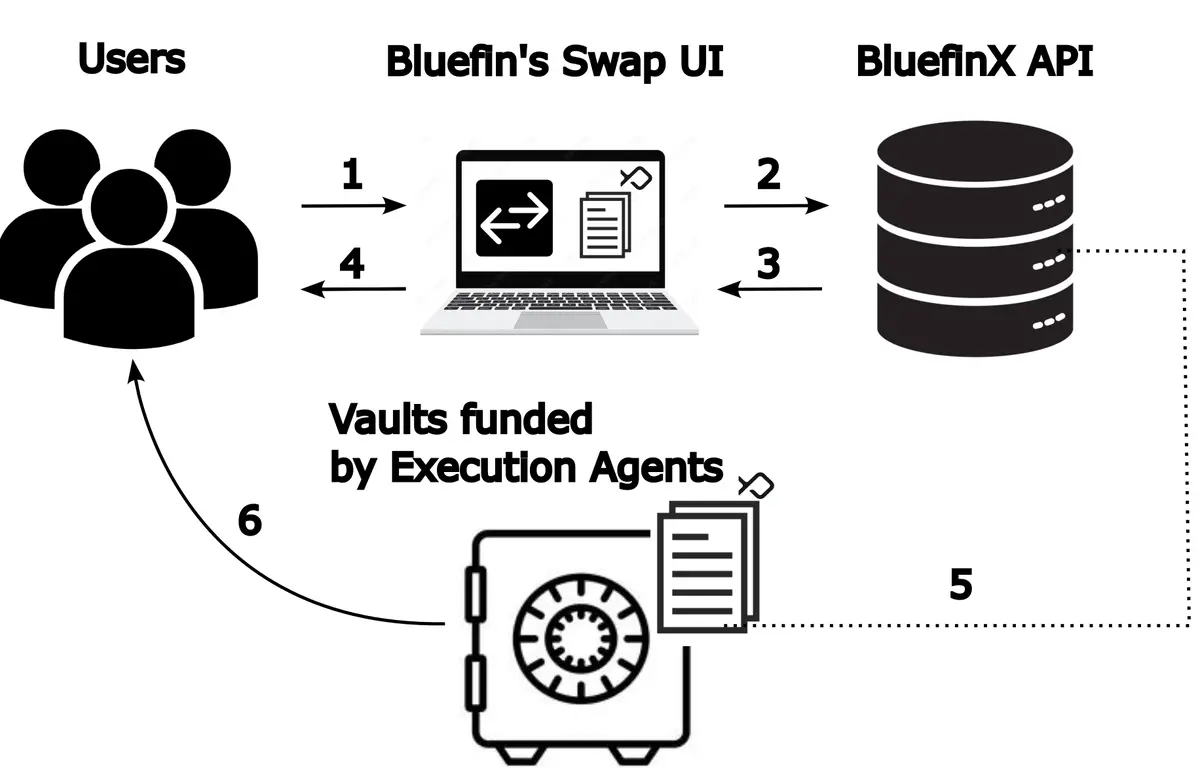
User Experience Advantages
The design of BluefinX ensures that each Swap balances speed and security:
High-Speed Execution: The RFQ process is completed off-chain, eliminating the need to wait for block confirmations.
Zero Slippage: Users can see the final fixed exchange amount before signing.
MEV Protection: Prevents bots from front-running or reordering transactions.
No Gas Fees: All transaction costs are borne by the execution agents.
Best Swap Price: The multi-agent bidding mechanism automatically selects the best quote for users.
Tron Comments
Advantages:
BluefinX, with its RFQ (Request-for-Quote) bidding mechanism at its core, has built a decentralized execution agent network, allowing each transaction to achieve the best price through bidding off-chain. It features zero slippage, MEV protection, and no gas costs, providing users with a smooth experience close to centralized exchanges while maintaining decentralized transparency. By integrating with Bluefin CLMM, BluefinX optimizes liquidity utilization and trade execution efficiency, setting a new standard for high-performance on-chain trading in the Sui ecosystem.
Disadvantages:
BluefinX's complex architecture relies on the activity and reputation of multiple execution agents, which may face challenges in liquidity coverage or quote delays in the early stages. Additionally, its off-chain bidding and API calling mechanisms may have synchronization risks in extreme network environments. As the network scales, the stability of system governance and agent incentive mechanisms will require time to validate.
2. Detailed Explanation of Key Projects of the Week
2.1. Detailed Explanation of Kakarot, which allows any EVM chain to seamlessly transition to ZK, with investments from OKX, Stareware, Foresight, and Bixin
Introduction
Kakarot, developed by KKRT Labs, is a lightweight, efficient, and state-of-the-art ZK-EVM proving engine.
This engine can generate zero-knowledge proofs for Ethereum's execution layer and consensus layer, enabling the "SNARKification of Ethereum," giving it scalability and processing capabilities comparable to Visa.
Kakarot is built on Cairo, a virtual machine (ZK-VM) developed by StarkWare that supports STARK zero-knowledge proofs.
Architecture Overview
Kakarot is a provable EVM built using Cairo, which is a zero-knowledge virtual machine (ZK-VM) launched by Starkware that supports STARK proofs.
Reasons for Choosing ZK-VM
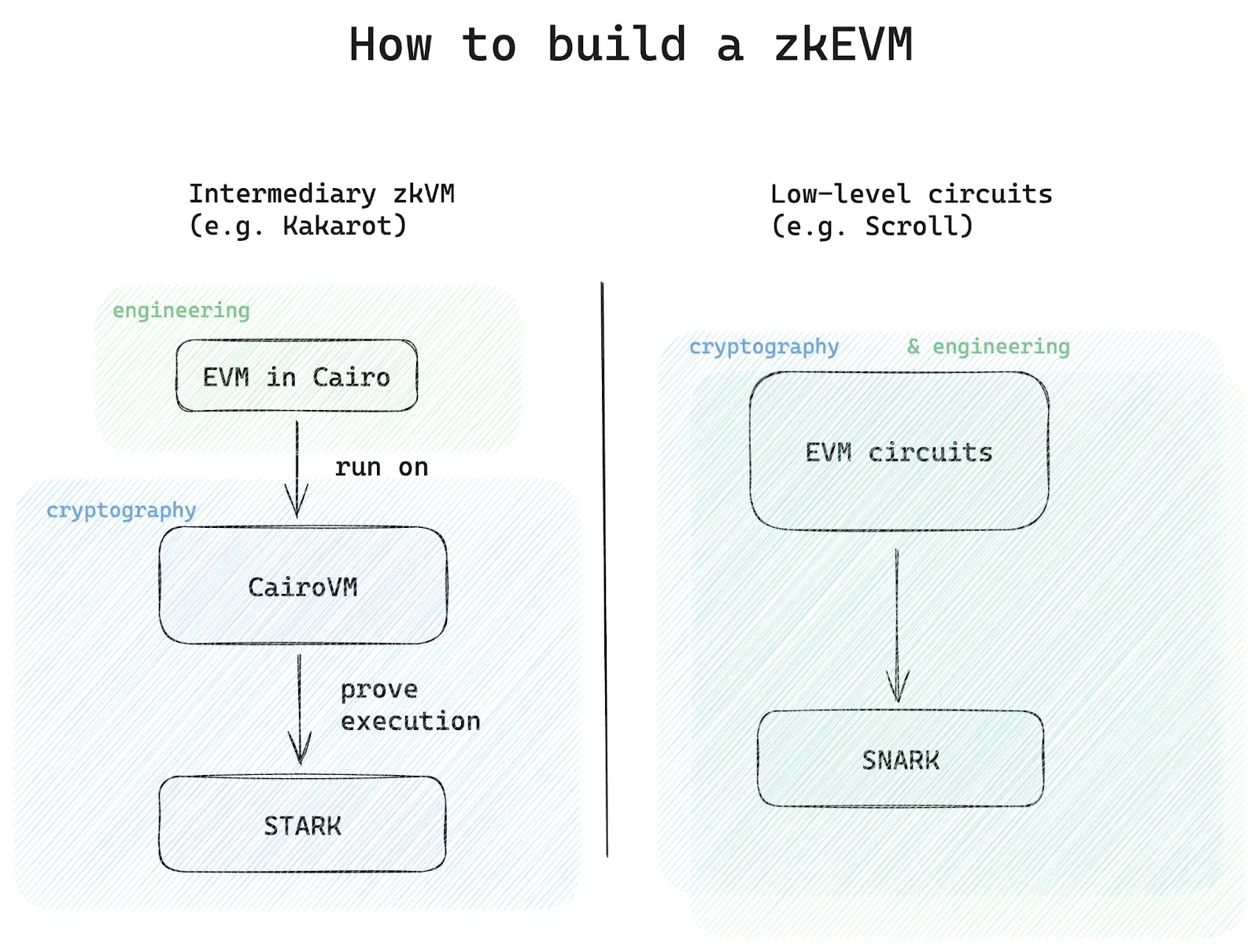
There are mainly two ways to build zero-knowledge applications (ZK-Applications) or zero-knowledge infrastructure (ZK-Infrastructure):
Using ZK-VM (zero-knowledge virtual machine);
Writing dedicated ZK circuits (ZK-circuits).
Differences Between ZK-VM and ZK-Circuit
ZK-VM is a virtual machine that can automatically generate ZK proofs during execution, proving that the computation is correct.
ZK-Circuit is a mathematical modeling of a specific process, breaking down computations into logical operation units, similar to the logic gates of electronic circuits.
From 2022 to 2023, almost all ZK-EVMs (such as Scroll, Linea, ZKSync) were based on ZK circuits. These circuits were built for single tasks, so they initially ran faster.
However, they have significant drawbacks:
High development difficulty;
Complex auditing;
High maintenance costs;
As ZK technology evolves, their performance advantages are being replaced by modern ZK-VMs.
In contrast, ZK-VM is more flexible and can be optimized for different tasks. Developers can develop ZK applications as easily as writing ordinary code and enhance performance by adding built-in modules or specialized opcodes.
These modules can perform low-level optimizations for specific computations, allowing ZK-VM to achieve performance close to or even matching dedicated circuits. As Vitalik stated in his article, this "Glue + Coprocessor architecture" represents a new direction for zero-knowledge computing.
For almost all application layer and infrastructure scenarios, ZK-VM outperforms ZK-Circuit in the following dimensions:
Development speed, maintenance difficulty, audit feasibility, proof costs, and optimization space.
Reasons for Choosing CairoVM
CairoVM, released in 2020, is the first Turing-complete ZK virtual machine. It made it possible to develop ZK infrastructure by writing code (Cairo language) rather than building circuits.
Cairo is a provable domain-specific language (ZK-DSL), meaning all programs written in Cairo can be verified through STARK proofs and can also be compatible with other proof systems supporting Cairo assembly in the future.
The Rise of the RISC-V Ecosystem
Recently, RISC-V-based ZK-VMs have gained attention because they can support common languages (such as Rust), lowering the learning threshold for ZK development.
However, we believe that CairoVM still has a decisive performance advantage:
CairoVM is better at arithmetic operations;
RISC-V is more focused on bitwise operations.
Given that STARK and most finite field encryption mainly rely on arithmetic operations, we believe CairoVM will maintain its leading performance in the medium term.
Key Metrics for Measuring ZK Capability
In the ZK field, how quickly a team can "prove existing software" is a core competitive advantage.
For example:
To make an existing Ethereum execution engine (such as revm) provable, ideally, the migration should be completed in a few days. The development efficiency and flexibility of CairoVM make this goal achievable.
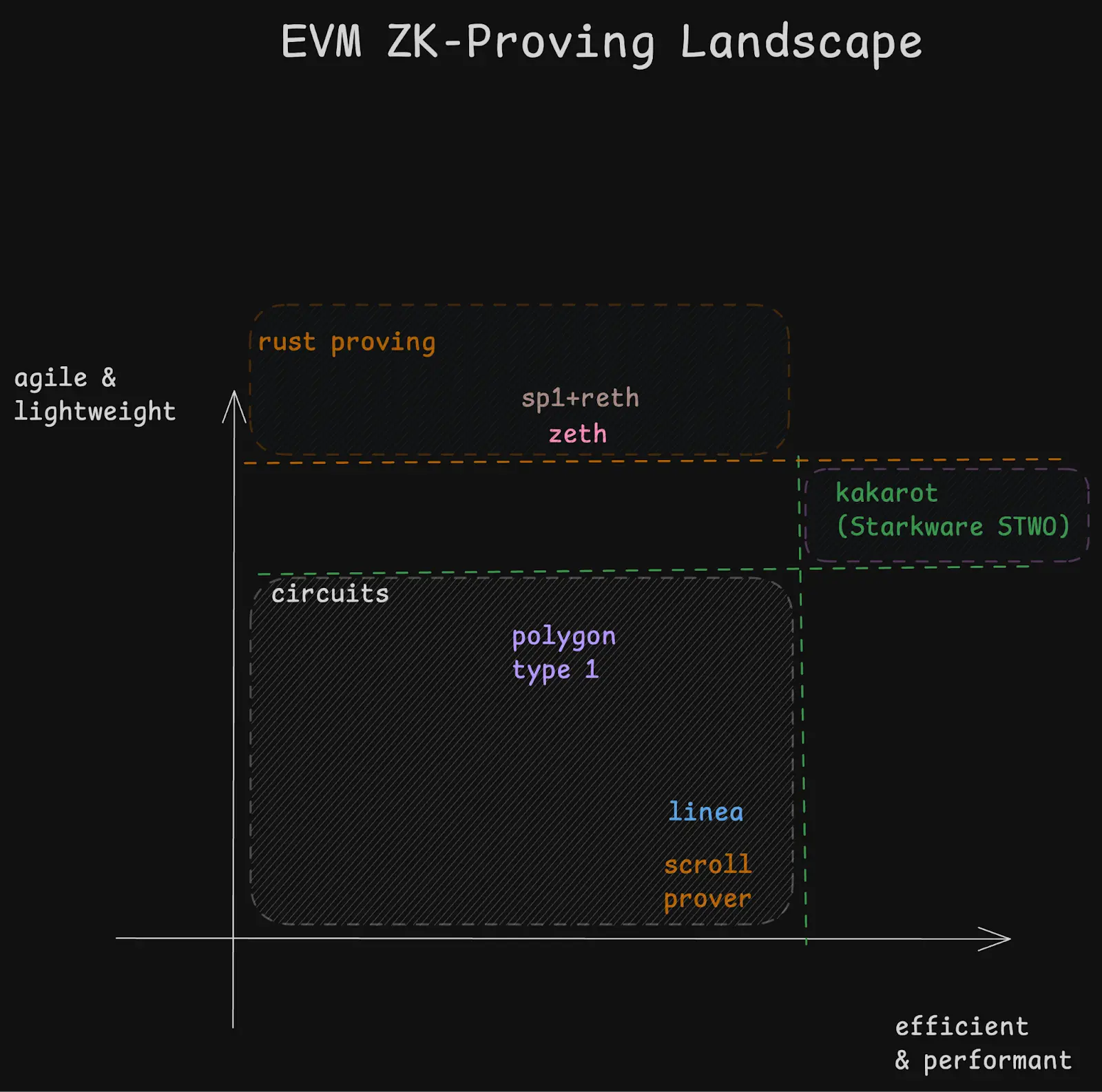
Kakarot: Seamlessly Transitioning Any EVM Chain to ZK
Kakarot can generate zero-knowledge proofs (ZK Proofs) for all Ethereum-equivalent chains, allowing any EVM chain to easily transition to a zero-knowledge architecture (ZK), significantly enhancing scalability while ensuring security.
This service is called Keth ------ a chain-agnostic EVM proof service that supports real-time proof generation.
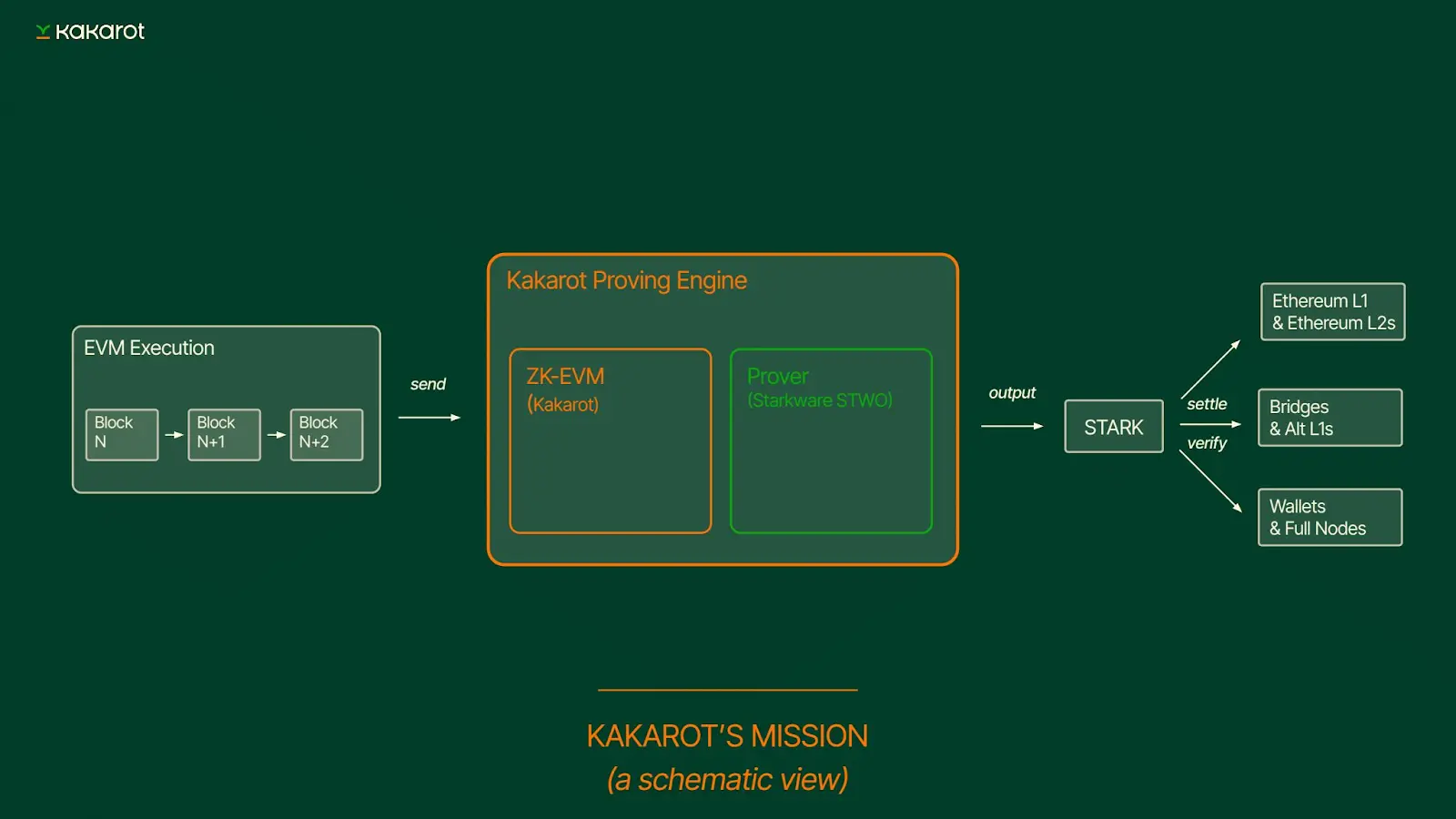
Through Keth, Kakarot aims to bring critical value to the entire Ethereum ecosystem:
Helping Optimistic Rollups smoothly transition to ZK-Rollups;
Strengthening the proof system of existing ZK-Rollups;
Supporting ZK Bridges and ZK infrastructure (such as full nodes);
Promoting the adoption of ZK technology at the Ethereum L1 layer.
Keth: Chain-Agnostic EVM Proof Engine
Keth aims to become a "ZK Proof Powerhouse," capable of "STARKifying" any EVM network.
Main application scenarios:
Assisting Optimistic Rollup in transitioning to ZK-Rollup;
Providing existing ZK-Rollup with a lower-cost, higher-performance proof stack;
Promoting all Rollups to enter Stage 2 ------ supporting multi-proof architecture, Keth will be one of them.
Through Keth, every EVM ZK-Rollup can simultaneously adopt multiple proof systems (such as Risc-Zero, Succinct, Kakarot) to jointly verify network states, ensuring system security and consistency, and avoiding single points of failure.
Towards the Era of "ZK-Everything"
The emergence of Keth is pushing blockchain into a new phase ------ "ZK Everything."
In this system:
All cross-chain bridges, wallets, and full nodes will be driven by zero-knowledge proofs;
The cost of Rollup infrastructure will be significantly reduced;
User sovereignty will be enhanced: users can verify proofs locally without trusting any centralized service provider.
Performance
Early benchmark tests show that the computational speed of the StarkWare STWO proof technology used by Keth can reach dozens of MHz per second, improving performance by several orders of magnitude compared to existing solutions.
Tron Comments
Advantages:
Kakarot, as a modular ZK-EVM built on CairoVM, has significant advantages in being lightweight, efficient, and easy to maintain. It enables more flexible development, auditing, and Ethereum upgrade adaptation through ZK-VM rather than dedicated circuits (ZK-circuits). Additionally, relying on StarkWare STARK technology, Kakarot can continuously enjoy performance improvements in zero-knowledge proofs (e.g., STWO Prover is expected to bring a thousand-fold efficiency increase). Its chain-agnostic proof service Keth further allows any EVM chain to smoothly transition to ZK mode, achieving cross-chain interoperability and secure scalability, thus promoting the future of "ZK-Everything."
Disadvantages:
Kakarot is still in its early stages, relying on the maturity of the Cairo ecosystem and the underlying technological evolution of StarkWare. While its performance and compatibility are strong, it may face competition from RISC-V ZK-VMs in the short term, as well as issues related to insufficient ecological tools and developer resources. Additionally, the complexity of ZK technology and high computational costs remain barriers to promotion in the early stages of adoption.
# III. Industry Data Analysis
1. Overall Market Performance
1.1. Price Trends of Spot BTC vs ETH
BTC
ETH
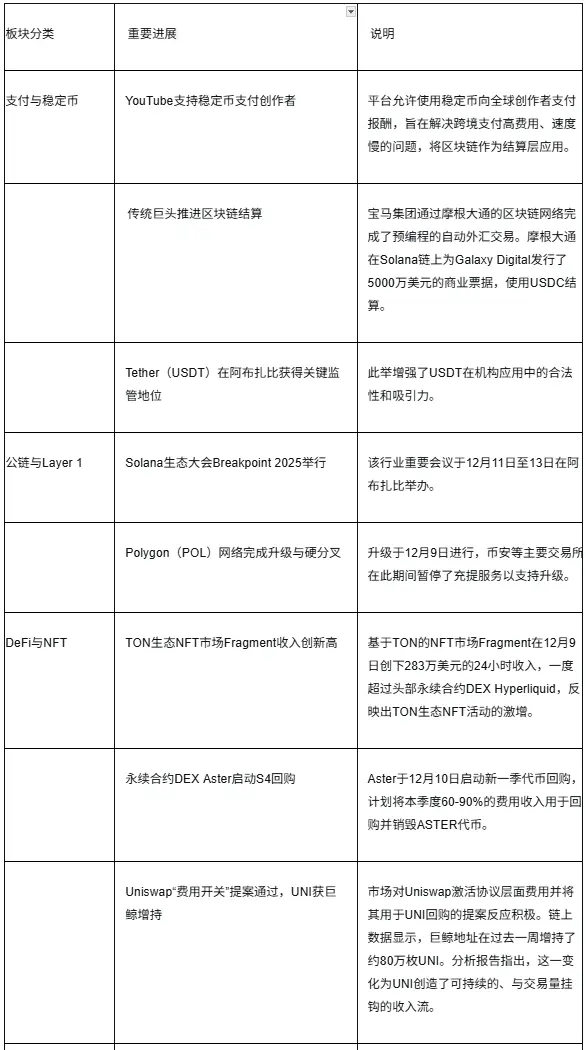
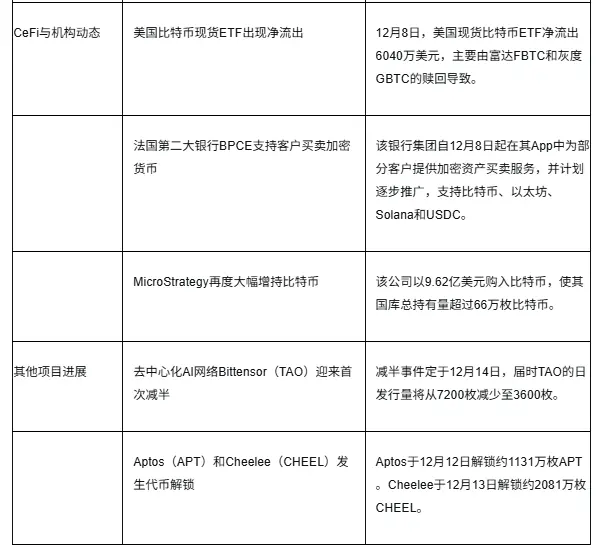
2. Summary of Hot Sectors
# IV. Review of Macroeconomic Data and Key Data Release Points for Next Week
The core information from the Federal Reserve's interest rate decision announced in December can be summarized as "interest rates remain unchanged, but the policy turning point has been formally confirmed." The Federal Reserve held its ground as expected, acknowledging that inflation is falling and the employment market is cooling, and it lowered future interest rate path expectations in the dot plot, releasing a clear signal that the rate hike cycle has ended and the next step will turn to rate cuts. However, the statement and press conference still emphasized vigilance against service inflation and wage growth to avoid the market overly pricing in easing. Overall, this meeting provided a directional "dovish confirmation" for the market but did not give a clear timetable for rate cuts, indicating that policy has entered an observation period, with subsequent pacing highly dependent on the further weakening of economic data.
Important data releases this week:
December 16: U.S. November unemployment rate; U.S. November seasonally adjusted non-farm payrolls
December 18: U.S. November unadjusted CPI year-on-year
# V. Regulatory Policies
United States: Promoting the Application of Digital Assets in Traditional Financial Markets
The U.S. Commodity Futures Trading Commission (CFTC) took a series of measures this week that are seen as "open-minded" towards the crypto market.
Launching a Tokenized Collateral Pilot: On December 8, the CFTC announced the launch of the "Tokenized Collateral Digital Asset Pilot Program for Derivatives Markets." This pilot allows specific non-securities digital assets (including Bitcoin, Ethereum, and stablecoin USDC) to be used as eligible collateral for derivatives trading regulated by the CFTC.
Issuing New Guidelines and Revoking Old Regulations: The CFTC simultaneously released "Regulatory Guidelines for Tokenized Collateral" and revoked the previously issued Advisory Document No. 20-34 from 2020, which had restricted futures brokers from accepting virtual currencies as customer collateral. The CFTC's acting chair stated that this move aims to eliminate "outdated and overly complex" guidance that hinders industry innovation.
European Union and Member States: Implementation and Divergence under the MiCA Framework
The European Union's "Markets in Crypto-Assets Regulation" (MiCA) continues to advance, but there are disputes among member states regarding specific implementation.
Disputes over Regulatory Authority in Poland: The Polish parliament upheld its previous veto of a domestic crypto bill aimed at implementing MiCA. Subsequently, the government submitted a nearly identical bill to parliament again. The core of the dispute lies in the bill's plan to grant market regulatory authority to Poland's financial regulatory body, conflicting with calls from some EU member states for more centralized regulation by the European Securities and Markets Authority (ESMA).
Italy Sets Strict Compliance Deadlines: Italy's market regulator has set strict MiCA compliance deadlines for virtual asset service providers, requiring them to seek authorization or exit the market by December 30, 2025.
Japan: Planning Fundamental Changes to the Regulatory Framework
On December 10, Japan's Financial Services Agency released a comprehensive report outlining plans for significant adjustments to the cryptocurrency regulatory framework.
Shift in Legal Basis: The plan is to shift the legal basis for regulating crypto assets from the current "Payment Services Act" to the "Financial Instruments and Exchange Act." This indicates a shift in regulatory attitude from viewing them as "payment means" to "investment tools," aimed at enhancing user protection.
Supporting Strengthening Measures: The new framework is expected to strengthen disclosure requirements for initial exchange offerings and empower regulatory agencies with stronger tools to combat unregistered overseas platforms, explicitly prohibiting insider trading.
China: Industry Associations Jointly Strengthen Risk Warnings
In mainland China, relevant financial industry associations jointly issued risk warnings regarding virtual currencies this week.
Seven Associations Issue Risk Warnings: On December 12, the China Internet Finance Association, the China Banking Association, and six other national financial industry associations jointly issued a notice reiterating that virtual currency-related businesses are illegal financial activities.
Clarifying Business Bans: They require all member units (including banks, payment institutions, securities and fund companies, etc.) not to engage in or provide any services related to virtual currencies or tokenized real-world assets, including trading, settlement, marketing, etc.
Warning the Public of Risks: They remind the public to stay away from various virtual currency business activities, be wary of fraud risks, and clearly inform that it is also illegal for overseas service providers to offer services domestically.
 Risk warning Risk warning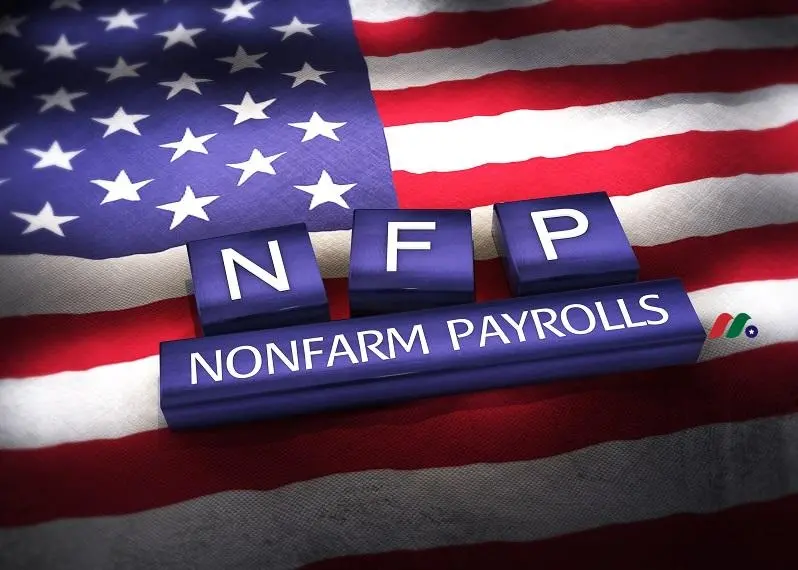




Popular articles





