








Stablecoins: Accelerating to Become Enterprise-Level Payment Infrastructure

At the beginning of January, the head of crypto at Visa mentioned a clear direction of change in the article "Eight Major Evolution Directions of Crypto and AI in 2026": the crypto industry is shifting from being driven by technology and speculation to scalable and practical financial infrastructure.
In this change, the role of stablecoins is particularly typical, evolving from a tool primarily used for trading and speculation to a fundamental component in enterprise-level payment and settlement systems. This transformation is not coincidental but rather the result of real business needs and changes in the global payment structure.
This trend is also reflected in the data. By December 2025, the global market capitalization of stablecoins had reached $310 billion, with the total annual transfer amount on stablecoin networks exceeding $36 trillion, marking a scale that surpasses the combined transactions of Visa and Mastercard for the first time. Additionally, about 13% of global financial institutions and enterprises are already using stablecoins in their daily operations, while over half (approximately 54%) plan to adopt or expand stablecoin capabilities within the next 6 to 12 months.

Why are stablecoins transitioning from speculative tools to infrastructure?
In recent years, the main use cases for stablecoins have concentrated on exchanges, DeFi, and arbitrage activities, with their value primarily reflected in hedging and liquidity intermediation. However, as enterprises deepen their global operations, the structural issues of traditional cross-border payment systems have become increasingly apparent:
Long settlement paths and low efficiency
Uncontrollable exchange rate costs due to multi-currency conversions
Fragmentation of the banking system, leading to significant differences in experiences between regions
High costs for reconciliation, auditing, and fund tracking
Against this backdrop, enterprises have begun to seek a funding vehicle that possesses digital efficiency while transcending geographical and systemic boundaries. Stablecoins precisely fill this gap. The stability of stablecoins is not only about price stability but more importantly: stable settlement rules, stable interfaces, and predictable fund behaviors, which are the attributes most valued by enterprise infrastructure.
When stablecoins move away from speculative scenarios and are integrated into enterprise payment systems, their advantages become very specific:
1. Significant improvement in settlement efficiency
Stablecoins can achieve near real-time transfers globally, reducing intermediary banks and clearing layers, which is particularly important for high-frequency cross-border payment scenarios;
2. More transparent cost structure
Stablecoin payments do not rely on complex correspondent banking systems, allowing enterprises to more clearly estimate fees and arrival times, avoiding hidden costs;
3. Traceable fund flows
On-chain records inherently possess traceability, providing enterprises with higher transparency in reconciliation, auditing, and internal risk control;
4. Stronger system composability
Stablecoins can be directly embedded into existing enterprise payment, accounting, or financial systems via APIs, rather than becoming a fragmented additional account.
These advantages enable stablecoins to begin exhibiting characteristics of infrastructure, rather than merely being a form of asset.
Currently, many enterprises are starting to use stablecoins in a few high-frequency, strong-demand scenarios. For example, using stablecoins for B2B settlements in cross-border trade and global supply chains; paying overseas employees or freelancers; settling income for content creators and partners in different countries for platform-based enterprises; and high-frequency small cross-border payments in businesses such as gaming, advertising, and SaaS.
These use cases all demonstrate that stablecoins are becoming a new underlying channel, rather than replacing a specific bank or payment method.
Why is this highly relevant to the evolution of payment infrastructure?
As stablecoins begin to be used by enterprises for settlement, distribution, and daily payments, their requirements for infrastructure have also changed:
Need to collaborate with existing enterprise payment systems and accounting systems
Need to meet compliance, risk control, and auditing requirements
Need to support multiple usage forms such as cards, accounts, and APIs
This is also why the next stage of stablecoin development is no longer just about issuance and circulation, but about reconstructing the infrastructure around enterprise payment scenarios. In this process, some Web3 innovative infrastructure service providers choose to start from real enterprise needs, viewing stablecoins as a foundational capability module in the payment system, attempting to solve several more fundamental issues around real enterprise payment scenarios:
How to enable stablecoins to work in conjunction with existing enterprise payment systems, card systems, and accounting processes
How to convert on-chain funds into payment capabilities that can be used in daily enterprise operations under compliance conditions
How to make stablecoins a "module" within the enterprise funding system through APIs, rather than an isolated asset
In practical implementation, these issues cannot be solved by single-point functionalities. Taking Interlace's current product structure as an example, its core provides several key capabilities around how enterprise funds are used, distributed, and managed:
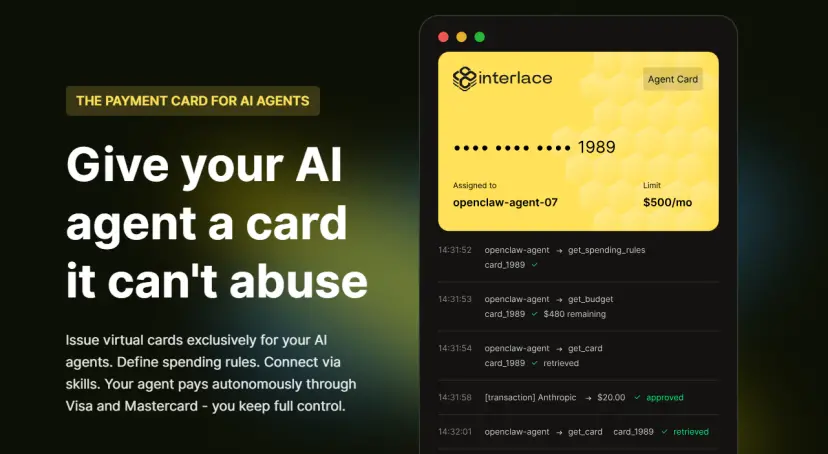
First, the connection capability between stablecoins and enterprise payment forms, i.e., how to convert on-chain funds into capabilities that can be directly used for daily expenditures. Around this point, Interlace offers payment forms including enterprise account systems and card products (virtual and physical cards), allowing stablecoin funds to be used for online payments, subscription fees, supplier settlements, and other high-frequency scenarios without enterprises having to handle complex on-chain operations themselves.
Second, the compliance and risk control structure aimed at enterprise use. Once stablecoins enter the enterprise accounting system, compliance, permission control, and auditing become prerequisites. Interlace incorporates enterprise-level account hierarchy, permission management, and transaction record systems into product design, ensuring that stablecoin funds possess traceable and auditable characteristics during use, meeting internal management and compliance requirements.
Third, the API-based fund operation capability. For platform-based or technology-driven enterprises, the usability of stablecoins largely depends on whether they can be directly called by the system. Through APIs, enterprises can embed stablecoin-related recharge, payment, card issuance, and settlement capabilities into their business processes, making them a module within the funding system rather than an independently existing asset.
This product form is a concrete manifestation of stablecoins transitioning from issuance and circulation to enterprise payment infrastructure.
Conclusion
What stablecoins are experiencing is not a simple application expansion, but a role transformation: from trading tools to enterprise-level financial infrastructure. When the industry begins to discuss the settlement efficiency, system integration capabilities, and scalable use of stablecoins, it indicates that a consensus is forming: their value no longer depends on market sentiment but on whether they can truly support enterprise-level fund flows. This may very well be the most important and certain direction for the evolution of stablecoins in the coming years.
 Risk warning Risk warning


Popular articles





