








Mining Companies' Great Migration: Some Have Already Secured $12.8 Billion in AI Orders
 Core Viewpoint

 Mining companies turn to AI computing power, with no turning back.
Original|Odaily Planet Daily Wenser
In the past decade, Bitcoin mining companies have been the most stable foundation of PoW networks and the cost anchor of the BTC "0-level market." However, this group of industry cornerstones is now collectively turning around, either actively or passively aligning themselves with AI.
On the surface, the direct incentive for mining companies to transform is the continuous increase in mining difficulty and the compression of profit margins by a sluggish market; but the deeper driving force is the extreme pursuit of AI narratives by the capital market—and mining companies happen to possess a batch of real assets that are easiest to transform: electricity, land, cooling systems, data centers, and ready-made data infrastructure, which can be exchanged for AI computing power orders worth hundreds of billions of dollars.
Amid the clamor of multi-model racing, mining companies at the intersection of energy, electricity, computing power, and crypto assets are undergoing an unprecedented yet almost inevitable industry migration.
Some are steady and cautious, while others are forced to turn around and go all in, but one thing is certain: the wind has risen; this is a structural migration from the crypto market to the AI world.
A Hard Battle That Must Be Fought, and a Cake That Is Hard to Refuse
Entering 2026, the real pressure on mining companies has never come solely from price fluctuations, but from structural squeezes: continuously rising difficulty, declining unit revenue, and increasing operating costs.
In the Cold Winter: Selling Coins to Survive and Bankruptcy Liquidation
On February 20, Bitcoin mining difficulty rose by 15% to 144.4T, marking the largest increase since 2021. During the same period, network computing power rebounded from 826EH/s to 1ZH/s, but the hash price fell to a multi-year low of about $23.9 per PH/s. Under the profit compression brought by the 2024 halving, mining companies were forced into cash flow defense mode.
The most symbolic event came from Bit Deer. On February 20, it disclosed that its BTC holdings had dropped to 0, with production and sales completely balanced that week. Although founder Wu Jihan later explained that "current 0 does not mean future 0," the market still viewed it as a reflection of the pressure on mining companies.
The predicament is not unique to one company. In early February, NFN8 Group applied for Chapter 11 bankruptcy protection in Texas, planning to sell all its assets. Documents showed that its core mining site suffered a fire, the leasing burden from a sale-leaseback model, and the cliff-like drop in hash price after the halving directly crushed cash flow. Despite owning multiple mining sites, NFN8's 5,000 mining machines were valued at less than $50,000, while liabilities reached the million-dollar range.
As the environment continues to deteriorate, the response from mining companies has been remarkably consistent—heading towards AI.
A Second Spring: Amazing Profits Behind Huge AI/HPC Orders
For AI giants, computing power data centers are always scarce: traditional construction cycles take 3-5 years, and land, electricity, and cooling costs are high. Mining companies already possess electricity contracts, infrastructure, and operational experience, making them the most realistic recipients during the AI expansion cycle.
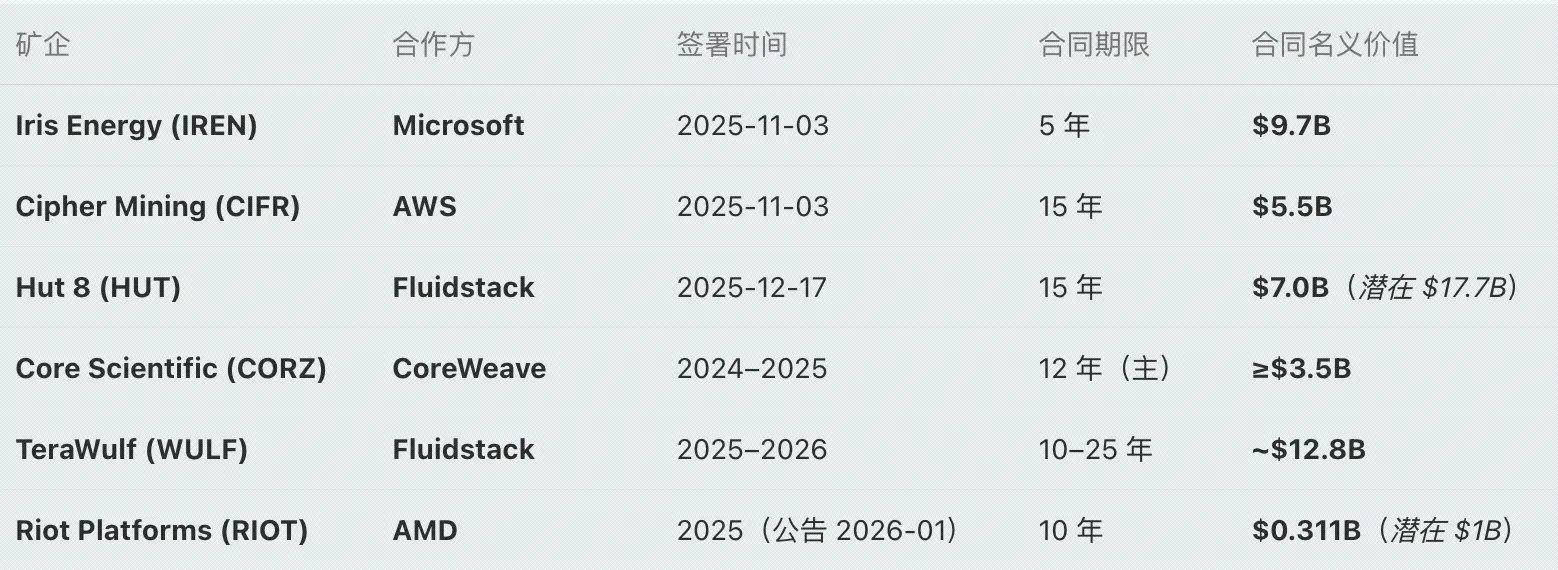
Since last year, mining companies have seen a concentrated explosion of orders. According to publicly available data, as of the time of writing, six mining companies, including IREN, CIFR, and HUT, have accumulated AI/HPC orders totaling approximately $38.5 billion, with TeraWulf and Fluidstack signing a $12.8 billion order contract, and IREN signing a five-year $9.7 billion contract with Microsoft, which has also become an important support for the stock prices of both companies. From financial reports, the proportion of AI/HPC revenue for several mining companies has increased from less than 15% to 40%-60%.
If mining is a cyclical business, AI is like a long-term cash flow pipeline.
Financial Report Consensus: AI Becomes the Keyword
The Q1 2026 financial report season almost sent a consistent signal that mining companies are undergoing systematic transformation.
"HPC Contract Giant" WULF: Holding Over $12.8 Billion in Contracts
Mining company TeraWulf reported a total revenue of $168.5 million for the full year of 2025, a year-on-year increase of 20.3%, of which $16.9 million came from the newly launched high-performance computing (HPC) leasing business.
TeraWulf currently holds over $12.8 billion in HPC contracts, with 522MW capacity already signed and has received $6.5 billion in financing support for data center expansion.
"AI Mining Company Small Giant" IREN: Holding a $9.7 Billion Order from Microsoft
Thanks to previous large orders and rapid transformation, IREN has subtly become a new generation of "AI mining company small giant."
According to the mining company IrisEnergy (IREN) financial report, as of January 31, 2026, it held cash and cash equivalents of $2.8 billion, and has raised over $9.2 billion this fiscal year through customer prepayments, convertible bonds, GPU leasing, and GPU financing. The company plans to add 140,000 GPUs, expecting to achieve $3.4 billion in annual recurring revenue by the end of 2026.
"Trump's Family" HUT: Holding a $7 Billion Order
Mining company Hut8 generated $9.6 million in revenue through hosting services in the 2025 fiscal year, holding approximately $1.4 billion in cash and Bitcoin reserves.
Additionally, Hut8's spun-off mining subsidiary AmericanBitcoin (ABTC) reported a total revenue of $185.2 million for the full year of 2025, deploying computing power of approximately 25EH/s and owning about 78,000 ASIC miners, with BTC reserves exceeding 6,000 coins.
The company is also a major crypto mining company supported by the Trump family, thus attracting significant market attention.
"Brand Transformation Completed" CIFR: Holding a $5.5 Billion Order
Mining company CipherDigital disclosed in its 2025 fiscal year performance report that it has officially changed its name from "CipherMining" to "CipherDigital" to complete its brand transformation.
In November last year, CIFR reached a leasing agreement worth up to $5.5 billion with Amazon Web Services; additionally, it also exchanged 5.4% equity for Google's consent to guarantee the $1.4 billion contract signed with Fluidstack.
"Selling Coins to Buy Land to Build Data Centers" RIOT: Reached Leasing Cooperation with AMD
Mining company RiotPlatforms announced its 2025 annual performance, achieving a total revenue of $647.4 million, a significant increase from $376.7 million in 2024; its Bitcoin holdings exceeded 18,000 coins.
In January this year, RIOT sold 1,080 Bitcoins and used the proceeds (approximately $96 million) to purchase land in Rockdale for data center development. Additionally, the company signed a data center leasing and service agreement with AMD, which will deploy 25 megawatts of critical IT load capacity in the Rockdale park. The aggressive investment firm Starboard Value stated that Riot's potential valuation for its transition to AI and HPC could reach $21 billion.
"BTC Staunch Faction" MARA: Partnering with Capital Institutions to Lay Out AI Data Centers
MARA's financial report data indicated that due to a roughly 14% decline in the average Bitcoin mining price, MARA's revenue for Q4 2025 was $202.3 million, a year-on-year decrease of about 6%. At the end of February, MARA announced a partnership with investment firm Starwood Capital Group to build a large data center for AI and cloud computing clients based on existing mining sites in the U.S. Following the announcement, its stock price surged by about 17% in after-hours trading.
It is worth mentioning that, unlike other mining companies that are firmly transitioning to the AI field, MARA's management emphasized that despite short-term price uncertainties, their long-term confidence in the Bitcoin asset class remains unchanged; Bitcoin will still be the long-term strategic core.
"Data Center Revenue Soars" CORZ: Holding CoreWeave Orders Exceeding $10 Billion
CoreScientific (CORZ) announced its Q4 2025 financial report, reporting total revenue of $79.8 million for Q4 2025, a decrease from $94.9 million in the same period last year. Among them, revenue from Bitcoin mining dropped to $42.2 million; revenue from data center hosting services surged to $31.3 million, up from $8.5 million in 2024. Q4 gross profit rose to $20.8 million, higher than $4.8 million in the same period of 2024.
CoreScientific CEO Adam Sullivan stated that the company's existing construction projects are more than halfway completed and are expanding the hosting platform to a 1.5 gigawatt leaseable capacity pipeline. Last October, AI company CoreWeave planned to acquire CoreScientific for about $9 billion in valuation, but ultimately abandoned the plan due to lack of shareholder approval; in January this year, CoreScientific sold 1,900 BTC (approximately $175 million) for business transformation.
The company estimates that AI business will drive a compound revenue growth of 60.9% from 2026 to 2028, reaching $1.5 billion by 2028.
Other Mining Company Representatives: Bitfarms Rebrands, BitDigital Shifts to ETH Camp
In February, Bitfarms (BITF) announced it would relocate its headquarters from Canada to the U.S. and plans to rebrand as Keel Infrastructure (pending shareholder, exchange, and court approval) to accelerate its transformation into infrastructure. Previously, the company had converted $300 million in debt financing into project financing for data center construction in Pennsylvania and sold the Paso Pe mining site for $30 million in January this year, officially exiting the Latin American market.
On the other hand, BitDigital's shift is more thorough. As early as last July, when the DAT (Odaily Note: Digital Asset Treasury Company) craze emerged, it was the first to announce a shift from BTC to ETH treasury for its listed company; in January this year, it further clarified that it would completely stop Bitcoin mining and instead focus on Ethereum infrastructure, staking, and HPC/AI strategies, marking the formal completion of its camp switch after five years in mining. Currently, its AI subsidiary WhiteFiber has completed its IPO, with BitDigital holding approximately 27 million shares, valued at over $457 million at current market value.
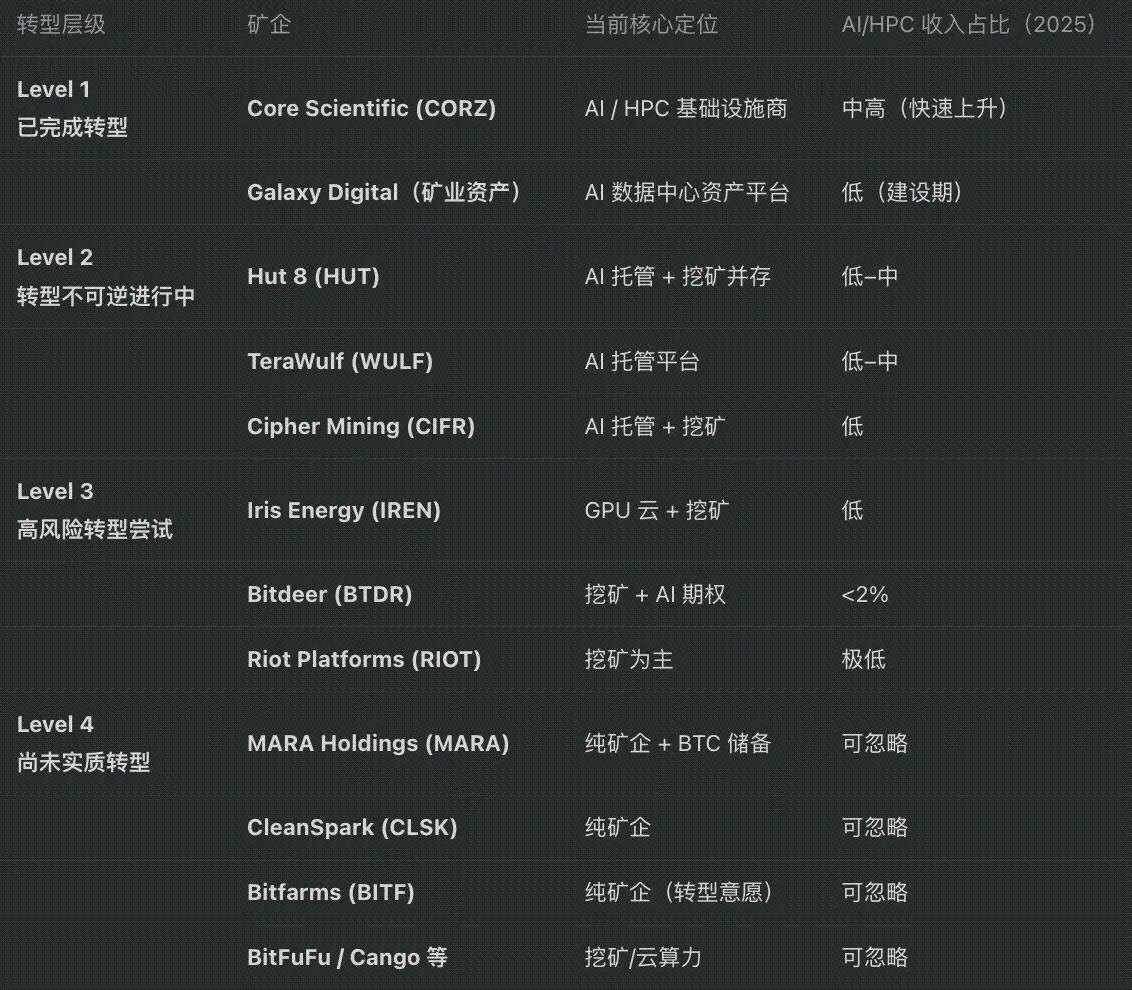
In addition to the above two companies, Galaxy, Bit Deer, Cleanspark, and Cango are still in the process of advancing their AI transformation, with revenue contributions yet to increase. Among them, Cango completed a $10.5 million equity financing in February this year and received an additional $65 million investment commitment, which may accelerate its layout in AI/HPC data center business.
The following is a brief comparison based on publicly available information for reference.
Capital Attitude: Choosing Winners, Not Narratives
The market is not fully accepting the "AI transformation," but rather quickly differentiating.
In early February, JPMorgan pointed out in a report that Bitcoin mining companies performed strongly at the beginning of the year, mainly driven by a temporary easing of network competition and the warming of the HPC narrative. At that time, the total market value of the 14 U.S.-listed mining companies and data center operators tracked by them rose to about $60 billion at the end of January, a quarter-on-quarter increase of 23%, far exceeding the approximately 1% increase in the S&P 500 during the same period.
However, soon after, with the intensive release of a new round of AI models and the impact of OpenClaw on the valuation system of software stocks, market sentiment quickly shifted, and capital began to worry about the structural disruption brought by AI, leading to a pullback in the stock prices of mining companies related to AI infrastructure, with CIFR, IREN, and Hut8 experiencing intraday declines of over 10%.
On February 10, Morgan Stanley released a research report, giving CIFR and WULF an overweight rating while downgrading MARA to underweight.
By the end of February, with order fulfillment and stock price recovery, market sentiment reversed again. Some analysts believe that against the backdrop of a high short position by hedge funds, coupled with mining companies locking in long-term low-cost electricity contracts, their strategic value is no longer limited to traditional mining but is closer to AI infrastructure suppliers.
As orders are fulfilled and stock prices recover, market logic gradually becomes clear: capital only bets on structural winners.
Therefore, the future of mining companies largely depends on three things:
Execution Ability: Can they quickly complete the transition of computing power forms;
Resource Endowment: Do they have scale advantages in electricity and land;
Narrative Ability: Can they embed themselves in the upstream supply chain of AI.
In fact, the decision of a company's transformation is not as important as the capital selection.
The tide has arrived, and mining companies have only two choices: either migrate with the trend or become history.
 Risk warning


Popular articles





