








How was the $900 billion Anthropic formed?
 Core Viewpoint

 Anthropic plans to raise 30 billion to sprint towards an IPO, but the huge computing costs and the risk of valuation inversion have caused early investors to adopt a wait-and-see approach, as the major test of the AI capital super bubble approaches.
Article by Su Yang
Edited by Xu Qingyang
Bloomberg reports, citing informed sources, that the AI startup Anthropic is in early negotiations with investors, aiming to raise at least $30 billion in new funding, with a valuation exceeding $900 billion.
Sources indicate that this round of financing is expected to be completed by the end of May 2026 at the earliest, although the deal has not yet been finalized, and no term sheet has been signed.
If the financing is successful, Anthropic will not only leave OpenAI (valued at $852 billion in March) behind but will also challenge the market capitalizations of tech giants like Apple and Microsoft. It is worth noting that early investors who bet on this company have largely chosen to sit on the sidelines in this round.

Anthropic CEO Dario Amodei. This image was generated by AI.
01 $30 Billion Annual Revenue and 40% Gross Margin
Why can a company see its valuation soar 15 times in just 14 months? The answer seems obvious: growth rate.
According to publicly reported data, Anthropic's annualized revenue skyrocketed from $1 billion in December 2024 to $30 billion by the end of March 2026. This means it has maintained a growth rate of over 10 times for several consecutive years.
Such a growth curve may have no precedent in the history of enterprise software.
Among the top ten companies in the Fortune Global 500 list, eight are clients of Anthropic. Over 1,000 enterprise accounts spend more than $1 million annually on Claude. Notably, its developer-focused coding product, Claude Code, reached an annualized revenue of $2.5 billion by February 2026, just six weeks after its launch in May 2025, with enterprise subscriptions quadrupling in that time.
Based on a valuation of $900 billion and an annualized revenue of $30 billion, the price-to-sales ratio is about 30 times. This multiple sounds extreme, but supporters are betting on the future when calculating. They believe that a company growing at ten times a year cannot be valued in the conventional way. Its pricing logic assumes that by 2028, it can maintain a similar compound growth rate, making the current valuation reasonable in hindsight.
Regarding Anthropic's revenue, its competitor OpenAI has raised its own doubts, suggesting that Anthropic's reported $30 billion annualized revenue uses a total revenue accounting method, meaning that when customers use its models through platforms like Amazon Web Services or Google Cloud, it counts all terminal consumption as revenue and lists the fees paid to cloud platforms as expenses.
OpenAI estimates that after deducting these intermediary costs, Anthropic's true annual revenue is closer to $22 billion. This $8 billion discrepancy is purely a methodological choice, but it will become a focal point for the market and regulators during the IPO.
More concerning than the revenue metrics is the cost.
According to data, Anthropic plans to spend about $19 billion on training and inference computing in 2026, a figure nearly equal to its entire annual revenue. More troubling is that due to inference costs exceeding expectations by 23%, its business's gross margin has been compressed to about 40%, a level far below most mature enterprise software companies.
Anthropic has yet to achieve profitability, with expectations that it will not break even until 2028. For a company valued close to $1 trillion, these financial metrics combined are indeed unusual.
02 Valuation-Driven Arms Race for Computing Power
Why does Anthropic need to raise so much money?
Nominally for development and expansion, but in reality, most of this $30 billion financing is to pay for computing infrastructure it has already committed to but has not yet built. This appears to be a model completely different from traditional tech financing.
In the past, startups raised funds to refine products, expand markets, and then gradually match valuations with growth. But in the AI era, startups need to first raise funds at extremely high valuations to lock in massive future computing power, hoping that this computing power can drive model capability leaps, leading to revenue growth that ultimately justifies that high valuation.
It resembles a debate over whether the chicken or the egg came first.
Now, the cycle of valuation driving computing power commitments, and computing power commitments requiring the next round of higher valuations to pay for them, is being accelerated. Anthropic is the most extreme embodiment of this model.
Once this cycle starts, it is hard to stop. It can elevate a company to great heights or plunge it into an abyss in an instant.
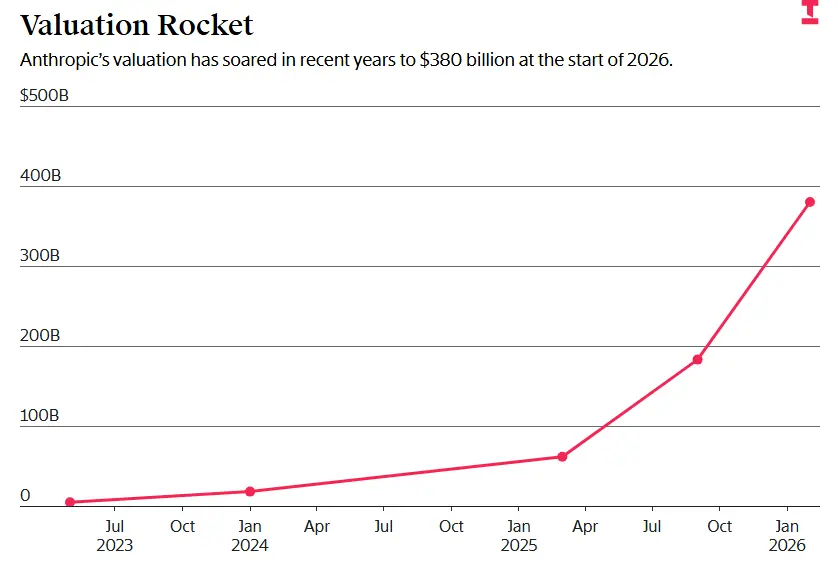
At the beginning of 2026, Anthropic's valuation soared to $380 billion.
Dario Amodei, CEO of Anthropic, stated shortly after the company completed its previous $30 billion financing round that if AI progress were delayed by 12 months, Anthropic would go bankrupt.
For a company valued at $900 billion, the distance between "extraordinary success" and "operational bankruptcy" may be just a few bad quarters.
This tense balance may be the reason why sensitive early investors have largely refrained from participating in this round.
03 Early Investors Taking a Wait-and-See Approach
According to Forbes, some early supporters of Anthropic—those who entered at a valuation of $4.1 billion in 2023 or $61.5 billion in March 2025—have shown little willingness to participate in this round.
The reason is simple: bankers privately expect that if Anthropic goes public as early as October 2026, its public market valuation could fall between $400 billion and $500 billion. This means that if someone invests at a $900 billion valuation in the last private round, theoretically, before the stock is unlocked and cannot be traded, this investment would already be at a loss on paper.
Such a significant discrepancy between late-stage private valuation and expected IPO valuation is extremely rare in the history of tech financing.
It serves as a signal that either the company is severely overvalued in the private market or that the public market will offer a completely different pricing. Either possibility is fraught with uncertainty.
The upcoming decisive event is the IPO itself.
We previously mentioned the key figure behind Anthropic's IPO and financing—the company's financial steward, Krishnan Rao.
The Information reported that at the time, Anthropic's computing power was largely dependent on Google. Rao felt this was unacceptable; one cannot put all eggs in one basket. He promoted a new strategy within the company and among investors: the computing power suppliers must be diversified.
According to The Information, Rao had in-depth discussions about this strategy with one of the investors, Byron Deeter of Bessemer Venture Partners. Deeter later remarked that it was Rao who made the company realize that finding more partners would accelerate growth.
Looking back now, Anthropic's actions have been faster than OpenAI's. They have already signed deep agreements with the three cloud computing giants: Amazon, Google, and Microsoft. At the chip level, they have also incorporated NVIDIA's GPUs, Google's self-developed TPUs, and Amazon's chips, forming a diversified supply network.
But merely signing agreements is not enough; the core issue is to ensure that suppliers can truly deliver the computing resources. Rao led two major deals by the end of 2025: one was a $30 billion investment to use Microsoft's cloud servers to run NVIDIA chips; the other was securing up to 1 million TPUs from Google.
By early April 2026, Anthropic took it a step further, reaching new agreements with Broadcom and Google to secure several gigawatt-level data center power capacities. These actions are no longer just about "purchasing" computing power but are about massively "reserving" future infrastructure.
Since Rao joined, he has helped the company complete multiple rounds of financing totaling $60 billion. By January of this year, the company's valuation had risen to $380 billion.
It can be said that under Rao's strong push, Anthropic's computing infrastructure and financial ammunition have reached unprecedented scales.
04 Is There a Bubble? We Will Know in Six Months
At the current pace, if this round of financing is completed as hoped, Anthropic is expected to seek an IPO between October 2026 and the first half of 2027, with Goldman Sachs, JPMorgan Chase, and Morgan Stanley reportedly discussing this matter.
At that time, the market's focus will no longer be on "Can Anthropic continue to grow?" but will turn into a referendum on the valuation logic of the entire AI industry: over the past three years, has the private market's pricing of AI been correct?
The capital expenditure commitments of super-large enterprises, multi-year computing power reservation contracts, 40% gross margins, the debate between total revenue and net revenue accounting, and the accelerated cycle of "valuation-computing power-revaluation"—all these complex issues that can be blurred in the private market will be placed under the microscope of the public market during the IPO.
If the public market is willing to give Anthropic a valuation of $1 trillion or even higher, then the $900 billion entry price looks like a generous early bet. But if the market only offers $500 billion, then the last batch of private investors will find themselves in a very awkward position.
A third possibility, perhaps more far-reaching, is that Anthropic's IPO will serve as a key data point to validate or falsify the structural assumptions of AI finance.
Everyone remembers Michael Burry, the protagonist of "The Big Short," who recently called out "tech stocks" and "chip stocks" as bubbles in his paid column. If Anthropic's IPO disproves the assumptions of AI finance, it will signal the moment of bubble burst.
Therefore, whether for Anthropic itself or for the entire AI industry that has become accustomed to soaring valuations over the past three years, the pressure test has just begun, and it will soon be given the most real and ruthless pricing by a stock price trend line.
Special contributor Jin Lu also contributed to this article.
 Risk warning



Popular articles





