U.S. bonds, AI, and inflation cannot coexist: Which side is BTC betting on?
 Core Viewpoint

 Washington is likely to choose to maintain the stability of the treasury market and the AI investment cycle, at the cost of allowing inflation to stay high for a longer period. This is a continuous tailwind for both gold and BTC: as it releases liquidity while removing duration risk from the private sector's balance sheets.
Author | Momir @ IOSG
Core Judgment: Washington is likely to choose to maintain the stability of the Treasury market and the AI investment cycle, at the cost of allowing inflation to remain high for a longer time. This is a continuous tailwind for both gold and BTC: as it releases liquidity while removing duration risk from the private sector's balance sheets.
The most critical macro price today is no longer the federal funds rate, but rather the yield that investors are willing to accept to hold long-term U.S. Treasuries.
As of August 24, the yield on the 10-year U.S. Treasury was about 4.70%, and the 30-year yield recently touched around 5.23%, close to a twenty-year high. This upward movement cannot be explained by a single factor. It is a combination of several forces: persistent inflation risks, continuous fiscal supply expansion, thinning marginal buying interest for longer durations, along with a new competitor for funds: AI infrastructure. The result is that investors demand higher compensation to hold long bonds.
To suppress the long end, the Treasury has stated it will at least double the upper limit of liquidity support repurchase operations. Upon the announcement, yields briefly fell but could not hold. This indicates that the underlying supply and inflation issues cannot be resolved with a few billion dollars in repurchases.
Why U.S. Treasuries Are Under Pressure
The Iran war acts as a catalyst on several levels: it drives up oil prices, exacerbates cost pressures, and may suppress real growth and tax revenues. It raises spending expectations: the gap in military supplies has been exposed, and adapting to new forms of warfare requires investment.
AI is a catalyst, but it operates in a completely different way: large-scale investments will boost economic growth and short-term inflation. Overall, this is a good thing because it increases the possibility of "diluting the debt ratio through growth." On the other hand, these investments have a huge appetite for capital, and this demand has begun to spill over into the bond market. Healthy balance sheet mega cloud providers are now competing with the Treasury for funds in periods previously dominated by government.
The Bank for International Settlements estimates that by 2025, the total bond issuance of mega firms will exceed $100 billion, primarily in long durations. An analysis by the Dallas Fed used about $300 billion to represent the investment-grade issuance scale related to AI. After duration conversion, this is equivalent to a maximum of $360 billion in 10-year equivalent duration.
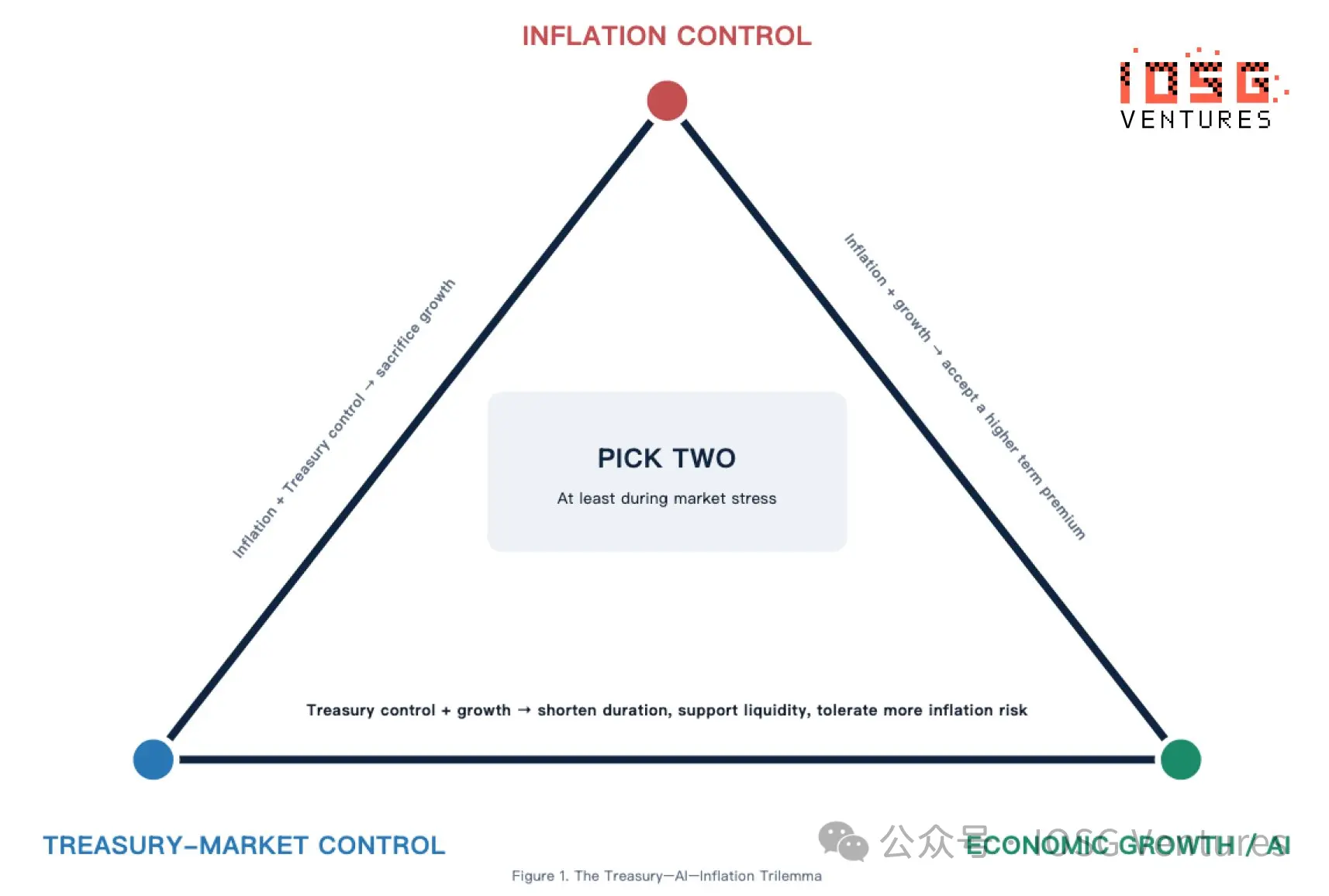
So, in my view, the U.S. is facing a difficult trilemma. It is becoming increasingly clear that strictly controlling inflation is the corner that is politically easiest to sacrifice.
Current U.S. Treasury Secretary Yellen's Response: First, Protect the Treasury Market
Yellen's recent actions show how closely she is monitoring the bond market.
Support the yen, reducing the risk of Japan being forced to sell U.S. Treasuries. Japan is the largest foreign holder of U.S. Treasuries. When it buys yen to support its currency, it needs dollars, and selling Treasuries is one way to obtain dollars: but this would amplify pressure on the Treasury market. Therefore, supporting the yen also reduces the likelihood of Japan selling Treasuries to intervene.
Repurchase the long end with poor liquidity. Repurchase does not equal debt cancellation. If new short-term Treasury bills are used for financing, it changes the maturity structure of government debt: the duration on one end decreases while the short-term notes increase on the other.
Shift issuance towards the short end, which is likely the next step. In 2023-24, the Treasury during Yellen's tenure heavily relied on short-term bills when financing needs surged. Stephen Miran and Nouriel Roubini referred to this practice in a 2024 paper as "aggressive Treasury issuance." Their argument is that the issuance of short-term bills exceeding the conventional path by about $800 billion has withdrawn duration from the market, with effects comparable to "invisible QE," loosening financial conditions roughly equivalent to a one percentage point rate cut; they also accused the Treasury of using this to boost the Biden administration's prospects for 2024. The likelihood of a similar operation being employed by Trump's Treasury is increasing.
If these operations proceed as expected, they could bring a wave of liquidity, reigniting the "currency devaluation trade."
Gold Has Secured a Seat
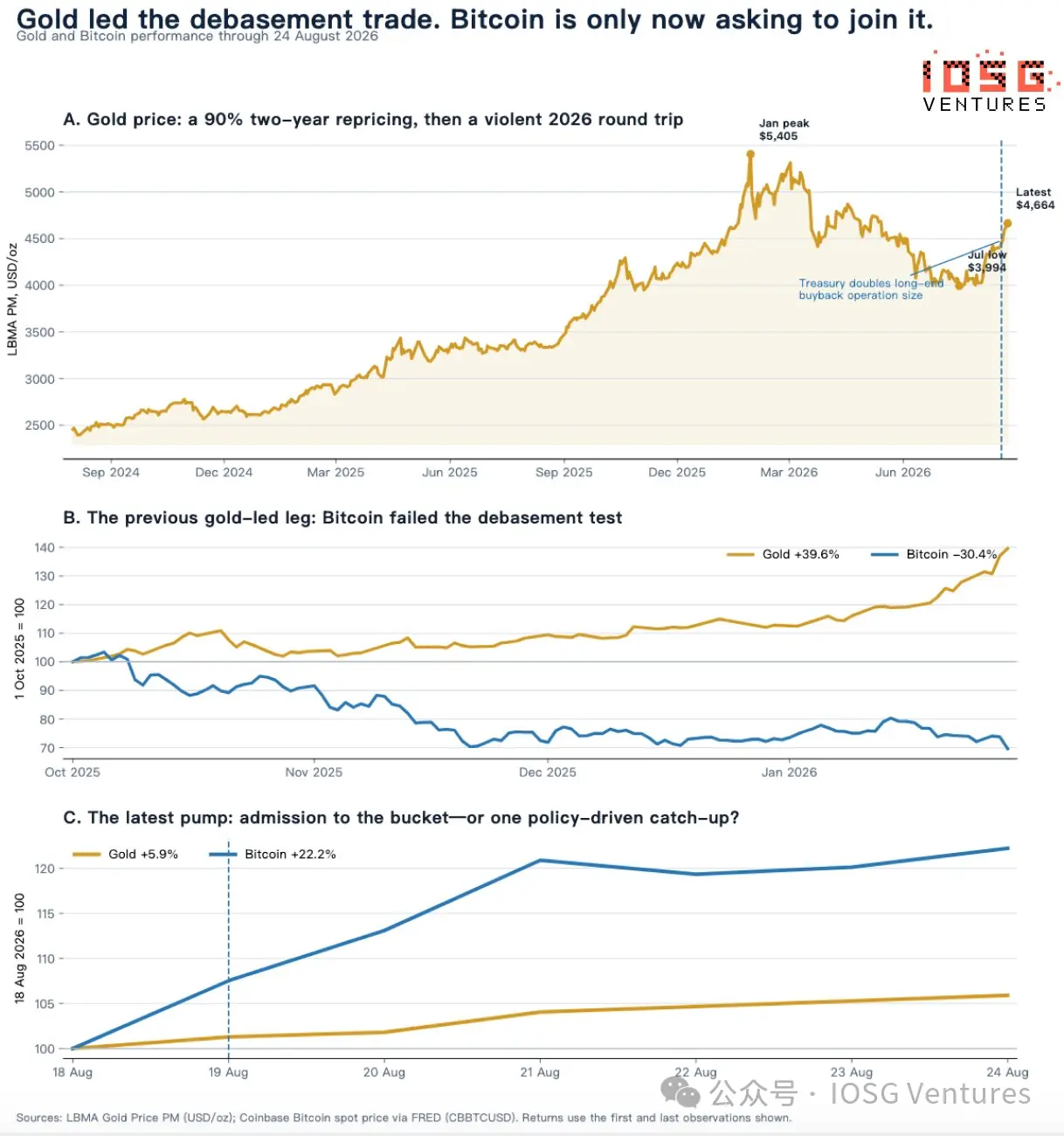
Gold's recent rise is not merely an inflation trade. From August 1, 2024, to August 24, 2026, the price of gold rose from $2,455 per ounce to $4,664 per ounce, an increase of about 90%. The driving factors include: a decline in trust in the dollar after it was used as a policy weapon, persistent inflation concerns, and perhaps the most critical point: the logic of devaluation, expanding the money supply, may be the only politically feasible way out of this debt cycle.
Is Bitcoin Qualified to Enter the "Devaluation Hedge Sector"?
Not yet, but the recent wave has made this question worth serious discussion.
In the last round led by gold, from October 1, 2025, to the peak of gold on January 29, 2026, gold rose by 39.6%, while Bitcoin fell by 30.4%. For an asset that markets itself as "digital gold," this performance is disappointing.
Recent price behavior has changed. From August 18 to 24, Bitcoin rose by 22.2%, while gold rose by 5.9%. This surge began to accelerate after the Treasury increased long-end repurchases. However, Washington was also pushing for crypto legislation that same week, so the attribution is not purely straightforward. If the market views it as an invisible QE trade rather than a pure devaluation trade, then Bitcoin's outperformance makes sense and is more likely to continue: when global liquidity expands, the response of crypto assets is often strong.
Conclusion, and What Possibilities Could Overturn It
This trilemma does not imply that inflation will necessarily spiral out of control, or that formal yield curve control will be implemented immediately. It is merely a framework to clarify where the constraints lie.
If inflation continues to exceed targets, deficits remain around 6% of GDP, and borrowers related to AI continue to increase long-duration supply, then the cost of simultaneously maintaining the stability of the Treasury market and the growth cycle will increasingly manifest as: shorter debt maturities, normalization of liquidity backstops, and tolerance for higher inflation risks. This is favorable for gold and BTC.
Conversely, the scenarios that could weaken this judgment are: inflation falling back to around 2%, Congress presenting a credible fiscal path, AI infrastructure becoming self-financing, or private demand absorbing the issuance of interest-bearing debt without requiring higher duration premiums.
Therefore, the next question for the market should not be "When will the Fed cut rates?" but rather: Which corner of the triangle will Washington let go first? If the Treasury accelerates this duration shift, Bitcoin will face a more sustained tailwind.
 Risk warning




Popular articles