Reg CA is not a switch for issuing tokens in a bull market, but rather a "graduation exam" for existing tokens
 Core Viewpoint

 This set of things is more like a bridge, not a destination.
Authors: Molly & Jeff & Ethan, IOSG
On August 18, 2026, the U.S. Securities and Exchange Commission (SEC) released the proposal for the "Regulation Crypto Assets" (Reg CA). On August 21, the proposal was officially published in the Federal Register, with the public comment period ending on October 20. This rule has not yet been implemented and is still in the opinion collection phase. Core Judgments
Reg CA will not trigger ICO 2.0. Issuing new tokens has become easier, but only for amounts below $5 million. There is a four-year cumulative cap, and the same token can only be used once in a lifetime, with even airdrops counting against the limit. This scale cannot support a market cycle. The SEC's own calculations do not make any assumptions for increased issuance.
The real benefit of Reg CA lies in clearing existing tokens. The safe harbor provisions have no limits on amounts or nationalities, and old projects can also use them: as long as the commitments made in the white paper that year have been fulfilled, a report can be submitted, and the token can shed its securities status. Among over 9,000 tokens globally, the vast majority have never had their legal status formally addressed—this rule governs not who can issue tokens, but who can "graduate."
Reg CA is likely to be implemented, but it will be later and narrower. All three sitting SEC commissioners support it, and the White House has publicly endorsed it, with the chair considering it a signature project during their term. However, the final version will not be available until at least 2027, and the provision excluding state law applicability, which affects the jurisdiction of states, is the most likely to be removed. Reg CA, as an administrative rule, cannot change laws and does not apply to the CFTC. This framework is more like a bridge, not a destination.
I. What exactly is Reg CA? What is driving the introduction of Reg CA? Before focusing on the rule itself, we can first look at the timing of its emergence. The day after the proposal was released, on August 19, Trump met with a group of crypto company executives at the White House—Coinbase, Gemini, Ripple, Chainlink Labs, Kraken, Anchorage, Grayscale, and OKX were all present—publicly urging Congress to pass a "fair version" of the CLARITY Act as soon as possible. In the same week, the CFTC held its first Innovation Advisory Committee meeting. SEC Chair Atkins released Reg CA while calling on Congress to send the CLARITY Act to the president's desk. The market's reaction to cryptocurrencies that week was also very direct. On the day the proposal was released, August 18, Bitcoin was still above $64,000; after the White House meeting on the 19th, it broke $70,000 for the first time since late May; combined with factors like Treasury buybacks, declining long-term yields, and ETF inflows, the highest price during the week reached $77,600, with a weekly increase of about 22%, the largest single-week rise in over two years.
Looking at these events together points to the same judgment: The approach to advancing crypto regulation in the U.S. has shifted from "waiting for Congress to legislate" to "administrative action first"—the White House sets the tone, the SEC issues rules, and the CFTC provides supporting measures, with legislation following behind. Reg CA is the most concrete step in this combination.
The rapid progress of this proposal is directly related to the current personnel structure of the SEC. The committee has five statutory seats, but currently only three are filled, all by Republicans—the last Democratic commissioner, Caroline Crenshaw, left office when her term expired in January 2026. Atkins, Peirce, and Uyeda have all issued statements of support, which is rare in recent significant rule-making, indicating that the checks on this rule will mainly come from outside the agency.
Will it ultimately become a formal rule? Our judgment is: the probability is not low, but the timing will be later than the market expects, and the content will likely be narrower than the current version. The supportive side is clear—there are no opposing votes within the committee, the White House has publicly endorsed it, and the chair considers it a signature project during their term. The risks are concentrated in three areas: first, it needs to accept comments during the review period and undergo Congressional scrutiny, especially since Rule 500 directly undermines state jurisdiction, making state securities regulators likely to voice objections; second, if the CLARITY Act passes first, Reg CA will need to realign with it. According to the SEC's usual timeline, the final rule will not be available until at least 2027 after the comment period ends on October 20.
 ▲ Figure 1: Legislative Phase of the Regulation Crypto Assets
A rule born in legislative deadlock
Reg CA did not appear out of thin air. It is an administrative alternative path after legislative stalling.
▲ Figure 1: Legislative Phase of the Regulation Crypto Assets
A rule born in legislative deadlock
Reg CA did not appear out of thin air. It is an administrative alternative path after legislative stalling.
The highly anticipated CLARITY Act (Digital Asset Market Clarity Act) passed the House vote in July 2025 and cleared the Senate Banking Committee in May 2026, but has yet to reach a full Senate vote. On August 8, the Senate introduced a cloture motion, which was immediately followed by a recess until September 13, missing the window before the recess. The next milestone is the procedural vote on September 15 (motion to proceed), which needs to cross the 60-vote threshold—if passed, there is still a chance for legislation within 2026; if not, it will be election season, and the difficulty of passing legislation will significantly increase. As of the time of writing, Polymarket has priced the likelihood of the CLARITY Act passing this year at below 20%.
The SEC did not wait for this outcome but actively promoted rule changes. In a statement on August 18, SEC Chair Atkins made the motivation very clear: forcing crypto assets into existing securities rules is a "square peg in a round hole," resulting in "driving investment overseas and limiting the protections we can provide to domestic investors." He set the goal for the rule as "minimal effective dose, maximum construction freedom, sustainable certainty," with the focus on "we are paving a way to bring innovators back to the U.S."
Reg CA and the CLARITY Act aim to solve the same problem, but they are not the same thing. The overlapping parts are in direction: neither takes "once a security, always a security" for granted, both provide a path for crypto assets to graduate from securities status, both set the graduation time frame at around four years, and both consider ongoing disclosure rather than pre-approval as the main regulatory means. It can be said that the SEC has created an administrative version based on the framework currently being discussed in Congress, intentionally aligning the direction to avoid future conflicts between the two standards.
But the differences lie in hierarchy and coverage, and these two points determine that they cannot replace each other. In terms of hierarchy, the CLARITY Act is law, while Reg CA is merely an administrative rule. Laws can amend both the Securities Act and the Commodity Exchange Act, redefining the jurisdictional boundaries between the SEC and the CFTC; administrative rules cannot change laws and do not apply to the CFTC, and can be overturned by the next commission or invalidated by the courts. In terms of coverage, CLARITY is a complete set of market structure legislation—issuance, trading platforms, brokers, custodians are all included; Reg CA only addresses "how to compliantly issue"—where the tokens are traded, who will provide liquidity, and who will act as custodian are explicitly stated as not being addressed in the proposal. CLARITY legislates for the entire market, while Reg CA opens a door for issuers. Once the door is open, who manages the road behind it still awaits Congressional legislation. The rule itself: two exemptions, one safe harbor, one state law channel First, let’s clarify what scenarios this rule addresses. It targets the act of project parties raising funds from the public through the issuance of crypto assets (tokens)—what was previously referred to as ICOs. Under current law, most of these issuances would be classified as securities offerings: either register with the SEC (which is impractical in terms of cost and time), or apply exemptions designed for equity like Reg D, Reg A, or Reg CF (none of which fit well). Reg CA aims to create a separate set of rules for the issuance of crypto assets and additionally address a problem that does not exist in the equity world—whether tokens can one day no longer be securities.
It is proposed to be incorporated into Title 17 of the Code of Federal Regulations, Part 228, with core content including: two issuance exemptions (how to compliantly issue), one safe harbor (when tokens are no longer securities), and one state law channel (how to circulate nationally after issuance).
 ▲ Figure 2: Four Parts of Reg CA
Rule 200 Startup Exemption: File and start work, but only one chance
This provision stipulates that small issuances follow a filing system. If a project raises no more than $5 million cumulatively within the next four years, it only needs to submit a Form NOR (Notice of Issuance) to EDGAR to start selling, the SEC does not conduct any pre-review, nor does it require financial statements, only a principle-based narrative disclosure covering investment contract structure, token specifications, management team, token economics, governance, and risk factors. This is the lowest threshold in the entire rule set and the most discussed in the market.
▲ Figure 2: Four Parts of Reg CA
Rule 200 Startup Exemption: File and start work, but only one chance
This provision stipulates that small issuances follow a filing system. If a project raises no more than $5 million cumulatively within the next four years, it only needs to submit a Form NOR (Notice of Issuance) to EDGAR to start selling, the SEC does not conduct any pre-review, nor does it require financial statements, only a principle-based narrative disclosure covering investment contract structure, token specifications, management team, token economics, governance, and risk factors. This is the lowest threshold in the entire rule set and the most discussed in the market.
The real highlights and pitfalls are not in the $5 million figure itself. There are three details in the provisions that have a far greater impact than the limit itself.
First, it does not require the issuer to be a U.S. entity. The text states that the issuer "can be an entity, an individual, or a group of individuals or entities" (Rule 200(b)(2), 91 FR 54609), and the preamble of the proposal clearly states that the startup exemption does not require a U.S. entity. This is the only provision in the entire rule that is completely open to non-U.S. entities: Cayman foundations, BVI entities, or even a developer team without any entity can invoke it.
Second, the scope of "covered transactions" goes far beyond financing. The definition in Rule 100 explicitly includes airdrops, as well as "rewards or incentives for activities conducted to operate, govern, or secure the associated network"—that is, staking rewards and governance rewards. For example: a five-person team establishes a foundation in the Cayman Islands to create a DePIN network, submits a Form NOR, publicly roadshows, and raises $3 million from retail investors globally; after the mainnet goes live, they airdrop a batch of tokens to early node operators, valued at $1.5 million at the time of issuance. This $1.5 million also counts against the $5 million cap, totaling $4.5 million, leaving only $500,000 of room. For projects with large airdrop scales, this limit is tighter than the market expects; and the proposal does not specify the valuation method for non-cash consideration—whether at fair value, spot price, or weighted average price, it currently remains blank.
Third, it is a one-time use, and limited to affiliates. The same issuer and its affiliates can only invoke this exemption once for the same or "substantially similar" crypto asset. Once used early, there is no turning back, and the term "substantially similar" is not defined in Rule 100, with the SEC also seeking opinions on whether to set a de minimis threshold.
Additionally, there is a timing trap: the exemption only covers transactions that occur after the Form NOR is submitted. Any public communication before submission may constitute an "offer" that is not protected by the exemption. Rule 300 Fundraising Exemption: Higher amounts correspond to higher requirements This provision stipulates that large issuances require qualification review. When the fundraising scale increases, it must apply the Rule 300 fundraising exemption. It is divided into two tiers—Tier 1 can raise $20 million every 12 months, Tier 2 can raise $75 million every 12 months—both tiers must submit Form 1-CRYPTO, and sales can only occur after SEC qualification review is passed, followed by ongoing information disclosure reports. In exchange, it allows issuers to publicly test the waters before formal filing. In terms of financial requirements, Tier 1 must provide financial statements that comply with U.S. GAAP but are exempt from audit, while Tier 2 must be audited.
But the real threshold for this tier is not the amount, but the entity qualifications and jurisdiction. The provisions require that the issuer be an entity established under U.S. law, with three cumulative requirements: more than half of the executives or directors must be U.S. citizens or residents, over 50% of assets must be located in the U.S., and the business must be primarily managed in the U.S. Returning to the previous example—if the Cayman team wants to raise $30 million under this tier, "setting up a subsidiary in Delaware" would not meet these three requirements, effectively meaning a complete relocation to the U.S.
In addition, restrictions on investors are also stricter, with both tiers requiring non-accredited investors to be limited to purchasing 10% of their annual income or net worth (whichever is higher), and there is no exception like the conventional Reg A exemption that allows "listed securities to be exempt." Therefore, a retail investor with an annual income of $200,000 and a net worth of $500,000 can invest a maximum of $50,000. However, this 10% limit may be difficult to enforce in the crypto world. Issuers can rely directly on the purchaser's own statements to determine compliance, as long as they are unaware that the statement is false at the time of sale. On-chain, this means three things: issuers cannot verify the income and net worth declared by purchasers, cannot aggregate the amounts purchased by the same person across multiple wallet addresses, and cannot know how much they have bought from other issuers.
 ▲ Figure 3: The real dividing line is not the amount, but the nationality
Additionally, there is a provision regarding the treatment of insiders' sell-offs, which may illustrate the orientation of this rule more than the text itself. a16z and Coinbase both proactively requested limits in their written opinions to the SEC's crypto working group—Coinbase's original statement was that "the development team and affiliates should be restricted from selling tokens for their own accounts until the network or protocol is sufficiently decentralized," reasoning that "ensuring that issuers, development teams, and affiliates retain ongoing economic incentives to complete the project." The SEC acknowledged this risk in the text and chose to respond by requiring disclosure, rather than setting a holding period. The SEC acknowledges the economic utility of lock-up periods but has not set that requirement. When the regulated party is more conservative than the regulator, the issue is no longer about lobbying winning, but that no one is applying the brakes.
Rule 400 Investment Contract Safe Harbor: The most substantial provision under Reg CA
This provision stipulates: when tokens are no longer "securities." There are only two conditions— the issuer has completed or permanently ceased all core management work promised under that investment contract and has made no new commitments; and has submitted a transformation report Form TR to the SEC. Once these conditions are met, the investment contract "will be deemed to no longer exist," and the attached crypto assets, in terms of the definitions of securities under the Securities Act and the Exchange Act, are no longer considered securities.
▲ Figure 3: The real dividing line is not the amount, but the nationality
Additionally, there is a provision regarding the treatment of insiders' sell-offs, which may illustrate the orientation of this rule more than the text itself. a16z and Coinbase both proactively requested limits in their written opinions to the SEC's crypto working group—Coinbase's original statement was that "the development team and affiliates should be restricted from selling tokens for their own accounts until the network or protocol is sufficiently decentralized," reasoning that "ensuring that issuers, development teams, and affiliates retain ongoing economic incentives to complete the project." The SEC acknowledged this risk in the text and chose to respond by requiring disclosure, rather than setting a holding period. The SEC acknowledges the economic utility of lock-up periods but has not set that requirement. When the regulated party is more conservative than the regulator, the issue is no longer about lobbying winning, but that no one is applying the brakes.
Rule 400 Investment Contract Safe Harbor: The most substantial provision under Reg CA
This provision stipulates: when tokens are no longer "securities." There are only two conditions— the issuer has completed or permanently ceased all core management work promised under that investment contract and has made no new commitments; and has submitted a transformation report Form TR to the SEC. Once these conditions are met, the investment contract "will be deemed to no longer exist," and the attached crypto assets, in terms of the definitions of securities under the Securities Act and the Exchange Act, are no longer considered securities.
What does "no longer being a security" specifically mean? It means that the issuance and transfer of this token no longer need to seek any exemptions, do not need to register; the platforms trading it do not have to register as securities exchanges or brokers because of it; institutions holding it are not subject to securities custody rules; and issuers no longer bear ongoing disclosure obligations under the Securities Act and the Exchange Act. However, it should be clarified that it removes the registration and disclosure shackles brought by the "securities" identity, not all regulation—federal securities law's anti-fraud provisions still apply, and commodity regulation, state anti-fraud, and consumer protection are also unaffected. The safe harbor is not a license. The proposal clarifies in the same section: like any safe harbor, it "only applies within the scope of the issuer meeting its conditions, and the commission is not excluded from challenging whether the issuer indeed meets these conditions."
For example, a project issued tokens in 2021 through Reg D 506(c) private placement, promising three things in its white paper: launching the mainnet, open-sourcing the client, and transferring governance to a DAO. After completing all three commitments, it submits Form TR, stating that these three commitments have been fulfilled and that no new core management commitments will be made, then this token would be deemed not to belong to securities. After that, the team continues to fix bugs, release new versions, and fund ecosystem development—the proposal clearly states that after the associated network reaches "functionality," services for securing, maintaining, improving, and enhancing that network, including sponsoring or funding development projects, do not constitute core management work. This effectively cancels the core of the enforcement theory from 2018 to 2024 that "continuous development by the foundation equals continuous management efforts."
Applying Rule 400's conditions as a rough filter, mainstream tokens roughly fall into three categories. One category is those that do not need this rule at all—BTC, ETH, etc., which have long been treated as non-securities in regulatory practice. Another category is the most typical candidates for graduation: those that completed financing through a clear token sale in earlier years, delivered the mainnet and core functions promised in the white paper, and still have a signable foundation or entity. Tokens like DOT, FIL, SOL, NEAR, AVAX fit this profile (not representing that they have been qualified). The third category is those that cannot proceed: Ripple is still actively operating and continuously making commitments, so "permanently ceasing core management efforts" is meaningless for it; tokenized securities and RWA are excluded due to contracts being tied to assets other than tokens. As for governance tokens (like UNI, AAVE), the distribution side is clean, but the bottleneck is at the last hurdle: the protocol is governed by a DAO, and who is qualified to represent the "issuer" to sign this document is itself a governance issue that needs to be resolved first. Rule 500 Exclusion of State Law Applicability: The only aspect that cannot be replaced by existing exemptions, and the most likely to be cut This provision stipulates: to let each state's "blue sky laws" (the securities laws of each U.S. state) no longer apply on a state-by-state basis. U.S. securities regulation operates on a dual federal and state track: an issuance that passes the SEC does not mean it can be sold; theoretically, it still needs to handle registration or apply for exemptions in each state where there are investors. The federal government has created the concept of "covered security"—as long as it falls into this category, all state registration and qualification requirements are excluded. Rule 500's technical path is quite clever: it redefines "qualified purchasers"—anyone who is the subject of sales under Reg CA, as well as any transactions involving covered investment contracts conducted by anyone other than issuers, underwriters, or dealers, are considered qualified purchasers. What qualified purchasers buy becomes covered securities, and the state registration and qualification requirements are thus excluded.
In practical terms: that token issued under Reg CA, sold on Coinbase from A to B, where A is neither the issuer nor an underwriter or dealer, does not need to handle registration or apply for exemptions on a state-by-state basis. No existing exemption can provide this. But the exemption is predicated on the issuer maintaining regular reporting (temporary reports do not count toward this determination); if reporting is interrupted, the exemption stops, and correction is required to restore it. For holders of this token, this represents a new type of compliance status risk that changes over time—the token you hold may enjoy state law exemptions today, but may not tomorrow, and you may not even know.
It is worth noting that this provision itself is not stable. It directly cuts the jurisdiction of state regulatory agencies, and state securities regulators are likely to push back during the comment period. The SEC is also asking in its request for comments whether to impose income, net worth, or investment asset thresholds on "qualified purchasers," and whether secondary market transactions should be included. How is it new compared to existing exemptions? For the past ninety years, U.S. companies have had only two doors to raise funds from the public.
One door is registration: submitting an S-1 registration statement, undergoing review, bearing ongoing disclosure obligations and real legal responsibilities—this is the path taken by U.S. IPOs. What it brings is two things: it can be sold to anyone, and freely traded after listing. The other door is to go through exemption procedures: the process is simpler, but costs must be paid elsewhere. Reg D can only sell to accredited investors, Reg CF has a one-year resale lock, and Reg A requires qualification review and auditing. If you want to reach the public and trade freely, you have to exchange registration and disclosure for it; taking the lighter path always comes with a tether.
Reg CA is the first to cut that tether—only for this class of assets, and only at the issuance end.
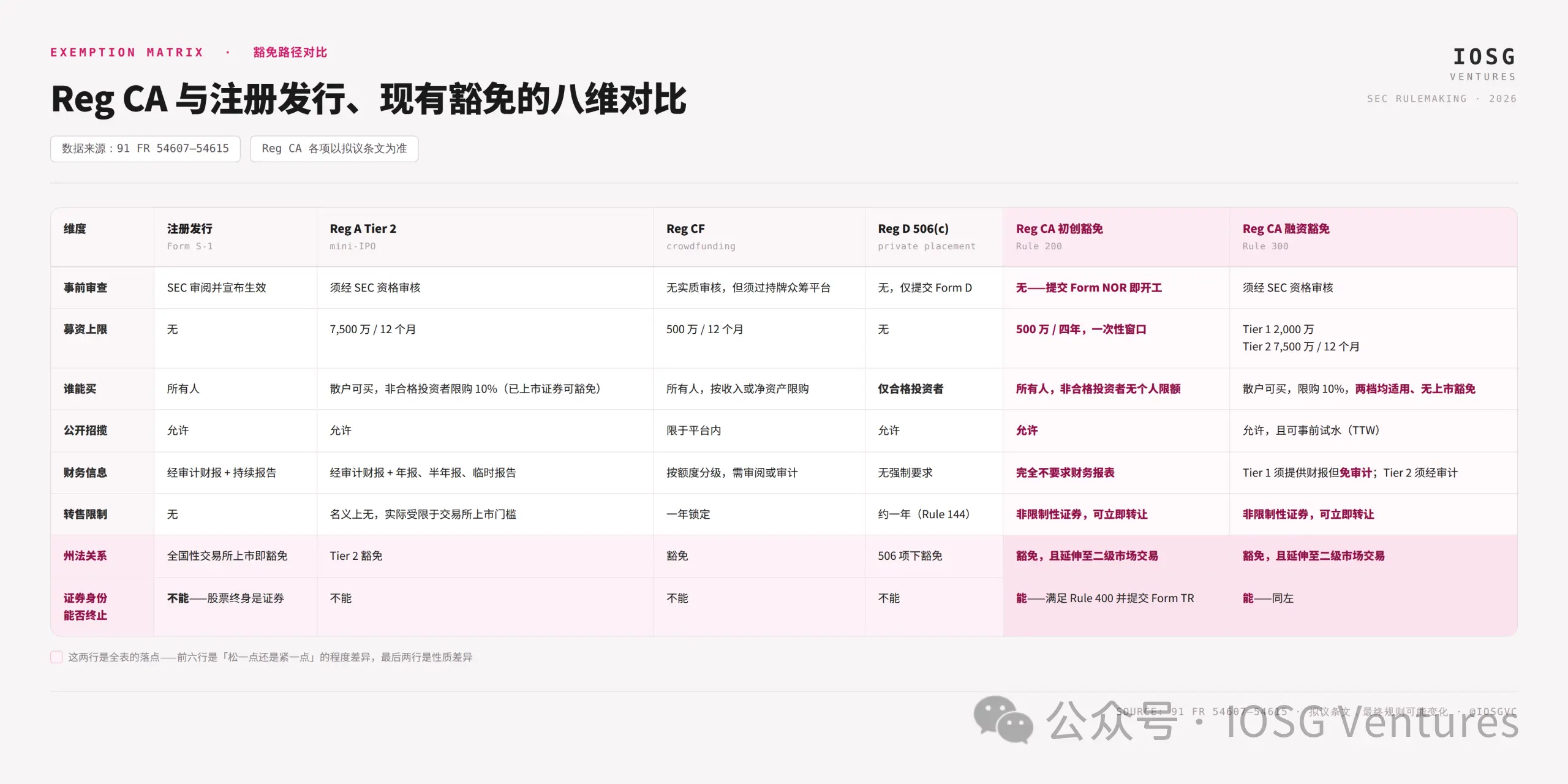 ▲ Figure 4: Comparison of Reg CA with Existing Exemptions
What does this comparison table illustrate? In summary, it can be boiled down to three statements.
▲ Figure 4: Comparison of Reg CA with Existing Exemptions
What does this comparison table illustrate? In summary, it can be boiled down to three statements.
First, it provides a small financing channel that did not exist before. Below $5 million, file and start work, with no pre-review, no financial statements required, can publicly advertise, available to everyone, and tokens can be transferred once obtained. None of the existing exemptions can simultaneously achieve these things: Reg D 506(c) can publicly solicit but only sells to accredited investors, Reg CF is available to everyone but has a one-year lock, and Reg A can do everything but must go through review and auditing. Reg CA removes these restrictions all at once.
Second, it is the first time that the exclusion of state law applicability extends to the secondary market. Previous exemptions only covered the issuance sold by the issuer; every subsequent transfer still faced state regulation. Tokens under Reg CA are different; A selling to B on an exchange also enjoys the exemption. This determines whether a token can truly circulate in the U.S., rather than having to go through the process again in each state.
Third, and most fundamentally: the identity of securities now has an endpoint. Stocks, shares under Reg A, shares under Reg CF, restricted securities under Reg D—when purchased, they are securities, and five years later, ten years later, or after the company sells, they are still securities, with no exit. Tokens under Reg CA are not: if they meet the conditions of Rule 400 and submit Form TR, they can no longer be securities. This is not just "loosening a bit," this is changing tracks.
II. Benefits and Drawbacks: Who Really Benefits
The market's default answer is the project parties issuing new tokens, but we do not see it that way. First, for the two tiers of issuance exemptions that the market is discussing, the SEC estimates in its document burden assessment that there will be a total of 130 issuances under both tiers annually, with 99 under the startup exemption and 31 under the fundraising exemption. This number is not a ceiling; it simply transfers the actual number of crypto-related issuances under existing Reg D, Reg A, and Reg CF into the new rules, the SEC estimates that the new rules will not generate any additional issuances. Second, Rule 400's safe harbor is open to issuers that have not used this rule, which is an unusual design in the exemption system, effectively declaring that its target audience already exists before the rule takes effect. The SEC expects that each year, 475 issuers will only use Rule 400's safe harbor without going through any issuance exemptions, which is 3.6 times the two tiers of issuance exemptions. The SEC is more answering a qualitative question about existing tokens, not a capital formation question. This assumption may be conservative, but it indicates where the SEC's focus lies: the market is talking about ICO 2.0, while the SEC's arithmetic is about clearing existing tokens. The real beneficiaries are written in this ratio, not on the financing channel side. Who can truly benefit from Reg CA? The first category of beneficiaries is existing tokens and their underlying old projects. From 2013 to 2024, approximately 9,746 crypto assets were launched globally (according to CoinMarketCap, excluding those that have been delisted; the SEC indicates this number may be low), while from 2016 to 2024, only 636 issuers completed crypto issuances in the U.S. using existing exemptions (regardless of whether they are U.S. or overseas teams). There is a huge gap in between, this gap indicates one thing: the legal status of the vast majority of tokens has never been formally addressed by any process. Neither confirmed nor denied, they have long been stuck in a legal status without an exit, and once a token is deemed to belong to an investment contract, it remains subject to securities law, with no process allowing it to exit. Rule 400 provides this batch of tokens with an administrative procedural endpoint for the first time, provided that the essential managerial efforts promised by the project party at issuance have been completed or permanently ceased, and no new commitments are made. In other words, this rule addresses not how to issue tokens, but how to conclude after they have been issued. The beneficiaries are not those who have not yet issued tokens, but those who have already issued and now want to shed their securities status.
The second category of beneficiaries is U.S. institutions holding existing tokens. Whether a token is a security may just be a legal label for retail investors, but for institutions, it is a question of whether they can buy it. As long as it may still be a security, a series of restrictions follow: funds must consider whether they will be deemed investment companies under the Investment Company Act, investment advisors must find qualified custodians according to securities custody rules, and auditors must ask every year how to classify this asset. Many institutions are not pessimistic; they just cannot hold it on their books. Rule 400 turns this issue into a verifiable fact—the issuer has submitted Form TR, which can be easily checked on EDGAR. Moreover, the Investment Company Act and custody rules are enforced by the SEC itself, and the SEC's rules are just right for institutions. Pushing further, there are even larger implications. Spot ETPs expanding from Bitcoin and Ethereum to SOL and XRP, each has the prerequisite that the underlying asset is not treated as a security; otherwise, this vehicle is likely to be deemed an investment company. Rule 400 effectively fills this gap for other tokens. Of course, it is only a necessary condition, not a sufficient one; there must also be a regulated futures market, sufficient spot liquidity, and cooperation from exchanges. But before this rule, the vast majority of tokens could not even reach the threshold. Therefore, in the matter of clearing existing tokens, the sellers are old projects, and the buyers are the institutions that have been watching from the sidelines.
The third category of beneficiaries, the quietest, is third-party professional service providers such as law firms, compliance agencies, and accounting firms. Onshore entity restructuring, auditing of commitment texts, and analysis and drafting of Form TR are real needs, but they are low-frequency, one-time, and highly overlapping with existing law firm businesses. They will be absorbed by professional service institutions and will not grow into an independent entrepreneurial market. This is a point that those who read Reg CA as a compliance SaaS opportunity may easily overlook. Who has not benefited: three categories of beneficiaries overestimated by the market However, there are three categories that the market mistakenly believes will benefit but actually have not. The first category is project parties that want to restart the U.S. primary market by issuing new tokens. Under the Reg CA rules, issuing tokens has indeed become easier; the startup exemption tier allows for public fundraising with just one document for amounts below $5 million. But this $5 million is a one-time cumulative cap over four years, and there are only 99 crypto issuances at this scale in 2024. To raise more, one must enter the fundraising exemption tier, with a maximum of $75 million per year, but the cost is that it must be issued by a U.S. entity, along with ongoing reporting obligations. Moreover, the commitments written in the issuance filing become the acceptance criteria for Rule 400 later; issuance may become easier, but graduation becomes more concrete. The current rules cannot support the narrative of a large-scale restart of ICO 2.0: the most groundbreaking and immediately actionable parts of Reg CA serve the tokens already in circulation, while the two exemptions for new issuances are constrained by the limits written into the text, insufficient in scale to support a market cycle.
The second category is DAOs and protocols that have already delegated decision-making to the community. The market assumes that governance tokens can finally be issued compliantly, but reading through the text reveals an unspoken prerequisite: there must be an identifiable, signable, and accountable issuer. The Rule 200 startup exemption does allow a group of individuals or entities to act as the issuer, seemingly leaving a loophole for teams without corporate entities, but it immediately requires that every member of this group sign and certify on Form NOR (Notice of Issuance) and the transformation report, and each member individually, as well as the group as a whole, must meet all compliance conditions, including passing the bad actor screening under Rule 104. There is another hurdle: if they want to follow the Rule 400 safe harbor rules and declare that the tokens are no longer securities, every member must also sign Form TR. For those protocols that did not make commitments to investors initially and whose networks are already functional, they do not need this rule. The real bottleneck is in the middle group, where the team made commitments, and decision-making power has been dispersed among thousands of token holders, needing to "graduate" through Rule 400 while struggling to gather signatories. The closer it is to having an accountable entity, the easier the rules are to use; the further away, the less applicable they become.
The third category is institutions that want to do RWA and move stocks, bonds, and fund shares onto the blockchain. This category is the most thoroughly misunderstood: Reg CA, by definition, excludes tokenized securities. Rule 100 sets three requirements for covered investment contracts, one of which is that the crypto asset itself must not be a security. Tokenized U.S. stocks, tokenized government bonds, tokenized fund shares—all of these tokens are securities themselves and are not within the scope of this rule. The proposal itself states that digital securities are more suitable for registered issuance, and the registration rules are not changed this time. Therefore, Reg CA and RWA are two parallel tracks, not one. Reg CA governs projects where "the token itself is not a security, but issuing the token constitutes an investment contract," while tokenized securities are "the token itself is a security," which still follows the old path of registration or traditional exemptions. The other side of the rule: who will bear the uncertainty Looking back at the other side of the rule, the truly disadvantaged parties fall into three categories. The first category is secondary market participants. The proposal does not touch on trading venues, brokers, custodians, and clearing; while the issuance side opens the door, there is no corresponding compliance for the secondary market. Moreover, Rule 500's exclusion of state law applicability is predicated on the issuer timely submitting regular reports; if there is a gap, it stops, and market makers and trading venues are left with a compliance status they cannot verify. The second category is those betting on legal certainty. Reg CA only governs the SEC, not the courts. Issuers meeting the conditions of Rule 400's safe harbor may still be sued under §12(a)(1): selling securities that were not registered and have no valid exemption, the buyer can demand a refund plus interest without needing to prove fraud or fault, just proving that this is a security and has not been registered. It acts like a return receipt that does not ask for reasons; if the court determines that the token is still a security, the receipt becomes effective. The safe harbor provides administrative certainty, not judicial certainty. The third category is existing projects that made vague commitments. Being vague was useful in the early stages; not writing specific milestones in the white paper, not providing timelines or personnel arrangements, made it easier to claim it was not a security, and previous legal interpretations confirmed this direction. The problem is that once this path is overturned, there is no second path: the acceptance criteria for Rule 400 is what you promised back then and whether you have completed it now, and if the project did not make any specific commitments initially, it cannot produce a verifiable list to prove it is no longer a security, instead getting stuck before the graduation line.
 ▲ Figure 5: Reg CA Benefit Map
So the answer changes with the standards. Issuing tokens has become easier, but only for amounts below $5 million. The old standard asked who could issue tokens, while the new standard asks who can graduate: not looking at the degree of decentralization, but at what was promised initially, whether it has been verifiably completed, and whether the network is functional. This is not a benefit on the issuance side, but a settlement on the performance side.
▲ Figure 5: Reg CA Benefit Map
So the answer changes with the standards. Issuing tokens has become easier, but only for amounts below $5 million. The old standard asked who could issue tokens, while the new standard asks who can graduate: not looking at the degree of decentralization, but at what was promised initially, whether it has been verifiably completed, and whether the network is functional. This is not a benefit on the issuance side, but a settlement on the performance side.
Of course, since the current Reg CA is still a draft for public comment, there is still room for changes. There are three conditions that can falsify the judgment of "clearing existing tokens is better than ICO 2.0," and we will continue to monitor and track the formal release: first, the final draft significantly relaxes the issuance end—raising the $5 million limit for the startup exemption, changing the one-time use restriction to repeatable, or deleting the four U.S. territorial requirements for the fundraising exemption; any one of these would fundamentally change the economics of new issuances, and the incremental narrative would overshadow the existing narrative; second, if the CLARITY Act passes this year, the statutory safe harbor would replace Rule 400, and Reg CA would retreat to a supporting arrangement, requiring a complete reanalysis based on the text of the CLARITY Act; third, if Rule 500 is cut from the final draft—state securities regulatory agencies have historically strongly opposed the federal exclusion of state law applicability, and once it is gone, even if tokens shed their federal securities status, secondary circulation would still have to go through blue sky laws state by state, making the legal significance of clearing existing tokens greater than the economic significance.
III. Compliance Reconstruction and Performance Constraints under Reg CA
Project Party Perspective: The focus of compliance shifts from the issuance point to the performance process For most project parties, the essence of Reg CA is not to limit fundraising amounts but to front-load compliance review to early structural design and establish a long-term traceability mechanism for public statements and performance after token issuance. If they plan to use Reg CA for fundraising issuance in the future, project parties can complete the following four core dimensions of compliance reconstruction throughout the entire lifecycle of token issuance. It should be noted that Reg CA is still a proposed rule; the following items 1 and 3 involve irreversible structural decisions, and it is recommended to wait for the final version to be clarified before implementation; items 2 and 4 are reversible actions that can be initiated immediately.
Splitting Financing Agreements: No longer bundling "equity + tokens" for issuance
According to Rule 100, compliant token investment contracts cannot be linked to any other assets (including equity and other derivative rights). The past industry practice of bundling equity + token warrants or SAFT in a single investment document financing model will directly lead to the project losing its qualification for compliant issuance under the Reg CA framework. If they plan to use Reg CA for fundraising issuance in the future, project parties must complete legal structural separation during the seed round and Series A financing stages. The rules constrain the investment contract level, not the issuing entity level; the same entity can simultaneously conduct equity financing and token distribution, as long as it ensures that the two are not included in the same investment contract.
Standardizing White Paper Commitments: Clearly defining the roadmap as the acceptance standard for the safe harbor
The core management effort disclosure required by Rule 103 will serve as the evidentiary basis for submitting Form TR under Rule 400 to prove that "commitments have been completed or permanently ceased." The white paper strategy is an irreversible structural choice. Overly vague statements may avoid securities classification in the early stages, but later lack verification standards, making it difficult to "graduate"; clear statements may directly trigger securities classification initially but provide clear evidence for subsequent safe harbor proof. Therefore, before issuing tokens, it is essential to rigorously review the granularity of the statements in the white paper and roadmap, ensuring that all public commitments have verifiable engineering landing indicators; for existing commitments that are no longer intended to be fulfilled, compile and internally archive a list of commitments that will no longer be fulfilled, and decide whether to publicly declare them once the final version is clarified.
Decision on Entity Registration Location: Matching structure according to target users and issuance channels
The Rule 300 fundraising exemption for public issuance (Tier 1/2) mandates U.S. entities, executives, and assets, while the Rule 200 startup exemption and Reg D 506(c) private placement channels have no restrictions on domestic entities. If the project's commercial growth heavily relies on U.S. retail investors, it must complete onshoring (establishing a domestic entity) early (before Series A); the cost of restructuring later will be very high; if opting for Reg D 506(c) (with no upper limit and can later invoke Rule 400), traditional offshore foundations (Cayman/BVI) can still continue to apply. Therefore, it is necessary to clarify the target user profile early in the structural design and decide the structural direction based on whether it is aimed at U.S. retail investors, to avoid blindly establishing offshore entities that lead to subsequent disqualification.
Project Operations After Token Issuance: Focus on completing functional delivery rather than decentralization
Reg CA clearly states that maintenance, updates, and funding activities after the network/application achieves functionality do not constitute core management efforts, and no new commitments should be made. This breaks the past misconception that "the team must be dissolved or the code handed over to achieve decentralization." The risk window is before functionality is achieved (commitment accumulation period); after functionality is achieved, the risk shifts to "new commitments" (new roadmaps will lead to compliance being recalibrated). Therefore, before functionality is achieved, all external commitments should be centrally managed to avoid improvisational expansions of the roadmap in social media and AMAs; after functionality is achieved, establish a review mechanism for the release of new commitments, clearly distinguishing product announcements from issuer commitments in statements, and publicly archive performance evidence to reserve a basis for submitting Form TR under the Rule 400 safe harbor.
Investor Perspective: Track Preference, Valuation Variables, and Clause Reconstruction From the investor's perspective, what Reg CA changes first is the investors' preferences and choices for future investment projects. The most direct layer is the track: Rule 400 requires that "the core management efforts promised have been completed or permanently ceased," which naturally favors those projects where commitments can end—a chain that has gone live is live, a protocol deployed no longer relies on the issuer; whereas consumer applications and platforms that require continuous iteration inherently demand ongoing new commitments, effectively remaining outside the graduation line for the long term, infrastructure may find it easier to navigate this path than applications. The second layer is pricing: whether a token can be depersonalized becomes a variable that can be factored into valuation; for the same FDV, tokens that can be depersonalized and those that cannot should have a price difference, and Term Sheets will start to include "graduation clauses"—requiring project parties to cooperate in archiving performance evidence after functionality goes live and setting internal approvals for new roadmap commitments. Finally, the due diligence focus shifts—previously looking at code, team, and degree of decentralization, in the future it will look at "commitment archives": versions of the white paper, Twitter, AMA, Discord announcements, because under Rule 400, every word the project party has said is a liability on the balance sheet.
Secondly, the impact of Reg CA also focuses on compliance management and exit paths for projects already invested in. The premise for invested projects to use Rule 400's safe harbor is that "the core management efforts promised have been completed or permanently ceased," and there are no new commitments. The performance progress of invested projects and their public statements directly determine whether the held assets can be depersonalized, which in turn directly affects asset valuation. Under the new rules, investors need to evaluate existing projects according to the conditions of Rule 400's safe harbor, focusing on verifying the completion of public commitments made by the project party and the status of product functionality going live, rather than the degree of decentralization or the team's departure; at the same time, they must control the public statements of invested projects to prevent new roadmap commitments after functionality goes live from triggering compliance recalibration; currently, they can promote already launched projects to complete public archiving of performance to retain evidence for future submission of Form TR.
Reg CA establishes a compliance framework of "issuing tokens looks at structural separation, performance looks at white paper fulfillment, and exit looks at depersonalization graduation," requiring project parties to thoroughly separate "equity and token" trading contracts early, choose the entity's jurisdiction based on user positioning, and strictly control public relations statements after product launch to prevent re-triggering reviews; at the same time, it requires VCs to update investment documents to constrain agreement separation and assess the feasibility of depersonalization for existing portfolios based on "roadmap fulfillment completion," reconstructing post-investment management and valuation logic by transforming regulatory uncertainty into assessable variables. Overall, this rule is less about a new round of token issuance benefits in the crypto market and more about a system arrangement jointly promoted by regulators and leading institutions to ensure compliance and risk clearing for existing assets.

 Risk warning