Donald Trump Jr. Fund invests $300 million in Polymarket's capital game
 Core Viewpoint

 The prediction market is no longer the exclusive domain of two companies; cryptocurrency exchanges and on-chain protocols are also getting involved.
Author: Zhou, ChainCatcher
According to WSJ reports, Donald Trump Jr., the eldest son of Trump, is set to increase his investment in the prediction market platform Polymarket by approximately $300 million through the investment fund 1789 Capital, where he serves as a partner.
This funding is part of a new $1 billion financing round led by 1789 Capital. If the transaction is successfully completed, Polymarket's valuation is expected to reach around $21 billion. 1789 Capital has previously invested about $200 million in Polymarket and is expected to become one of its largest shareholders after this round.
The Past and Present of 1789 Capital
1789 Capital was established in October 2022, founded by investment bankers Omeed Malik, Rebekah Mercer, and entrepreneur Chris Buskirk, with Malik serving as president.
Malik graduated from Colgate University and Emory University School of Law. He worked as a corporate lawyer early in his career before moving to MF Global and then to Bank of America Merrill Lynch, where he was responsible for the commodities brokerage business.
In early 2018, Malik left after an investigation into allegations made by subordinates and subsequently filed a $100 million arbitration claim, accusing the bank of defamation and discrimination. Bank of America agreed in July of that year to pay an undisclosed amount in the millions to settle the matter, and neither party provided a conclusive statement on the facts.
Afterward, Malik founded the boutique investment bank Fawakhari Partners, investing in conservative new media projects and serving as the chairman of a SPAC. According to his own recollection, his political shift began with dissatisfaction over the government's handling of the COVID-19 pandemic, after which his investment narrative gradually shifted towards anti-ESG and anti-DEI.
After the 2024 election, Trump Jr. joined 1789 Capital as a partner, and the fund quickly expanded in size.
By early 2025, its growth equity fund was approximately $150 million to $200 million, surpassing $1 billion by September of that year, and reaching $2 billion by the end of December, closing to new investors. By May 2026, the assets under management had risen to about $3.5 billion, an increase of about 17 times compared to early 2025.
The fund invests in a wide range of areas. In artificial intelligence, it includes Cerebras, Groq, Perplexity, Databricks, and Crusoe; in defense and military, it has Anduril, Hadrian, and Vulcan Elements; in consumer, it includes e-commerce platform GrabAGun, e-cigarette brand Juul, and PublicSquare; in space, it covers SpaceX and Axiom Space, and it has also participated in funding for Musk's Neuralink, X, and xAI.
According to CNN, in the first 500 days after Trump's second term began, the ten defense, aerospace, and software companies invested by 1789 Capital received over $1.6 billion from federal contracts and grants. 1789 responded that it had never discussed federal contracts with the government. Trump Jr.'s side stated that he does not connect the companies he invests in or advises with federal agencies.
One of the most closely watched cases is Vulcan Elements. In August 2025, 1789 Capital completed its investment when the company's valuation was about $200 million. Three months later, the Pentagon issued a $620 million loan to it, and the Department of Commerce added a $50 million grant, causing the company's valuation to jump to about $2 billion. Senator Elizabeth Warren and others co-signed a letter accusing this transaction of serious conflicts of interest.
Polymarket is another name that cannot be avoided by this institution. Since January 2025, Trump Jr. has served as a paid strategic advisor to Kalshi and received company stock valued at about $300,000. In August 2025, he joined the Polymarket advisory board against the backdrop of 1789 Capital's investment in Polymarket.
The two companies are direct competitors, and he sits at the table for both. His spokesperson responded that this would not change his role at Kalshi. Meanwhile, Trump Media Group once planned to embed its own prediction product Truth Predict into Truth Social and discussed providing Truth API to Wall Street.
According to Fortune, although there is currently no public evidence showing that Donald Trump Jr. or the Trump family has used insider government information for trading, the potential conflicts of interest arising from the intertwining of presidential public information, market trading, and family business interests are drawing external attention.
Valuation Frenzy, Revenue Mystery, Polymarket's Capital Game
Polymarket's valuation jumps almost always follow a regulatory or capital event.
In 2022, the U.S. Commodity Futures Trading Commission determined that it was operating an unregistered derivatives exchange, imposing a $1.4 million fine and requiring it to block U.S. users. The platform subsequently shifted to offshore operations, settling event contracts with on-chain stablecoins.
The 2024 U.S. election became a turning point, with political betting turning Polymarket into a global opinion market, leading to a significant increase in trading volume in the fourth quarter of that year.
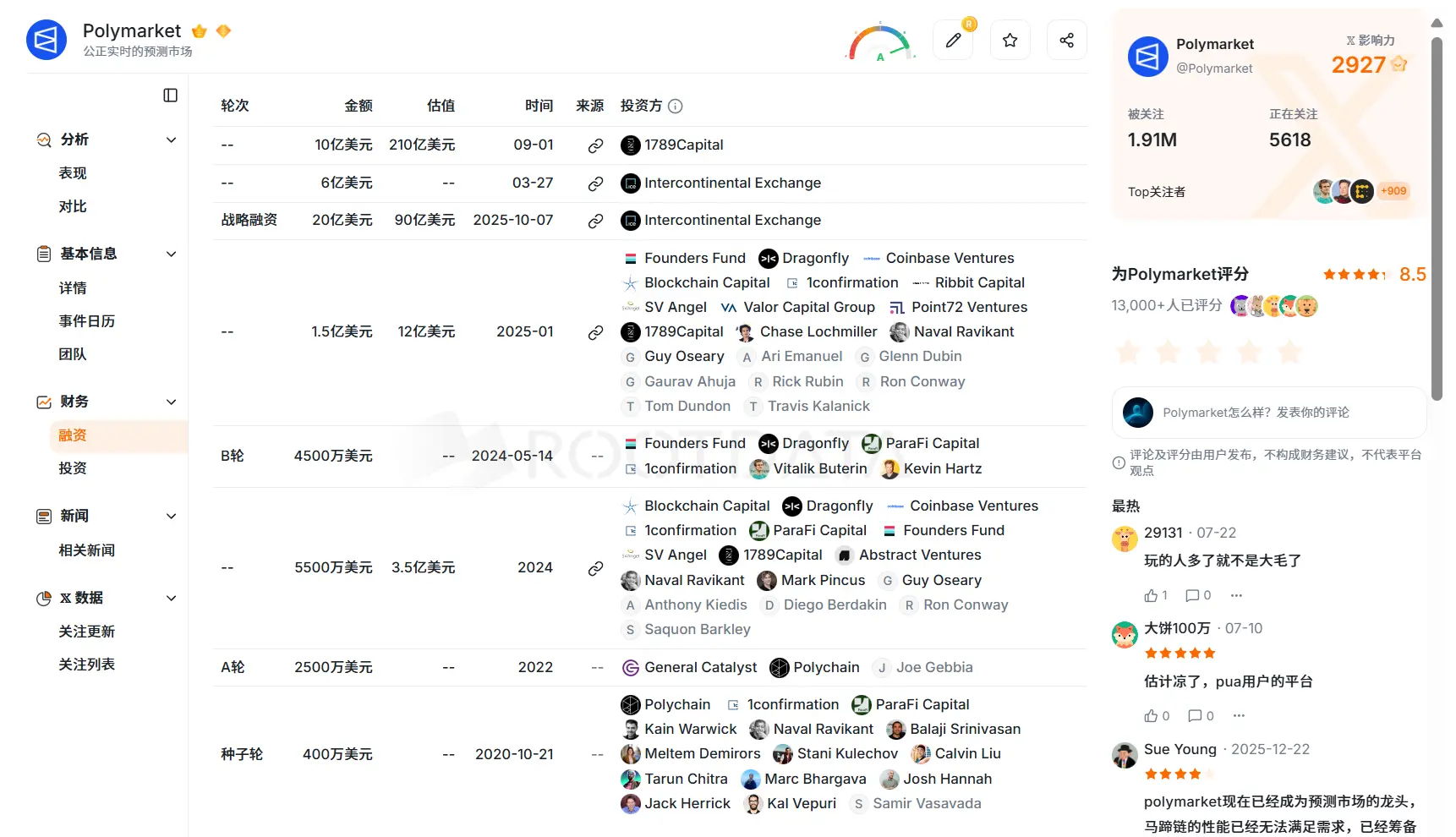
In July 2025, the Department of Justice and CFTC ended their previous investigation into the platform without prosecution. On the 21st of the same month, Polymarket invested $112 million to acquire the licensed exchange and clearinghouse QCEX, gaining a shell resource to return to the U.S. market. On August 26, 1789 Capital announced a strategic investment, and Trump Jr. simultaneously joined the advisory board.
In October 2025, the parent company of the New York Stock Exchange, Intercontinental Exchange, committed to invest up to $2 billion, with a pre-investment valuation of about $8 billion. On November 25, the CFTC issued a revised designation order allowing its U.S. entity to operate as a futures broker intermediary. After the regulatory door opened, traditional finance began to enter the market on a large scale.
In March 2026, Intercontinental Exchange invested another $600 million. The company disclosed cumulative holdings of about $1.6 billion, accounting for approximately 22% of the outstanding shares, making it the largest institutional shareholder (recently indicating it may continue to increase its stake). In April 2026, a round of financing introduced institutions like D.E. Shaw and G Squared, bringing the valuation to about $15 billion. Now, 1789 Capital is leading a new round of about $1 billion, contributing about $300 million, with a post-investment valuation looking towards $21 billion, and after this round, it will also become one of the largest shareholders.
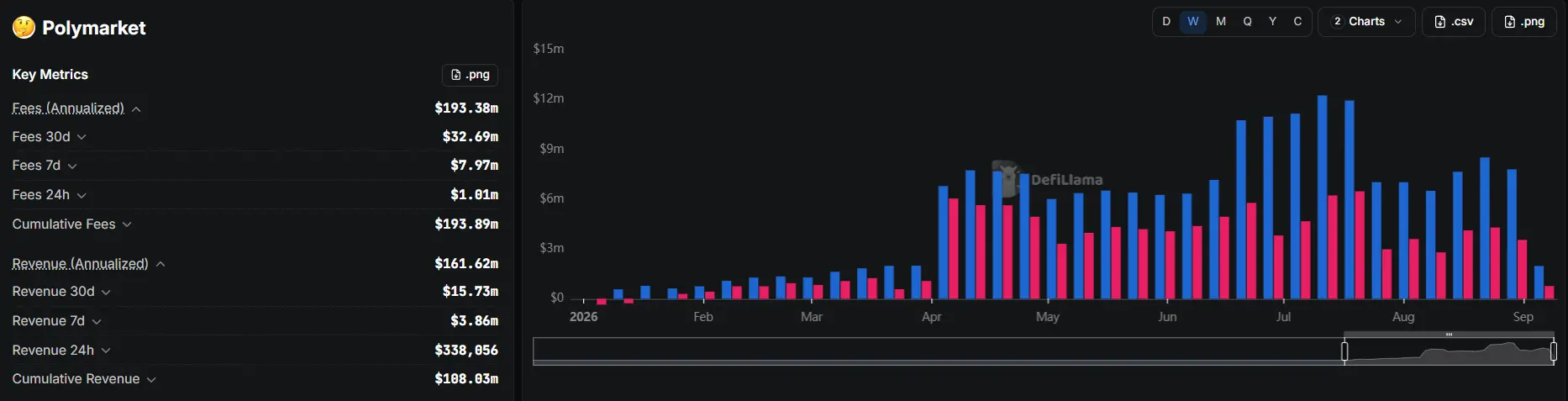
Behind the rapidly rising valuation, the revenue figures tell a different story. Polymarket began charging traders fees in January 2026, with annual revenue projections from third-party platform Sacra at about $1 billion, while on-chain data platform DefiLlama estimates annual revenue at about $162 million, a difference of nearly eight times. Based on a $21 billion valuation, using the former gives a price-to-sales ratio of about 21 times, while the latter approaches 130 times.
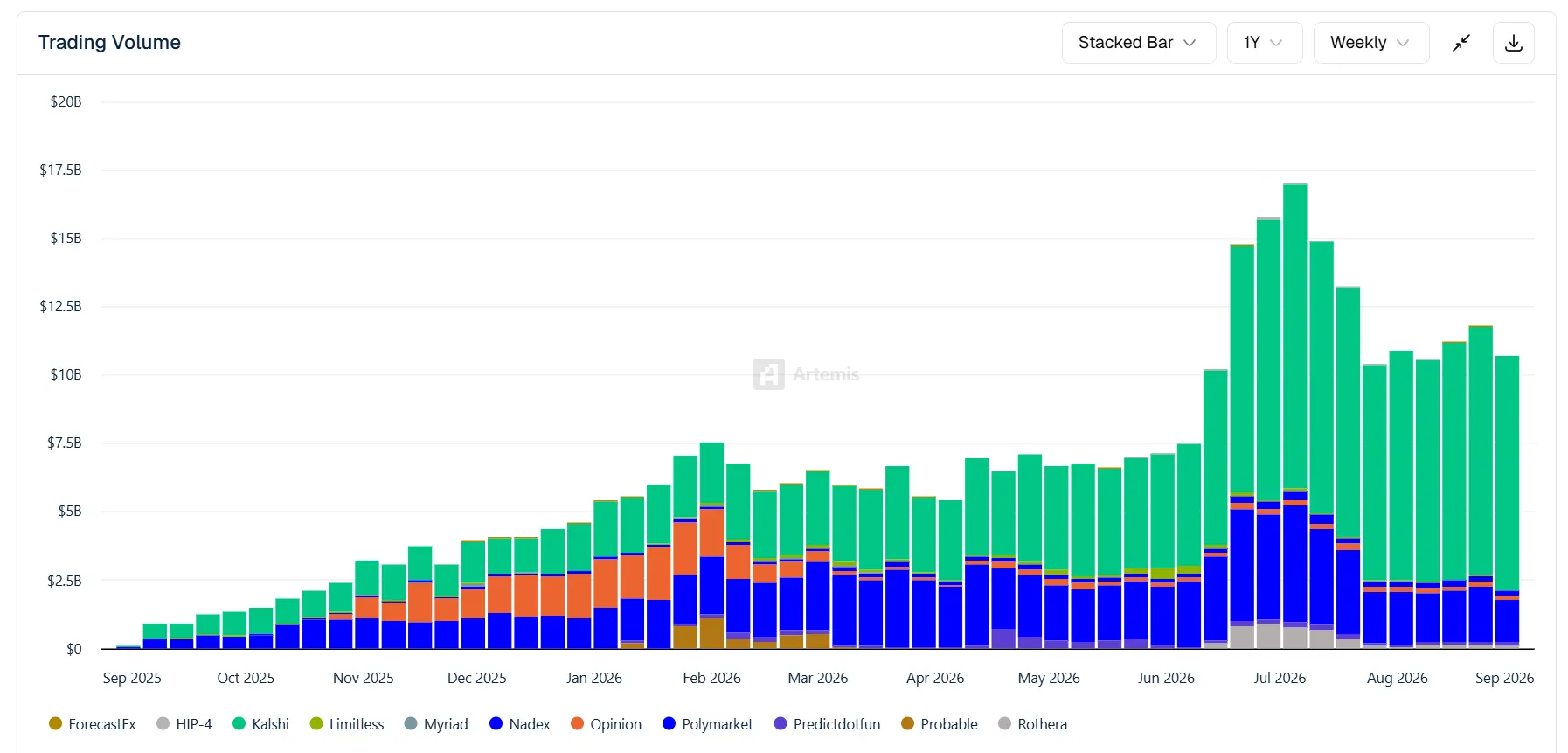
Data platform Artemis shows that from October to December 2024, the prediction market was almost entirely Polymarket's market. This year, the situation began to reverse, with the World Cup pushing the total market weekly trading volume to about $17 billion, maintaining above $10 billion per week afterward, but the incremental volume mainly flowed to competitor Kalshi.
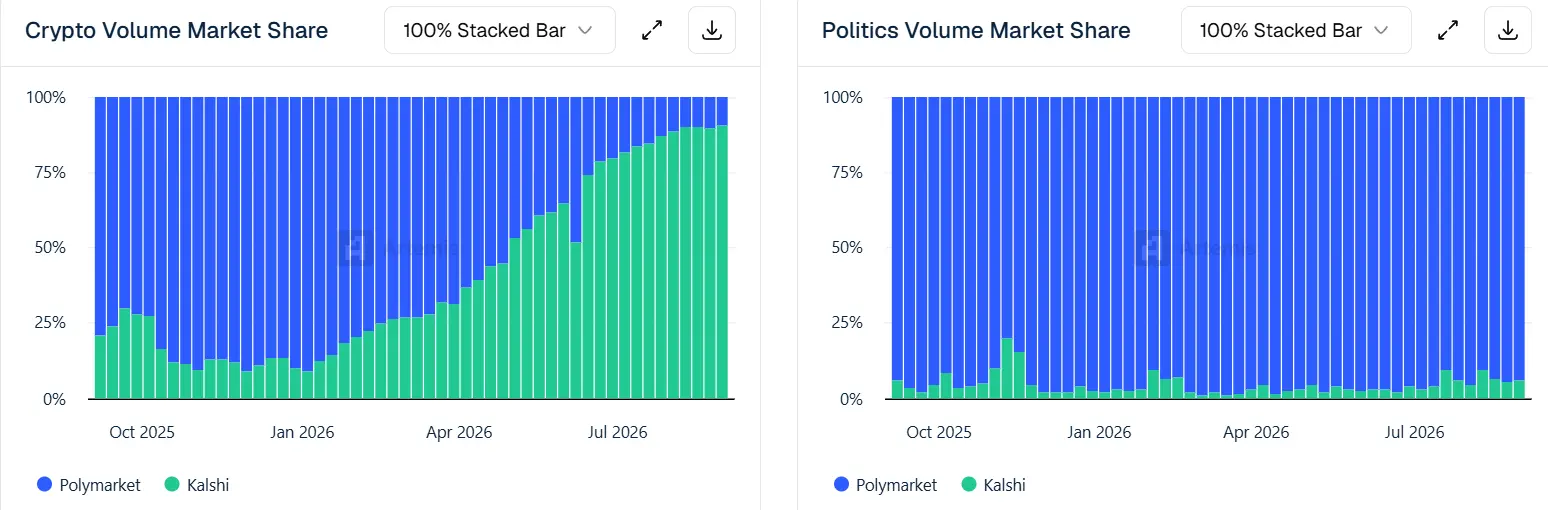
By August, Kalshi's non-sports trading was about $24.9 billion, while Polymarket only had about $1.5 billion; Polymarket's share of the crypto category dropped from about 80% to about 10% within a year. Political betting remains Polymarket's stronghold, consistently holding about 90% market share.
Even after regaining U.S. compliance licenses, Polymarket's business focus remains overseas. On-chain data shows that in the week of August 30, its fee income from international users contributed about $1.4 million, while U.S. users contributed about $610,000, with international accounting for over 70%, and the trading volume structure is roughly similar.
More importantly, the prediction market is no longer exclusive to the two companies. As trading volume increases, centralized exchanges and on-chain protocols are also squeezing in, which means Polymarket is being pressured from both sides.
Coinbase opened prediction markets to U.S. users from the beginning of the year, routing orders through Kalshi's compliant track, claiming this is one of the fastest new products to launch. Robinhood embedded event contracts into its brokerage app earlier, first directing traffic to Kalshi, then preparing for its own licensed exchange Rothera. Crypto.com launched OG, Gemini launched Predictions, and Interactive Brokers' ForecastTrader and Webull have also listed similar products. The traffic entry is shifting from crypto-native websites to brokers and exchanges that already have funding accounts.
On the other side of the chain is also splitting. Limitless on Base is doing 15-minute and hourly crypto short-cycle trading, with monthly trading volume once reaching the billion-dollar level. Opinion and Predict.fun on BNB Chain are capturing macro themes and Binance wallet traffic, respectively. Myriad is moving into media embedding, while Azuro provides market-making infrastructure for dozens of frontends, and Hyperliquid is integrating result contracts into its own order book with HIP-4.
With capital rushing in, the market is becoming increasingly crowded, making the issue of exit more urgent. The capital exit routes are nothing more than issuing tokens and going public. Last year, Polymarket executives publicly stated that there would be tokens and airdrops; the parent company Blockratize applied for the registration of the POLY and $POLY trademarks in February this year, and ICE's cooperation announcement also mentioned future tokenization arrangements, but the specific issuance time and airdrop rules have not yet been finalized.
Currently, the company has not submitted an IPO prospectus, and J.P. Morgan ended its banking partnership with Polymarket last year due to regulatory risks, but the bank stated that it still maintains multiple business interactions with the company and is considering participating in future IPO underwriting.

 Risk warning