U.S. non-farm payrolls unexpectedly strong, September rate hike probability rises to about 60%, market closely watches next week's CPI
 Core Viewpoint

 In August, the United States added 162,000 non-farm jobs, about three times the expected amount, indicating that the labor market remains resilient. The probability of the Federal Reserve raising interest rates in September has risen to about 60%. U.S. Treasury yields generally increased, and U.S. stocks closed lower, but the weekly trend still shows an upward movement. Investments in AI infrastructure and credit expansion continue to support the economy, and the market will focus on next week's CPI data to assess the Federal Reserve's policy path.
Author: Wall Street Insights
The U.S. non-farm payroll data for August significantly exceeded expectations, further widening the divergence in market views on the Federal Reserve's policy direction in September. Strong job growth indicates that the U.S. economy remains resilient, prompting the market to revise upward its expectations for Fed interest rate hikes. U.S. stocks fell on Friday, U.S. Treasury yields generally rose, and gold came under pressure.
Data released by the U.S. Department of Labor on Friday showed that non-farm payrolls increased by 162,000 in August, approximately three times the economists' expectations. The stronger-than-expected employment performance suggests that the labor market has not shown the significant deterioration that the market had previously worried about, complicating the Fed's policy trade-offs between employment and inflation.
The federal funds futures market indicates that the probability of the Fed raising interest rates at the September 16 meeting has risen to about 60%. Previously, Fed Governor Waller signaled a preference to keep rates unchanged, leading to a temporary retreat in market bets on a September rate hike.
Market reactions have leaned hawkish. All three major U.S. stock indices closed lower on Friday, while U.S. Treasury yields generally rose. However, from a weekly perspective, the S&P 500 and Nasdaq 100 indices still achieved gains, indicating that the market adjustment triggered by this employment data remains relatively limited.
U.S. Treasury yields rise across the board, with no significant pressure on risk assets
Following the employment data release, U.S. Treasuries were sold off, and yields across various maturities generally rose.
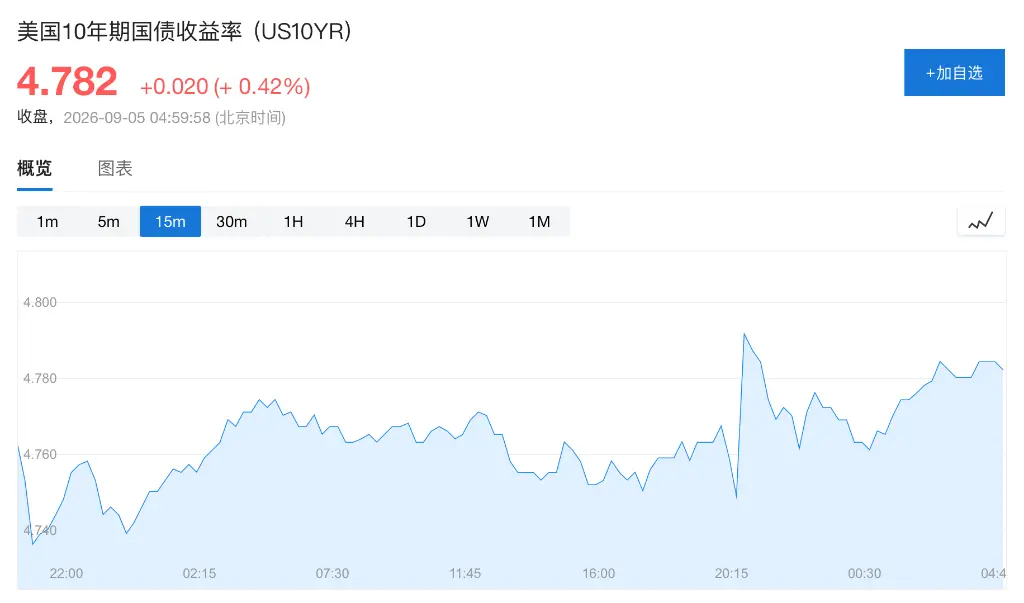
Among them, the 2-year U.S. Treasury yield, which is most sensitive to monetary policy, rose by 3.4 basis points to 4.3703%, reaching a session high of 4.416%, the highest since January 2025; the 10-year Treasury yield increased by 2.2 basis points to 4.782%; and the 30-year Treasury yield rose slightly by 0.3 basis points to 5.246%.
However, the current volatility in the bond market has had limited transmission to other risk assets. Credit spreads remain at relatively low levels, and the cost of downside protection for risk assets is also relatively limited. J.P. Morgan noted that liquidity in the U.S. Treasury market has significantly deteriorated, but stock index futures and corporate bond ETFs have not shown similar pressure.
Collin Martin, head of fixed income research and strategy at Charles Schwab, stated that current financial conditions remain loose, and credit spreads are still at abnormally narrow levels. Meanwhile, corporate earnings have grown more than 20% year-on-year, and the current corporate financing costs do not seem to be exerting significant pressure on companies.
This means that although the employment data has raised interest rate expectations, the impact of high rates on corporate financing and risk assets has not yet fully manifested.
The AI investment boom provides support, with a divergence in employment structure
The current resilience of the U.S. economy is also related to the ongoing surge in AI infrastructure investment.
Brad Conger, Chief Investment Officer at Hirtle & Co., stated that the "AI substitution effect" can be faintly seen in the August employment data: financial activities and the information sector combined lost 34,000 jobs, while industries related to data center construction, equipment supply, and power support, such as construction, manufacturing, and utilities, showed stronger employment performance.
Economists at BNP Paribas noted in a client report that this employment report indicates that the U.S. economy is still in a phase of cyclical expansion, with loose policies and the AI infrastructure investment boom providing significant support. With labor supply constrained, the unemployment rate may continue to decline, and wages face upward pressure.
Meanwhile, high financing costs have not yet significantly suppressed credit expansion. J.P. Morgan found that despite rising borrowing costs, the scale of U.S. loans and money creation has not contracted in tandem; bank loans are still growing, and the net issuance of U.S. investment-grade corporate bonds also increased in August.
Therefore, the current situation facing the U.S. economy is not a typical "high rates suppressing demand" scenario. Although corporate financing costs have risen, credit activity and investment demand are still maintaining certain growth, which is one reason why risk assets have not experienced more severe adjustments in response to the hawkish employment data.
Rising rate hike expectations, CPI will become the next key verification
The non-farm data is clearly hawkish, but it is not sufficient to fully determine the Fed's next policy path. The market will now turn more attention to inflation data.
Dan Suzuki, global investment strategist at iCapital, warned that if rates rise significantly further, it may force investors to more aggressively reduce risk exposure and further worsen market sentiment.
Sarah Hunt, Chief Market Strategist at Alpine Saxon Woods, stated that compared to a weaker employment report, this employment data provides significantly limited policy basis for the doves.
Marvin Loh, senior macro strategist at State Street, pointed out that Friday's employment report again indicates that even in the absence of structural conditions to lower the unemployment rate, the U.S. economy is still performing well. He believes the market is sending a signal to Waller that "rates should be raised" and still expects the Fed to raise rates within this year.
Greg Boutle, head of U.S. equity and derivatives strategy at BNP Paribas, stated that as the earnings season is basically over, macro data will become an important variable affecting the market in the coming weeks. He believes that it is currently appropriate to maintain a more cautious attitude toward stocks, but it is not yet time to be clearly bearish.
In his view, although Friday's non-farm data was slightly hawkish, it still did not fully clarify the Fed's next policy direction. The next key variable is the CPI data to be released next week, as well as whether the Fed will choose to raise rates before the U.S. midterm elections.

 Risk warning