








Bernstein: The Gap in AI Data Centers and the Valuation Dispute with Celestica
 Core Viewpoint
 The debate focuses on several specific issues: whether the power and land for data centers are sufficient, whether Celestica's profit margins are stable, and when companies like Ciena and Arista will have the opportunity to contribute to performance.
Written by: Rita
Celestica's earnings per share for 2028 are expected to reach $36, according to Bernstein. Based on the buy-side expectations heard by the institution, the stock price corresponds to about 9.7 times the 2028 price-to-earnings ratio. The profit forecast is already high, but the valuation is kept low. Investors are concerned about how many high-value orders Celestica can secure after Google adds more suppliers.
Bernstein's report on October 14 did not change its positive outlook on the U.S. networking and communication equipment industry. After engaging with investors, the institution found that the debate focused on several specific issues: whether there is enough power and land for data centers, whether Celestica's profit margins are stable, and when companies like Ciena and Arista will see opportunities reflected in their performance.
U.S. Supply Shortage Does Not Represent Global Gap
Bernstein estimates that the shipment of AI accelerators corresponds to about 43 gigawatts of data center rack demand. The market often compares this with the approximately 26 gigawatts of new data center supply in the U.S. by 2027, concluding that there is a severe supply shortage. However, demand is global, and the supply figures only account for the U.S., so the scopes of the two are different.
According to the historical ratio of the U.S. accounting for about 70% of global data center capacity, the 26 gigawatts of U.S. supply corresponds to about 37 gigawatts globally, leaving a gap of about 6 gigawatts. If the U.S. share drops to 60%, the corresponding global supply would be close to 43 gigawatts. Bernstein believes that the expansion of AI projects overseas can alleviate the impact of tight power and land in the U.S.
Overseas projects still require time for construction. If available data centers cannot keep up with equipment shipments, operators may delay purchasing servers and networking equipment. For hardware companies, the continuous growth in demand and timely order fulfillment are two things that need to be validated.
Bernstein also provided a return estimate: by 2027, AI end-user spending needs to reach about $700 billion for the related investments of hyperscale cloud providers to achieve about a 15% return. The institution believes that, given the current industry growth rate, this level of spending is achievable. What remains to be seen is whether user spending can keep pace with the infrastructure investments that have already been laid out.
Celestica Must Secure High-Value Orders
What makes investors hesitant about Celestica (CLS) is the sustainability of the profit forecast. Bernstein raised its earnings per share forecast for 2028 from $35 to $36, while still expecting about $24 for 2027. The buy-side expectations heard by the institution are approximately $37 and $25, which are close to its own forecasts.
Google's introduction of other suppliers for the TPU project is a reason for market concern about Celestica losing market share. Bernstein assesses that Google will assign some mature projects to new suppliers, while the higher-value racks with stricter delivery requirements will still primarily rely on Celestica. If this division of labor can be maintained, the impact of new competition on its profits may be less than the market fears.
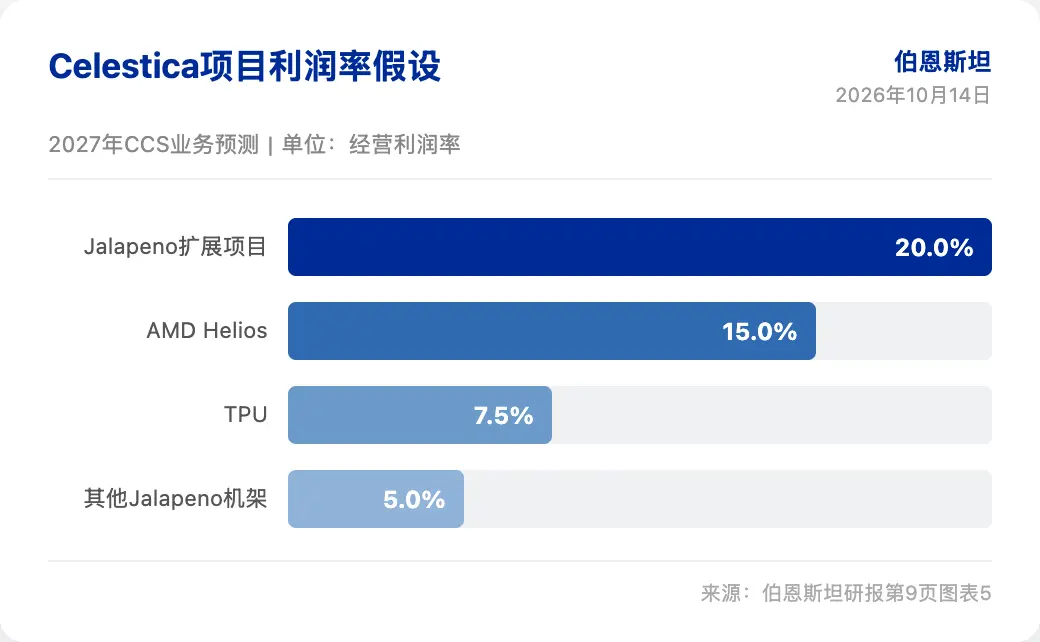
The increase in revenue also depends on which products it comes from. Bernstein estimates that Celestica's TPU business has a profit margin of about 7.5%, while AMD Helios and some 1.6T switch projects have about 15%. The profit margins of different projects vary significantly; even if total revenue reaches the forecast, the company needs to have a sufficient number of high-margin businesses to achieve the corresponding profit targets.
The investor day on October 27 is therefore particularly important. The market wants to hear how orders are allocated, when new projects will ramp up, and how management views the profit margins for 2027. Bernstein maintains its "Outperform" rating on Celestica with a target price of $520; the current valuation of about 9.7 times reflects that the market has not fully accepted its long-term profit expectations.
Ciena Awaits Revenue Upgrades
Ciena (CIEN) has fewer debates. Investors engaged by Bernstein generally recognize the long-term demand for cross-data center connectivity and do not have much disagreement on its valuation. What makes them hesitant is the timing: the opportunity can already be quantified, but recent profit forecasts are still difficult to upgrade.
Bernstein uses the Stargate project as a case study, estimating the potential market size for cross-data center connectivity equipment to be about $10.94 billion. This figure is based on project construction goals, and there are still several steps before Ciena secures orders. The institution believes that after the supply constraints on pump lasers and ceramic packaging ease, product deliveries will increase, making it easier for the market to see this opportunity reflected in performance.
Bernstein maintains Ciena's "Outperform" rating and also assesses that its stock price may fluctuate within a certain range in the short term. The long-term market size has already entered discussions, and the more useful signals at the moment are whether supply can keep up and when new demand will translate into the company's revenue.
Arista Aims to Capture Share from Open Networks
Arista (ANET) faces a different kind of competition. Nvidia has a strong position in the AI networking market, and cloud providers want to reduce their reliance on proprietary solutions from a single supplier. Bernstein believes that the expansion of open Ethernet applications will provide Arista with opportunities to capture market share.
The institution values Arista's long-term cooperation with Meta and Microsoft. Both clients use its networking products and participate in the co-design of new solutions. Such client relationships help Arista enter new projects, but the stock price already reflects high expectations. The speed of open network advancement and how many orders Arista ultimately secures will affect the market's acceptance of its valuation.
Cisco and Corning face different concerns. Bernstein believes that Cisco's market expectations are relatively low, and a slight beat could improve stock performance, but when looking at the business separately, the valuation advantage is not as obvious as the surface numbers suggest. Corning's AI fiber business has growth opportunities, but weakness in its mobile and automotive businesses may still drag down overall performance, and other fiber manufacturers expanding production will also bring competition. The institution maintains a "Market Perform" rating for both companies.
Disclaimer
This article is a compilation and interpretation of third-party brokerage research reports (Bernstein, October 14, 2026) by Chao Xiang Research, combined with publicly available market information. The ratings, target prices, profit forecasts, and related judgments quoted in this article are the views of the analysts of that brokerage and only represent the position of their respective institutions, not the views of Chao Xiang Research, nor do they constitute any investment advice.
The market carries risks, and decisions should be made independently. This article should not be used as the basis for buying or selling any securities.
 Risk warning




Popular articles





