








Goldman Sachs interpretation: It is expected that interest rate cuts will not occur until the second half of 2027. How much longer will high interest rates last?
 Core Viewpoint

 Goldman Sachs expects another interest rate hike in December, but the duration of high rates will determine the economic cost.
Editor’s Note: U.S. inflation has risen again, and the issue of interest rate hikes by the Federal Reserve has once again become the focus of the market. Data released on October 14 showed that the U.S. CPI rose 0.6% month-on-month and 3.7% year-on-year in September. Gasoline prices contributed to more than half of the monthly increase, but after excluding food and energy, the core CPI still rose 0.3% month-on-month, unchanged from August, indicating that underlying price pressures have not further eased.
The stickiness of inflation provides a reason for continued tightening, but high financing costs are also accumulating growth pressures. For the market, whether the next interest rate hike will occur is just a matter of the present: the longer-term variable is how long interest rates will remain high and how long businesses and households will have to endure high financing costs.
Goldman Sachs' baseline in its macro research briefing suggests that the Federal Reserve will raise interest rates once more in December, followed by three rate cuts starting in September 2027, with long-term rates expected to decline in the coming months. Under this scenario, Goldman Sachs estimates that higher interest rates will drag down U.S. GDP growth by about 0.2 percentage points by 2027; if interest rates remain at current levels, the drag will exceed twice that number.
This means that Goldman Sachs' judgment of relatively limited growth costs relies on subsequent declines in interest rates. If inflation does not recede for a long time and long-term financing costs remain high, the market will need to reassess not only how much more the Federal Reserve will raise rates but also how long the U.S. economy can withstand these conditions.
The following is the original text translation:
After inflation exceeded expectations, the market reassessed the Federal Reserve's interest rate path. However, the scenario analysis provided by Goldman Sachs pushes the issue further towards growth: interest rates have already risen to high levels, and how long they will be maintained next could significantly change the economic costs of tightening.
According to the report provided, Goldman Sachs still expects the Federal Reserve to raise rates once more in December, followed by three rate cuts starting in September 2027. Meanwhile, its baseline assumption is that long-term rates will decline from current levels in the coming months.
Under this path, Goldman Sachs estimates that higher interest rates will drag down U.S. GDP growth by about 0.2 percentage points by 2027. If interest rates remain at current levels, the drag will expand to more than double the baseline estimate.
The gap between the two scenarios reveals the most important judgment of this report: future growth pressures depend both on how the Federal Reserve acts next and on whether market financing costs can decrease accordingly.
Core Inflation Not Cooling, Federal Reserve Still Hard to Relax
U.S. inflation rose in September, with energy being the main driver. Gasoline prices rose 9.1% month-on-month, pushing the overall CPI monthly increase from 0.4% in August to 0.6%.
However, price pressures were not all concentrated in energy. The core CPI rose 0.3% month-on-month for two consecutive months, while housing price increases rose from 0.3% in August to 0.4%. This makes it difficult for the market to explain this inflation performance solely through fluctuations in gasoline prices.
For the Federal Reserve, the key is whether price increases can be sustained. Energy prices can quickly push up overall inflation, and the subsequent impact depends on price trends and cost transmission; whether core inflation can stabilize and slow down relates to policymakers' judgments on underlying price pressures.
This data is not sufficient to determine the subsequent policy path, but the lack of further cooling in core inflation means that more evidence is needed to judge whether inflation will continue to decline.
Goldman Sachs' baseline in the report still includes one more rate hike in December. However, the existing excerpt does not disclose the complete process of forecast adjustments, so it cannot be concluded that the firm changed the timing or frequency of rate hikes due to this CPI.
Growth Drag Could Double, Key Is When Rates Fall
Goldman Sachs' growth estimates are based on a clear interest rate path: another rate hike this year, followed by a decline in long-term rates, and then starting rate cuts later in 2027.
This means that its estimated 0.2 percentage point growth drag already includes the condition of a gradually easing future financing environment. If this condition cannot be met, the pressure on the economy will also increase.
Goldman Sachs estimates that if interest rates remain at current levels, the drag on U.S. GDP growth by 2027 will exceed twice that of the baseline scenario. Compared to a single rate hike, the persistence of high financing costs could lead to a greater cumulative impact.
Understanding this difference requires distinguishing between policy rates and long-term market rates. The Federal Reserve directly influences short-term funding prices, while the cost of funds for housing loans, corporate long-term financing, and investment projects is also affected by long-term market rates.
Therefore, even if the Federal Reserve stops raising rates, businesses and households may not immediately experience relief from declining financing costs. If long-term rates remain high, housing demand, corporate investment, and credit activity may still face pressure.
It should be clarified that the 0.2 percentage points is the growth drag estimated by Goldman Sachs' model, not a forecast of U.S. GDP growth rate, nor does it represent a decline in the total economy by 0.2%. The provided materials do not disclose the complete model settings, so specific losses in various industries cannot be further inferred.
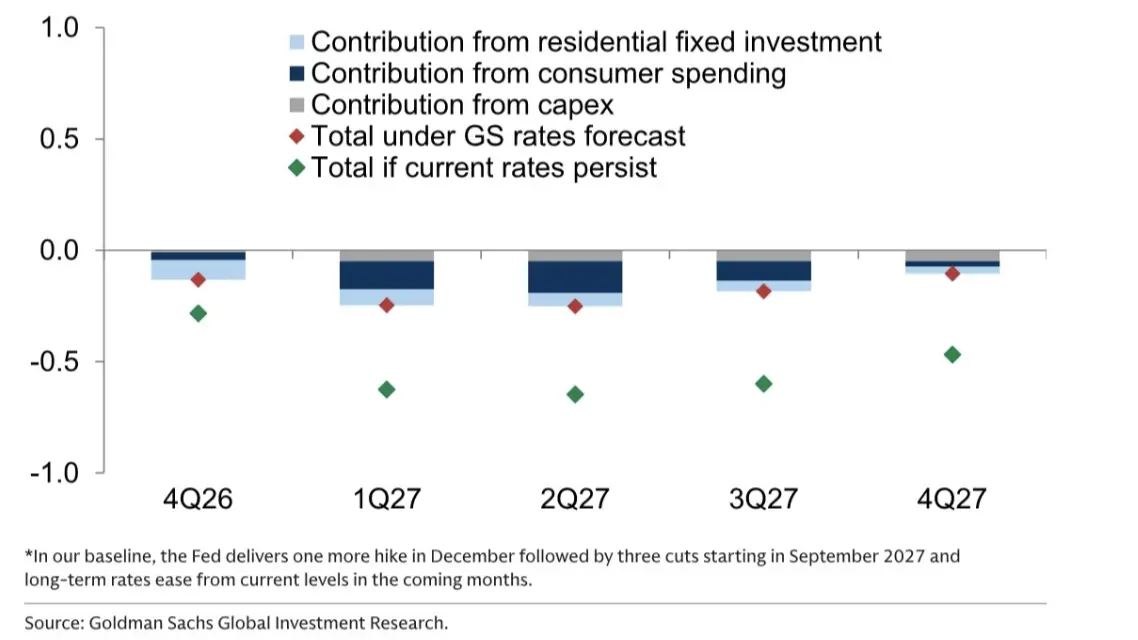
Caption: Goldman Sachs' baseline assumption is that the Federal Reserve will raise rates once more in December, followed by three rate cuts starting in September 2027, with long-term rates expected to decline from current levels in the coming months. The image shows model estimates under different interest rate paths.
Whether Goldman Sachs' Baseline Holds Depends on Two Conditions
Goldman Sachs also expects another rate hike this year and rate cuts next year, reflecting a conditional policy path: short-term inflation still needs to be constrained, followed by gradual adjustments to economic and price conditions.
However, this judgment requires the combination of two conditions.
First, core inflation must show more sustained easing. If price increases do not decrease for a long time, or if energy costs further transmit to other goods and services, the duration of tightening may be extended. The timing of the expected rate cuts by Goldman Sachs will also face reassessment.
Second, long-term rates need to fall from current levels. This is an important assumption in Goldman Sachs' relatively mild growth drag estimate. If long-term rates remain high, even if policy rates are no longer continuously raised, financing costs may still continue to suppress demand.
From an asset pricing perspective, this requires investors to separately assess the policy shift and the improvement in the financing environment. Stopping rate hikes can alleviate concerns about further tightening, but whether growth pressures can ease will depend on whether actual borrowing costs decline.
The variables to be observed going forward are therefore clearer: whether core inflation continues to slow, whether long-term rates decline, and whether housing, investment, and employment begin to show more significant pressure.
The 0.2 percentage point growth drag estimated by Goldman Sachs is the result under the scenario of subsequent rate declines. If inflation stickiness forces financing costs to remain high for a longer time, the costs that the U.S. economy needs to bear could be significantly higher than this baseline.
 Risk warning



Popular articles





