








Asia's "Black Thursday": One AI, Four Pricing Models, the Market Went Crazy

 When interest rate expectations shift and valuations of external tech stocks come under pressure, the financing and quantitative funds in these sectors concentrate on withdrawing. The rise of liquor and brokerage stocks against the trend indicates that funds are not withdrawing completely, but are making structural defensive switches.
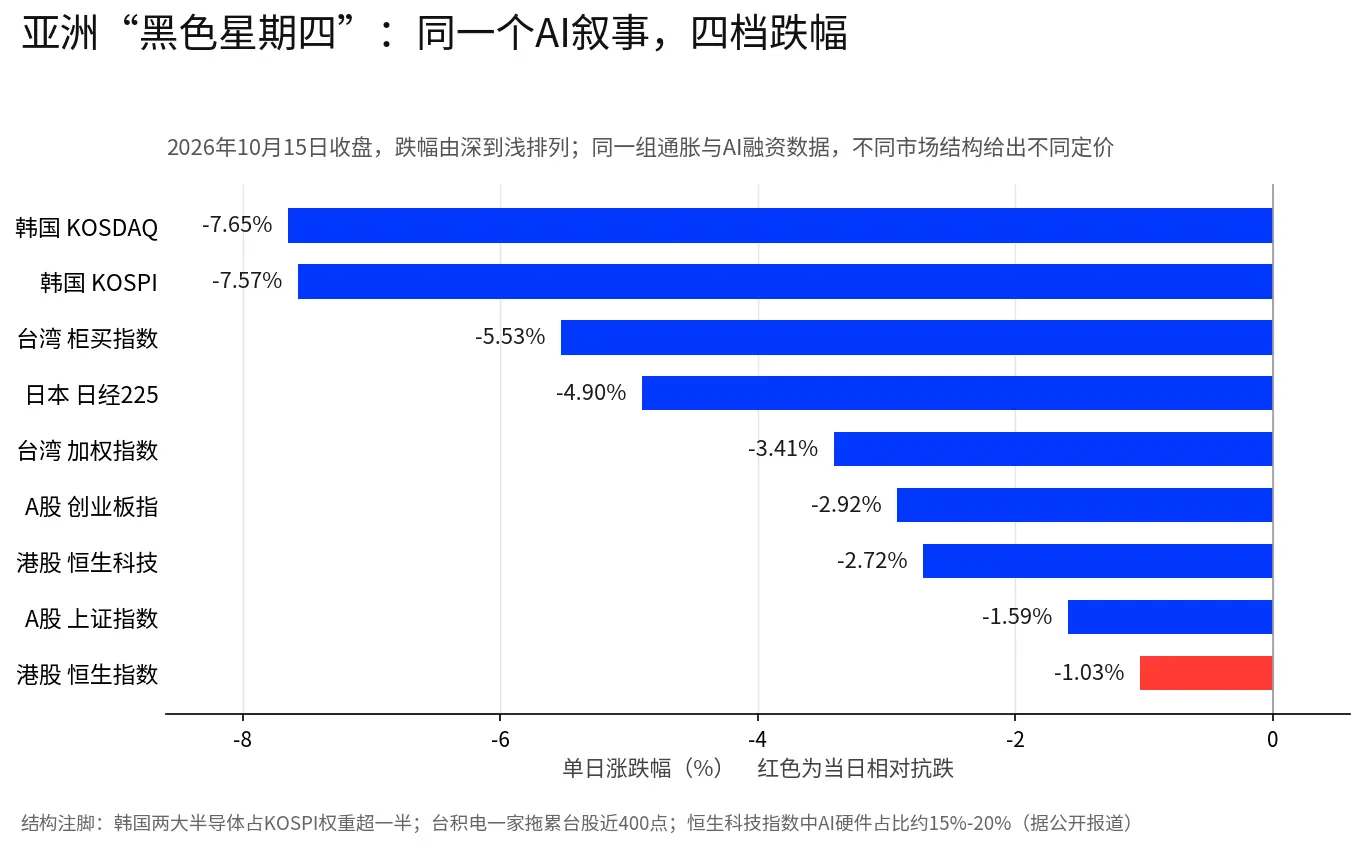
Introduction: On October 15, the Asian markets experienced a rare synchronized deep decline, but the drop varied by seven times. If it were simply "the Asian markets fell together," the declines should be similar; behind the four levels of decline is the same AI narrative being repriced in four different market structures. This article breaks down the situation in five markets: South Korea, Japan, Taiwan, Hong Kong, and A-shares, examining what AI assets look like in each market and where the impact is coming from.
South Korea: The epicenter, the disappearance of buying power is more noteworthy than changes in profits
The KOSPI and KOSDAQ triggered a level one circuit breaker in succession, pausing trading for 20 minutes. This is the 10th circuit breaker in the South Korean stock market this year and the first time since July 29 that both major indices have triggered a circuit breaker on the same day. SK Hynix fell by 11.06%, and Samsung Electronics fell by 9.48%; since October 6, the KOSPI has fallen for the seventh consecutive trading day, with a cumulative decline of about 21%.
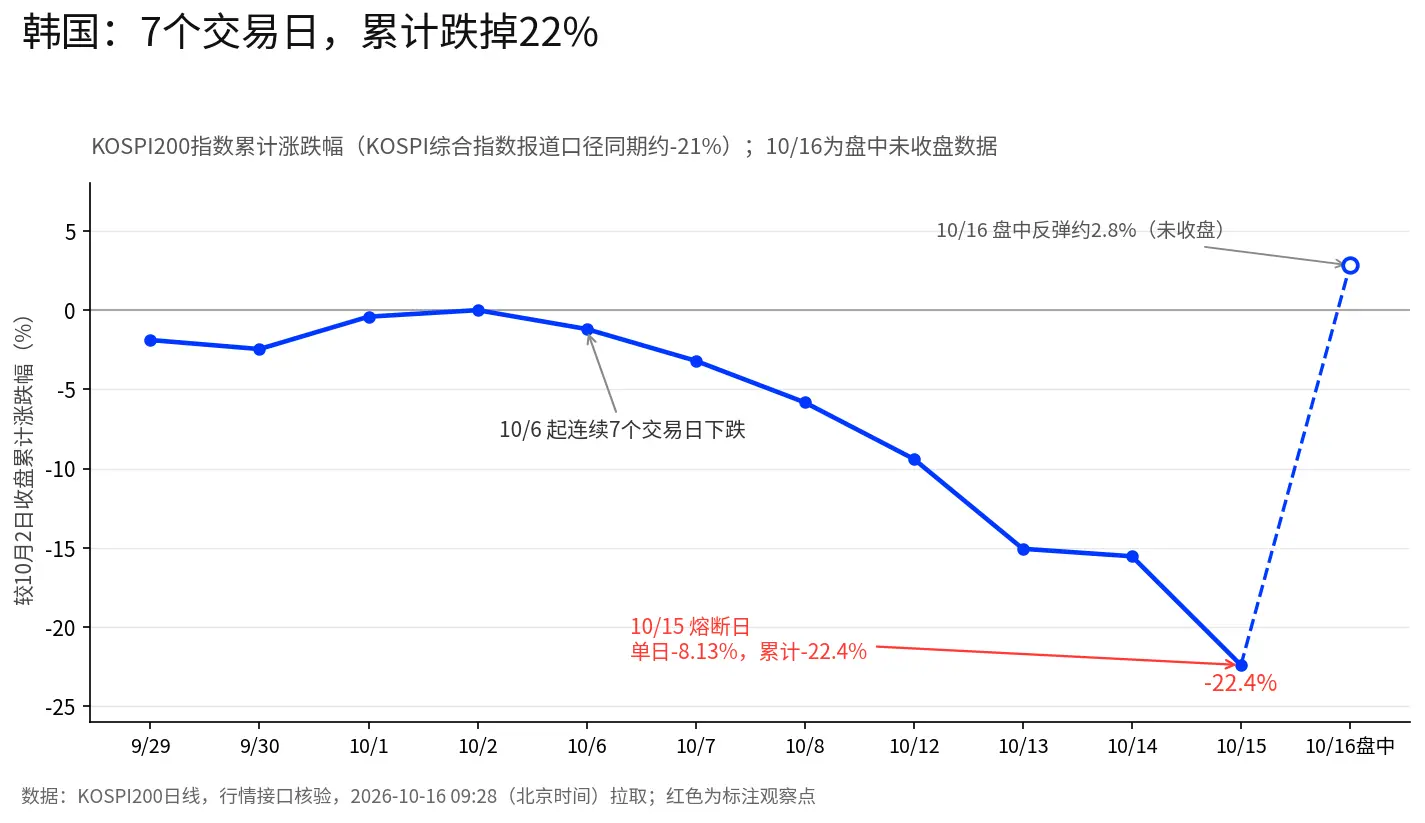
The KOSPI200 data is more detailed than reported: based on the closing price on October 2, the cumulative drop by the close on October 15 was 22.4%, with a single-day drop of 6.25% on October 13 and 8.13% on October 15 (the KOSPI composite index was -7.57% that day). Reports indicate that after a rapid decline during trading, both major indices triggered a level one circuit breaker and paused trading for 20 minutes. The circuit breaker mechanism provides a cooling-off period but does not change the chip structure—foreign capital that needs to sell and buybacks that have concluded still face selling pressure after the pause ends. Notably, as of 9:28 AM Beijing time on October 16, the KOSPI200 rebounded about 2.8% during trading (unclosed data): a rebound from overselling may occur, but the issue of a vacuum in buying power ultimately needs to be addressed by new funds.
The most worthy contradiction to explore is that profits are still at record levels. Samsung Electronics' preliminary results show that the operating profit for the third quarter is expected to be 107.4 trillion won, nearly nine times that of the same period last year (according to reports), but the stock price has fallen nearly 20% since the earnings forecast was released. According to KB Securities researchers (according to reports), market concerns about the sustainability of AI investments are driving investors to price semiconductors based on cyclical stock logic. This is not a story of "earnings falling short of expectations," but rather a story of "whether the market is willing to pay a growth stock premium for cyclical peak earnings."
Changes in chip structure may be more critical than profits. Reports indicate that foreign capital has withdrawn over $130 billion from the South Korean stock market this year, the largest among major Asian markets; on October 15, there was a net sell of about 2.9 trillion won (KOSPI, combined with KOSDAQ reports totaling about 3.6 trillion won), marking the eighth consecutive trading day of net selling. A more important variable is buybacks: Samsung Electronics and SK Hynix's combined buyback plan of about 55 trillion won (approximately $41 billion) is nearing completion, and JPMorgan estimates that most of the $23 billion in buying in the South Korean stock market last month came from the buybacks of these two companies (according to reports). After this important source of buying power fades, the market's ability to absorb selling pressure has clearly weakened.
The South Korean Financial Services Commission stated after the meeting that it will closely monitor the market and quickly implement emergency plans if necessary; attending officials and experts believe that under multiple overlapping factors, the extent of the decline and the speed of capital outflow may have shown a certain degree of overreaction.
Japan: The trigger and the balance sheet
The Nikkei 225 fell 4.90% to 64,425.95 points, with a drop of 3,318.34 points, marking the third-largest drop in history. Reports indicate that the trigger point that day was the significant decline in bond prices of the American cloud computing company CoreWeave—AI-related stocks had been rising continuously, and market concerns about the scale of industrial investment, financing costs, and balance sheet conditions had been accumulating, with the volatility of related bonds amplifying risk aversion.
The sell-off was concentrated in the semiconductor chain. Reports indicate that the leading semiconductor automatic test equipment company Advantest fell over 14%, Tokyo Electron saw a maximum intraday drop of nearly 8%, and SoftBank Group fell 9.33%. The uniqueness of the Japanese market lies in the fact that SoftBank is one of the largest AI investors in Asia and paid a record financing yield at the end of last month to support its AI investment plans. When AI financing costs rise, the pressure on SoftBank's balance sheet is quickly reflected in its stock price; and since semiconductor equipment manufacturers are concentrated in the Nikkei weight, their valuations are also more sensitive to interest rates and AI capital expenditures.
Connecting these three events into a chain makes it clearer: the weakening of CoreWeave's bonds is the financing end of American AI infrastructure, SoftBank paying record yields for AI investments is the investment end, and the concentrated sell-off of equipment manufacturers and semiconductor weight stocks is the production end—three links of the same financing chain being priced by the market on the same day. Whether this chain continues to tighten is more indicative of where the constraints for the next phase of the AI market lie than simply looking at the declines in any one market.
Taiwan: One company drags down nearly 400 points, small and medium-sized stocks fall deeper
The Taiwan Weighted Index closed down 1,655.96 points at 46,969.87 points, marking the sixth-largest closing drop in history; the OTC Index (mainly small and medium-sized stocks) fell 5.53%, with a total of 1,898 listed companies declining (according to reports).
Taiwan Semiconductor Manufacturing Company ADR fell 3.4% the previous night, opening down 70 NT dollars that day, closing at 2,440 NT dollars, a drop of 2.01%, dragging down the index by nearly 396 points (according to reports). According to Taiwanese media reports, MediaTek fell 6.93%, Delta Electronics fell 8.68%, and ASE Technology Holding Co. hit the limit down. Local investment analysts interpret this as a chip structure issue: inflation higher than expected, rising probability of further interest rate hikes by the Federal Reserve, and AI companies relying on debt to support construction expenditures, combined with high financing balances, led to simultaneous releases of profit-taking and financing cleaning selling pressure (according to reports, this view only represents the judgment of relevant individuals).
Hong Kong: The market with the smallest decline, southbound funds are making structural adjustments
The Hang Seng Index closed down 1.03% at 24,062.72 points, the smallest decline among major Asian markets. The structural reason is that AI hardware accounts for only about 15% to 20% of the Hang Seng Tech Index, which is essentially dominated by internet platforms; when AI hardware valuations are reassessed, the structural dispersion provides a buffer.
The behavior of southbound funds is worth examining closely. On October 15, southbound funds had a net sell of 5.08 billion HKD, the highest single-day figure in nearly two weeks (according to reports). There is a clear structure in the flow: net buying of Tencent at 852 million HKD, China National Offshore Oil Corporation at 331 million HKD; net selling of Yangtze Optical Fibre and Cable at 931 million HKD, Hua Hong Semiconductor at 800 million HKD, and Semiconductor Manufacturing International Corporation (continuously reduced for the 13th day). Southbound funds appear to be shifting internally within the Hong Kong stock market from AI hardware manufacturing to platforms and defensive assets, which is a different nature of action compared to the overall withdrawal of foreign capital from South Korean semiconductors.
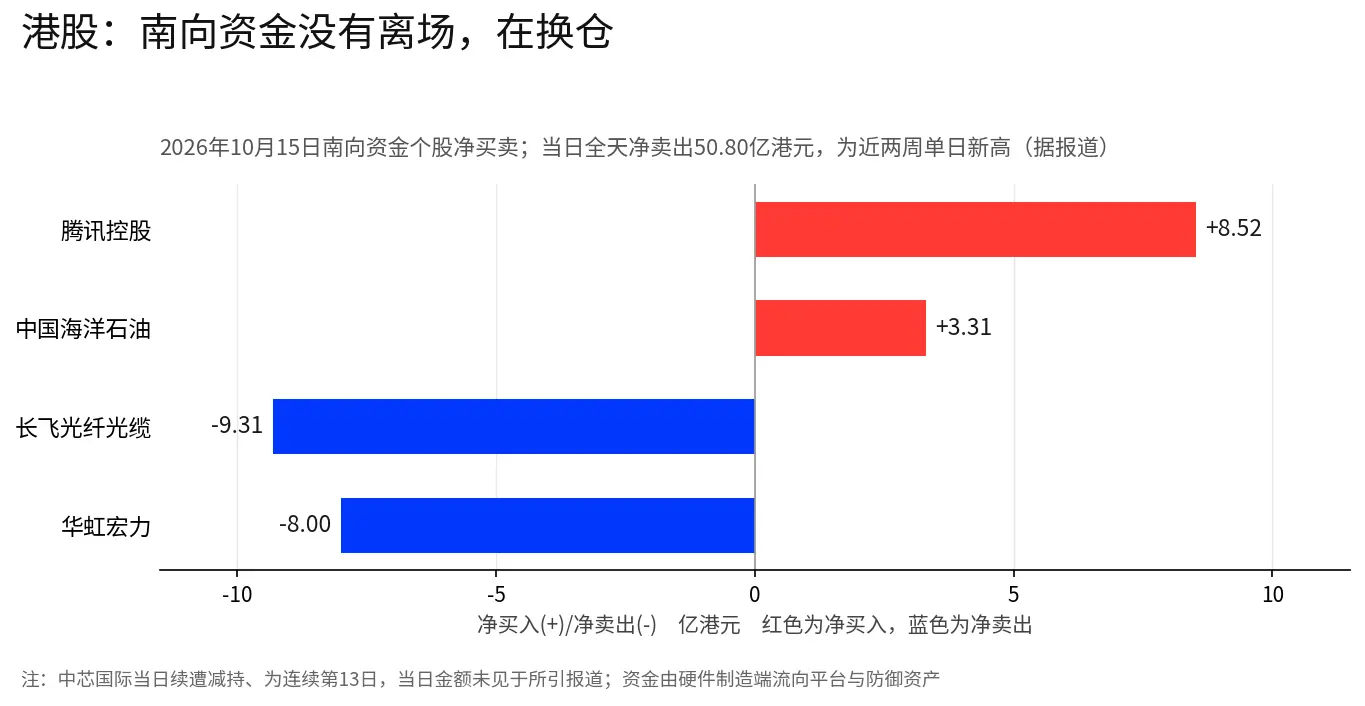
If this adjustment continues, the pressure on hardware in the Hong Kong stock market remains, while the platforms may show relatively stronger resilience; this is an observational perspective and does not constitute a pricing conclusion.
A-shares: The combination of sentiment, technical aspects, and external shocks
The Shanghai Composite Index closed down 1.59% at 3,707.48 points, barely holding above 3,700 points, while the ChiNext Index fell 2.92%; across the market, 5,108 stocks declined, with a total market value evaporating by about 2.25 trillion yuan in a single day (according to reports). Fund managers interviewed in mainland China believe that the adjustment is a resonance of internal and external factors: the Nasdaq fell 1.88% overnight, and the Philadelphia Semiconductor Index fell 4.3%, with the pressure of AI hardware valuations being transmitted domestically, while insufficient incremental funds remain the core contradiction (according to reports, this view only represents the judgment of relevant institutions); investment strategy professionals state that the market is not experiencing a non-resistant decline, but rather a concentrated release after the combination of sentiment, technical aspects, and external shocks, with external factors being an important trigger (according to reports).
The uniqueness of A-shares lies in the fact that optical modules and PCBs have been crowded trading directions over the past two years. When interest rate expectations shift and external tech stock valuations come under pressure, the financing positions and quantitative funds in these sectors have concentrated withdrawals. The rise of liquor and brokerage stocks against the trend indicates that funds are not fully withdrawing but are making structural defensive switches.
The same AI, four pricing methods
Putting the five markets together, the root of the differences lies in the different forms of AI assets in each market structure:
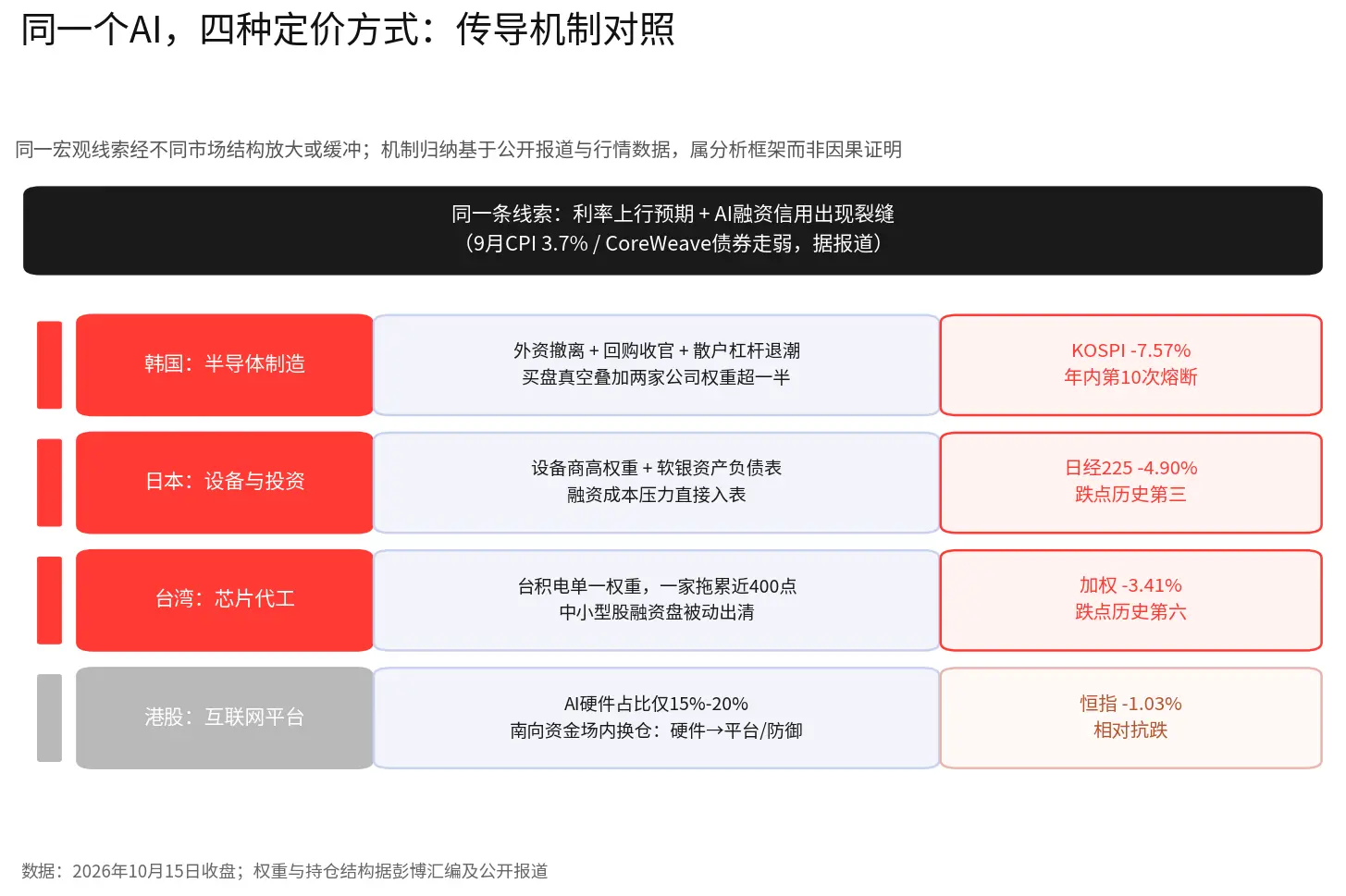
In South Korea, AI is semiconductor manufacturing: two companies account for over half of the KOSPI weight (compiled by Bloomberg), with a high proportion of foreign ownership and buybacks being an important source of buying. When foreign capital withdraws and buybacks conclude simultaneously, the concentration amplifies the decline.
In Japan, AI is semiconductor equipment and investment: equipment manufacturers are core weights, and SoftBank is the largest AI investor. When financing costs rise, the pressure on balance sheets is directly transmitted.
In Taiwan, AI is chip foundry: TSMC alone contributed nearly 400 points to the decline, making it nearly impossible for the index to hedge a single weight; small and medium-sized stocks further amplify volatility.
In Hong Kong, AI is internet platforms: with a low hardware proportion, southbound funds internally complete a structural hedge of "hardware for platforms."
In A-shares, AI leans towards manufacturing and computing power chains: crowded optical modules and PCBs face deeper pressure, while defensive sectors rise against the trend, indicating an internal market switch.
The same AI narrative corresponds to completely different asset structures in the four markets. When the macro variable of "AI financing constraints" impacts all markets, each market's way of bearing the shock depends on what its AI assets look like. Historical comparisons serve only as references; past performance does not guarantee future results.
Why the buffering methods differ: The nature of three types of buying power
The differences among the four markets, in addition to the forms of AI assets, also stem from the nature of the buying power.
Foreign capital is trend-following capital. It is most sensitive to interest rates and credit events; once a direction is formed, selling is continuous and in the same direction—net selling of about 2.9 trillion won in a single day for eight consecutive days exemplifies this nature.
Buybacks are mechanical buying power with a limited duration. They buy continuously without regard to valuation during the announcement period; the scale of 55 trillion won is sufficient to support the market during slow declines; however, they disappear once the announcement period ends, providing no continuity. This is the change in the South Korean stock market that is most easily underestimated in this round.
Southbound funds are allocation-type funds. On that day, there was a net sell of 5.08 billion HKD, but they sold hardware and bought platforms and defensive assets; the money did not leave the market but merely shifted positions internally.
A-shares' financing positions are leveraged funds. They usually amplify gains but are passively liquidated during declines, turning crowded trades into concentrated releases; the rise of liquor and brokerage stocks against the trend indicates that market funds are switching rather than fully retreating.
Facing the same clue of "AI financing constraints": South Korea encountered a simultaneous retreat of three types of buying power, with the impact amplified by high concentration; Hong Kong encountered internal maneuvering of allocation-type funds, with the impact absorbed by structural dispersion. The difference in declines by seven times can be partially explained by asset structure and the other half by the nature of buying power. This framework is inductive rather than causal proof; its validity can be verified through the following observational points.
Upcoming market focus points
First, whether the foreign capital sell-off of Korean stocks has slowed after regulatory statements, and whether there are specific arrangements for stabilization measures; the approximately 2.8% intraday rebound of KOSPI200 in the morning session on October 16 (as of 9:28 AM Beijing time) can be sustained, is the first observation window for the nature of the incoming funds. Second, the bond prices and credit spreads of CoreWeave. It is one of the important triggers for this round of Asian AI hardware sell-off; if the bonds continue to weaken, the pressure on AI companies' financing costs will continue to transmit to Asian hardware stocks. Third, whether the southbound funds' "hardware exchange for platform" reallocation continues can serve as one of the observation indicators for the structural differentiation of Hong Kong stocks. Fourth, the clearing progress of the financing balance in the technology sector of A-shares, as well as the sustainability of the counter-trend performance of liquor and brokerage stocks.
Disclaimer: The content of this article is for general information and market commentary purposes only, compiled based on publicly available information as of the time mentioned in the text. Relevant market data, expectations, and probabilities may change with market conditions. The views and investment strategies quoted from third-party institutions, analysts, or other individuals in this article only represent the views of the relevant third parties at a specific time and do not represent the views or recommendations of BIT. This article does not constitute investment advice, investment research, an invitation, solicitation, or recommendation for any securities, investment products, or trading strategies, nor should it be the basis for any investment decisions. Financial markets carry risks, and securities prices and market performance may fluctuate; past performance and historical market trends do not represent or guarantee future results. Investors should independently assess the relevant risks based on their own circumstances and seek professional advice when necessary. BIT's Hong Kong stock trading services are not provided to residents of Hong Kong or users in other restricted jurisdictions.
 Risk warning



Popular articles





