








Anthropic released an internal employment report: the working hours of intelligent agents reached six times that of humans, the "Era of Meta-Work" has arrived
 Core Viewpoint

 As one of the leading companies in AI applications, these changes within Anthropic provide a sample for observing how AI may influence the working methods and hiring needs of other companies.
Author: Tencent Technology
On October 16, local time in the United States, Anthropic released an internal research report on its workforce structure—"How Employment is Changing at Anthropic."
This study is based on Anthropic's internal employment records, AI usage telemetry data, employee output metrics, employee surveys, internal communication records, calendar data, and hiring decision scorecards, combined with 17 in-depth employee interviews, systematically analyzing the changes in job content, recruitment structure, and labor demand after the deep application of AI in the company.
The report presents four main findings:
First, the recruitment proportion of entry-level technical positions at Anthropic has significantly decreased, from 27% at the beginning of 2025 to 9% in 2026. However, the overall employment scale of the company is still expanding, with the pressure being on entry-level positions rather than the total number of positions.
Second, the working hours of AI agents have rapidly increased. As of August 2026, the interactive agents directly guided by Anthropic employees have work hours that have reached six times that of human operators. Productivity in several positions has improved, and the research team further assessed the independent contribution of AI through comparative analysis.
Third, the work content of employees is undergoing structural changes. From directly executing tasks to building tools, monitoring workflows, and managing agents, the focus of employees' work is gradually shifting. Meanwhile, human attention has become a new bottleneck, and recruitment standards are beginning to shift from domain expertise to autonomy and judgment.
Fourth, Anthropic has begun to establish early warning systems and internal personnel allocation mechanisms. However, the report points out that corporate-level responses are still insufficient to address broader social issues such as the narrowing of entry-level positions.
As one of the leading companies in AI applications, these internal changes at Anthropic provide a sample for observing how AI may influence the work methods and recruitment needs of other companies.
Shrinking Recruitment of Entry-Level Positions
The most striking data in the report is the significant decline in the recruitment proportion of entry-level technical positions.
Since the beginning of 2025, the proportion of junior employees in Anthropic's technical department has decreased from 21% to 14%, while the recruitment proportion of entry-level technical positions has dropped from 27% to 9%. After December 2025, there has been a particularly noticeable decline in the number of job postings for entry-level positions.
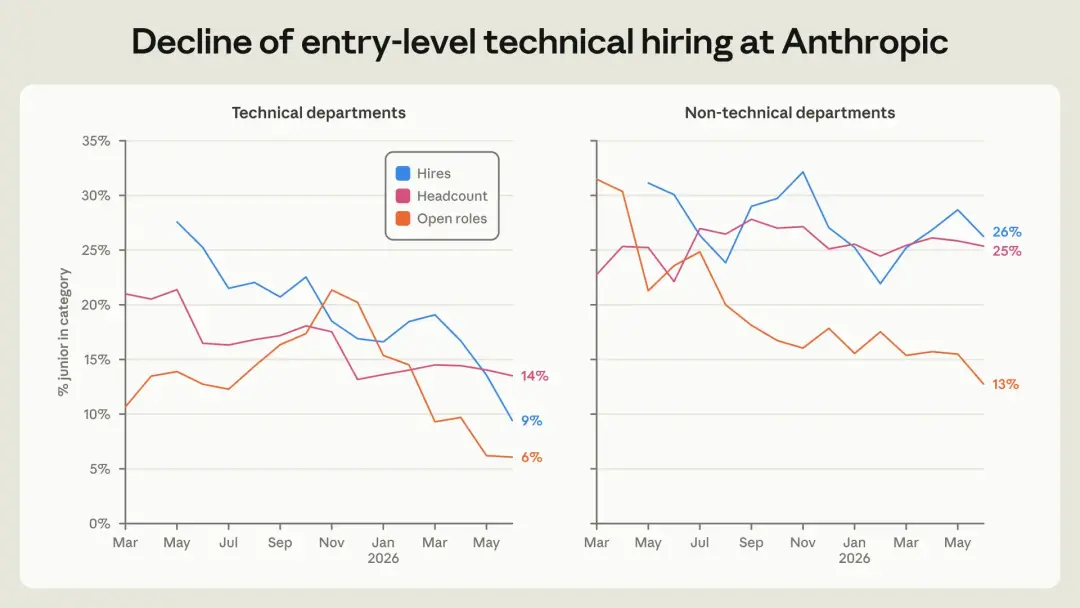
Decline in Anthropic's entry-level technical position recruitment
This change is not due to a contraction of the company. On the contrary, Anthropic has expanded to three times its original size over the past year, and the absolute number of technical positions is still increasing. The real change is in the recruitment structure: new positions are more concentrated at the mid-senior and expert levels, while the entry-level positions have clearly narrowed.
Discussions about the demand for entry-level positions first emerged in the core technology department in January 2026.
Some teams heavily using Claude found that routine engineering tasks such as basic coding and bug checking could increasingly be handled by models. The impact on performance engineering positions is particularly evident. One interviewee stated that this almost overnight changed the team's talent needs.
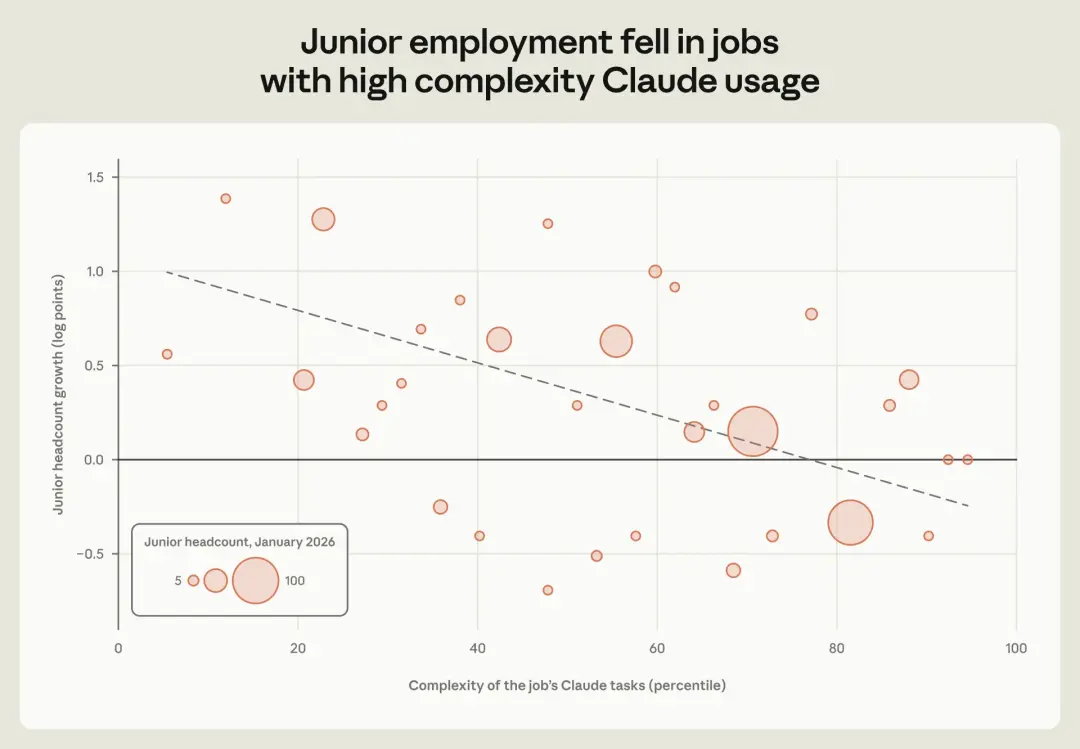
Positions with higher complexity using Claude see slower growth in entry-level employees
By April 2026, engineering and research teams had begun systematically lowering the recruitment weight for lower-level positions. An internal survey that month showed that about one-third of machine learning managers and one-fifth of software engineering managers indicated that they had reduced hiring due to the use of AI.
Entry-level positions are the first to be impacted, which is related to the characteristics of such jobs.
Entry-level work typically has clear rules and strong execution characteristics, which are precisely the areas that current large language models can handle well. Tasks such as coding, data processing, document organization, and customer support have all been affected by AI to varying degrees, and the model's ability to perform these tasks continues to improve.
As the model's capabilities leap forward every few months, the first to be replaced may be at the "bottom end" of the skill ladder.
Non-technical departments are also showing similar trends. Typically, when a company expands, support departments such as administration, finance, and human resources also increase in personnel. However, at Anthropic, methods such as agent assistants, automated reviews, and outsourced ticket services have allowed the company to maintain a streamlined clerical staff while rapidly expanding.
An administrative assistant developed a personal assistant agent for schedule management and email classification, stating that the team has moved past the stage of enhancing entry-level administrative positions with Claude, and the focus of work has begun to shift towards higher-level coordination and planning tasks.
Agent Work Hours Reach Six Times That of Employees
Behind the changes in recruitment structure is the rapid proliferation of agents within the company.
In March 2026, the cumulative work hours of two types of AI agents—those autonomously operating and those directly guided by employees—first exceeded the work hours of human employees. Since then, the work hours of agents have continued to grow. By August of this year, the work hours of interactive agents directly guided by employees had reached six times that of human employees.
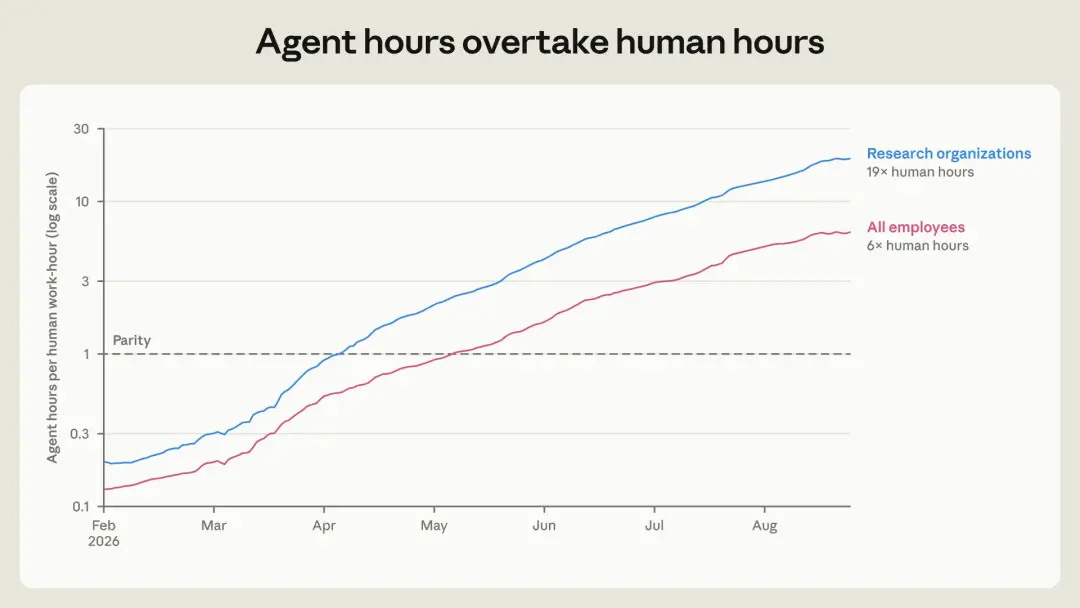
Agent work hours have exceeded human hours
A large number of agents have been deployed in the software engineering field, undertaking tasks such as test case generation, code checks, infrastructure maintenance, and codebase migration. This data does not yet include fully autonomous agent clusters. For individual engineers, this means they can arrange multiple agents to continuously perform tasks while checking the code and analysis results they generate. The work of engineers is also gradually shifting from personally writing code to task allocation and result review.
The changes in productivity are also reflected in specific data. The report shows that the average code submission per engineer has increased to five times its original amount within six months, while the query processing volume of data scientists has significantly risen, and the output of non-technical positions such as lawyers, accounts payable, and sales has also increased.
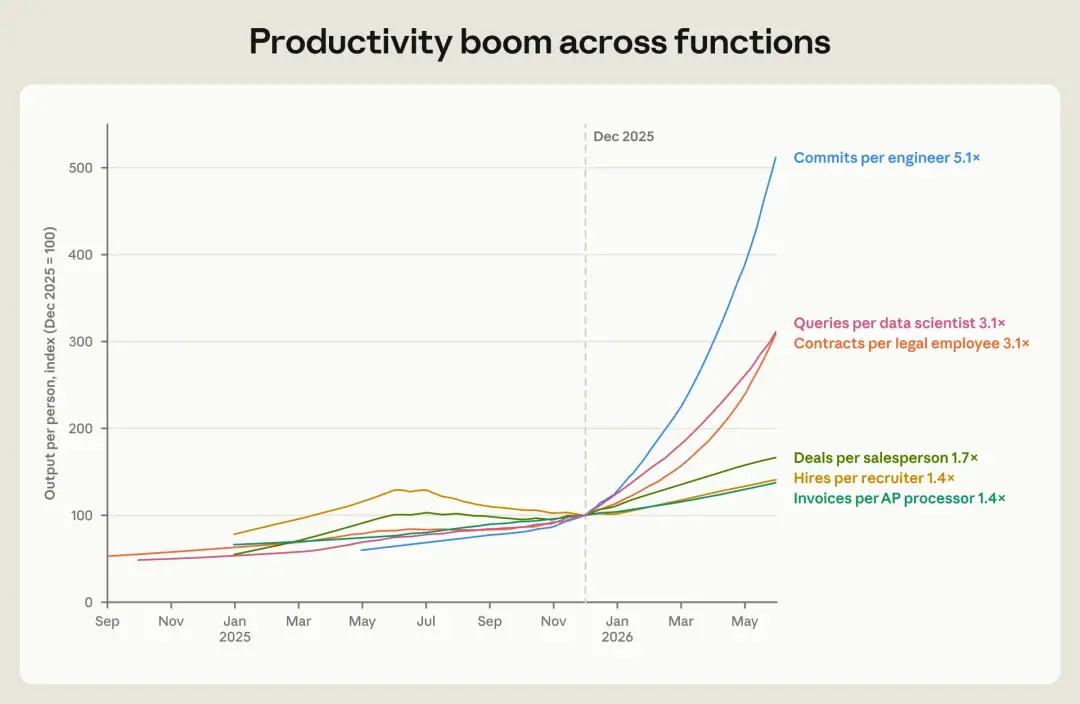
Employee productivity surged after multiple functional departments at Anthropic adopted AI technology
To eliminate the interference of factors such as business growth, the research team employed a comparative analysis method. They tracked 192 engineers who adopted coding agents and used 74 engineers who had not yet adopted the tool as a control group, utilizing individual and month fixed effects for estimation.
The results showed that after adopting coding agents, engineers experienced statistically significant rapid growth in their code submission volume.
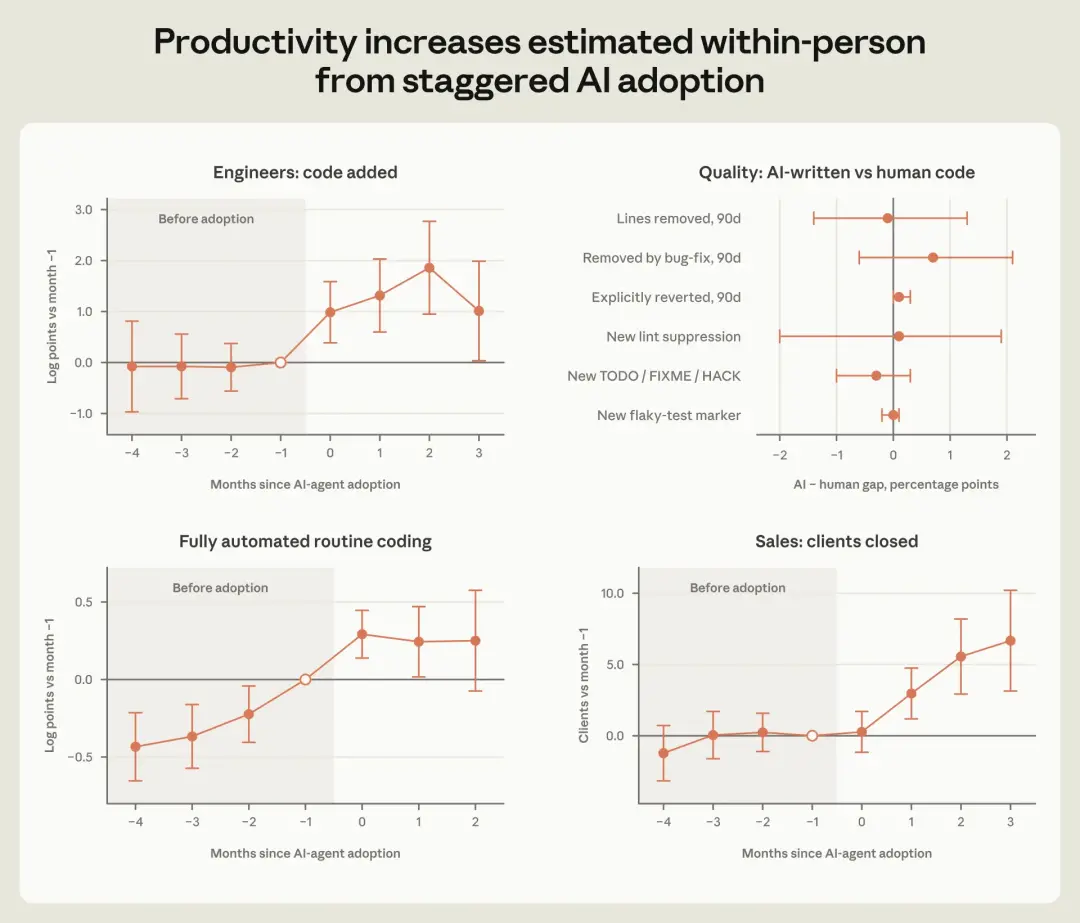
Anthropic engineers saw an increase in output after adopting coding agents, with no significant difference in the rollback rate of AI-generated code compared to handwritten code
The report also analyzed whether AI would generate low-quality code.
The research team compared code generated directly by agents and code manually written by the same employee in the same month and code directory, using the proportion of code deleted or rolled back within 90 days as a quality assessment metric. The results showed no statistically significant difference in code quality between the two. At least in terms of rollback rates, AI-generated code performs comparably to human-written code.
Productivity in non-technical positions has also improved. The report indicates that sales representatives saw an increase in the number of completed customer transactions after adopting agents. One client manager estimated that Claude automated about 20% of routine work, including drafting emails and operating customer management systems.
Another interviewee stated that the time freed up by automation allowed them to increase their customer meeting volume by 30%.
From Executors to Agent Managers
The increase in the number of agents and productivity improvements have not freed employees from work. On the contrary, human attention is gradually becoming the bottleneck for agent output.
The report shows that in interactive conversations, agents spend about 80% of their time in a waiting state, needing humans to issue commands, confirm results, or provide next steps.
The research team also converted the tokens output by agents into reading time based on the average reading speed of ordinary people. The results showed that the content generated in interactive Claude sessions in non-technical departments takes up a significant portion of employees' weekly work time. Just reading and processing AI-generated content has become a workload that cannot be ignored.
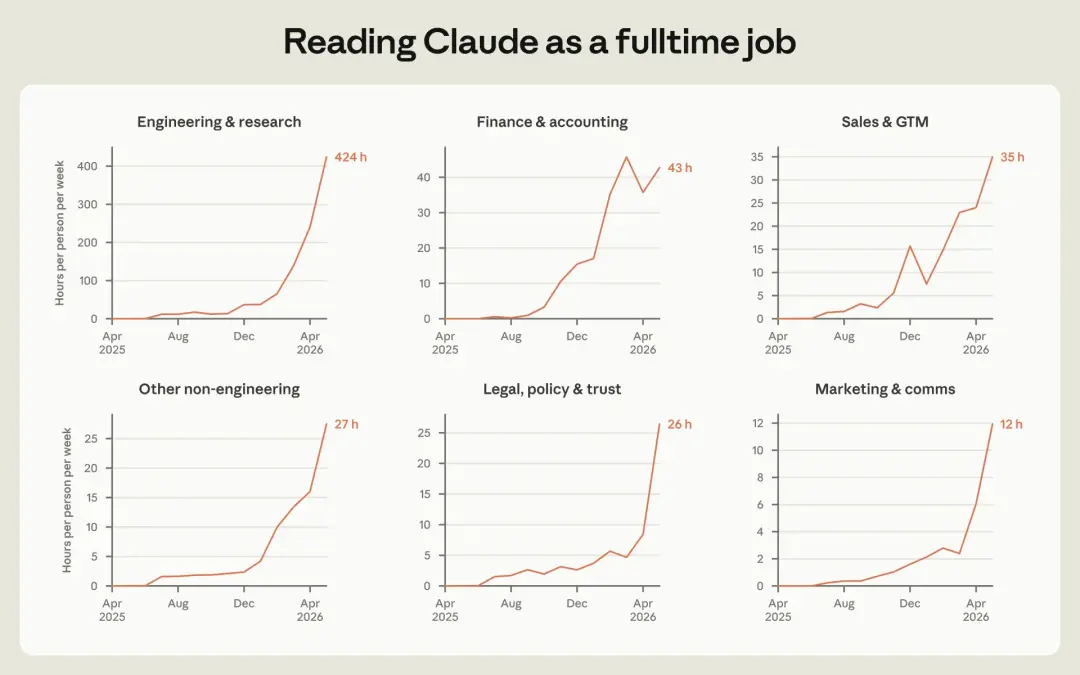
Reading only Claude's output is equivalent to a full-time workload
In response to this change, employees have gradually formed a new way of working. The report refers to this as "meta-work," which involves management work centered around agents, including building management tools, writing standing instructions, designing monitoring dashboards, and arranging cross-reviews among different agents. The core of this type of work is no longer directly executing specific tasks but rather designing and managing the processes through which AI completes tasks.
Relevant data also records this transition. In the fall of 2025, "meta-work" accounted for about 10% of employees' interactive Claude sessions. By spring 2026, this proportion rose to 22%. The growth mainly came from agent management activities, including writing specifications for multi-agent systems, arranging cross-reviews among agents, and monitoring the operational status of workflows.
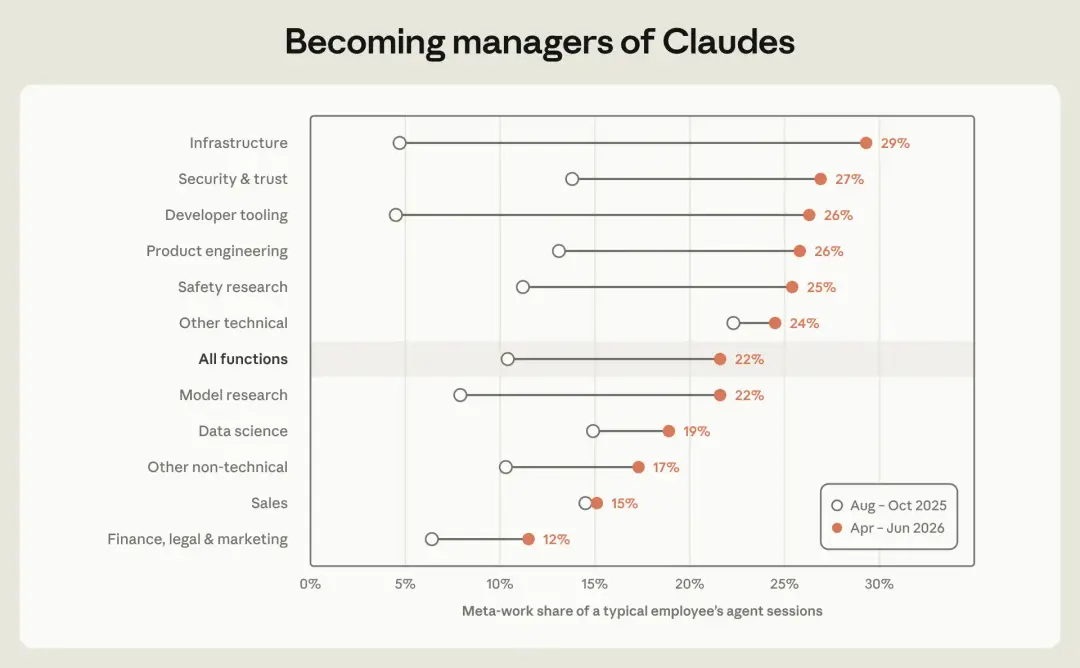
Anthropic employees are increasingly managing agents rather than doing the actual work themselves
The changes in work methods are also reflected in recruitment standards.
The research team conducted automated coding analysis on the interview scorecards of thousands of Anthropic employees since 2024 and found that the proportion of evaluations mentioning the ability to use AI tools in technical positions increased from about 5% to about 15%, while in non-technical positions, it rose from about 7% to about 28%.
At the same time, the focus of recruitment assessment has also changed. In technical positions, autonomy and judgment have become rapidly growing assessment dimensions, while the weight of domain expertise has relatively decreased; non-technical positions place greater emphasis on customer awareness and mission orientation, with less discussion on execution skills. A hiring manager stated that he expects model capabilities to still vary across different fields, so he hopes team members can switch flexibly between different areas.
A case in the report also reflects this change.
A design team at Anthropic responsible for writing greetings for the Claude.ai product developed a context mapping system in the spring of 2026, guiding agents to generate product copy, thereby expanding the team's output capacity. Subsequently, the team shifted to agent prompt engineering, taking on the responsibility of writing model evaluation content and prompts.
The report summarized this: Writers who once influenced human behavior through language are now beginning to influence Claude's behavior through language. In other words, the job titles and shells have not changed, but the core of their work may have.
Entry-Level Challenges
The case of Anthropic presents the impact of AI on employment structures. As one of the leading companies in AI applications, the changes occurring within the company provide a reference for observing potential changes in other industries in the future.
Currently, the impact of AI on employment is first reflected in entry-level cognitive labor. Positions such as junior programmers, entry-level analysts, frontline customer service, basic copywriters, and junior finance roles, which were traditionally the starting points for university graduates entering the workforce, are now gradually being influenced by AI.
The issues brought about by this change are not only about the number of positions. Entry-level roles are also important starting points for employees to accumulate experience, learn business processes, and gradually grow. As this level shrinks, the opportunities for young people to secure their first job and accumulate professional experience may also decrease. If companies gradually shift their requirements for newcomers towards the ability to use AI tools, judgment, and autonomy, then the question of at what stage and through what means these abilities should be acquired also becomes a challenge to face.
The report discusses several measures that companies can take:
First, through a broad equity-sharing mechanism, allow employees to share in the benefits brought about by AI-driven productivity improvements. When employees need to manage agents and take on more decision-making responsibilities, aligning personal interests with organizational goals becomes even more important.
Second, establish an early warning system to continuously monitor the impact of AI on different positions and plan for the internal reassignment of affected employees in advance.
Third, strengthen internal mobility mechanisms. When existing tasks gradually become automated, help employees transition to new work areas instead of pushing them directly into the external labor market.
However, internal measures within companies are still insufficient to address broader social issues. As a cutting-edge AI company, Anthropic is in a position to provide internal reassignment and benefit-sharing mechanisms for its employees. For most traditional industry companies and employees, these resources and institutional arrangements may not be available. Who will help these companies identify changes in positions? Who will bear the costs of employee skill transitions? These questions have gone beyond the scope of a single company's response.
At the end of the report, one statement is noteworthy: "A workforce that is anxious and worried is not a workforce that will do its best."
This statement reminds us that the impact of AI on employment is not only economic but also psychological and social.
As the definition of work is rapidly changing, as entry barriers continue to rise, and as everyone needs to constantly prove they will not be replaced by AI, this ongoing uncertainty itself can become a widespread social psychological burden.
Anthropic's experiments are still ongoing. The capabilities of agents are continuously enhancing, the number of applications is steadily increasing, and the division of labor between humans and AI is also constantly changing. The final form of this transformation remains unclear, but one thing is certain: jobs may not disappear, but the meaning, thresholds, and value rankings of work are being rewritten.

 Risk warning



Popular articles





