"All bad things collided," yet the US stock market rebounded against the trend: Wall Street staged a "no tickets to sell" short squeeze
 Core Viewpoint


 NVIDIA founder Jensen Huang left quietly, CPI and PPI exceeded expectations consecutively, and the Federal Reserve hinted at a 50 basis point rate hike in December—bad news came all at once, yet the U.S. stock market rose against the trend, with the S&P 500 gaining 2% for the week. Goldman Sachs data shows that hedge fund net leverage has dropped to a five-year low, short positions have been largely cleared, and despite the bad news, there were "no tickets to sell," leading to a short squeeze that boosted the stock market; the bond market faced pressure alone, with the yield on the 2-year U.S. Treasury soaring 35 basis points in a single week.
Author: Zhang Yaqi, Wall Street Journal
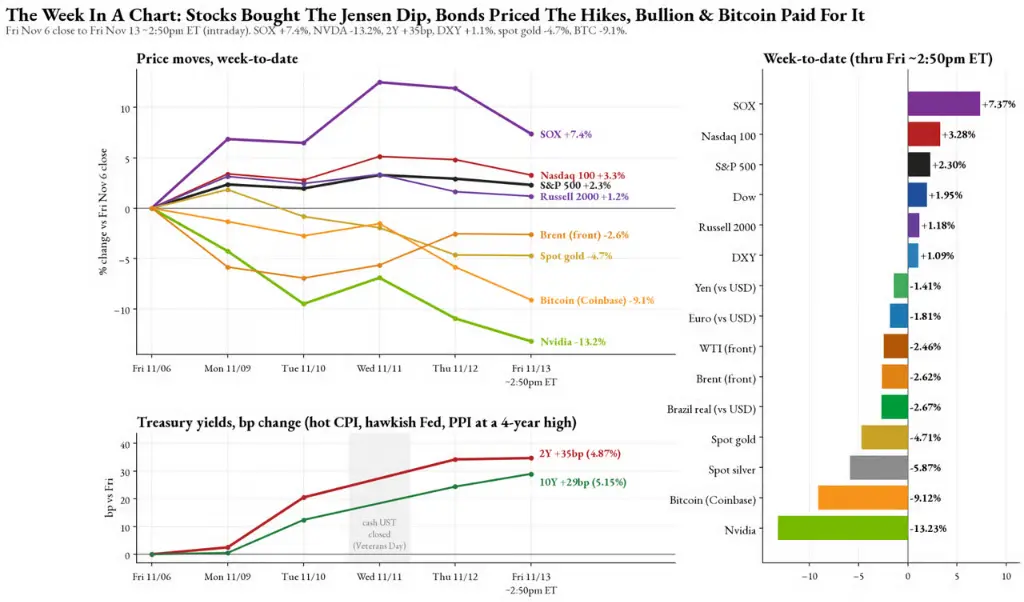
Within a week, after being embroiled in scandals, the founder of NVIDIA resigned quietly. The U.S. CPI exceeded expectations for the third consecutive month, PPI climbed to a four-year high, and Federal Reserve officials hinted at a 50 basis point rate hike in December------all negative news exploded simultaneously, yet the U.S. stock market rose against the trend, with the S&P 500 gaining 2% for the week, and the Philadelphia Semiconductor Index achieving its best weekly performance since April.
There is only one answer: The bears have no cards left to play.
This is a typical "no tickets to sell" short squeeze. Goldman Sachs Prime data shows that hedge funds significantly reduced leverage during the midterm election week, with net long positions dropping to a five-year low. Entering this week, shorts have basically cleared out; when bad news hit, the market couldn't find enough selling pressure to absorb it, and instead of collapsing, the stock market surged due to the short squeeze. Meanwhile, the bond market bore all the macro shocks alone------the 2-year U.S. Treasury yield soared 35 basis points in one week, marking the largest weekly increase since October 2024, while the 10-year yield broke through 5.15%.
However, the last two trading days of the week showed signs of fatigue, with the S&P 500 encountering resistance at the 100-day moving average, and on Friday, the stock market began to "understand the letter from the bond market." Goldman Sachs senior trader Rich Privorotsky warned: "The market needs oil prices to stabilize and interest rates to fall, but neither of these happened this week."
NVIDIA CEO Resigns, AI Trading Shifts Direction
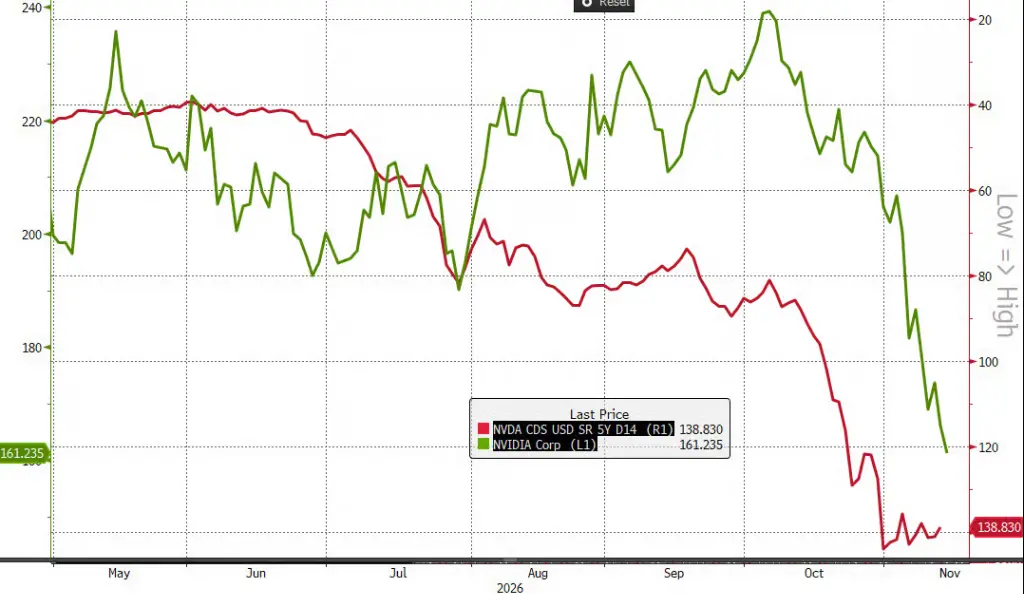
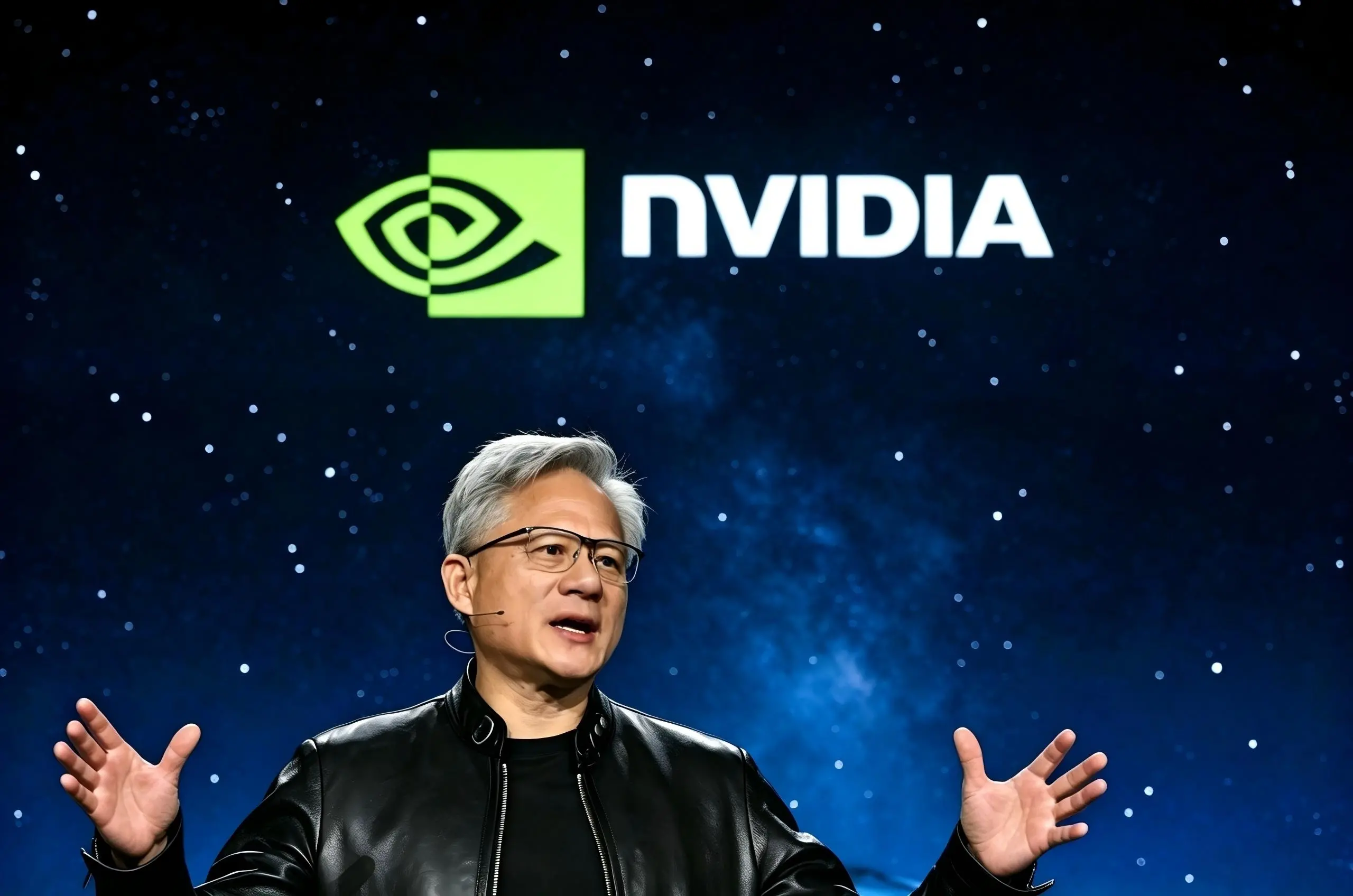
The departure of Jensen Huang, the soul of NVIDIA for 33 years, was the biggest black swan of the week. Last weekend, Huang admitted to infidelity, and the company immediately launched an independent investigation. On Tuesday, House Republicans considered issuing subpoenas, and Secretary of State Rubio reportedly warned Trump about this; NVIDIA's market value has evaporated by nearly $2 trillion from its historical peak.

On Wednesday evening, The New York Times revealed that Huang was involved in a second extramarital affair with the vice president of NVIDIA's healthcare division, while The Wall Street Journal reported that the board was preparing to dismiss him. At 8:48 AM on Thursday, Huang officially announced his resignation. CFO Colette Kress was appointed as interim CEO, and former Synopsys CEO Harvey Jones became NVIDIA's first independent chairman.
The sell-side issued 14 research reports overnight, including three downgrades and six target price reductions. Goldman Sachs analyst James Schneider lowered the valuation multiple from 30 times to 22 times, with a target price of $220, citing Apple's devaluation path after losing Steve Jobs as a reference. Bernstein analyst Stacy Rasgon downgraded the rating, warning in a report titled "Where Does He Find the Time?" that more scandals would emerge.
However, NVIDIA's stock opened about 12% lower that day but closed down only 4% to 5%. According to Vanda Research, retail buying of NVIDIA reached an all-time high that day, about 41 times the normal level, as retail investors re-priced "NVIDIA without Jensen Huang" in just 30 minutes. For the week, NVIDIA fell about 11%, but funds did not exit the AI sector; they simply changed direction: AMD rose about 30% for the week, Broadcom rose about 24%, and the Philadelphia Semiconductor Index recorded its best weekly performance since April.

J.P. Morgan analyst Harlan Sur lowered NVIDIA's target price to $215; J.P. Morgan's credit team maintained a downgrade rating, warning that the biggest risk comes from GPU financing agreements in which NVIDIA participates as a supplier, investor, or guarantor.
"No Tickets to Sell": Position Clearing Creates Short Squeeze
The core logic behind this week's stock market rebound lies not in fundamentals, but in positions. Goldman Sachs Prime data shows that U.S. long-short hedge funds reduced total leverage by 8.7 percentage points during the midterm election week, marking the largest single-week decline since March 2020; net leverage dropped to 43.3%, a five-year low. Since the deleveraging began, institutional clients have net sold over $30 billion in tech stocks, with semiconductor positions "almost completely reversing the gains of 2026."
Monday thus evolved into a "full-scale rebound": The S&P 500 rose 2.35% in a single day, the largest single-day gain since the Iran ceasefire, the Nasdaq 100 rose 3.4%, and the Philadelphia Semiconductor Index rose 6.8%. Goldman Sachs' trading desk observed "lightweight rebound trading" and judged that "today's rise reflects a lack of supply rather than buyers chasing prices." Nomura strategist Charlie McElligott referred to it as "epic volatility compression," as market makers were forced to buy during the rise. The VIX fell 27% for the week to 18.7, marking the largest single-week decline in a year.

Goldman Sachs' volatility trading desk noted that last Thursday, the U.S. market traded a record 55.8 million put options, followed by protective positions being sold at one of the fastest rates in history. Goldman Sachs' Lee Coppersmith pointed out that the realized volatility of VVIX (volatility of volatility) reached historical highs in both the 5-day and 10-day windows, "which is another sign that risk appetite remains extremely fragile."
Systematic long-short funds recorded their best two-day performance in nearly three years, with repurchase projects running at 1.6 times last year's pace, and the total authorized repurchase amount reached a record high of $1.5 trillion year-to-date. The only systematic seller is the CTA strategy, with Goldman Sachs estimating that regardless of market direction, CTAs will sell about $31 billion in S&P futures.
Inflation Heats Up for Three Consecutive Months, Fed Signals Accelerated Tightening
The macro shock occurred on Tuesday. Before the CPI data was released, Federal Reserve Governor Chris Waller stated in London that if core CPI month-on-month reaches "0.3% or higher," "the December meeting should consider a 50 basis point rate hike." The data was subsequently released, showing core CPI was about twice Goldman Sachs' estimate of 0.16%, with only one out of 70 forecasters predicting a higher figure.
Privorotsky commented, "This inflation report is of no help; CPI is broadly hot… the strong range has far exceeded energy, spreading to healthcare services, insurance, and other areas… it is difficult to simply attribute it to energy transmission effects, as underlying inflation has proven sticky." Goldman Sachs economist Mike Cahill pointed out that over the past four months, CPI has cumulatively exceeded forecasts by about 32 basis points, and no single component contributed more than 4 basis points, "this is what caught everyone off guard in 2021 to 2022."

Federal Reserve officials collectively ramped up their stance. Dallas Fed President Lorie Logan stated that the FOMC "needs to raise rates at least two more times by 25 basis points"; Governor Bowman expressed support for a December rate hike; San Francisco Fed President Daly stated she "leans toward further tightening"; Cleveland Fed President Hammack said "we need to adjust policy to a restrictive level"; and Chicago Fed President Goolsbee warned "we are approaching a region that is extremely tricky for any central bank in history," describing the surge in data center construction as "historically large fiscal stimulus."
Goldman Sachs economists immediately added another rate hike in March 2027, predicting that the federal funds rate peak would reach 4.25% to 4.50%, with the first rate cut delayed until December 2027. Nomura made similar adjustments, with the market currently pricing in a roughly 10% probability of a 50 basis point rate hike in December and about a 70% probability of another 25 basis points in January next year.
On Friday, PPI added further pressure: producer prices rose 6.5% year-on-year, the highest since November 2022; core PPI rose 5.0% year-on-year. White House Council of Economic Advisers Chair Christopher Phelan attempted to downplay expectations of a significant 50 basis point rate hike, but both the bond and stock markets did not buy it.

Bond Market Bears the Shock Alone, 30-Year Yield Hits New High
In the words of a senior bond trader, Tuesday was "a complete slaughter."
The 2-year U.S. Treasury yield jumped 17.5 basis points that day, marking the largest single-day increase since October 2024. Supply pressures compounded the situation: the Treasury Department concentrated refinancing auctions before the holiday, with all three maturities encountering "tailing" (where the auction yield is higher than the secondary market). The tailing for the 3-year auction on Monday was the largest since May; the tailing for the 10-year auction on Tuesday was the largest since February, with the indirect bid ratio plummeting from 80.3% to 61.2%, the lowest since October 2023; on Thursday, the 30-year auction yield was 5.441%, with the tailing being the largest since June, and the proportion of primary dealers forced to hold was also the highest since June.

For the week, the 2-year yield rose about 35 basis points, the 10-year yield about 28 basis points, and the 30-year yield about 20 basis points. The 10-year yield broke through 5.15%, just about 15 basis points away from a multi-year high. The yield curve from 5 to 30 years flattened bearishly by about 13 basis points.

At 2 PM on Thursday, the Treasury Department released the October fiscal deficit data, which further alerted the market: the October deficit reached $404 billion, the worst October performance on record, and also the worst start to a fiscal year in U.S. history, primarily driven by a surge in defense spending and $115.5 billion in interest payments, which now account for 28.2% of total federal revenue, also a historical record.
It is noteworthy that this round of bond market shocks is driven by real interest rates: the 10-year breakeven inflation expectations have hardly moved, while TIPS yields have risen for the fifth consecutive trading day, accumulating a rise of 90 basis points this year, indicating that the market is pricing in tighter monetary policy rather than higher inflation expectations.
Credit Market: Surface Calm, Underlying Cracks
The credit market remains calm at the index level. The CDX investment-grade credit spread continues to narrow, and the CDS of the ultra-large cloud computing companies has fallen to a one-month low, with data center CDS dropping below 500 basis points again. Goldman Sachs investment-grade trader Kevin Boova summarized:
"In short, there are no signs of panic in the credit market."

However, beneath the surface, cracks are widening. The CDS spread in the chip industry has surpassed that of ultra-large cloud computing companies for the first time. The CCC spread is close to the peak of this cycle, widening by 270 basis points in three months, while the BB spread has narrowed. On Tuesday, due to the sell-off of U.S. Treasuries, investment-grade corporate bonds recorded their worst single-day performance since September 23.

CoreWeave is currently the core stress test case. Its bonds maturing in 2032 are priced at a spread exceeding the benchmark by 990 basis points, with the yield on existing unsecured bonds still above 15%. Management stated that they will stop issuing junk bonds and instead rely on prepayments and secured contract mortgage financing, including investment-grade loans expected to have an interest rate of 7% to 7.5% and an amount not less than $4 billion. CEO Michael Intrator stated that the reason for not repurchasing their own bonds is "to deploy capital to places with higher returns."

In addition, SoftBank recorded a $7 billion loss this week due to the write-off of $3.7 billion in AI power equipment deposits, with its stock price dropping by 10%.
Oil Prices: A Dramatic Reversal from "Ceasefire Expectations" to "No Need for an Agreement"
In the first half of this week, oil prices continued to decline from last week. Trump stated that a large-scale strike is "highly unlikely," and Al Arabiya reported that International Atomic Energy Agency inspectors may return to Iran. Brent crude oil briefly fell nearly 6% to $92.57 per barrel, dropping below $90 for the first time on Tuesday, and the average price of gasoline in the U.S. also fell below $4 per gallon.

However, the situation then took a sharp turn. Tankers in the Strait of Hormuz have been hitting mines almost daily, the Islamic Revolutionary Guard attacked navigation equipment guiding ships through the southern channel of the Strait on Oman’s Dasmal Island, and Iranian officials stated that they would not move "even one atom" of enriched uranium out of the country. On Thursday, shortly after The Wall Street Journal reported that Vice President Vance was considering direct talks with Iran, Trump closed the door on diplomacy, clearly stating, "We don’t need to reach an agreement," and added, "We have taken their money, hundreds of billions, and their strait!" Oil prices then rebounded sharply.
Goldman Sachs' EMEA team briefly commented: "It feels like the de-escalation is dead." On Friday, the International Energy Agency stated that the oil market is shifting towards oversupply, limiting the rise in oil prices, with Brent crude closing around $96 per barrel and WTI around $89, showing a moderate weekly decline.

Fund Flows: Withdrawals from Money Market Funds, Inflows into European Stocks
LSEG Lipper's latest data shows that global equity funds had a net inflow of $51 billion this week, the largest single-week inflow since the end of September, marking the eighth consecutive week of net inflows. Among them, European equity funds saw an inflow of $35.1 billion, the highest since June 2021, while the Stoxx 600 index set multiple historical highs during the same period; U.S. equity funds had an inflow of $6.6 billion, and Asian funds had an inflow of $6.2 billion.
Domestically in the U.S., equity funds recorded a net inflow for the second consecutive week, but the $6.6 billion scale is less than half of the previous week's $15 billion. Large-cap funds absorbed $11.6 billion, while small-cap funds saw a total outflow of $3.5 billion, and sector-themed funds had an outflow of $2.5 billion. Money market funds saw an outflow of $37.5 billion, giving back part of the previous week's largest single-week inflow since April 2020; bond funds had a slight outflow of $500 million, interrupting a seven-week streak of inflows.
The flow pattern is clear: funds are flowing back into the stock market, but the destination is Europe and large-cap stocks, rather than the higher-risk segments of the U.S. market.
Outlook for Next Week: Nvidia Earnings and Anthropic IPO as Key Tests
The market enters next week with a cleaner position structure, while facing a Federal Reserve that clearly wants to accelerate tightening, along with two key events that will determine whether the AI rebound can be sustained.
Nvidia Earnings Report (Tuesday, November 17): This will be Colette Kress's first earnings report as interim CEO, facing a performance guidance of $108 billion. With the stock price at about 10 times Goldman Sachs' 2027 earnings forecast, the numbers themselves are no longer the focus; the market wants to know: can this company operate normally without its founder?
Anthropic Pricing and IPO (November 18-19): Anthropic officially launched its IPO this week, seeking a valuation of up to $64 billion, corresponding to a market cap of about $1 trillion (fully diluted about $1.4 trillion), with reports indicating that the subscription multiple has reached about six times. If the IPO performs strongly, it will inject confidence into AI trading; if it performs poorly, it could become the next "clearing event" in the hands of short sellers.
Bond Supply and Foreign Demand: The 10-year yield is only about 15 basis points away from a multi-year high, with the 20-year auction and the 10-year TIPS reissue being the supply tests for next week, and foreign demand being a key observation variable—previously, the sharp drop in the indirect bidding ratio for the 10-year auction has already been a warning signal.
Federal Reserve and Macroeconomic Data: Retail sales and industrial production data will be released on Tuesday, along with speeches from several Federal Reserve officials. If they exceed expectations again, a 50 basis point rate hike in December will be basically confirmed.
Geopolitical Risks: Trump clearly stated that "no agreement is needed," and the third U.S. aircraft carrier is reportedly on its way to the Middle East, with tankers hitting mines daily, and Iran's ceasefire negotiations returning to a deadlock.
As Privorotsky said: "AI trading has survived Jensen Huang's departure, but Waller is another problem—because he won't resign." Nvidia's earnings report on Tuesday is the next test, and the December Federal Reserve dot plot will be the real decisive moment.
 Risk warning

ChainCatcher reminds readers to view blockchain rationally, enhance risk awareness, and be cautious of various virtual token issuances and speculations. All content on this site is solely market information or related party opinions, and does not constitute any form of investment advice. If you find sensitive information in the content, please click , and we will handle it promptly.


Popular articles