Scan to download
BTC $75,590.88 +1.40%
ETH $2,356.60 +0.93%
BNB $632.64 +1.97%
XRP $1.45 +2.77%
SOL $88.18 +3.74%
TRX $0.3237 -1.03%
DOGE $0.0987 +2.62%
ADA $0.2576 +3.71%
BCH $449.59 +2.20%
LINK $9.52 +2.79%
HYPE $43.56 -2.47%
AAVE $117.16 +10.35%
SUI $0.9997 +3.22%
XLM $0.1693 +5.54%
ZEC $332.39 -3.29%
BTC $75,590.88 +1.40%
ETH $2,356.60 +0.93%
BNB $632.64 +1.97%
XRP $1.45 +2.77%
SOL $88.18 +3.74%
TRX $0.3237 -1.03%
DOGE $0.0987 +2.62%
ADA $0.2576 +3.71%
BCH $449.59 +2.20%
LINK $9.52 +2.79%
HYPE $43.56 -2.47%
AAVE $117.16 +10.35%
SUI $0.9997 +3.22%
XLM $0.1693 +5.54%
ZEC $332.39 -3.29%

dvt

Vitalik proposed to introduce a native DVT staking mechanism at the Ethereum protocol layer to enhance security and decentralization

Ethereum co-founder Vitalik Buterin recently proposed a "native DVT (Distributed Validator Technology)" solution at the Ethereum Research forum, suggesting that DVT be directly integrated into the Ethereum staking protocol layer to enhance network security while promoting decentralization at the validator level.According to the proposal, validators can register multiple independent keys and operate collectively in the form of "grouped validators"; only when a set threshold number of key signatures is reached will the block proposal or witness be considered valid. This mechanism can significantly reduce the risk of single points of failure or validators going offline due to node breaches, while still maintaining existing slashing protections under reasonable threshold settings.Vitalik pointed out that, unlike current DVT solutions that rely on external coordination layers and complex deployments, native DVT will be directly embedded into the protocol itself. Validators holding multiple minimum staking thresholds (32 ETH) can set up to 16 keys and specify a signature threshold, effectively allowing multiple standard nodes to collectively form a single validator identity. He noted that the additional performance overhead of this design is minimal, only adding one extra delay for block production without affecting witness delays, and is compatible with any signature scheme, helping to reduce reliance on long-term potentially risky cryptographic assumptions.On the decentralization front, Vitalik believes that native DVT will enable individuals and institutions to participate in staking more easily in a "self-custodial, fault-tolerant" manner, rather than relying on large staking service providers, thereby improving the decentralization metrics of the Ethereum validator set (such as the Nakamoto coefficient). The proposal is still in the early discussion stage and will require extensive evaluation and consensus from the Ethereum community moving forward.

Lido has deployed the Simple DVT module on the mainnet, and it is expected that over 250 new node operators will join in the coming months

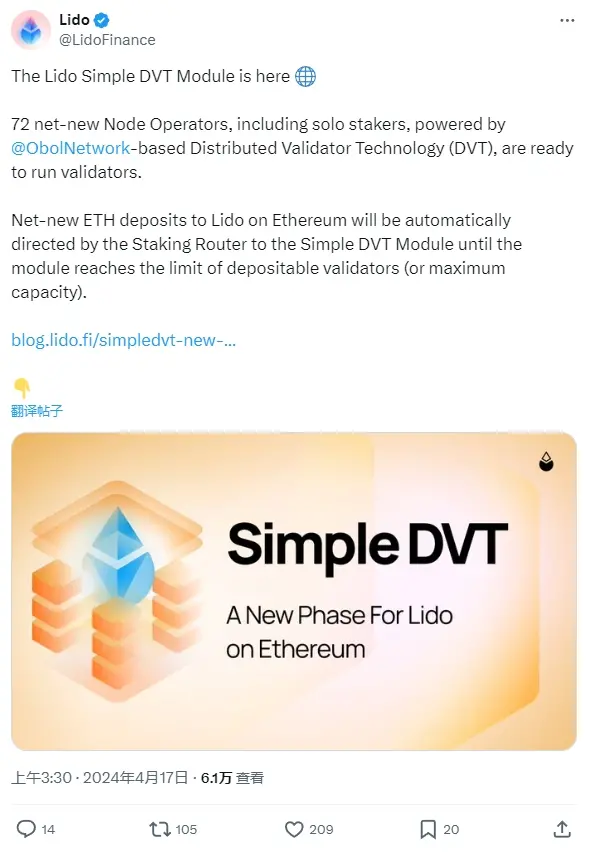
ChainCatcher news, Lido announced that its Simple DVT (Distributed Validator Technology) module has been deployed on the Ethereum mainnet. This Simple DVT module (sDVTm) is the second mainnet module of the Lido protocol, designed to leverage the technology provided by Obol and SSV Network to offer independent and community stakers the opportunity to participate in running validators using Lido. After intensive testing on the testnet, all aggregated performance metrics exceeded the minimum targets. Additionally, Lido mentioned that a performance report will be submitted to the DAO after the first Obol network cluster validator has been active for 30 days, paving the way for future network expansion. Meanwhile, the third SSV network testnet is nearing completion and has also exceeded all minimum performance standards. Lido plans to release a comprehensive review after the testnet concludes and submit a proposal regarding the entry of SSV network participants into the mainnet.Lido stated that with the launch of the Simple DVT module, it is expected that over 250 new node operators will join the Lido protocol in the coming months, which will increase Lido's node operator base by 676%. This marks the beginning of the initial implementation phase of the Simple DVT module, with more Obol-based clusters expected to join the mainnet in the coming months, and a DAO proposal is anticipated to be submitted to incorporate SSV network participants into the mainnet.
2024-04-17
app_icon
ChainCatcher Building the Web3 world with innovations.