The Evolution of Cryptocurrency Exchanges Over 13 Years
 Core Viewpoint

 Hong Kong's policy support undoubtedly brings unprecedented development opportunities for cryptocurrency exchanges. At the same time, Huobi has changed ownership, Binance maintains its dominance, and OKX is heavily promoting globalization. Under the influence of different external and internal driving forces, how will the CEX landscape evolve in the context of the new cycle?
Written by: longcrypto, The Path of the Metaverse
October 31 marks the 14th anniversary of the release of the Bitcoin white paper, a concise 3,192 words that laid a solid foundation for the subsequent grand development of the cryptocurrency industry.
On the same day, Hong Kong released a policy declaration for the development of virtual assets, consisting of 3,800 words, showcasing Hong Kong's determination to fully embrace the metaverse, welcome Web3, and integrate into the crypto world.
The entire industry is excited: Ensure that Web3 happens in Hong Kong!
Hong Kong's embrace of the virtual asset sector and its preparation for a licensing system for new virtual asset service providers has greatly boosted the confidence of industry participants. Lennix, the Financial Market Director of OKX, stated that the virtual asset trading platform OKX is planning to apply for this license.
The policy support from Hong Kong undoubtedly brings unprecedented development opportunities for cryptocurrency exchanges. Meanwhile, within the industry, we see changes such as Huobi changing ownership, Binance's dominance, and OKX's global expansion. Under these external and internal driving forces, one cannot help but ponder how the CEX landscape will evolve in the context of a new cycle.
At this current moment, no one can predict an accurate answer. In fact, if we extend the timeline, since the emergence of the first exchange in the crypto world, we have seen the rise of absolute powerhouses like Mt. Gox, the fleeting presence of disruptors like FCoin, the once-dominant "HBO" trio, and many smaller exchanges that have gradually been forgotten in the annals of history. Their founders once harbored dreams, intertwining personal struggles with the opportunities of the times, propelling the industry forward.
Starting Point
On October 31, 2008, the Bitcoin white paper was published. On January 3, 2009, the BTC genesis block was born.
According to Satoshi Nakamoto's design, the total supply of Bitcoin is 21 million, with an initial issuance of 0, and subsequent coins are mined entirely by "miners." The average block time is about 10 minutes, and the initial block reward was 50 BTC, halving every four years.
Although Bitcoin was designed as a peer-to-peer electronic cash system and has since been endowed with various functions such as "digital gold" and a tool against fiat currency inflation, it had no cash value for a considerable time after its birth.
It wasn't until October 5, 2009, that the first Bitcoin exchange was born. New Liberty Standard published the first Bitcoin/USD exchange rate: 1.00 USD = 1,309.03 BTC, making the price of each Bitcoin 0.00764 USD.
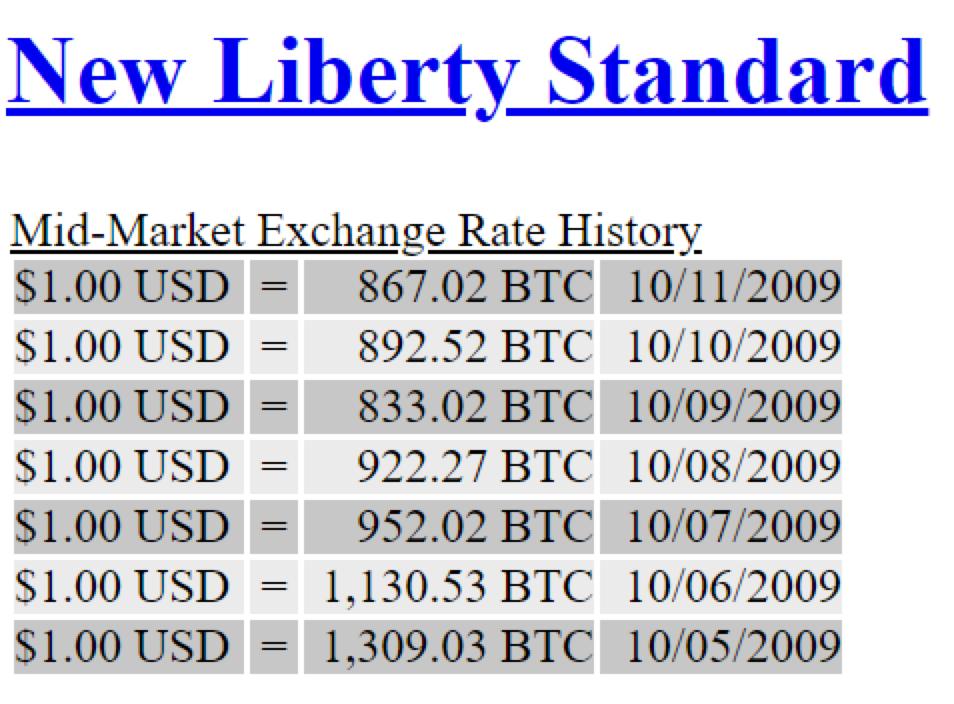
This price was not determined by the free market but was based on a seemingly "reasonable" cost pricing model:

This pricing principle assumed that the price of Bitcoin was equivalent to the electricity costs incurred in mining.
Another significant contribution of New Liberty Standard to the crypto space was the proposal to use the Thai baht currency symbol as the official currency symbol for Bitcoin and "BTC" as the currency code for Bitcoin.
On January 15, 2010, a user named "dwdollar" on the Bitcointalk.org forum began building his own Bitcoin exchange, providing a real-time USD exchange rate for Bitcoin, allowing people to buy and sell Bitcoin from each other.
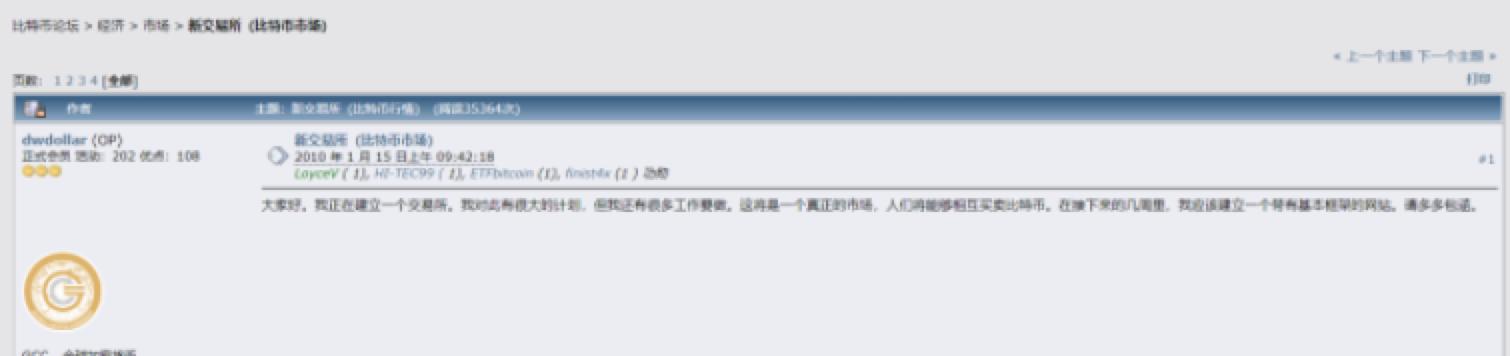 * (Image source: bitcointalk) *
After testing, on March 16, 2010, the bitcoinmarket exchange officially went live, which many later authors mistakenly believed to be the world's first Bitcoin exchange. However, bitcoinmarket had very few users, with only 9 registered on the first day and 3 making deposits, including dwdollar himself. dwdollar also purchased 500 Bitcoins at a price of 0.0067 USD each.
At that time, transactions were conducted using PayPal, which led to many fraud incidents, forcing bitcoinmarket to stop PayPal transactions on June 4, 2011.
Dominance
After earlier explorations, in 2011, exchanges began to spring up worldwide like mushrooms after rain. "Kou Cat" publicly traded GLBSE, Slovenia's second-largest exchange Bitstamp, the Russian-founded BTC-e, Brazil's first Bitcoin exchange Bitcoin Brasil, Poland's first Bitcoin exchange Bitomat, and China's first Bitcoin exchange BTC China were all established that year.
In 2013, China began to experience its first wave of Bitcoin exchange fever. BtcTrade, CHBTC, Yunbi, Huobi, OKCoin, Bit Era, Bter, Jubi, Yuanbao, 796 Exchange, FXBTC, and others were established. BTC China, which was established earlier, also welcomed its benefactor, Li Qiyuan, who secured 5 million USD in funding from investors just four months after joining the company.
With many competitors, the most dominant powerhouse in Bitcoin exchange history took the stage.
In July 2010, Mt. Gox (nicknamed "Mt. Gox"), founded by Jed McCaleb, became the largest Bitcoin exchange by trading volume within a month. In March 2011, Mt. Gox was sold to Japan's Tibanne co, managed by Mark Karpeles (nicknamed "Fat Man"). At its peak, Mt. Gox accounted for 80% of global Bitcoin online trading volume.
On February 28, 2014, Mt. Gox filed for bankruptcy, having lost 850,000 BTC, including 750,000 BTC from customers and 100,000 BTC from Mt. Gox itself.
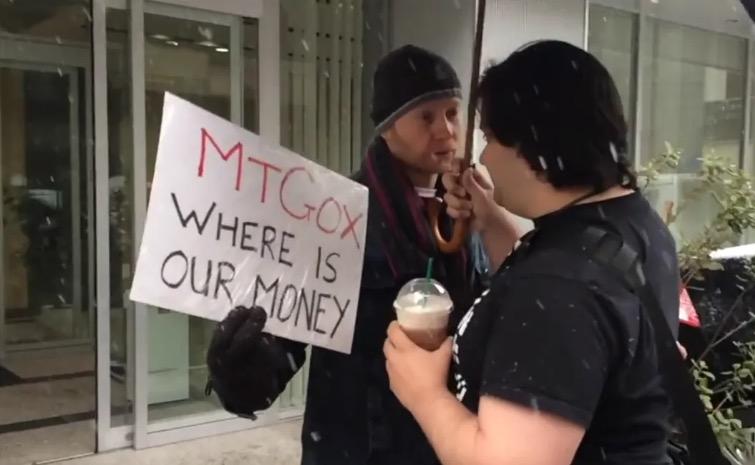
In the years following Mt. Gox's collapse, the stable dominance position was vacant.
During this time, three giants emerged abroad, represented by Bitfinex, Bitstamp, and Btc-e, while BTC China, OKCoin, and Huobi formed a three-way stalemate, with the latter two alternating in the top position.
In May 2018, FCoin exchange burst onto the scene, and within just half a month of its launch, its trading volume not only topped the charts but also exceeded the combined total of the second and seventh places.
Of course, all of this was predicated on the large influx of users and arbitrage bots brought by "transaction mining."
On February 17, 2020, FCoin founder Zhang Jian released an announcement titled "The Truth About FCoin," stating that FCoin's capital reserves could no longer meet user withdrawal requests, estimating that the scale of unmet withdrawals was between 7,000 and 13,000 BTC. The last line of the announcement read: "In my lifetime, I will take full responsibility."
Currently, Binance is the largest by volume. According to statistics published by The Block's research VP Larry Cermak on October 24, Binance's total spot and derivatives trading volume exceeded all other exchanges in the past 24 hours, with spot accounting for 55.1% of total trading volume and derivatives accounting for 54.4%.
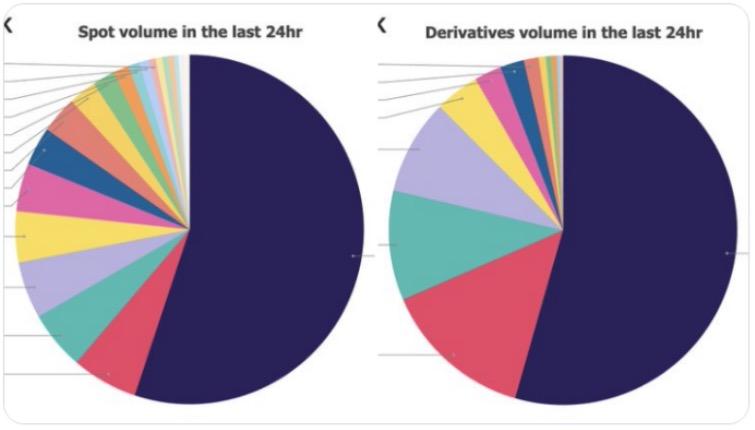
- (Image source: * *Larry Cermak) *
Regulation
As an unregulated currency, Bitcoin's potential financial risks have gradually attracted the attention of regulators as its size has increased. Centralized exchanges, as the primary venues for centralized bidding, naturally bear the brunt.
On December 5, 2013, the central bank and five ministries issued a notice on "Preventing Bitcoin Risks," which was officially termed "National Five Articles" by early insiders, stating that Bitcoin should not exist as a currency and prohibiting financial institutions from providing Bitcoin trading services. On December 16, the central bank summoned third-party payment companies like Alipay and Tenpay, demanding that they not provide payment and clearing services to Bitcoin, Litecoin, and other trading websites. Following this crackdown, Bitcoin's price plummeted by 60%.
This regulation forced some second- and third-tier exchanges out of the historical stage. After third-party payment channels were completely blocked, Huobi quickly opened manual payment options, which allowed it to become the largest Bitcoin trading platform in China.
Following China's lead, in February 2014, the Russian Prosecutor General's Office issued a statement declaring that Bitcoin could not be used within Russia.
On September 4, 2017, the People's Bank of China and seven ministries jointly issued a notice on "Preventing Risks of Token Issuance and Financing" (known in the industry as the "94 Document"), cracking down on ICO activities that disrupted normal economic and financial order.
In February 2021, virtual currencies were included in the "Regulations on Preventing and Dealing with Illegal Fundraising." On the evening of May 18 of the same year, the China Internet Finance Association, the China Banking Association, and the China Payment and Clearing Association jointly issued a notice on "Preventing Risks of Virtual Currency Trading Speculation." On May 21, the Financial Stability Development Committee of the State Council (hereinafter referred to as the Financial Committee) explicitly proposed to crack down on Bitcoin mining and trading activities.
In March 2022, the People's Bank of China announced that the speculation in virtual currency trading had been effectively curbed, with China's share of global Bitcoin trading volume rapidly declining from over 90% to 10%.
During this period, exchanges underwent a major reshuffle. BTC China exited the trading market, while Huobi actively expanded into overseas markets. OKEx and Binance also established themselves overseas that year and rapidly grew.
Although the United States has not issued specific regulatory documents targeting Bitcoin, several executives from exchanges have been arrested for money laundering offenses.
In February 2014, BitInstant.com CEO Charlie Shrem was arrested by U.S. authorities on suspicion of money laundering.
In July 2017, BTC-e's key figure Alexander Vinnik was arrested by Greek authorities at the request of the U.S., which accused him of creating the cryptocurrency trading platform BTC-e and laundering billions of dollars through it.
In October 2020, the founders of BitMEX and three executives were charged criminally and civilly by the U.S. Department of Justice and the Commodity Futures Trading Commission (CFTC), accused of conspiring to violate the U.S. Bank Secrecy Act, operating an unregistered trading platform, and violating KYC and anti-money laundering regulations.
War
2014 was the inaugural year for Bitcoin futures, and the "National Five Articles" had a huge impact on Bitcoin prices, leading to a prolonged bear market lasting two years.
In the one-sided bear market, spot trading volume significantly shrank, while Bitcoin futures trading began to heat up.
The 796 Exchange, established in June 2013, became an early pioneer in Bitcoin futures trading, at one point becoming the largest trading platform by volume during the bear market of 2014.
In September 2014, Huobi launched BitVC to enter the futures trading market. Shortly after, OKCoin launched Bitcoin virtual futures trading on September 15.
The futures war officially began. The three exchanges also engaged in a price war over trading fees, with 796's contract fees dropping from an initial 0.3% to 0.03%, OKCoin's futures opening fee set at 0.03%, and closing fee at 0. Huobi's BitVC futures trading fee was 0.025%, and it later launched the V-point privilege feature to further reduce fees.
In this futures war, OKCoin emerged as the final winner, while 796 faced access issues on November 3, gradually losing customer trust. Huobi seized the opportunity to catch up but did not hold on until the end.
In 2018, the crypto market fell into another bear market, reigniting the contract war.
At this time, the dominant player to challenge was BitMEX, established in 2014, which offered leverage up to 100 times, with founder Hayes dubbed the "King of Leverage." BitMEX's daily trading volume peaked at over 16 billion USD.
In March 2018, ByBit, focused on derivatives trading, was established, known for its marketing prowess. The founder even personally participated in trading during product launches, leaving the audience in awe.
On December 10, 2018, Huobi's contracts officially launched.
On December 11, 2018, OKEx announced it would launch perpetual contract trading.
In 2019, FTX, focused on derivatives trading, was established.
After the "312" flash crash in 2020, BitMEX gradually exited the historical stage, while Binance, OKEx, and Huobi all surpassed BitMEX in the derivatives sector.
In 2018, there was also a brief war against FCoin.
At that time, FCoin surpassed all previously established exchanges in trading volume through transaction mining.
Volume manipulation not only disrupted industry rules but also risked siphoning off existing users from other exchanges. Soon, FCoin faced a joint crackdown from leading platforms, with OKEx launching a digital asset exchange open win-win plan, Binance initiating a digital asset exchange alliance plan, and Huobi upgrading HT to a global ecological token. Exchanges began to cultivate their own forces, and cloud exchanges emerged widely, allowing operators to share the trading depth and liquidity of leading exchanges without any technical development. During this period, professional cloud trading system service providers like CoinCore Cloud, ChainUP, and Gangsheng Technology emerged, leading to a surge of thousands of exchanges in the market.
This war ended with the collapse of FCoin. Subsequently, the "HBO" trio composed of OKEx, Huobi, and Binance maintained a relatively stable structure.
In 2020, with the Federal Reserve's monetary easing, DeFi Summer arrived.
DEXs like Uniswap, Sushiswap, Curve, and DYDX rose rapidly, capturing long-tail markets that centralized exchanges struggled to reach and potentially threatening CEX's long-term pricing power.
A major battle is inevitable.
Centralized exchanges rushed to list various popular DeFi tokens for free while also creating or supporting their own exchange public chains. In September 2020, Binance launched BSC. On September 13, OKChain was officially renamed OKExChain, with its mainnet going live in January 2021. In December, Huobi launched the Huobi ECO Chain.
Among these, BSC was the most successful, HECO was the most controversial, and OKC launched later, missing the golden window for development.
As exchanges launched DeFi public chains, DEXs and CEXs transitioned from opposition to mutual embrace, but the neutrality of exchange public chains was called into question. Particularly, the incident on October 7, where 2 million BNB were stolen from the BSC chain, and Binance's contrasting response to multiple DeFi projects being hacked in May 2021, led many to mock Binance for tearing off the so-called decentralized facade of BSC.
Dreams
"After all, I am also an idealistic young person, I Have a dream."
This was said by Huobi founder Li Lin. In February 2014, Huobi's daily trading volume reached 380,000 BTC, with a trading amount exceeding 3.8 billion USD, capturing over 50% of the global Bitcoin trading market, becoming the largest Bitcoin trading platform in the world.
Li Lin once said he is a person who takes things seriously and always hopes to do everything to perfection. As a serial entrepreneur, he has founded social platform "Friendship Network" and group buying comparison site "Renrenzhe," but Huobi is the project he is most proud of.
"I am willing to be the indestructible little cockroach, and I will not give up because of difficulties."
In December 2013, despite the "National Five Articles," Li Lin did not give up, and Huobi quickly became a leading exchange.
During the "94" incident in 2017, Li Lin did not give up, and Huobi began its globalization, obtaining financial licenses in the U.S., South Korea, Japan, Gibraltar, Hong Kong, and other regions.
In 2019, facing criticism from Huobi supporters, Li Lin personally responded on his public account, showing his immense passion for the industry.
On October 8, 2022, Huobi's main entity changed hands, and Li Lin was no longer a shareholder of HuobiGlobal, nor did he directly or indirectly hold any authority over HuobiGlobal.
After ten years of hardship, the passion remains undiminished. One wonders if, at the moment of making this decision, Li Lin recalled the entrepreneurial youth who once harbored dreams.
Voyage
2017 was a watershed year for the industry, marking the beginning of the globalization strategy for Chinese exchanges, with Binance, Huobi, and OKEx all entering global markets that year.
In 2022, the market once again entered a winter, and exchanges faced new transformations.
On January 18, OKEx announced its brand upgrade to OKX.
A single letter change reflects the new changes in the exchange, shifting from pure token trading to ventures into the metaverse, GameFi, Web3.0, and other fields. Subsequently, OKX launched a Web3 wallet, integrating digital currency wallets, DEX, NFT markets, and DApp exploration into four major sections, allowing users to view and manage their on-chain assets in the OKX Web3 wallet without manual configuration.
Looking back at the development of exchanges, we can clearly see the evolution from initially providing only BTC trading to later offering equity crowdfunding, leveraged lending, futures contracts, perpetual contracts, leveraged tokens, options, and now NFT trading, continuously expanding the boundaries of financial assets and reconstructing a new financial order.
At the same time, exchanges in the industry are pushing the crypto world into broader realms from different directions.
For example, the first licensed exchange in the U.S., Coinbase, adheres to a compliance route, wielding significant influence in the U.S. and globally, with talents emerging from the Coinbase ecosystem branching out into various fields within the crypto space.
In April 2021, Coinbase went public on the NASDAQ, with its market value reaching as high as 100 billion USD post-IPO. This became an important milestone in the development of cryptocurrency exchanges.
Binance, on the other hand, is making moves on multiple fronts. CZ meets with political leaders in various countries to seek greater recognition for cryptocurrencies. At the same time, it established venture capital and incubation institution Binance Labs, searching globally for promising crypto projects. Currently, Binance Labs manages assets totaling 7.5 billion USD and has invested in over 200 projects, making it the largest crypto asset venture capital institution in the industry.
However, as the largest exchange by trading volume, Binance inevitably attracts controversy for certain actions. For instance, the BSC theft incident and last month's forced conversion of USDC, USDP, and TUSD stablecoin balances and new deposits into BUSD have been criticized as crypto hegemony.
FTX, born in the cracks, adopted a Wall Street elite approach. The founder SBF's identity as an "altruist" is widely known in the crypto space; he even supported the 2020 U.S. presidential election, donating 5.2 million USD to Biden in an attempt to bring more favorable policy support to the crypto industry.
After the change in ownership, Huobi, under Sun Yuchen's leadership, took an unconventional route, with "Sun's late arrival never wasting any hot marketing opportunity." On October 17, crypto influencer "Liangxi" transitioned to Twitter, and the first space live broadcast attracted the highest number of viewers on Twitter's real-time Space rankings. Sun Yuchen pledged 50,000 USD to support Liangxi's "dream in the bear market," and Liangxi, who had previously criticized exchanges after a liquidation, changed her tone to warmly address Sun as "Brother Sun."
On October 24, Liangxi and Sun Yuchen made their live debut on Huobi, resulting in over 3,000 new registrations for Huobi during the broadcast, with Sun Yuchen praising the outcome.
As a top influencer in the crypto space, 19-year-old Liangxi captivates the audience with her authenticity, and her spontaneous outbursts are hard for many to resist. While Huobi can leverage her to capture traffic, the impact on reputation also needs to be considered.
Unlike Huobi's use of controversial KOLs for marketing, FTX and OKX expanded public awareness of the crypto industry by sponsoring influential sporting events.
In 2021, FTX secured the naming rights to the Miami Heat arena for 135 million USD and acquired the naming rights to the California Memorial Stadium, home of the Golden Bears. OKX became the chief sponsor of the McLaren racing team in May of this year and invested 20 million USD to sponsor Manchester City in July.
Sponsoring popular sports events or clubs is not unusual in real life, but for the crypto industry, which remains relatively niche and cutting-edge, it can achieve "breakthrough" marketing. Especially since crypto is inherently globally circulated, combining it with globally popular sports events is a natural fit, significantly enhancing the brand image and recognition of exchanges in various countries and regions. On the other hand, the enthusiasts of these sports events are generally younger, more open to new things, and have great potential to convert into new users in the crypto industry.
Today, the crypto industry is in a new round of winter, with Crypto.com, Bybit, Coinbase, and others laying off employees to varying degrees, while OKX and Binance are expanding their workforce, reflecting the significant role that leading exchanges play as ballast in the industry's development. Additionally, OKX, in collaboration with LinkedIn, released the 2022 Global Web3 Talent Report, providing clear guidance for outstanding talents to join Web3.
In the 13 years since the first crypto exchange appeared, crypto trading has undergone several transformations. The period from 2009 to 2011 was the embryonic stage of crypto exchanges, where Bitcoin's value was only recognized by a small group of geeks. From 2011 to 2014, as Bitcoin gained wider recognition, exchanges experienced their first boom, with Mt. Gox becoming the dominant player. From 2014 to 2016, Mt. Gox went bankrupt due to hacking attacks, leading to a three-way stalemate in the market, with platforms like OKCoin, Huobi, and BTC China accounting for 80% of global trading volume at one point. Since 2017, Binance has become the industry leader, OKX has focused on internationalization, while the older exchange Huobi has shown signs of aging, being surpassed by newer players like Kucoin and FTX.
It is evident that as the pinnacle of the industry pyramid, crypto exchanges are constantly engaged in fierce competition.
Behind the ever-changing landscape, one thing remains constant: security and trust. If there had been no coin loss incidents, would Mt. Gox still have collapsed? If there had been no liquidity crisis caused by a series of institutional failures, would platforms like AEX and Huobi have fallen into trouble? Because of trust, crypto enthusiasts around the world voluntarily became Binance angels, whom CZ regards as the secret to Binance's success. Due to its emphasis on security, during the unprecedented Luna collapse, OKX's risk control system activated an automatic redemption mechanism, allowing users who participated in UST investments to escape disaster.
Currently, the industry's narrative is shifting from Crypto to Web3, while Crypto, as the foundation of Web3, will undoubtedly remain unshakable. To this day, there are still 1.7 billion people worldwide without bank accounts, and cryptocurrencies, as permissionless money, can provide rich financial services for these individuals. As platforms for value exchange, crypto exchanges are bound to usher in a new wave of significant development, and the landscape of exchanges will further change.
 Risk warning
 Risk warning