4E Labs | Crypto Stock Panorama: From Bitcoin Hoarders to Capital Games in Blockchain Infrastructure (Part 1)

 Coinbase (COIN) and Circle (CRCL) have jointly built a bridge connecting traditional finance and digital assets through a dual pillar model of fiat and cryptocurrency. Coinbase provides cryptocurrency trading and custody services, while Circle issues the USDC stablecoin, facilitating the conversion from fiat to crypto and blockchain payments.
In the context of the successful launch of Bitcoin ETFs, the gradual release of Ethereum ETFs, and the countdown to stablecoin legislation, a group of publicly listed companies that are highly related to the crypto industry is playing an increasingly important role in the capital market, with the institutionalization process accelerating the differentiation of related stocks. They cover various segments such as trading platforms, mining, power, asset management, and stablecoin issuance, forming a bridge asset pool between traditional finance and Web3.
I. Overview of Latest Stock Price Performance (as of July 9, 2025)
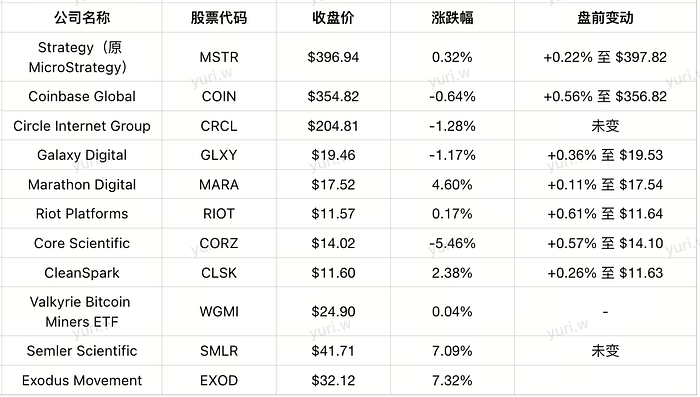 Source: Yahoo Finance
ETF Fund Flows (as of July 9)
- BTC Spot ETF: Daily net inflow of $75.3M, cumulative inflow of $49.91B, holding approximately 1.25M BTC
- ETH Spot ETF: Daily net inflow of $46.7M, cumulative inflow of $4.52B, holding approximately 4.21M ETH
II. Breakdown of Crypto Stock Sector and Company Positioning
1. Bitcoin Asset Reserve Type: Core asset strategy centered on BTC, companies incorporate it into their balance sheets for long-term holding
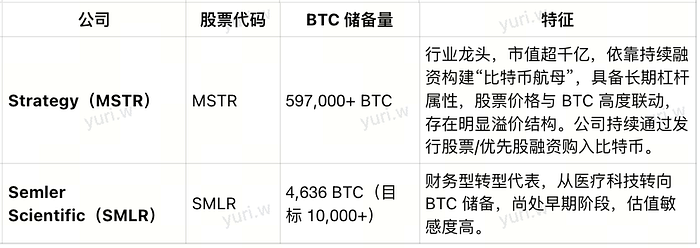
1.1 MicroStrategy (MSTR): The Prototype of Bitcoin Corporate Accumulators
MicroStrategy (now renamed Strategy) is one of the earliest and most representative Bitcoin corporate reserve holders globally. Since 2020, under the leadership of Executive Chairman Michael Saylor, the company has gradually abandoned traditional cash reserves and massively shifted its balance sheet towards Bitcoin. As of July 2025, the company holds a total of 597,325 Bitcoins, with an average purchase price of approximately $66,385, totaling over $33.1 billion. Its stock price is highly correlated with Bitcoin prices, reaching a correlation of 0.95 after the approval of the Bitcoin spot ETF in 2024, and is viewed by the market as a "high-leverage BTC alternative."
The funds for purchasing Bitcoin mainly come from three major channels: issuing stocks (such as the latest round of a $4.2 billion plan), convertible bond financing, and operating cash flow.
This BTC-centered strategy has transformed it from a BI software company into a Bitcoin carrier in the capital market. However, this model also brings financial risks such as high leverage (debt/equity ratio of 24.44%) and net losses (nearly $5.3 billion), making it extremely sensitive to Bitcoin price fluctuations. The company appears to be an enterprise analytics software provider (AI-driven Strategy One platform), but has actually evolved into a capital market vehicle for Bitcoin allocation, with the value of its Bitcoin holdings far exceeding its software business itself.
In the future, the company will continue to focus on increasing its BTC holdings while actively developing SaaS-based enterprise financial management tools (such as Strategy Mosaic™), hoping to software its Bitcoin strategy, expand service revenue, and alleviate reliance on a single asset.
1.2 Semler Scientific (SMLR): The Aggressive Transformation of a Medical Technology Company
Semler Scientific, Inc. (SMLR) is a Nasdaq-listed medical technology company founded in 2007, headquartered in Santa Clara, California. The company's core product QuantaFlo focuses on rapid diagnosis of peripheral artery disease (PAD) and is widely used by medical professionals across various fields. Since 2024, the company has adopted Bitcoin as its primary financial reserve asset to combat inflation and currency devaluation. As of July 2, 2025, the company holds 4,636 Bitcoins, with a total purchase cost of $360.0 million, planning to increase its holdings to 105,000 Bitcoins by the end of 2027.
- Q1 2025 Financial Data: Revenue of $8.8 million, a year-on-year decrease of 44%; net loss of $64.7 million, with an unrealized loss on Bitcoin fair value of $41.8 million.
- Bitcoin Purchase Method: The company raised funds to purchase Bitcoin through ATM issuance (for example, selling 559,000 shares from April 25 to 29, 2025, netting $19.5 million) and convertible bond financing. From June to early July 2025, an additional 187 Bitcoins were purchased at a cost of approximately $20 million.
In the future, the company plans to continue increasing its Bitcoin holdings while focusing on the development of its medical technology business. Despite a 44% decline in revenue in Q1 2025 and a net loss of $64.7 million, the company believes that its Bitcoin strategy will bring long-term value to shareholders. Challenges ahead include declining revenue from medical operations and potential legal liabilities (such as a $29.8 million liability from the DOJ).
🔹 Both are BTC reserve types, but MSTR is a global flagship holding platform, while SMLR is a "small and new" transformative financial explorer, with the former serving as a primary allocation reference and the latter suitable for thematic rotation participation.
2. Trading and Financial Services Type: Ecological traffic entry, supporting trading, custody, stablecoins, and wallet ecosystems
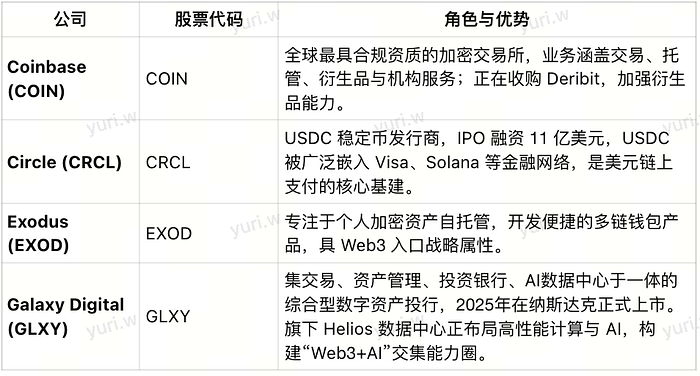
2.1 Galaxy Digital (GLXY): Full-Stack Crypto Investment Bank
Galaxy Digital Holdings Ltd. (stock code: GLXY) was founded in 2018 by Mike Novogratz and is headquartered in New York. The company completed its registration in the U.S. in 2025 and plans to list on Nasdaq. As a full-stack crypto investment bank, Galaxy is dedicated to promoting global adoption of blockchain and digital assets.
- **Main Businesses
- Global Market**: Provides digital asset trading, liquidity support, and customized financing services.
- Asset Management: Manages $7 billion in assets, covering crypto funds and staking services.
- Digital Infrastructure: Develops crypto mining, staking services, and AI data centers (such as Helios campus).
- Investment Banking: Offers mergers and acquisitions, capital market services, and strategic consulting.
- Research and Consulting: Publishes industry reports and provides insights into crypto assets for institutional clients.
- **Financial Overview
- Q1 2025**: The company recorded a net loss of $295 million (diluted loss per share of $0.86), mainly impacted by the decline in digital asset prices and a $57 million impairment charge due to the closure of the Helios campus mining business.
- Full Year 2024: Galaxy Digital Holdings LP achieved net revenue of $365 million (adjusted for a $166 million legal settlement reserve, it would be $532 million), with GDH Ltd. reporting net comprehensive income of $78.9 million.
- Profit Resilience: In Q1 2025, net profit was $78.86 million, with a price-to-earnings ratio of approximately 34-42 times, lower than the industry peak, reflecting valuation compression.
Galaxy Digital, with its diversified business model covering the crypto ecosystem, is a unique full-stack crypto investment bank. Its diversified business model gives it a unique position in the crypto industry, but the losses in Q1 2025 highlight the challenges of market volatility on its financial performance. In the future, the company will continue to deepen the application of blockchain technology, expand into AI and high-performance computing, and provide a broader range of financial services for institutional clients.
2.2 Exodus Movement (EXOD): Decentralized Finance Entry
Exodus Movement, Inc. (stock code: EXOD) was founded in 2015 and is a fintech company focused on blockchain and digital assets. The company offers self-custody wallets, cryptocurrency trading, fiat on/off-ramp services, and staking services, supporting multi-chain operations and integrating the DeFi ecosystem (such as Uniswap, Rarible). The company lowers the entry barrier for users into DeFi through innovative products Exoswap and Passkeys Wallet, positioning itself as a convenient entry point for decentralized finance.
- 2024: Revenue of $116.27 million, a year-on-year increase of 106.94%; net profit of $112.96 million.
- Q1 2025: Revenue of $36 million, a year-on-year increase of 24%; monthly active users (MAU) decreased by 30% to 1.2 million.
Since upgrading from OTCQX to the NYSE American market in 2024, the company has gained increased market attention, with its stock price rising by 42.76% at the beginning of 2025. Exodus's mission is to "ignite the escape from the traditional banking system," promoting the widespread adoption of cryptocurrencies and DeFi by empowering users with complete control over their digital assets (private keys stored on user devices). The company supports over 100 cryptocurrencies (such as Bitcoin, Ethereum, Litecoin, etc.) and provides a seamless experience across multiple platforms (desktop, mobile, browser extension).
In the future, Exodus will deepen DeFi integration, globally promote fiat exchange services (XO Pay), and enhance its fiat-to-crypto capabilities through acquisitions (such as Banxa Holdings). Core challenges include market volatility, regulatory uncertainty, intensified competition, and slowing user growth (30% decline in Q1 MAU).
2.3 Coinbase (COIN) and Circle (CRCL): Dual Pillars of Fiat-Crypto
Coinbase (COIN) and Circle (CRCL) have jointly built a bridge connecting traditional finance and digital assets through a dual pillar model of fiat and cryptocurrency. Coinbase provides cryptocurrency trading and custody services, while Circle issues the USDC stablecoin, facilitating the conversion from fiat to crypto and blockchain payments.
- Main Businesses: Coinbase focuses on one-stop solutions for cryptocurrency exchanges, custody, and payments; Circle focuses on USDC issuance, payment networks, and blockchain infrastructure, being the second-largest dollar stablecoin globally. Coinbase promotes USDC, while Circle provides reserve yield sharing, forming a "fiat-crypto" closed loop. In 2024, USDC revenue accounted for 42% of Coinbase's non-trading revenue. USDC is Coinbase's second-largest revenue source, accounting for about 15% of revenue in Q1 2025, surpassing staking revenue.
- Financial Performance: In 2024, Coinbase's revenue was $9.185 billion, a year-on-year increase of 75%; Circle's revenue was $1.68 billion, a year-on-year increase of 15.57%. In Q1 2025, Coinbase's revenue grew by 72%, while Circle benefited from the IPO boom, with an IPO market value of $60 billion.
Coinbase Global (COIN)
- Market Position: Successfully included in the S&P 500 in 2025, marking its mainstream recognition in terms of institutionalization and liquidity. It occupies 90% of the U.S. spot ETF custody share, converting compliance costs into competitive advantages through "regulatory arbitrage."
- Strategic Dynamics: Spent $2.9 billion to acquire the derivatives leader Deribit, strengthening its global options trading layout; custody assets exceed $400 billion.
- New Growth Points: Revenue from ETH staking and Layer 2 solutions accounts for 35%, and the cross-border payment product "Coinbase Commerce" integrates into the Shopify ecosystem; expanding USDC payment applications and enhancing DeFi ecosystem support on the Base network.
- Risk Points: Revenue relies heavily on trading activities, making it significantly affected by market volatility; also facing global compliance pressures and hacking risks. The SEC lawsuit remains unresolved, and loosening Trump-era policies may weaken its compliance premium.
Circle Internet Group (CRCL)
- Business Advantages: Asset-backed by U.S. Treasuries and cash, with strong compliance; high integration within networks such as Visa and Solana.
- New Growth Points: The corporate treasury management platform "Circle Business" adds PayPal and Stripe integration, targeting the B2B cross-border settlement blue ocean; expands cross-border payments and tokenized financial applications through CPN and USYC, applying for a trust bank license.
- Policy Dividends: The stablecoin USDC is recognized under the GENIUS Act, requiring 100% reserve assets, eliminating de-pegging risks.
- Potential Risks: Slowing growth rate, market share of stablecoins being eroded by new competitors, and high reliance on interest rate markets.
🔹 This type of enterprise plays the role of "utilities" in the crypto financial system, constructing the underlying support structure from exchanges, payment stablecoins to wallets and institutional services. COIN and CRCL are the core platforms, EXOD provides personal entry, and GLXY connects traditional finance with the new computing power market, allowing for a combination of stability and growth in allocation.
 Risk warning Risk warning




Popular articles