








Is the rise of Bitcoin treasury companies an inevitable path beyond the dollar?

 In the past, the dollar was priced in gold; now gold is priced in dollars. One day, Bitcoin will surpass the dollar, and then other things will naturally be priced in it.
Original Author: Lyn Alden
Original Translation: AididiaoJP, Foresight News
The views of cypherpunks and traditional institutions regarding Bitcoin stocks differ, but both have their merits. Bitcoin must function as a free currency, but the influx of substantial capital into Bitcoin is also entirely reasonable.
Over the past year or so, the rise of Bitcoin has largely been driven by the emergence of treasury strategies involving Bitcoin among publicly traded companies.
Although MicroStrategy set this precedent as early as 2020, other companies were slow to follow. However, after the Financial Accounting Standards Board (FASB) made significant updates to the accounting treatment of Bitcoin on balance sheets in 2023, a new wave of Bitcoin treasury asset strategies emerged in 2024 and 2025.
This article explores this trend and analyzes its overall impact on the Bitcoin ecosystem. It also discusses related topics regarding Bitcoin as a medium of exchange and a store of value.
Why Bitcoin Stocks and Bonds?
As early as August 2024, when this trend was still in its infancy, I wrote an article titled “A New Look at Corporate Treasury Strategy” explaining the practicality of Bitcoin as a corporate treasury asset. At that time, only a few companies had adopted this strategy on a large scale, but since then, more new and existing companies have begun to adopt it. Those early adopters of this strategy, such as MicroStrategy and Metaplanet, have seen significant increases in their stock prices and market capitalizations.
The article explains why companies should consider implementing this strategy. But what about investors? Why is this strategy so attractive to them? From an investor's perspective, why buy Bitcoin stocks instead of directly purchasing Bitcoin? There are several main reasons.
Bitcoin Stocks, Reason One: Restricted Capital
There are trillions of dollars in custodial capital globally, a portion of which has strict investment restrictions.
For example, some stock funds can only be used to purchase stocks and cannot buy bonds, ETFs, commodities, or other assets. Similarly, some bond funds can only purchase bonds. There are also more specific restrictions, such as fund managers being allowed to buy only healthcare stocks or non-investment-grade bonds.
Some of these fund managers are optimistic about Bitcoin, and many even hold Bitcoin themselves. However, they cannot gain direct exposure to Bitcoin through their funds. If someone issues a stock with Bitcoin on the balance sheet (Bitcoin stock) or issues convertible bonds for a company with Bitcoin on the balance sheet, they can bypass the restrictions to make purchases. This is a previously undeveloped market that is now gradually being explored in places like the United States, Japan, the United Kingdom, and South Korea.
Since 2018, I have been creating real fund model portfolios so that readers can track my holdings.
At the beginning of 2020, I strongly recommended Bitcoin as an investment target and invested in it myself. I wanted to include some Bitcoin exposure in my model portfolio, but at that time, the brokerage account I used for that portfolio could not purchase Bitcoin or Bitcoin-related securities. I couldn't even buy the Grayscale Bitcoin Trust (GBTC) because it was traded over-the-counter and not listed on major exchanges.
Fortunately, MicroStrategy incorporated Bitcoin into its balance sheet in August 2020. The stock is listed on NASDAQ, and my model portfolio brokerage account could purchase it directly. Therefore, considering the various restrictions of that portfolio, I was pleased to buy MSTR early on, and this decision has yielded substantial returns over the past five years:
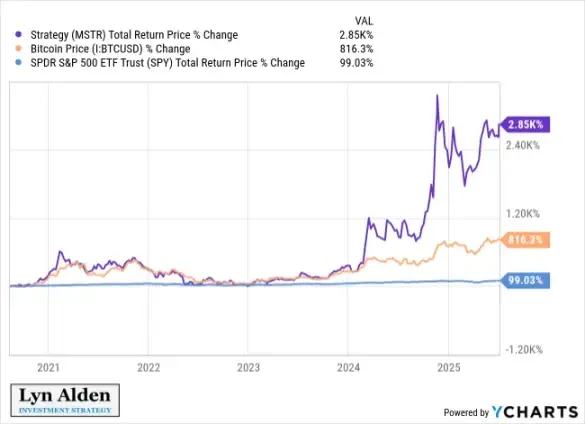
Later, the brokerage account added the ability to purchase securities like GBTC, and of course, it also added major spot Bitcoin ETFs. Nevertheless, I still hold MSTR in that portfolio.
In short, due to investment restrictions, many funds can only hold stocks or bonds with Bitcoin exposure and cannot hold ETFs or similar securities. Bitcoin treasury companies (“Bitcoin stocks”) provide them with an opportunity.
This does not conflict with Bitcoin being a self-custodial, anonymous asset; rather, it complements it.
Bitcoin Stocks, Reason Two: Companies Have Ideal Leverage
The fundamental strategy for companies adopting Bitcoin as a treasury asset is to hold Bitcoin instead of cash equivalents. However, the first batch of Bitcoin stocks often has a high level of confidence in this concept. Therefore, they do not just buy Bitcoin directly but purchase Bitcoin using leverage.
Publicly traded companies happen to have better leverage tools than hedge funds and most other capital; specifically, they have the ability to issue corporate bonds.
Hedge funds and certain other capital typically use margin loans. They borrow money to purchase more assets, but if the asset value declines too much relative to the borrowed amount, they face margin calls. Margin calls may force hedge funds to sell assets during significant price declines, even if they firmly believe those assets will recover and reach new highs; being forced to sell quality assets at a low point is a disaster.
In contrast, companies can issue bonds, typically with maturities of several years. If they hold Bitcoin and its price drops, they are not forced to sell due to the decline in Bitcoin. This makes them more resilient to volatility than entities relying on margin loans. Of course, there are still bearish scenarios that could force companies to liquidate, but these scenarios require longer bear markets to occur, making them less likely.
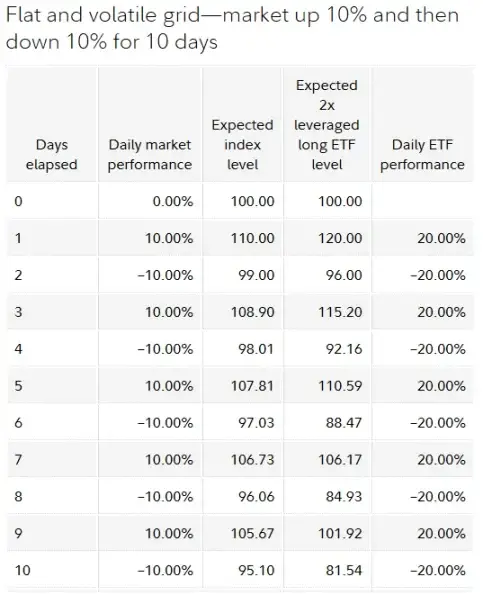
This long-term corporate leverage is usually better than leveraged ETFs. Since leveraged ETFs cannot use long-term debt and reset leverage daily, volatility often has adverse effects.
What happens to a 2x leveraged ETF if the underlying asset experiences alternating +10% and -10% fluctuations during a trading day? Over time, leveraged products will gradually deteriorate relative to the index they track:
In fact, since its inception, the performance of the 2x leveraged Bitcoin ETF BITU has not truly outperformed Bitcoin, even though Bitcoin's price has risen during this period. You might expect the 2x leveraged version to significantly outperform, but in reality, it mainly increases volatility without providing higher returns. Here is a performance chart of BITU since its inception:
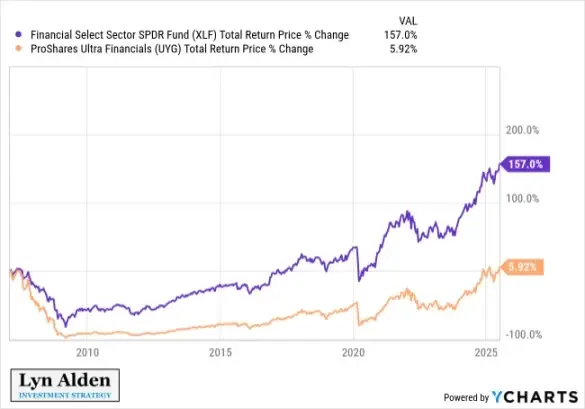
The same situation occurs in the long-term history of highly volatile stocks, such as 2x leveraged ETFs in the financial or energy sectors. During periods of volatility, their performance lags far behind:
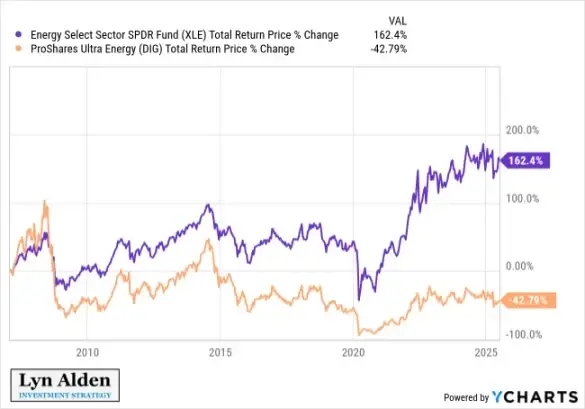
Therefore, unless you are a short-term trader, choosing intraday leverage usually yields poor results. Volatility is very unfavorable for leverage.
However, attaching long-term debt to an asset typically does not encounter the same issues. Appreciating assets with long-term debt are an extremely attractive combination. Therefore, Bitcoin treasury companies are appealing securities for highly confident Bitcoin bulls who wish to enhance returns through reasonably safe leverage.
Not everyone should use leverage, but those who choose to do so will naturally want to do it in an optimized manner. There are now various Bitcoin treasury companies with different risk profiles, sizes, industries, and jurisdictions, and real market demand is gradually being met.
Similarly, some securities issued by these companies, such as convertible bonds or preferred stocks, can provide exposure to Bitcoin prices while reducing volatility. Diversified securities offer investors the specific types of exposure they need.
What Impact Do Bitcoin Treasury Companies Have on Bitcoin?
Now that we understand the reasons for the existence of Bitcoin treasury companies and the market gap they fill for investors, the next question is: Are they beneficial to the overall Bitcoin network? Does their existence undermine Bitcoin's value as a free currency?
First, it is essential to clarify what the theoretical development path of a decentralized currency would look like if it were to succeed. What steps need to be taken, and what is the general order?
Thus, this section will be divided into two parts. The first part is an economic analysis of how a new form of currency might gain popularity, i.e., what a successful path might look like. The second part analyzes whether companies facilitate or hinder this path.
Part One: What Would Success Look Like?
“If a global, digital, sound, open-source, programmable currency were to circulate from scratch, what would it look like?”
Ludwig Wittgenstein once asked a friend, “Tell me, why do people think it is more natural for the sun to revolve around the earth than for the earth to rotate?” The friend replied, “Well, obviously because it looks like the sun is revolving around the earth.” Ludwig countered, “Then what would it look like if the earth appeared to be rotating?”
------ Wittgenstein's Money, Alan Farrington, 2020
Bitcoin was born in early 2009, and during 2009 and 2010, some enthusiasts mined, collected, tested, traded Bitcoin, or explored ways to contribute to or improve it. They were captivated by the idea of Bitcoin.
In 2010, Satoshi Nakamoto himself described how to assign initial value to Bitcoin from scratch on the Bitcoin forum:
“As a thought experiment, suppose there is a precious metal as scarce as gold, but with the following characteristics:
- Monotonous gray color
- Poor conductivity
- Low strength, poor ductility or malleability
- No practical or decorative use
And a special, magical property:
- Can be transmitted through communication channels
If it gained any value for some reason, then anyone wanting to transfer wealth over long distances could buy some to transmit, and the recipient could sell it.”
After achieving initial success, Bitcoin faced the challenge of payment networks spawning countless competitors. Numerous altcoins emerged, offering similar functionalities, primarily for purchasing, transferring, and being sold by recipients. The introduction of stablecoins in 2014 eliminated token volatility through dollar collateral.
In fact, the rise of competitors was the biggest reason I did not buy Bitcoin in early 2010. It was not that I opposed the concept, but I believed the industry was filled with speculative bubbles and could be infinitely replicated. In other words, while Bitcoin's supply might be limited, its concept was limitless.
However, in the second half of 2010, I noticed one thing: Bitcoin's network effect was continuously growing. Like communication protocols, Bitcoin greatly benefits from network effects. The more people use it, the more useful it becomes for others; this is a self-reinforcing cycle. And this is the true meaning of holding Bitcoin. The network effect must continue to grow to surpass this niche and crowded phase.
We can categorize currencies into two types:
The first type is “situational currency,” which refers to currencies that can solve specific problems but are not widely used in other contexts. An asset that can be purchased with local currency, transmitted through high slippage (capital controls, payment platform bans, etc.), and sold or exchanged for local currency by the recipient. It has value, but success in this regard does not necessarily lead to broader success.
The second type is “universal currency,” which refers to currencies that are widely accepted in specific regions or industries. Importantly, recipients do not immediately sell or exchange it upon receipt; they hold it as a cash balance and may reuse it elsewhere.
For a currency to become a universal currency, spenders must hold it long-term, and recipients must be willing to hold it. If a new universal currency is to rise, most people may initially view it as an investment because they believe its purchasing power may appreciate, and then they will be willing to use it as a payment method. At this point, they do not need to be persuaded to accept it as a payment method because they have already recognized this asset.
Bitcoin's simple and secure design (proof of work, fixed supply, limited script complexity, moderate node requirements, and decentralization left by the disappearance of its founder) and its first-mover network effect give it the best liquidity and security, which is why many people wish to buy and hold Bitcoin. So far, Bitcoin has achieved great success in this regard: as a secure and portable store of value, users can freely choose to spend or exchange it.
A secure, highly liquid, convertible, and portable store of value lies between situational currency and universal currency. Unlike situational currency, people view universal currency as a long-term asset rather than something to be immediately sold or exchanged upon receipt. However, unlike universal currency, it has not yet been widely accepted in most regions because those who take the time to study it remain a minority.
This stage takes a long time to complete due to volatility and the existing scale of network effects Bitcoin faces, as people's spending and liabilities are denominated in existing currencies.
If a new currency network with independent units (i.e., not pegged as a credit track of existing currencies but a system completely parallel to central banks) is to develop from scratch to scale, it needs upward volatility. Any appreciating asset with upward volatility will attract speculators, which will inevitably lead to downward volatility periods. In other words, it will look like this:
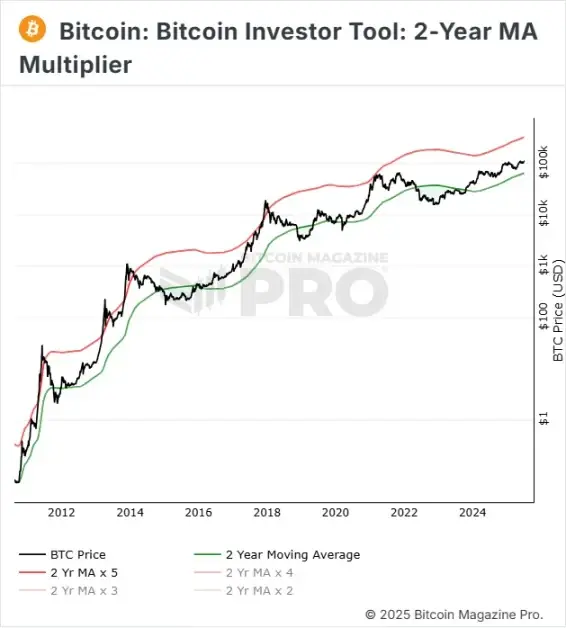
During its adoption phase, it is a form of currency that has flaws in the short term. If you receive some Bitcoin and wish to use it to pay your rent at the end of the month, neither you nor your landlord can afford for it to potentially drop 20% in value over the month. The landlord's spending relies on the network effect of existing fiat currency; she needs to know the value of the rent received from the tenant. And you, as the tenant, need to ensure you can pay the rent at the end of the month with currency that will not depreciate quickly.
Thus, Bitcoin is primarily viewed as an investment during this era. Believers are more likely to be willing to use it for payments. Those with specific payment issues (such as capital controls, payment platform bans, etc.) are also more likely to use it, although they are increasingly opting for stablecoins with similar liquidity for payments. If you are only using stablecoins for the short term, their centralized nature is not significant.
Early Bitcoin supporters tried to persuade Bitcoin holders to use Bitcoin more. I do not believe this is a sustainable approach. Bitcoin will not gain popularity as a charitable means. For it to achieve widespread and sustained popularity, it must fill the payment gaps that exist in the market for spenders and recipients. And at the current adoption stage, this is not easy, especially since every transaction involves capital gains tax, while options like stablecoins can meet short-term spending needs.
Having a sound, liquid, interchangeable, and portable store of value provides holders with advantages that other assets cannot offer during its adoption phase. They can take Bitcoin anywhere in the world without relying on central counterparties and credit structures. It also allows holders to avoid significant capital erosion through cross-border payments (including recipients banned by platforms). They may not be able to use Bitcoin for payments anytime and anywhere, but in most cases, they can find ways to exchange it for local currency, and in some cases, they can pay directly with it.
Imagine you randomly need to go to a country. What currency can you bring to ensure you have enough purchasing power without relying on the global credit network? In other words, how can you ensure that you can still transact even if all your credit cards are disabled, even if it incurs some capital erosion?
The best answer today is often physical dollars. If you bring dollars, although you may not be able to use them directly, it is easy to find someone willing to exchange them for local currency at a reasonable rate and with sufficient liquidity.
Other answers might include gold and silver as well as euros. Similarly, in most countries, it is not difficult to find brokers willing to accept gold, silver, or euros and exchange them at fair local values.
The renminbi, yen, pound, and some other currencies may also serve as alternatives, but they often face more capital erosion. I would place Bitcoin somewhere in the top ten, around the 5th to 10th position, especially if you are going to a city center. Most cities have many exchange options available for assistance when needed. Considering Bitcoin's only 16-year history, this is already quite remarkable.
The more than 160 other fiat currencies are very poor currencies outside their home countries, and the vast majority are so.
The dollar is currently the most liquid currency in the world. Smaller and less liquid assets are almost always priced in larger and more liquid assets. People use larger and more liquid currencies as units of account and price their main liabilities in them.
Previously, the dollar was defined by a certain amount of gold. Eventually, the dollar network became larger and more ubiquitous than gold, and the situation reversed: now gold is primarily priced in dollars. In the long history, Bitcoin may surpass the dollar in this way, but it is far from reaching that level at present. What Bitcoin is priced in during this process does not matter; it is an anonymous asset that can be priced in the largest and most liquid currency, and if one day it becomes the largest and most liquid currency, then other things will naturally be priced in it.
While people can freely price in any currency, most will quickly start pricing in Bitcoin. Critics describe this as a flaw of Bitcoin; a new decentralized currency asset has no other path to grow except being priced in existing currencies.
Part Two: How Companies and Bitcoin Stocks Interact
As early as 2014, Pierre Rochard wrote a prescient article titled “Speculative Attack.”
In the foreign exchange market, a speculative attack refers to borrowing a weak currency to buy more strong currencies or other quality assets. This is one of the reasons central banks raise interest rates, and some countries resort to outright capital controls to prevent entities from arbitraging their mismanaged currencies.
Wikipedia provides an effective definition:
“In economics, a speculative attack refers to the sudden selling of unreliable assets by previously inactive speculators, acquiring some valuable assets (currencies, gold) in the process.”
Due to Bitcoin's appreciating nature, various entities will ultimately borrow currency to buy more Bitcoin. At that time, Bitcoin's price was slightly above $600, with a market cap just over $8 billion.
Initially, borrowing funds to purchase Bitcoin was a rare phenomenon. But now, with the Bitcoin network having high liquidity and a market cap exceeding $2 trillion, billions of dollars in corporate bonds from mainstream capital markets are specifically used to purchase Bitcoin.
Today, 11 years later, this phenomenon has become commonplace. Is it good or bad for the Bitcoin network?
From my observation, there are mainly two types of critics who believe this is detrimental to the Bitcoin network.
The first type of critic is a Bitcoin user themselves. Many of them belong to the cypherpunk or sovereignist camps. From their perspective, handing Bitcoin over to custodians seems dangerous or at least contrary to the idea of a decentralized network. Some of them refer to corporate Bitcoin treasury supporters as “suit Bitcoin enthusiasts,” which I think is a good term. This Bitcoin camp prefers that people manage their private keys themselves. Some of them further argue that the rehypothecation of major custodians may suppress prices or otherwise undermine Bitcoin's value as a free currency. While I appreciate the values of this camp, some of them seem to hold utopian dreams, hoping everyone is as interested in fully controlling their money as they are.
The second type of critic is typically someone who has held a negative view of Bitcoin in the past. For years, they have questioned Bitcoin. As Bitcoin has become the best-performing asset and has repeatedly reached new highs over the years and across multiple cycles, some of them have changed their views, now believing that “the price of Bitcoin may be rising, but its value has been captured.” I place less importance on this camp than the first. This is similar to the permanent bears in the stock market, who, when their bearish arguments fail to materialize after a decade, turn around and say, “The market is up just because the Fed printed too much money.” My response is, “Well, yes, that’s why you shouldn’t be bearish.”
What I want to say to both camps is that the choice of some large capital to hold Bitcoin does not mean that the “libertarian” Bitcoin has been harmed in any way. It can still be self-custodied and transferred peer-to-peer as usual. Moreover, as more types of entities hold it, the network becomes larger and less volatile, which also helps improve its utility as a peer-to-peer payment currency. It may also provide political cover, helping policymakers mainstream it. If Bitcoin reaches this scale, the emergence of Bitcoin stocks and the phenomenon of large capital purchasing Bitcoin is inevitable.
One skill of permanent bears is to adjust their narratives as needed, so they are right no matter what happens. They define Bitcoin as having no reasonable path to success. If Bitcoin remains niche? Then its price appreciation and liquidity will be harmed; see, it has failed! If it is adopted by large entities and governments and continues to grow on a large scale? Then its value has been captured and lost direction.
But if it is to become large, widely accepted, and somehow change the world, how could that path not involve companies and governments?
Bitcoin's price-driving journey has gone through several major stages.
In the first stage, people mined Bitcoin with their computers or sent money to Mt. Gox to buy Bitcoin, along with other early adopter behaviors. This was the early user phase.
In the second stage, especially after the collapse of Mt. Gox, purchasing and using Bitcoin became easier. Domestic exchanges in many countries made it easier for people to buy Bitcoin than ever before. The first hardware wallets emerged in 2014, making self-custody more secure. This was the retail buyer phase, where slippage during purchases still existed but was decreasing.
In the third stage, Bitcoin became sufficiently widespread, with strong liquidity and a long enough track record to attract more institutions. Some entities established institutional-grade custody services for it, publicly traded companies began purchasing Bitcoin, and various ETFs and other financial products emerged, allowing various funds and custodial capital to gain exposure. Some countries, such as Bhutan, El Salvador, and the UAE, mine or purchase and hold Bitcoin at the sovereign state level. Other countries, like the United States, choose to hold their confiscated Bitcoin rather than sell it directly.
Fortunately, although companies are currently the main buyers, retail investors can still freely purchase Bitcoin with zero slippage.
I hear people say, “I thought Bitcoin was for the people, a peer-to-peer cash payment, but now it’s all large corporations holding it.” Bitcoin is indeed for the people; anyone with internet access can buy, hold, or transfer it.
That is why I agree with both the cypherpunk perspective and the suit Bitcoin enthusiast perspective. I want Bitcoin to function as a free currency, which is also a significant reason I became a general partner at Ego Death Capital. We fund startups and build solutions for the Bitcoin network and its users. This is also why I support the Human Rights Foundation and other nonprofits that fund developers and educators focused on providing financial tools for people in inflationary environments. However, once corporations, investment funds, and even sovereign entities understand Bitcoin, it is reasonable for them to purchase it, as Bitcoin has now entered their line of sight.
It is important to remember that most people are not active investors. They do not buy stocks and do not deeply analyze the differences between Bitcoin and other cryptocurrencies. If they speculate on some asset as traders, they are likely to buy at the top and get washed out at the bottom. Their investments are typically passively allocated rather than chosen by themselves. In the past, it was usually pension funds making allocations. Nowadays, it is typically done by financial advisors.
In my view, expecting billions of people to actively buy Bitcoin is unreasonable. However, it is reasonable to strive to lower the barriers to entry through technological solutions and educational resources, allowing anyone to choose to engage with Bitcoin.
The best expression I have seen is: “Bitcoin serves anyone, not everyone.” In practice, this means that everyone should be guided to understand Bitcoin, but only a portion will choose to accept it.
Key Takeaways
The development of Bitcoin monetization roughly follows this path:
Bitcoin initially was a collectible for enthusiasts and those with transformative dreams, a new technology that could potentially provide some value to people.
Bitcoin began to serve as a situational medium of exchange, even being used by pragmatists who originally did not pay attention to it. For example, when funds need to be sent to countries with capital controls, Bitcoin can facilitate transfers when other payment channels fail. When someone needs to receive payments or donations but is banned by major online payment platforms (like WikiLeaks), Bitcoin can be a good solution.
High volatility, numerous competitors, and various purchasing costs such as capital gains taxes hindered Bitcoin's sustained growth as a common medium of exchange. If you pay a merchant who does not hold Bitcoin with Bitcoin, and they automatically convert it to fiat, the benefits of Bitcoin cannot be fully realized.
Bitcoin is more widely viewed as an ideal portable appreciating capital. Unlike other cryptocurrencies, it has achieved decentralization, security, simplicity, scarcity, and scalability, making it an asset worth holding long-term. While it is not always easy to buy coffee with it, it has begun to enter the top ten anonymous assets that can be carried during international travel and exchanged for local value without barriers, surpassing the vast majority of fiat currencies.
The Bitcoin network has sufficient liquidity, scale, and durability to attract the active attention of businesses and governments. A significant amount of custodial capital is interested in this asset, and companies and funds provide them with indirect exposure to Bitcoin. Meanwhile, Bitcoin continues to exist as an open and permissionless network, meaning individuals also continue to use and build it.
If the Bitcoin network continues to expand, they may achieve:
As the Bitcoin network grows larger, more liquid, and less volatile, its appeal to large sovereign entities will also increase. Initially, Bitcoin was merely an asset for small sovereign fund investments, but it may eventually become a large-scale foreign exchange reserve or international settlement means. Countries have been trying to build closed-source alternative payment methods, but with low adoption rates and a lack of consensus, this open-source settlement network with independent units and limited supply is gradually penetrating globally.
Overall, I still believe Bitcoin is in a good state technically and economically, and its adoption path is expanding as expected.
 Risk warning
 Risk warning



Popular articles





