








From trading masters to全民炒币, what is the South Korean crypto market playing at?
 The South Korean cryptocurrency market is making a strong comeback from the "Terra shadow," becoming a force that global investors cannot ignore.
Written by: Umbrella
Recently, two traders in the South Korean crypto market have become the focus of discussion in the crypto circle due to their astonishing performance.
A trader known by the nickname Namseokhee has made high-leverage long bets on altcoins on Binance, increasing his long positions from 75 to 105 within two weeks, with returns skyrocketing from 134 times to 1400 times, while his initial margin was less than $3,000.
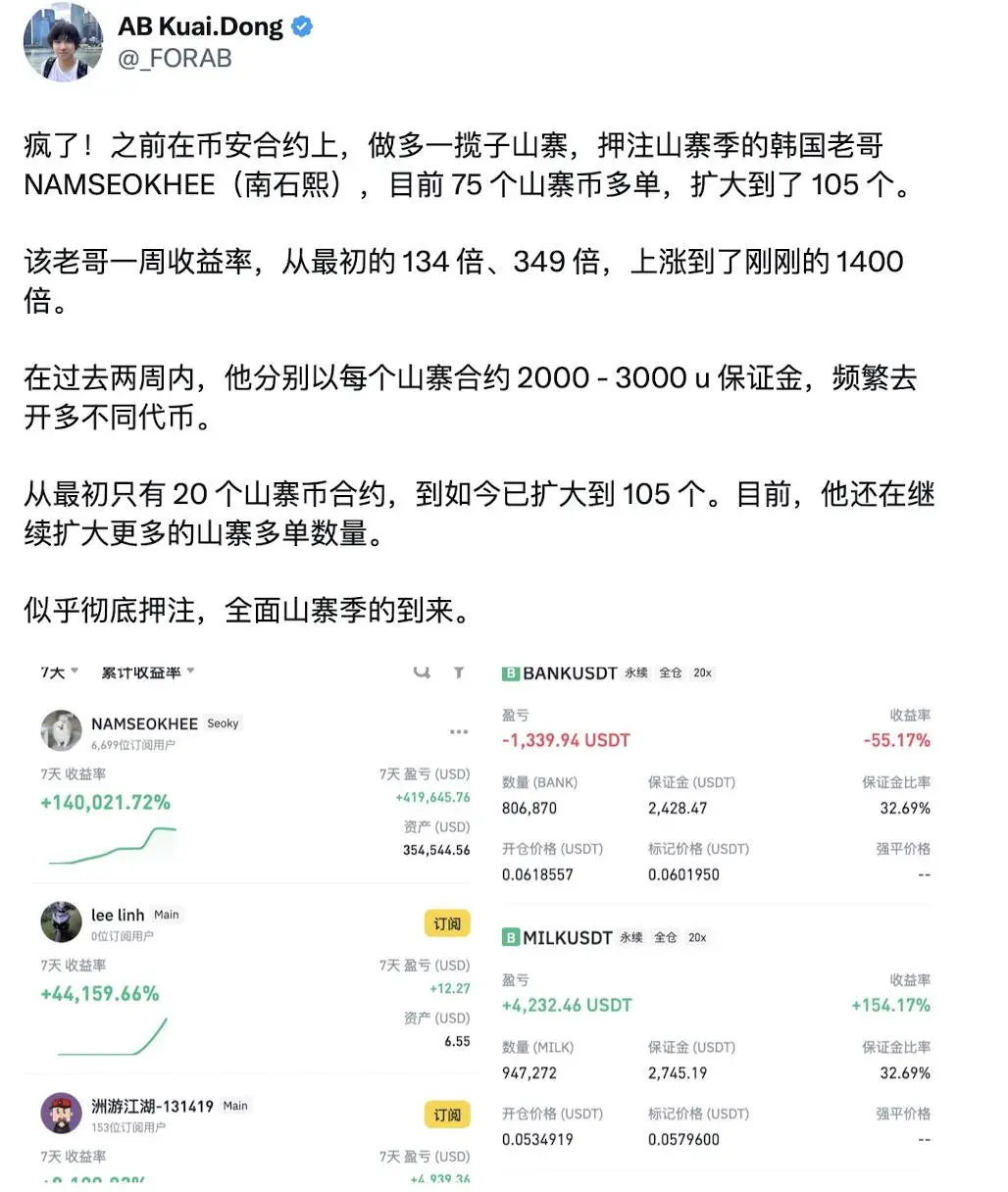
Image source: @_FORAB
Another trader, Ohtanishohei, is a staunch supporter of Ethereum, continuously increasing his ETH contract long positions over the past two weeks, with profits rising from $1.57 million to a peak of $3.37 million.
Their dazzling achievements have not only ignited the enthusiasm of South Korean investors but have also drawn the world's attention to this vibrant market in South Korea.
In the past six months, the South Korean market has been mentioned more frequently in the crypto field, and its rise is not coincidental. In 2024, the combined asset management scale of South Korea's five major cryptocurrency exchanges surpassed $74.8 billion, with managed assets reaching $73 billion and an average daily trading volume exceeding that of the two major Korean stock exchanges.
As the largest cryptocurrency exchange in South Korea, Upbit's daily trading volume once exceeded $10.2 billion, a year-on-year increase of 94.5%. Even more noteworthy is that the Korean won accounts for as much as 37% of global fiat-to-crypto trading, second only to the US dollar.
These figures indicate that South Korea is not only a hub for crypto trading in Asia but is also gaining an increasingly significant market position globally.
Betting on Altcoins, Everyone is Trading Crypto
When it comes to South Korea, many crypto investors may have a negative first impression. In 2022, the Terra project founded by South Korean trader Do Kwon once reached a market value of $40 billion but plummeted to zero due to the collapse of its algorithmic stablecoin, resulting in losses exceeding $6 billion for South Korean investors. BTC was affected, dropping from $40,000 in early May to $17,000 within two months.
This incident led to a 30% drop in trading volume on the two major cryptocurrency exchanges in South Korea, Upbit and Bithumb, and the Korean won's share in global crypto trading fell from 40% to 25%. Along with this decline, South Korea's position in the crypto market also diminished.
Fast forward to the second half of 2024, several altcoins have seen their prices soar after being listed on South Korean exchanges, a phenomenon that continues to this day. Recently, CYBER was listed on the South Korean exchange Upbit, with its price surging over 130% in a single day and trading volume skyrocketing by 500%, with its market cap briefly exceeding $170 million.
This data reflects that the enthusiasm of South Korean crypto investors may far exceed our imagination, which is also corroborated by the composition of South Korean crypto investors.
According to the latest report from the Hanwha Financial Research Institute titled "Investment Trends in Virtual Assets Among Generations 20-50," among 1,000 financial investors aged 20 to 50, 27% hold cryptocurrencies, accounting for 14% of their total financial assets, and as many as 70% of respondents expressed willingness to invest in cryptocurrencies in the future.
The frenzy of South Koreans for cryptocurrencies goes beyond this. According to data from the Bank of Korea in 2024, by November 2024, 30% of South Korean residents had opened cryptocurrency exchange accounts, with two out of every ten government officials holding cryptocurrencies.
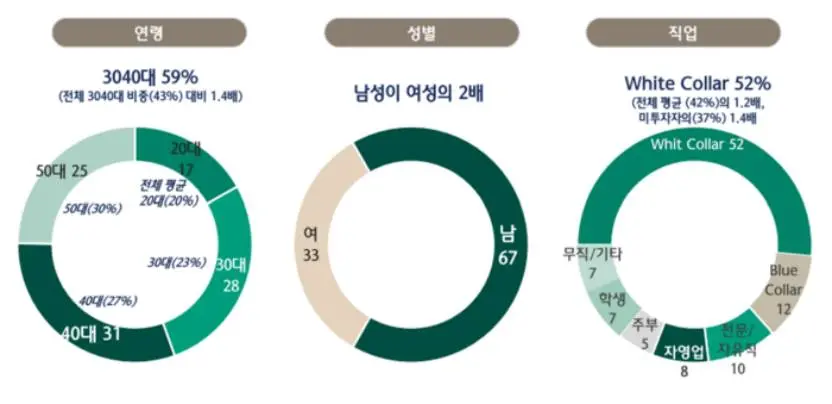
Behind the phenomenon of "everyone trading crypto" in South Korea is the current social background and the government's changing attitude towards crypto.
Currently, young people in South Korea are facing unprecedented social pressure.
According to data released by the Korean Statistical Office, the youth unemployment rate in South Korea reached 5.5% in July 2025. South Korean youth generally have a pessimistic outlook on the economy, and with upward mobility almost completely locked, countless young South Koreans view cryptocurrencies as the only opportunity for class advancement.
This also explains why the trading strategies of South Korean crypto traders tend to favor high-leverage trading. In popular cultural works in South Korea, certain classic lines also reflect this social phenomenon.

Image source: South Korean popular drama "Squid Game 2"
Regarding the South Korean government's attitude towards the crypto market, the biggest positive news for South Korean traders recently has been the rise of Lee Jae-myung as the President of South Korea.
Lee Jae-myung is not only a winner in the political arena but also one of the most steadfast advocates for South Korea's crypto policies. In his commitment to the "Korean crypto industry," he pointed out that he would promote the legalization of virtual asset spot ETFs and guide the large-scale allocation of crypto assets by the national pension fund, as well as the establishment of a Korean won stablecoin.
The attitude behind these messages points to a common result: South Korea is making a "comeback" in the crypto market, and this time the storm it stirs up may be more intense than ever.
Tom Lee, the New Do Kwon of South Korea?
The "comeback" of the South Korean crypto market is not only reflected in policy statements but also in the actual actions of South Korean investors. The "watchlist" of South Korean investors often includes the following assets:
ETH
In the South Korean crypto market, the crypto gold here is not BTC but ETH.
According to the two major cryptocurrency exchanges in South Korea, Upbit and Bithumb, in the past 24 hours, the ETH/KRW trading pair accounted for 18.06% and 12.1% of the trading volume, respectively, with a total trading volume exceeding $1.26 billion. Moreover, Upbit alone reached an astonishing ETH trading volume of $111.1 billion in July.
This is largely due to Tom Lee, the chairman of BitMine, the institution with the largest ETH holdings, who is also a Korean-American, continuously boosting confidence among South Korean crypto traders.
Combined with national sentiment, media promotion, and the crypto label, Tom Lee is currently regarded by South Korean crypto traders as a figure comparable to the founder of LUNA, Do Kwon. Even legendary trader Eugene has mentioned Tom Lee in the community.
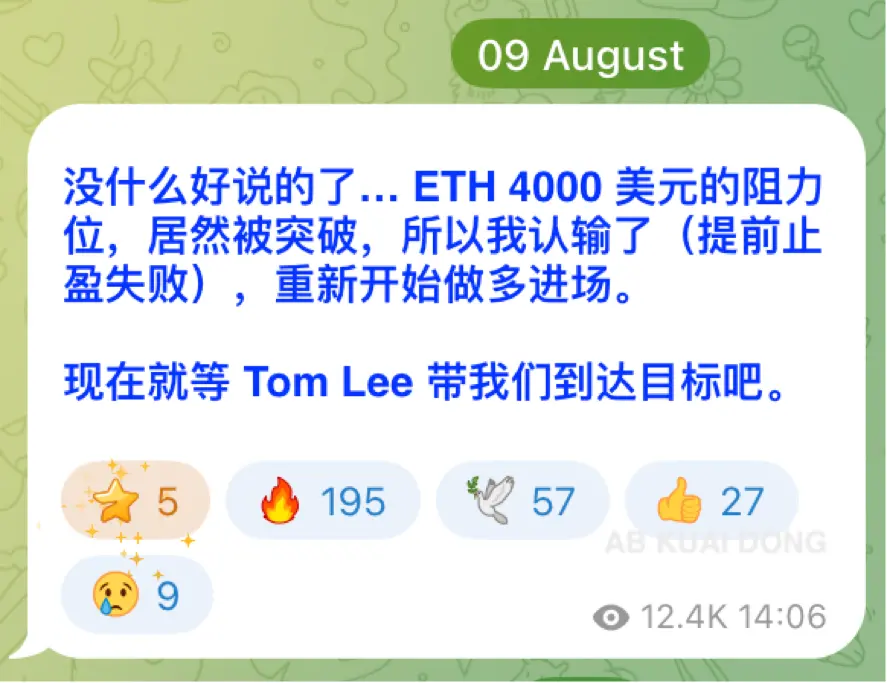
Image source: @_FORAB
BMNR
In addition to ETH, Tom Lee's importance in the hearts of South Korean traders is also reflected in the stock BMNR of the ETH microstrategy company BitMine.
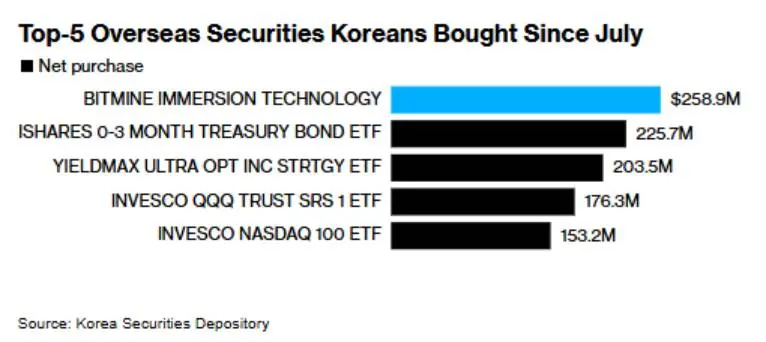
As of August 15, BitMine held over 1.2 million ETH, valued at $5.3 billion, more than double the second-place SharpLink's ETH holdings. According to data from the Korea Securities Depository, since July, South Korean retail investors have cumulatively net purchased over $259 million of BMNR, making it the most popular foreign security during the same period.
In the eyes of countless South Korean traders, BitMine has become the operator controlling the rise of ETH, while the US stock BMNR has become a leveraged version of ETH. Compared to ETH, BMNR has risen by as much as 66% since July 1, aligning more with the high-risk preferences of South Korean crypto traders.
XRP
In addition to ETH, XRP is also a highly favored asset among South Korean crypto investors. In the past 24 hours, the total trading volume of XRP on Upbit and Bithumb reached $1.13 billion, just $100 million less than ETH.
On May 26, the XRP/KRW trading pair surpassed BTC and ETH to top the KRW market. Even more astonishingly, at that time, the price of XRP on Upbit surged to $2.65 billion, exceeding the international market price by 3%.
On the other hand, Upbit, South Korea's largest cryptocurrency exchange, holds over 5.9 billion XRP, nearly twice that of Binance. Behind this crazy phenomenon, the SEC's withdrawal of the XRP securities lawsuit and its potential for cross-border payments are attracting South Korean investors, while the Korean won stablecoin policy further boosts its demand, with retail investors generally optimistic about XRP's future potential.
Returning to the Crypto Stage
Driven by popular assets like ETH, BMNR, and XRP, the South Korean crypto market is making a remarkable return to the Crypto stage. From retail to institutional investors, from policy to culture, South Koreans seem to have regarded cryptocurrencies as a new engine for national development. However, this "everyone trading crypto" and high-leverage trading strategy is not without concerns.
Just yesterday, on August 14, after the US released PPI data, the crypto market plummeted, and Namseokhee, who had heavily bet on the previous one-sided bullish trend, saw his positions turn from profit to loss, even experiencing the largest historical loss. Although such extreme trading strategies are not worth advocating, the enthusiasm of South Korean crypto traders cannot be ignored.
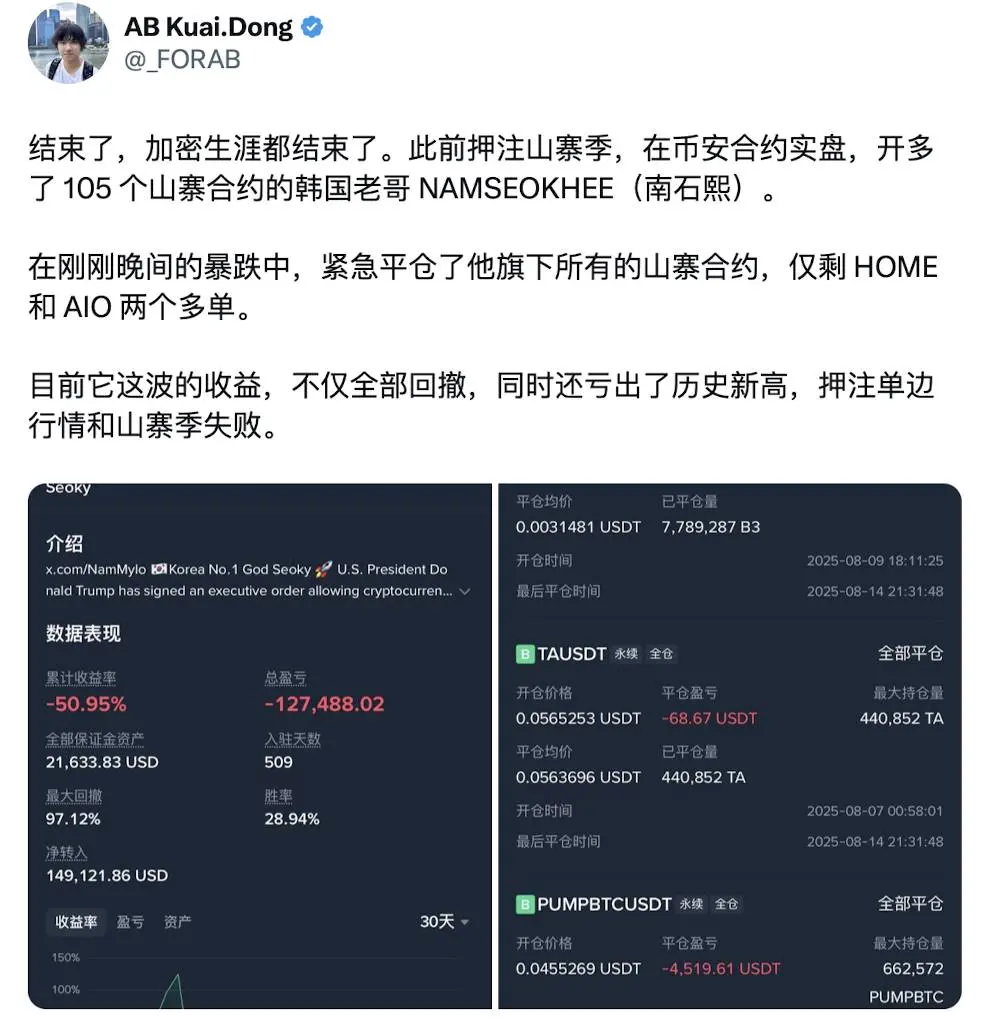
Image source: @_FORAB
In summary, the South Korean crypto market is making a strong comeback from the "shadow of Terra," becoming a force that global investors cannot overlook. In the near future, with the popularization of the Korean won stablecoin and the further implementation of pro-crypto policies, we are likely to see South Korea rise to the status of "Asia's crypto capital."
Click to learn about job openings at ChainCatcher
Recommended reading:
 Risk warning
 Risk warning


Popular articles





