








Detailed Explanation of AAVE V4 Upgrade: Reshaping Lending with Modularity, Can Old Coins Welcome Another Spring?
 The V4 update may allow us to see its strong competitiveness in the DeFi field in the future, as well as the source of its continuously increasing business volume.
Written by: Umbrella, Deep Tide TechFlow
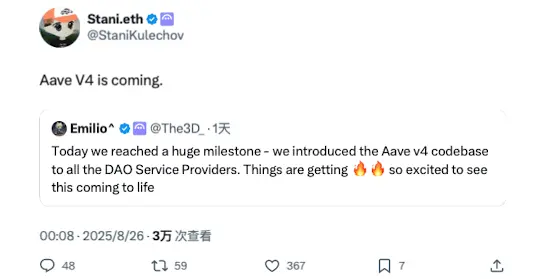
On the evening of the 25th, AAVE founder Stani's announcement of the upcoming AAVE V4 quickly attracted a lot of attention and discussion, while the recent controversy between AAVE and WLFI regarding the 7% token allocation proposal has also stirred up quite a commotion in the market.
For a time, the market's focus gathered on AAVE, this established lending protocol.
Although the controversy between AAVE and WLFI has not yet reached a final conclusion, behind this "drama," there seems to be a different picture emerging—"new coins flow like water, but AAVE remains steadfast."
With the emergence of more and more new coins, stimulated by the fixed on-chain token lending demand, AAVE undoubtedly possesses a solid fundamental and catalyst.
This V4 update may allow us to see its strong competitive edge in the DeFi field and the root of its continuously rising business volume.
From Lending Protocol to DeFi Infrastructure
When we discuss AAVE V4, we first need to understand a key question: why does the market have expectations for this upgrade?
From ETHLend in 2017 to today’s DeFi giant with a TVL of $38.6 billion, as an established protocol, every version update of AAVE has actually been an optimization, and can influence the liquidity and gameplay of on-chain assets to varying degrees.
The version history of AAVE is, in fact, the evolution of DeFi lending.
At the beginning of 2020, when V1 was launched, the total locked value in DeFi was still less than $1 billion. AAVE adopted liquidity pools instead of the P2P model, transforming lending from "waiting for matching" to "instant execution." This change helped AAVE quickly gain market share.
V2 was launched at the end of 2020, with core innovations including flash loans and debt tokenization. Flash loans gave rise to arbitrage and liquidation ecosystems, becoming an important source of income for the protocol. Debt tokenization allowed positions to be transferred, paving the way for subsequent yield aggregators. The 2022 V3 focused on cross-chain interoperability, allowing more on-chain assets to enter AAVE, becoming a connector for multi-chain liquidity.
More importantly, AAVE has become a pricing benchmark. DeFi protocols reference AAVE's supply and demand curve when designing interest rates. New projects benchmark AAVE's parameters when choosing collateral ratios.
However, despite being infrastructure, the limitations of V3's architecture have become increasingly apparent.
The biggest issue is liquidity fragmentation. Currently, AAVE has a TVL of $60 billion on Ethereum, only $4.4 billion on Arbitrum, and even less on Base. Each chain is an independent kingdom, and funds cannot flow efficiently. This not only reduces capital efficiency but also limits the development of smaller chains.
The second issue is the innovation bottleneck. Any new feature needs to go through a complete governance process, often taking months from proposal to implementation. In the rapidly iterating environment of DeFi, this speed clearly cannot keep up with market demand.
The third issue is that customization needs cannot be met. RWA projects require KYC, GameFi needs NFT collateral, and institutions need isolated pools. However, V3's unified architecture struggles to meet these differentiated needs. It either supports everything or nothing, with no middle ground.
This is the core problem that V4 aims to solve: how to transform AAVE from a powerful but rigid product into a flexible and open platform.
V4 Upgrade
According to publicly available information, the core improvement direction of V4 is to introduce a "Unified Liquidity Layer," adopting a Hub-Spoke model to change existing technical designs and even business models.
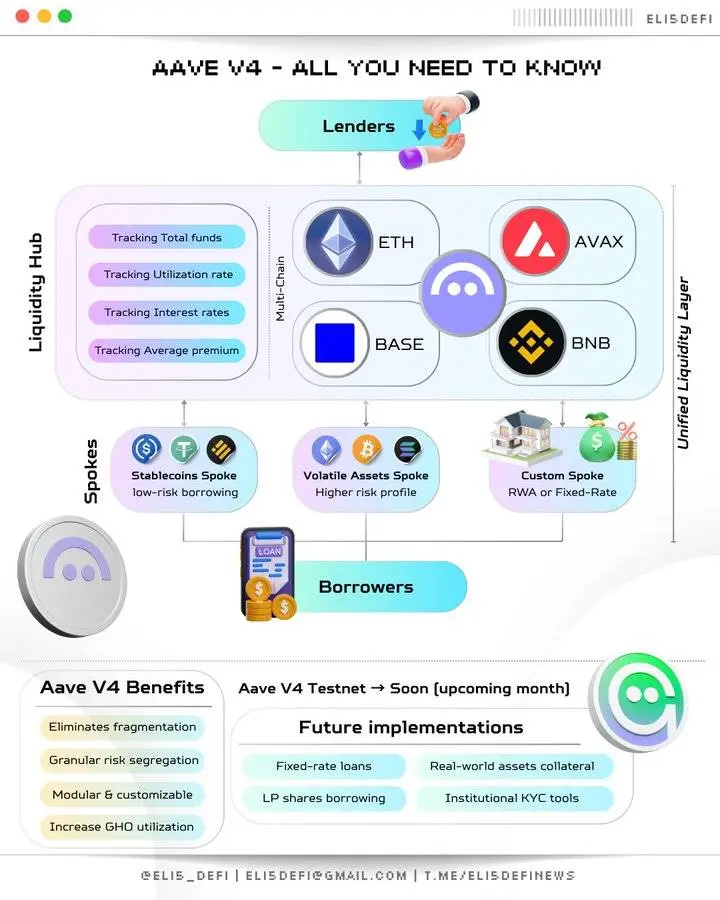
Image source: @Eli5DeFi
Hub-Spoke: Solving the "Want Both" Problem
In simple terms, the Hub gathers all liquidity, while the Spoke is responsible for specific business. Users always interact through the Spoke, and each Spoke can have its own rules and risk parameters.
What does this mean? It means AAVE no longer needs to serve everyone with a single set of rules but can allow different Spokes to cater to different needs.
For example, Frax Finance can create a dedicated Spoke that only accepts frxETH and FRAX as collateral, setting more aggressive parameters; meanwhile, an "institutional Spoke" might only accept BTC and ETH, requiring KYC but offering lower interest rates.
Both Spokes share the same Hub's liquidity but are risk-isolated from each other.
The brilliance of this architecture lies in its ability to solve the "want both" dilemma. It provides deep liquidity while ensuring risk isolation; it allows for unified management while enabling flexible customization. In the past, these were contradictory in AAVE, but the Hub-Spoke model allows them to coexist.
Dynamic Risk Premium Mechanism
In addition to the Hub-Spoke architecture, V4 also introduces a dynamic risk premium mechanism, revolutionizing the way lending rates are set.
Unlike the unified rate model of V3, V4 dynamically adjusts rates based on collateral quality and market liquidity. For instance, high liquidity assets like WETH enjoy a base rate, while more volatile assets like LINK need to pay an additional premium. This mechanism is executed automatically through smart contracts, enhancing the protocol's security and making borrowing costs fairer.
Smart Accounts
The smart account feature in V4 makes user operations more efficient. In the past, users had to switch wallets between different chains or markets, managing complex positions was time-consuming and labor-intensive. Now, smart accounts allow users to manage multi-chain assets and lending strategies through a single wallet, reducing operational steps.
A user can adjust WETH collateral on Ethereum and borrow on Aptos within the same interface, without manually transferring assets across chains. This simplified experience allows both small users and professional traders to participate in DeFi more easily.
Cross-Chain and RWA: Expanding the Boundaries of DeFi
V4 achieves second-level cross-chain interaction through Chainlink CCIP, supporting non-EVM chains like Aptos, allowing more assets to seamlessly connect to AAVE. For example, a user can use assets on Polygon as collateral to borrow on Arbitrum, all completed in one transaction. Additionally, V4 integrates real-world assets (RWA), such as tokenized government bonds, opening new pathways for institutional funds to enter DeFi. This not only expands AAVE's asset coverage but also makes the lending market more inclusive.
Market Reaction
Although AAVE experienced a sharp decline this week alongside the broader crypto market, its rebound today is significantly stronger than other leading DeFi projects.
The AAVE token saw a trading volume of $18.72 million within 24 hours after the market crash this week, far exceeding Uni's $7.2 million and Ldo's $3.65 million, reflecting investors' positive response to the protocol's innovation, while the increased trading activity further enhanced liquidity.
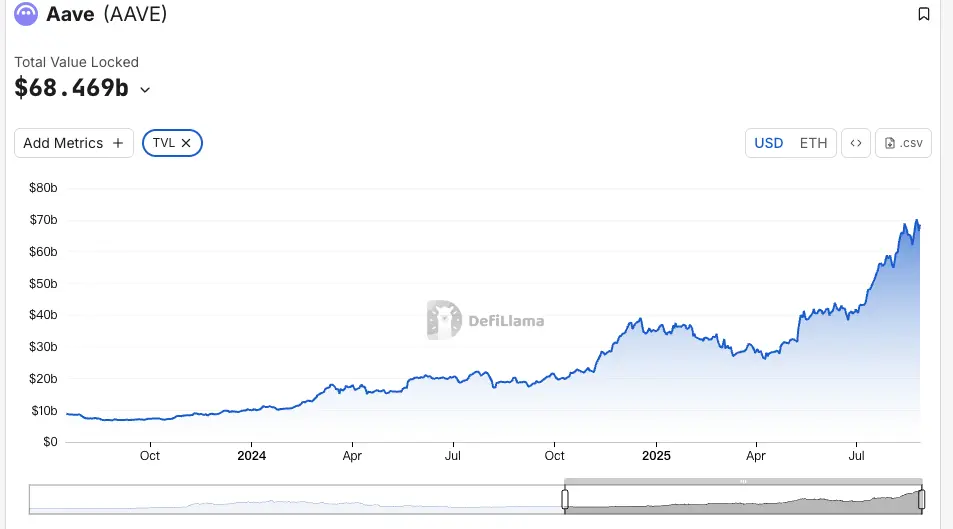
TVL more intuitively reflects the market's recognition of it. Compared to early August, AAVE's TVL surged by 19% this month to nearly $70 billion, setting a new historical high, currently ranking first in TVL on the ETH chain. This growth far exceeds the average level of the DeFi market, and the increase in TVL also validates the effectiveness of AAVE V4's multi-asset support strategy, perhaps indicating that institutional funds have quietly entered the market.
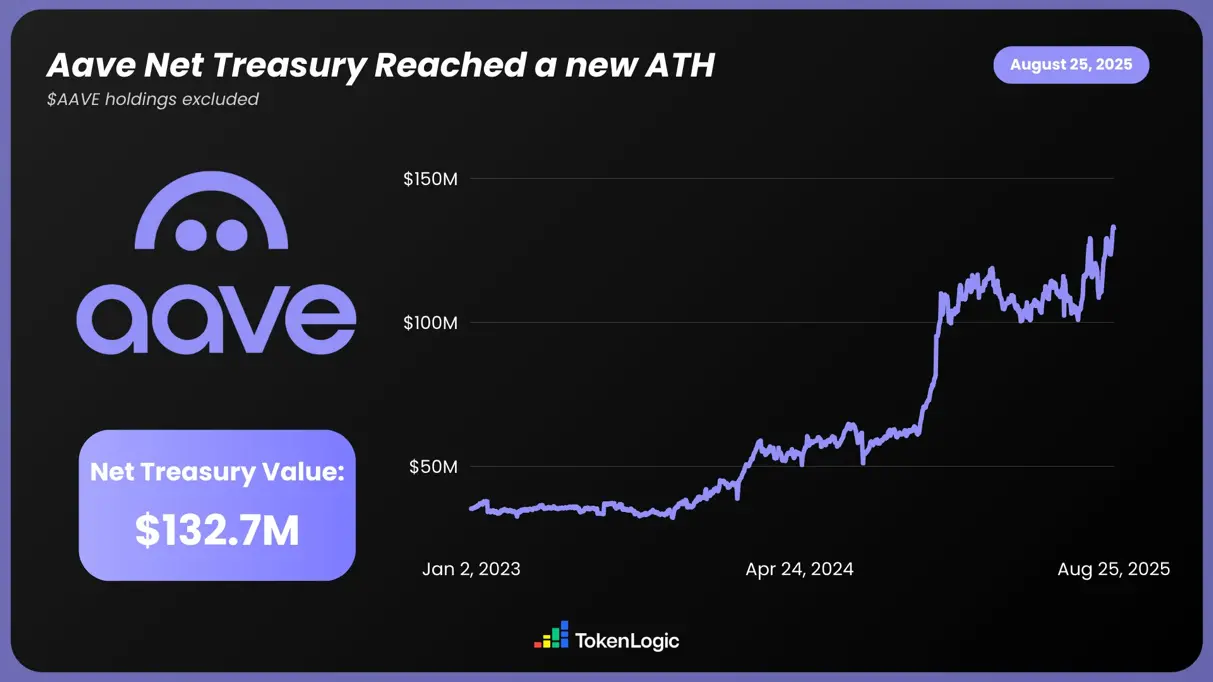
According to TokenLogic data, AAVE's net asset total has reached a new high of $132.7 million (excluding AAVE token holdings), growing approximately 130% over the past year.
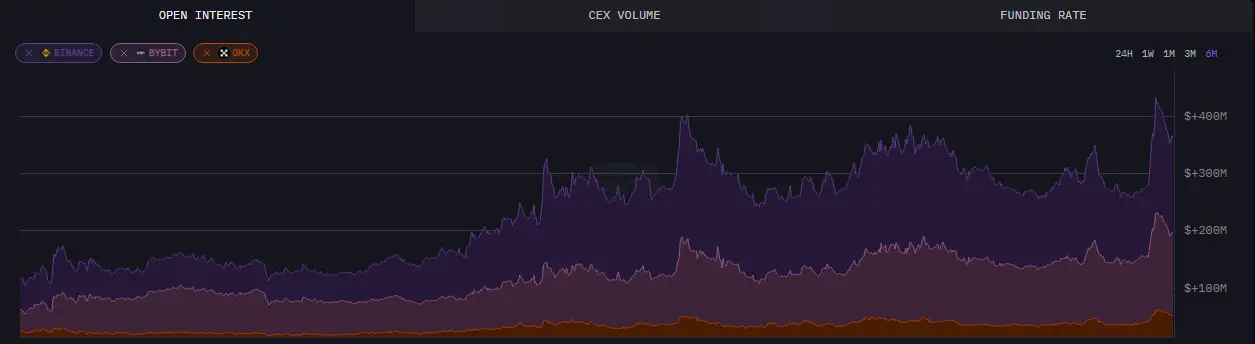
On-chain data shows that as of August 24, AAVE's open contracts exceeded $430 million, setting a new six-month high.
In addition to the intuitive data, AAVE's upgrade has also sparked widespread discussion in the community. The preliminary information released for V4 has received substantial support and recognition, especially regarding capital utilization and composable DeFi, showing the market more possibilities and potential.
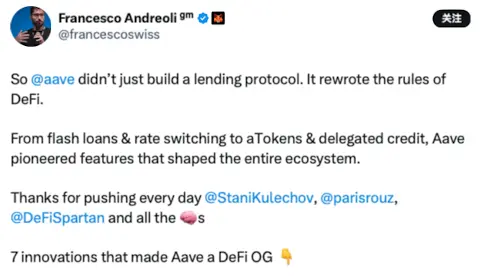
Make DeFi Great Again
Based on the updates disclosed so far, AAVE's upgrade is likely to elevate the DeFi market to a new level. The modular architecture, cross-chain expansion, and RWA integration are not only igniting market enthusiasm but also driving the rise in price and TVL.
Its founder Stani also seems confident about the impact of the V4 upgrade on the DeFi sector.
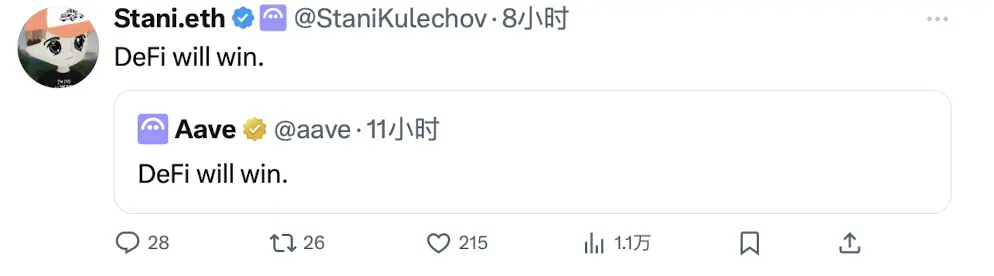
Perhaps in the near future, AAVE will ride the "tailwind" of liquidity brought by the upcoming crypto bull market and soar to new heights, opening up infinite possibilities.
 Risk warning
 Risk warning




Popular articles





